


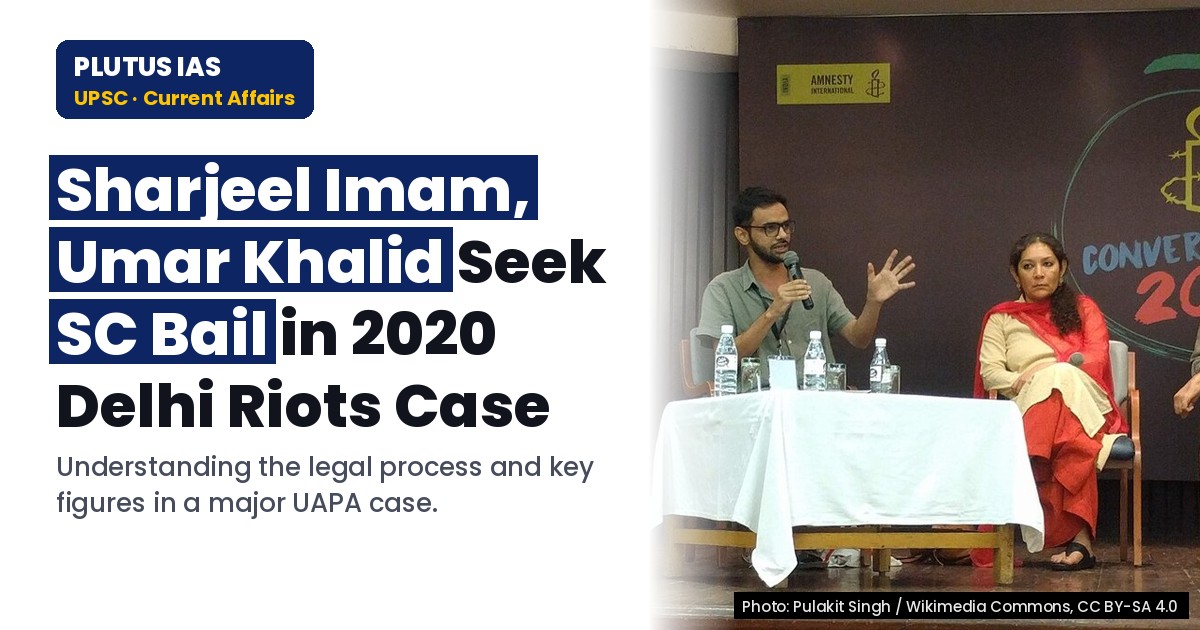
06 Nov Delhi Riots Case: Sharjeel Imam, Umar Khalid Seek SC Bail
✎ The UAPA is India's stringent anti-terrorism law, imposing a high threshold for bail, with judicial review ensuring a balance between national security and individual liberties, while lower courts adhere to the principle of…
Subject Relevance — Where This Topic Fits
- GS Paper II — Indian Polity and Governance: Structure, Functioning, Conduct of Business, Powers & Privileges and Issues Arising Out of these Bodies; Government Policies and Interventions for Development in various sectors and Issues arising out of their Design and Implementation; Important Aspects of Governance, Transparency and Accountability, E-governance- applications, models, successes, limitations, and potential; Citizens Charters, Transparency & Accountability and institutional and other measures. | GS Paper III — Internal Security: Linkages between development and spread of extremism; Role of external state and non-state actors in creating challenges to internal security; Challenges to internal security through communication networks, role of media and social networking sites in internal security challenges, basics of cyber security; money-laundering and its prevention; Security challenges and their management in border areas – linkages of organized crime with terrorism; Various Security forces and agencies and their mandate.
- Prelims: Unlawful Activities (Prevention) Act (UAPA), Bail jurisprudence, Supreme Court of India, High Courts, Trial Courts, Fundamental Rights, Judicial discipline, Protected witnesses
- Essay: The delicate balance between national security and individual liberties in a democratic framework., The role of the judiciary in upholding constitutional principles amidst stringent security legislation.
Quick Revision: The UAPA is India’s stringent anti-terrorism law, imposing a high threshold for bail, with judicial review ensuring a balance between national security and individual liberties, while lower courts adhere to the principle of judicial discipline by following higher court directives.
Why is this in the news?
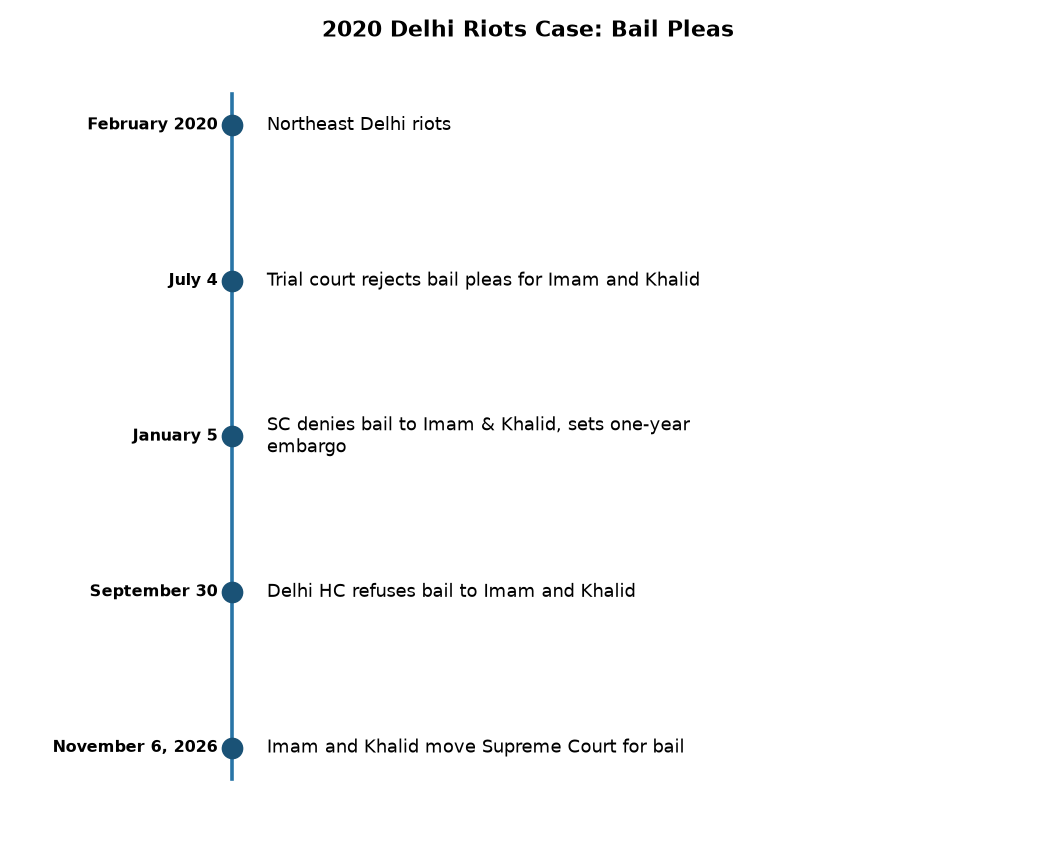
Activists Sharjeel Imam and Umar Khalid, accused in the 2020 Northeast Delhi riots ‘larger conspiracy’ case under the Unlawful Activities (Prevention) Act (UAPA), have approached the Supreme Court seeking bail. This development follows the Delhi High Court’s refusal to grant them bail, citing ‘judicial discipline’ and adherence to a previous Supreme Court order that had set specific conditions for their bail applications, including the completion of protected witness examination or the expiry of a one-year embargo. The petitioners contend that the prosecution has failed to examine protected witnesses and that the stipulated one-year period is nearing its end, despite their prolonged incarceration as undertrials.
Background
- The February 2020 Northeast Delhi riots resulted in significant casualties and injuries, prompting investigations into an alleged ‘larger conspiracy’.
- Sharjeel Imam and Umar Khalid, along with 16 others, were booked under the stringent Unlawful Activities (Prevention) Act (UAPA) in connection with this ‘larger conspiracy’ case.
- The Delhi Police Special Cell alleged that the riots were a result of a ‘deep-rooted conspiracy’ hatched after the Citizenship Amendment Bill received Cabinet approval in December 2019.
- The Supreme Court, on January 5, while granting bail to other co-accused, had differentiated the roles of Imam and Khalid, describing them as ‘ideological drivers’ of the alleged conspiracy, and imposed specific conditions for their bail applications.
- Both the trial court and the Delhi High Court subsequently refused bail to Imam and Khalid, citing ‘judicial discipline’ and the binding nature of the Supreme Court’s January 5 order.
- The prosecution has cited over 900 witnesses, including approximately 50 protected witnesses, in the case, which is currently at the stage of arguments on charge.
- The petitioners have been incarcerated for over six years as undertrials, with arguments focusing on the non-examination of protected witnesses and the approaching expiry of the one-year embargo set by the Supreme Court.
Understanding the Unlawful Activities (Prevention) Act (UAPA) and Bail Jurisprudence
- The Unlawful Activities (Prevention) Act (UAPA), enacted in 1967, is India’s primary anti-terrorism law, designed to prevent unlawful activities associations and deal with terrorist activities.
- It grants significant powers to law enforcement agencies for investigation, detention, and prosecution, often imposing stringent conditions for bail compared to ordinary criminal laws.
- Section 43D(5) of UAPA is particularly notable, as it stipulates that bail shall not be granted if, on a perusal of the case diary or the report under section 173 of the Code of Criminal Procedure, the court is of the opinion that there are reasonable grounds for believing that the accusation against such person is prima facie true.
- Bail jurisprudence under UAPA involves a higher threshold for proving innocence or the absence of a prima facie case, shifting the burden to the accused to demonstrate that the accusation is not true.
- The Supreme Court and High Courts exercise judicial review over UAPA cases, ensuring that due process is followed and fundamental rights are not unduly curtailed, while also balancing national security concerns.
- ‘Judicial discipline’ refers to the principle that lower courts are bound by the precedents and orders of higher courts, particularly the Supreme Court, ensuring consistency and hierarchy in the judicial system.
- Protected witnesses are individuals whose identities are kept confidential by the court to safeguard them from potential intimidation or harm, especially in sensitive cases involving serious charges.
- The concept of ‘undertrial’ refers to an individual who is awaiting trial in a court of law and has not yet been convicted or acquitted, often remaining in judicial custody during this period.
Key Features
| Feature | Significance |
|---|---|
| Unlawful Activities (Prevention) Act (UAPA) | A stringent anti-terror law under which the accused are charged, allowing for extended periods of detention without bail. |
| Bail Application | A legal mechanism allowing an accused person to be released from custody, typically on condition that they appear in court when required. |
| Supreme Court Embargo | A specific directive from the apex court, in this instance, setting a one-year period or completion of protected witness examination for seeking bail. |
| Protected Witnesses | Individuals whose identities are concealed to ensure their safety, particularly in sensitive cases, posing challenges for defence in cross-examination. |
| Judicial Discipline | The principle that lower courts are bound by the precedents and directives established by higher courts, ensuring consistency and hierarchy in the judicial system. |
| Undertrial Prisoner Status | Refers to individuals who are incarcerated while awaiting trial or the conclusion of their legal proceedings, highlighting concerns about prolonged detention. |
Why it Matters
Legal and Judicial Significance
- The case highlights the procedural aspects of bail jurisprudence under stringent laws like UAPA, particularly concerning the balance between national security interests and individual liberties.
- It underscores the hierarchy of the Indian judiciary, where lower courts are bound by the directives of higher courts, as evidenced by the Delhi High Court’s adherence to the Supreme Court’s order.
- The prolonged detention of undertrials raises questions about the ‘right to a speedy trial’ and the potential for the process itself to become a form of punishment, irrespective of guilt.
Human Rights and Civil Liberties Significance
- The application of UAPA in cases involving alleged conspiracy, rather than direct acts of violence, often leads to debates regarding its potential for misuse and its impact on dissent and free speech.
- The issue of protected witnesses, while crucial for their safety, presents challenges for the defence in ensuring a fair trial, as the inability to examine them can impede the defence’s ability to challenge evidence effectively.
- The case draws attention to the plight of undertrial prisoners, many of whom spend significant periods in custody, sometimes exceeding the potential sentence they might receive if convicted.
Governance and Public Order Significance
- The Delhi riots case underscores the complexities involved in investigating and prosecuting large-scale public disorder incidents, particularly when allegations of ‘larger conspiracy’ are involved.
- It reflects the state’s approach to maintaining public order and addressing perceived threats to national security, often through the invocation of stringent legal provisions.
- The judicial process in such high-profile cases can influence public perception of justice delivery and the rule of law, impacting societal trust in institutions.
Challenges
1. Balancing Security and Liberty
- The UAPA allows for extended detention without bail, raising concerns about the erosion of individual liberties in the pursuit of national security.
- The stringent bail conditions under UAPA often place a high burden on the accused to prove their innocence, rather than the prosecution proving guilt, which can be challenging.
UPSC Link: Indian Constitution – Fundamental Rights
2. Prolonged Detention of Undertrials
- Accused individuals spending several years in custody as undertrials, without conviction, can amount to a violation of the right to a speedy trial.
- The delay in witness examination and trial proceedings contributes significantly to the extended periods of incarceration for undertrials.
UPSC Link: Judicial System – Criminal Justice Reform
3. Fair Trial Concerns with Protected Witnesses
- The inability of the defence to examine protected witnesses can hinder the accused’s right to a fair trial and the ability to effectively challenge prosecution evidence.
- Balancing witness protection with the accused’s right to confront their accusers is a critical challenge in such cases.
UPSC Link: Judicial System – Due Process
4. Judicial Overburden and Delays
- The sheer volume of witnesses and evidence in complex cases like the Delhi riots can lead to significant delays in trial proceedings, contributing to judicial backlog.
- The multiple layers of appeals and bail applications further strain judicial resources and prolong the overall legal process.
UPSC Link: Judicial System – Efficiency
Challenges — UPSC Perspective
| Issue | Concern |
|---|---|
| UAPA Application | Potential for prolonged detention without bail, impacting individual liberty and the presumption of innocence. |
| Protected Witnesses | Challenges for the defence in cross-examination, potentially affecting the fairness of the trial proceedings. |
| Judicial Embargoes | Specific directives from higher courts can limit the discretion of lower courts, potentially delaying fresh bail considerations. |
| Trial Delays | Extensive witness lists and complex evidence contribute to protracted trials, leading to long periods of undertrial incarceration. |
| Judicial Hierarchy | Lower courts’ inability to deviate from higher court orders, even when circumstances evolve, can lead to perceived inflexibility. |
Way Forward
- Expedite the examination of protected witnesses in a time-bound manner to ensure timely progression of trials and uphold the right to a speedy trial.
- Implement robust mechanisms for regular review of undertrial cases, especially those under stringent laws, to prevent indefinite detention.
- Strengthen legal aid services for undertrial prisoners to ensure effective representation and timely access to legal recourse.
- Explore alternative dispute resolution mechanisms where appropriate, to reduce the burden on the formal judicial system and expedite case disposal.
- Promote judicial training and capacity building to enhance efficiency in handling complex cases, including those involving numerous witnesses and extensive evidence.
- Re-evaluate bail provisions under stringent laws to strike a better balance between national security imperatives and the fundamental rights of the accused, without compromising either.
- Utilise technology effectively in court proceedings to streamline processes, manage evidence, and facilitate faster trials.
UPSC Value Addition
Keywords for Mains Answer-Writing
Unlawful Activities (Prevention) Act (UAPA) · Bail jurisprudence · Undertrial prisoners · Right to speedy trial · Judicial discipline · Supreme Court directives · High Court jurisdiction · Trial court powers · Protected witnesses · Criminal justice system reform
Constitutional & Policy Linkages
- {‘article’: ‘Article 21’, ‘note’: ‘Right to life and personal liberty’}
- {‘article’: ‘Article 22’, ‘note’: ‘Protection against arrest and detention’}
- {‘article’: ‘Article 14’, ‘note’: ‘Equality before the law’}
- {‘article’: ‘Article 39A’, ‘note’: ‘Equal justice and free legal aid’}
Concept Flow
Alleged ‘larger conspiracy’ in 2020 Delhi riots → Accused charged under Unlawful Activities (Prevention) Act (UAPA) → Prolonged detention as undertrials; multiple bail rejections → Supreme Court imposes one-year embargo on fresh bail pleas → Accused move Supreme Court seeking bail, citing embargo expiry → Judicial system grapples with balancing security, liberty, and speedy trial
Prelims Practice Questions
Q1. Consider the following statements regarding the Unlawful Activities (Prevention) Act (UAPA):
1. The UAPA allows for detention of individuals for extended periods without charge.
2. The Act defines ‘terrorist act’ broadly to include acts intended to threaten the unity, integrity, security, or sovereignty of India.
3. Bail under UAPA is generally more difficult to obtain compared to ordinary criminal laws, with a higher threshold for the accused to prove innocence.
How many of the above statements are correct?
- Only one
- Only two
- Only three
- None
Answer: Only three — Statement 1 is incorrect; UAPA allows for extended detention without bail, not without charge. Charges are filed, but bail is restricted. Statement 2 is correct; the definition of ‘terrorist act’ under UAPA is indeed broad. Statement 3 is correct; Section 43D(5) of UAPA imposes stringent conditions for bail, requiring the court to be satisfied that there are reasonable grounds for believing that the accusation against such person is prima facie true.
Q2. Assertion (A): The principle of ‘judicial discipline’ mandates lower courts to adhere to the precedents and orders set by higher courts.
Reason (R): This adherence ensures consistency, predictability, and uniformity in the application of law across the judicial hierarchy.
Select the correct option:
- Both A and R are true, and R is the correct explanation of A.
- Both A and R are true, but R is not the correct explanation of A.
- A is true, but R is false.
- A is false, but R is true.
Answer: Both A and R are true, and R is the correct explanation of A. — Assertion (A) correctly defines judicial discipline as the obligation of lower courts to follow higher court pronouncements. Reason (R) accurately explains the rationale behind judicial discipline, which is to maintain consistency and certainty in the legal system. Therefore, R is the correct explanation of A.
Mains Practice Question
✍ Examine the challenges faced by undertrial prisoners in securing bail under stringent laws like the Unlawful Activities (Prevention) Act (UAPA). Discuss the role of the judiciary in balancing individual liberty with national security concerns, with reference to recent Supreme Court pronouncements. (15 Marks)
Approach: MODEL-ANSWER SKELETON:
1. Introduction: Briefly define undertrial prisoners and the context of stringent laws like UAPA.
2. Challenges for Undertrial Prisoners under UAPA:
a. Stringent Bail Conditions: Section 43D(5) UAPA – ‘prima facie true’ test.
b. Prolonged Detention: Extended periods of incarceration without trial, often exceeding the maximum sentence for the alleged offence.
c. Burden of Proof: Effective reversal of the presumption of innocence.
d. Witness Protection: Delays in witness examination, especially protected witnesses.
e. Judicial Discretion: Limited scope for courts to grant bail.
f. Impact on Fundamental Rights: Violation of Article 21 (Right to Life and Personal Liberty) and Article 22 (Protection against arrest and detention).
3. Role of the Judiciary in Balancing Liberty and Security:
a. Interpretation of UAPA: Courts’ evolving interpretation of ‘prima facie true’ (e.g., NIA v. Zahoor Ahmad Shah Watali).
b. Right to Speedy Trial: Recognition of speedy trial as a fundamental right (e.g., Hussainara Khatoon v. Home Secretary, State of Bihar).
c. Bail as a Rule, Jail as an Exception: Reiteration of this principle even in stringent laws, where applicable (e.g., Satender Kumar Antil v. CBI).
d. Specific Supreme Court Pronouncements: Reference to recent judgments that have either tightened or eased bail conditions, or imposed time limits for trial/witness examination in specific contexts.
e. Safeguarding Due Process: Ensuring fair investigation and trial procedures.
4. Conclusion: Summarize the ongoing tension and suggest potential reforms or judicial activism to protect individual rights while upholding national security.
Source: The Indian Express
Generated by AanyaAi for educational purpose.
Related guides on our sites
- Current affairs for upsc 2026
- Best PSIR optional coaching in delhi for UPSC
- Best PSIR optional coaching for upsc
- Best PSIR optional teacher for upsc

- Swachh Survekshan: MP’s 9 Cities Honored by President - November 8, 2026
- ईपीएफओ का विशेष अभियान 6: जनसेवा, स्वच्छता और रिकॉर्ड प्रबंधन में सफलता - November 8, 2026
- Andhra Pradesh: Drought to Deluge & Cyclones Impact - November 8, 2026

No Comments