


19 Jul Delhi Schools to Implement Year-Long Air Pollution Awareness Plan
Subject Relevance — Where This Topic Fits
- GS Paper I — Social Issues (Urbanisation, Environmental Degradation) | GS Paper II — Governance (Government Policies & Interventions), Social Justice (Health) | GS Paper III — Environment (Environmental Pollution & Degradation, Conservation), Science & Technology (Environmental Technology)
- Prelims: Air Pollution, CAQM, DPCC, IEC Action Plan, PM2.5, PM10, NOx, SOx, Ozone, AQI
- Essay: Environmental Education as a Catalyst for Sustainable Development, The Role of Citizen Participation in Tackling Urban Environmental Challenges
Quick Revision: Delhi’s year-long school-based air pollution awareness campaign, guided by CAQM and DPCC, aims to foster environmental literacy and behavioural change among students, complementing regulatory efforts to combat urban air pollution.
Why is this in the news?
The Directorate of Education, Delhi Government, has instructed all schools to implement a year-long air pollution awareness campaign. This initiative aims to educate students from classes 6 to 12 about the causes, effects, and mitigation strategies of air pollution through various activities, aligning with the frameworks of the Commission for Air Quality Management (CAQM) and the Delhi Pollution Control Committee (DPCC).
Background
- Delhi consistently ranks among the most polluted cities globally, facing severe air quality challenges, particularly during the winter months.
- Major sources of air pollution in Delhi include vehicular emissions, industrial pollution, construction dust, road dust, biomass burning (stubble burning), and municipal solid waste burning.
- The adverse health impacts of air pollution range from respiratory and cardiovascular diseases to neurological disorders and premature mortality.
- Previous governmental efforts have included the Graded Response Action Plan (GRAP), Odd-Even scheme, and promotion of electric vehicles, but a sustained public awareness component, especially among youth, has been identified as crucial.
- The National Clean Air Programme (NCAP) aims to reduce particulate matter concentration by 20-30% by 2024, with public awareness being a key pillar.
- Educational institutions are recognised as vital platforms for fostering environmental stewardship and promoting behavioural change among future generations.
What is the Year-Long Air Pollution Awareness Campaign?
- A directive from the Delhi Directorate of Education mandating all government schools to conduct a continuous, year-long awareness program on air pollution.
- Aims to educate students from Class 6 to 12 about the causes, health impacts, environmental effects, and preventive measures related to air pollution.
- Incorporates a diverse range of activities such as poster making, slogan writing, essay and speech competitions, and street plays (Nukkad Natak).
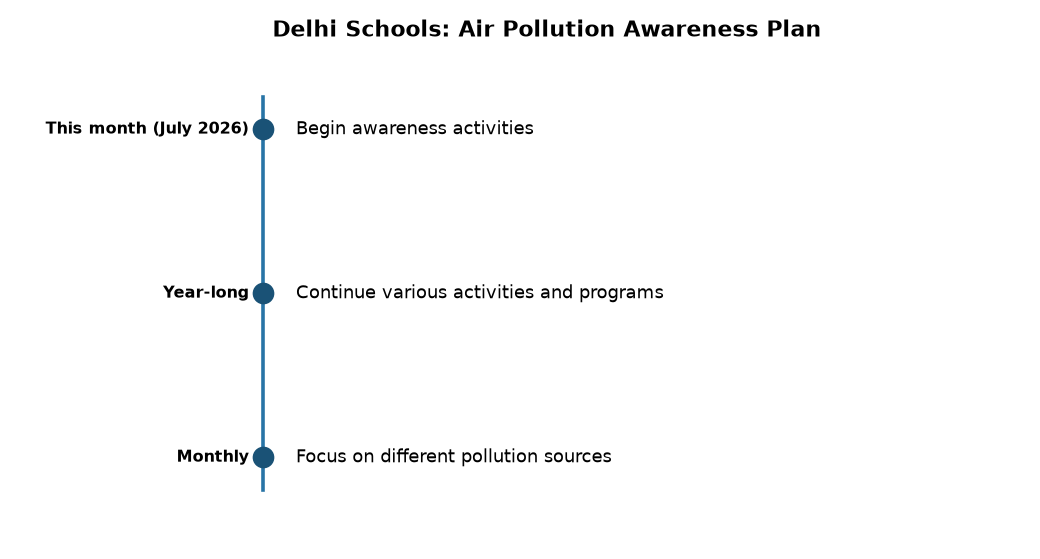
- The campaign is structured around an Information, Education, and Communication (IEC) Action Plan, addressing specific pollution sources each month.
- Monthly themes include vehicular emissions (July onwards), road dust (July-September), construction dust (September-November), municipal solid waste and stubble burning (November-December), industrial emissions (January), thermal power plants (February), and diesel generator sets (March).
- Also includes raising awareness about the ban on sharp kite strings (‘manjha’) due to its environmental and safety hazards.
- The initiative is based on the framework provided by the Commission for Air Quality Management (CAQM) and directives from the Delhi Pollution Control Committee (DPCC).
- District Education Officers are tasked with ensuring the effective implementation of this plan across schools in their respective jurisdictions.
Key Features
| Feature | Significance |
|---|---|
| Year-Long Duration | Ensures sustained engagement and deeper understanding, moving beyond episodic campaigns. |
| Targeted Age Group (Class 6-12) | Focuses on adolescents and young adults, who can act as agents of change within their families and communities. |
| Diverse Activities (Posters, Nukkad Natak) | Catters to different learning styles, making the education engaging and memorable. |
| Monthly Thematic Focus | Allows for in-depth exploration of specific pollution sources, aligning with seasonal variations and policy priorities. |
| Alignment with CAQM & DPCC | Ensures consistency with broader regional and state-level air quality management strategies. |
| Ban on Sharp Manjha Awareness | Addresses a specific, often overlooked, environmental and safety concern with direct community relevance. |
Why it Matters
Environmental Education and Awareness
- Fosters a generation of environmentally conscious citizens, equipped with knowledge to make informed choices.
- Promotes behavioural changes at individual and household levels, such as reduced vehicle usage, proper waste disposal, and energy conservation.
- Increases public participation in air quality improvement efforts, strengthening the ‘Jan Bhagidari’ aspect of environmental governance.
Public Health Improvement
- Educates students about the severe health impacts of air pollution, encouraging preventive measures and advocacy for cleaner air.
- Empowers individuals to protect themselves and their families from pollution exposure, particularly vulnerable groups like children and the elderly.
Policy Implementation and Governance
- Supports the objectives of national and state-level air quality management programs like NCAP and GRAP by building a supportive public.
- Helps in identifying local pollution hotspots and sources through community feedback and increased vigilance, aiding enforcement agencies.
- Reinforces the ‘polluter pays’ principle by increasing public demand for accountability from polluting industries and activities.
Sustainable Development Goals (SDGs)
- Directly contributes to SDG 3 (Good Health and Well-being) by addressing a major health risk.
- Supports SDG 4 (Quality Education) by integrating environmental literacy into the curriculum.
- Aligns with SDG 11 (Sustainable Cities and Communities) by promoting cleaner urban environments.
- Advances SDG 13 (Climate Action) and SDG 15 (Life on Land) by fostering responsible environmental stewardship.
Challenges
1. Implementation Gaps and Monitoring
- Ensuring uniform and effective implementation across all schools, especially in resource-constrained settings.
- Lack of robust monitoring mechanisms to assess the actual impact and reach of the awareness activities.
UPSC Link: GS Paper II — Governance, GS Paper III — Environment
2. Teacher Training and Resources
- Adequate training for teachers to effectively deliver complex environmental concepts in an engaging manner.
- Availability of appropriate educational materials, tools, and resources for conducting diverse activities.
UPSC Link: GS Paper II — Education, Human Resource Development
3. Sustaining Student Engagement
- Maintaining student interest and participation throughout a year-long campaign, avoiding monotony.
- Translating awareness into tangible behavioural changes beyond the school environment.
UPSC Link: GS Paper I — Social Psychology, GS Paper II — Social Justice
4. Addressing Root Causes
- While awareness is crucial, it must be complemented by stringent policy enforcement and technological solutions to tackle industrial and vehicular emissions.
- Political will and inter-state cooperation are essential for addressing transboundary pollution sources like stubble burning.
UPSC Link: GS Paper III — Environment, GS Paper II — Governance
5. Measuring Impact and Outcomes
- Difficulty in quantifying the direct impact of awareness campaigns on actual air quality improvement.
- Establishing clear metrics for success beyond participation rates, such as changes in knowledge, attitudes, and practices.
UPSC Link: GS Paper II — Policy Evaluation, GS Paper III — Environment
Challenges — UPSC Perspective
| Issue | Concern |
|---|---|
| Resource Constraints | Schools may lack funds, trained personnel, or materials for effective program delivery. |
| Curriculum Overload | Adding new activities without integrating them thoughtfully might strain existing academic schedules. |
| Behavioural Inertia | Awareness does not automatically translate into sustained behavioural change without reinforcement. |
| External Pollution Sources | Campaign’s impact limited if major external sources (e.g., stubble burning) are not effectively controlled. |
| Data Collection & Reporting | Ensuring accurate and timely reporting of activities and outcomes from all schools. |
Government Initiatives — Must-Memorise for Prelims
- National Clean Air Programme (NCAP)
- Graded Response Action Plan (GRAP)
- FAME India Scheme (Faster Adoption and Manufacturing of Electric Vehicles)
- Pradhan Mantri Ujjwala Yojana (PMUY)
- Swachh Bharat Abhiyan (Urban & Rural)
- National Green Corps (NGC) ‘Eco-Club’ Programme
- Air (Prevention and Control of Pollution) Act, 1981
- Environment (Protection) Act, 1986
- Commission for Air Quality Management (CAQM) in NCR and Adjoining Areas Act, 2021
- Delhi Pollution Control Committee (DPCC)
Way Forward
- Integrate environmental education seamlessly into the existing curriculum, rather than treating it as an add-on, to ensure sustained engagement.
- Develop comprehensive training modules for teachers, equipping them with pedagogical tools and up-to-date information on air pollution.
- Foster partnerships with environmental NGOs, scientific institutions, and local communities to leverage expertise and resources for effective outreach.
- Implement a robust monitoring and evaluation framework to track the campaign’s progress, identify challenges, and measure its impact on student knowledge, attitudes, and behaviours.
- Encourage inter-school competitions and collaborative projects to foster a sense of collective responsibility and innovative problem-solving.
- Extend awareness efforts to parents and the wider community through school-led initiatives, creating a broader ecosystem of environmental consciousness.
- Utilise digital platforms and social media to amplify messages, share best practices, and engage a wider audience beyond the school premises.
- Ensure that awareness campaigns are complemented by stringent regulatory measures and infrastructural improvements to address the root causes of pollution.
UPSC Value Addition
Keywords for Mains Answer-Writing
Air Quality Management · Environmental Education · Behavioural Change · Public Participation · Sustainable Development Goals · Inter-sectoral Coordination · Urban Pollution · Health Impacts · Citizen Science · Policy Implementation · Climate Action · Environmental Governance
Constitutional & Policy Linkages
- Article 21 (Right to Life and Personal Liberty, implicitly includes right to clean environment)
- Article 48A (Protection and Improvement of Environment and Safeguarding of Forests and Wildlife)
- Article 51A(g) (Fundamental Duty to protect and improve the natural environment)
- Environment (Protection) Act, 1986 (Umbrella legislation for environmental protection)
- Air (Prevention and Control of Pollution) Act, 1981 (Specific legislation for air pollution control)
- CAQM Act, 2021 (Statutory body for air quality management in NCR)
Concept Flow
Severe Air Pollution in Delhi → Need for Public Awareness & Behavioural Change → Directorate of Education’s Mandate for Year-Long Campaign → Implementation of IEC Action Plan in Schools → Increased Student & Community Awareness → Promotion of Environmentally Responsible Practices → Contribution to Improved Air Quality & Public Health
Prelims Practice Questions
Q1. Consider the following statements regarding air pollution management in Delhi:
1. The Commission for Air Quality Management (CAQM) is a statutory body for air quality management in the National Capital Region and adjoining areas.
2. The Delhi Pollution Control Committee (DPCC) is responsible for implementing environmental laws and rules within Delhi.
3. The Graded Response Action Plan (GRAP) is a set of emergency measures implemented based on the severity of air pollution levels.
Which of the statements given above are correct?
- A. 1 and 2 only
- B. 2 and 3 only
- C. 1 and 3 only
- D. 1, 2 and 3
Answer: D. 1, 2 and 3 — Statement 1 is correct: CAQM was established by an Act of Parliament in 2021. Statement 2 is correct: DPCC is the state pollution control board for Delhi. Statement 3 is correct: GRAP is an emergency action plan to tackle severe air pollution, implemented in phases based on AQI levels.
Q2. Which of the following are considered major sources of air pollution in Delhi?
1. Vehicular emissions
2. Construction and demolition activities
3. Stubble burning in neighbouring states
4. Industrial emissions
Select the correct answer using the code given below:
- A. 1 and 2 only
- B. 2, 3 and 4 only
- C. 1, 3 and 4 only
- D. 1, 2, 3 and 4
Answer: D. 1, 2, 3 and 4 — All four options – vehicular emissions, construction and demolition activities, stubble burning in neighbouring states, and industrial emissions – are well-documented major contributors to air pollution in Delhi. The campaign specifically targets awareness around these sources.
Mains Practice Question
✍ The Delhi government’s year-long air pollution awareness campaign in schools represents a significant step towards fostering environmental consciousness. Critically analyse the potential benefits and challenges of such an initiative in addressing the complex issue of urban air pollution, and suggest measures for its effective implementation and long-term impact. (250 words)
Approach: Begin by acknowledging the severity of Delhi’s air pollution. Discuss the potential benefits of the campaign, focusing on environmental education, behavioural change, public health, and support for policy implementation. Subsequently, critically analyse the challenges such as implementation gaps, resource constraints, sustaining engagement, and the need to address root causes beyond awareness. Conclude by suggesting concrete measures for effective implementation, including teacher training, curriculum integration, robust monitoring, and community engagement, to ensure the initiative’s long-term impact and contribution to sustainable air quality improvement.
Source: amarujala.com
Generated by AanyaAi for educational purpose.


No Comments