


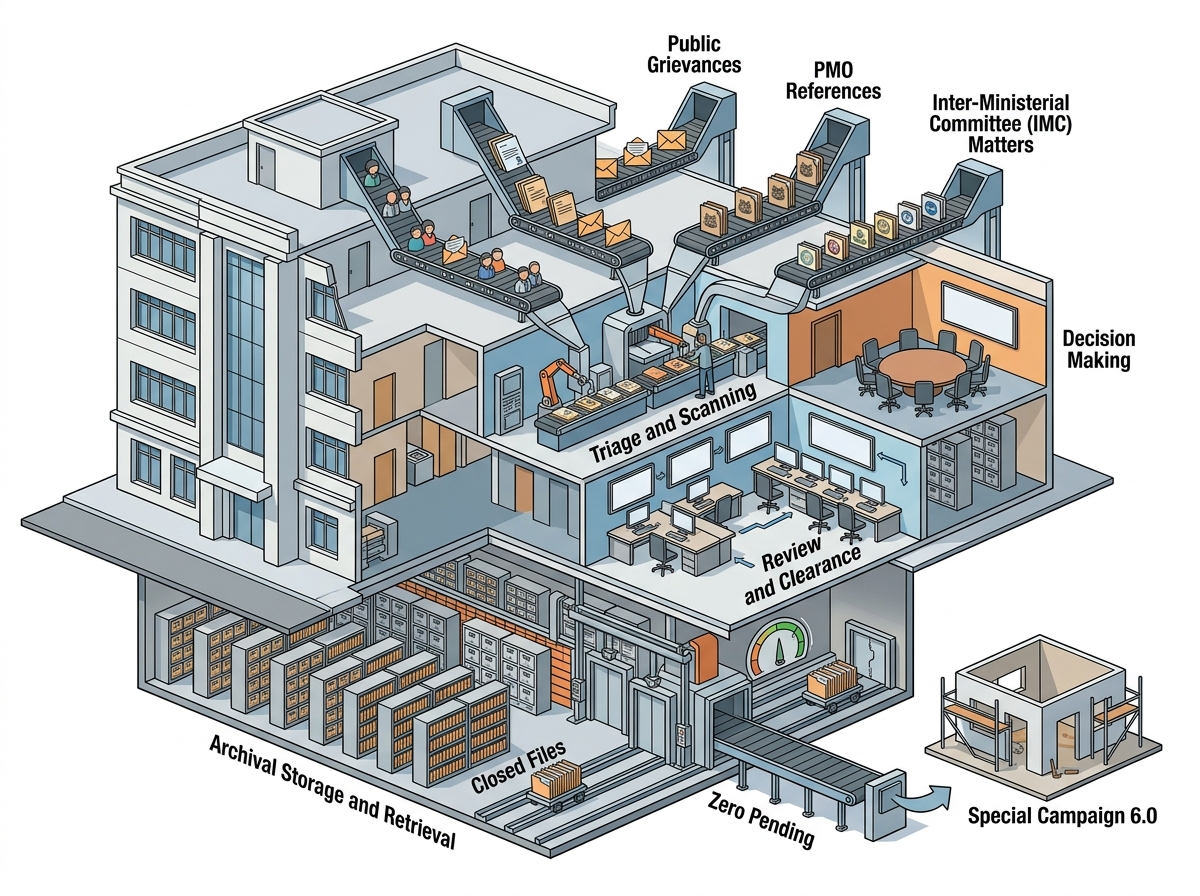
17 Sep DIPAM achieves zero pending cases under Special Campaign 5.0 for key grievances
✎ DIPAM’s achievement of zero pending cases in key categories under Special Campaign 5.0 highlights the importance of process simplification, efficient record management, and institutional cleanliness in improving governance…
Subject Relevance — Where This Topic Fits
- GS Paper II — Government Policies and Interventions for Development | GS Paper III — Economic Reforms and Governance
- Prelims: Special Campaign 5.0, DIPAM, PMO references, Inter-Ministerial Committee (IMC), Parliamentary assurances, Urinal sensors, Asset scrapping
- Essay: Administrative reforms and public service delivery, Sustainable governance through technology and process simplification
Quick Revision: DIPAM’s achievement of zero pending cases in key categories under Special Campaign 5.0 highlights the importance of process simplification, efficient record management, and institutional cleanliness in improving governance standards.
Why is this in the news?
The Department of Investment and Public Asset Management (DIPAM), under the Ministry of Finance, has achieved zero pending cases in key categories—public grievances, PMO references, and inter-ministerial committee (IMC) matters—under Special Campaign 5.0 (November 2025–August 2026). This milestone underscores DIPAM’s commitment to administrative efficiency, process simplification, and sustainable office management, setting a benchmark for other government departments. The achievement is particularly significant as it aligns with the broader objectives of Special Campaign 5.0, which aims to institutionalise cleanliness, reduce pendency, and enhance governance standards across government offices.
Background
- Special Campaign 5.0 (November 2025–August 2026) was launched by the Government of India to institutionalise cleanliness, reduce pendency of public grievances, and improve administrative efficiency in government offices.
- The campaign is part of a broader governance reform initiative aimed at enhancing citizen-centric service delivery and reducing bureaucratic delays.
- DIPAM, a department under the Ministry of Finance, is responsible for managing government investments in public sector enterprises and assets, making its administrative efficiency critical for economic governance.
- The campaign builds on the success of Special Campaign 4.0, which also focused on reducing pendency and improving office infrastructure.
- DIPAM does not have any attached or subordinate offices or autonomous bodies, making its administrative reforms directly attributable to its internal processes and initiatives.
What is Special Campaign 5.0 and DIPAM’s Role?
- Special Campaign 5.0 is a government-wide initiative launched to institutionalise cleanliness, reduce pendency of public grievances, and improve administrative efficiency in government offices.
- The campaign is implemented under the aegis of the Department of Administrative Reforms and Public Grievances (DARPG), Ministry of Personnel, Public Grievances and Pensions.
- Key objectives include: (a) reducing pendency of public grievances, appeals, inter-ministerial references, PMO references, and parliamentary assurances; (b) improving office cleanliness and infrastructure; and (c) enhancing record management and process simplification.
- DIPAM, under the Ministry of Finance, is tasked with managing government investments in public sector enterprises and assets, making its administrative reforms critical for economic governance.
- The department also undertook initiatives to improve office cleanliness, such as installing urinal sensors in washrooms and scrapping obsolete vehicles to free up parking space, thereby enhancing space utilisation.
- DIPAM conducted ‘Swachhta Pakhwada’ in January 2026, a fortnight-long campaign to promote cleanliness, awareness, and civic responsibility among officers and staff.
- The department is now preparing for Special Campaign 6.0 (October 2–31, 2026), which will further focus on cleanliness, efficiency, and reducing pendency in administrative processes.
Key Features
| Feature | Significance |
|---|---|
| Zero pending inter-ministerial committee (IMC) references | Demonstrates institutional efficiency in resolving cross-departmental disputes and ensuring timely administrative action. |
| Zero pending public grievances and PMO references | Reflects proactive redressal mechanisms and citizen-centric governance in public service delivery. |
| Installation of urinal sensors in washrooms | Enhances hygiene standards and promotes sustainable infrastructure management within office premises. |
| Scrapping of obsolete vehicles | Optimizes asset utilization by freeing up parking space and aligning with government directives on vehicle disposal. |
| Conduct of ‘Swachhta Pakhwada’ (January 2026) | Fosters a culture of cleanliness and civic responsibility among officials through awareness campaigns and competitions. |
Why it Matters
Administrative Efficiency
- Achievement of zero pending cases in critical governance categories underscores the efficacy of Special Campaign 5.0 in reducing bureaucratic delays.
- Timely resolution of parliamentary assurances and appeals strengthens public trust in institutional responsiveness.
- Process simplification and record management improvements contribute to long-term administrative streamlining.
Public Service Delivery
- Zero pending public grievances indicate effective grievance redressal mechanisms, aligning with the principles of citizen-centric governance.
- Resolution of PMO references ensures alignment between executive directives and departmental implementation.
- Enhanced office hygiene and infrastructure management directly impact the quality of work environment for officials.
Asset and Infrastructure Management
- Scrapping of obsolete vehicles exemplifies adherence to government policies on sustainable asset disposal and space optimization.
- Installation of urinal sensors and ‘Swachhta Pakhwada’ initiatives reflect a commitment to sustainable and hygienic infrastructure practices.
- Efficient space utilization through asset management contributes to cost savings and operational efficiency.
Challenges
1. Sustaining Zero-Pending Status
- Maintaining zero pending cases requires continuous monitoring and proactive case management to prevent backlog accumulation.
- Ensuring that new cases are resolved within stipulated timelines demands robust workflow automation and staff capacity building.
UPSC Link: GS-II: Governance, Transparency & Accountability
2. Institutionalizing Hygiene and Sustainability Practices
- Long-term adherence to cleanliness standards necessitates institutionalization of best practices beyond campaign-driven initiatives.
- Balancing sustainability goals with operational costs remains a persistent challenge in infrastructure upgrades.
UPSC Link: GS-II: Public Health & Environmental Governance
3. Cross-Departmental Coordination
- Resolving inter-ministerial references efficiently requires seamless inter-departmental collaboration, which can be hindered by bureaucratic silos.
- Ensuring consistency in policy interpretation across ministries is critical to avoiding recurring disputes.
UPSC Link: GS-II: Centre-State Relations & Inter-Governmental Coordination
4. Technology Adoption and Digital Literacy
- Effective use of automation tools for case tracking and record management depends on staff proficiency in digital systems.
- Resistance to digital transformation in traditional bureaucratic setups may pose adoption challenges.
UPSC Link: GS-III: Science & Technology in Governance
Challenges — UPSC Perspective
| Issue | Concern |
|---|---|
| Backlog Prevention | Risk of new cases accumulating without timely resolution mechanisms. |
| Resource Constraints | Limited staff and financial resources may hinder sustained campaign efforts. |
| Behavioral Change | Ensuring long-term adherence to hygiene and efficiency norms among officials. |
| Policy Consistency | Maintaining uniformity in policy interpretation across departments to avoid recurring disputes. |
| Infrastructure Upgrades | Balancing sustainability goals with budgetary limitations in office maintenance. |
Way Forward
- Institutionalize a real-time dashboard for tracking pending cases to ensure zero backlog status is maintained.
- Expand digital case management systems to automate workflows and reduce manual intervention in grievance redressal.
- Conduct quarterly audits of office infrastructure to identify and address hygiene and space utilization gaps.
- Launch capacity-building programs for officials on digital literacy and sustainable governance practices.
- Strengthen inter-departmental coordination mechanisms to resolve inter-ministerial references proactively.
- Integrate citizen feedback loops to continuously improve grievance redressal processes and public service delivery.
- Promote public-private partnerships for sustainable infrastructure upgrades, such as waste management and energy efficiency.
- Document and disseminate best practices from Special Campaign 5.0 to other ministries for replication.
UPSC Value Addition
Keywords for Mains Answer-Writing
Special Campaign 5.0 · Department of Investment and Public Asset Management (DIPAM) · zero pending cases · PMO references · public grievances · office hygiene initiatives · asset management · space utilisation · Swachhata Pakhwada · government efficiency · institutional reforms · record management · inter-ministerial coordination · time-bound disposal · public service delivery
Constitutional & Policy Linkages
- Article 77(3) – Rules for transaction of Government business (delegation of authority for efficient case disposal).
- Article 53 – Executive power of the Union (ensuring timely implementation of government directives).
Concept Flow
Initiation of Special Campaign 5.0 → Focus on reducing pending cases and improving office hygiene → Implementation of process simplifications and infrastructure upgrades → Achievement of zero pending cases in key categories → Institutionalization of best practices → Preparation for Special Campaign 6.0 with enhanced targets.
Prelims Practice Questions
Q1. Consider the following statements about Special Campaign 5.0 in the context of government administration:
1. It aims to institutionalise cleanliness and reduce pending matters in government offices.
2. The Department of Investment and Public Asset Management (DIPAM) achieved zero pending cases in public grievances, PMO references, and appeals.
3. The campaign mandates the establishment of subordinate offices under DIPAM for effective implementation.
How many of the above statements are correct?
- Only one
- Only two
- All
- None
Answer: Only two — Statement 1 is correct as Special Campaign 5.0 focuses on institutionalising cleanliness and reducing pending matters. Statement 2 is correct as DIPAM achieved zero pending cases in specified categories. Statement 3 is incorrect because DIPAM does not have any subordinate offices under its purview.
Q2. Assertion (A): The Special Campaign 5.0 framework includes the installation of urinal sensors in office washrooms as part of its hygiene initiatives.
Reason (R): The campaign prioritises sustainable cleanliness measures to improve office hygiene standards.
Options:
A. Both A and R are true, and R is the correct explanation of A.
B. Both A and R are true, but R is NOT the correct explanation of A.
C. A is true, but R is false.
D. A is false, but R is true.
Answer: ? — Assertion (A) is true as the installation of urinal sensors is explicitly mentioned as part of the hygiene initiatives under Special Campaign 5.0. Reason (R) is also true and correctly explains the purpose of the assertion, as the campaign aims to institutionalise cleanliness and improve hygiene standards.
Q3. Match the following initiatives undertaken by DIPAM under Special Campaign 5.0 with their corresponding objectives:
Column I (Initiative)
A. Urinal sensors in washrooms
B. Scrapping of obsolete vehicles
C. Swachhata Pakhwada
D. Time-bound disposal of public grievances
Column II (Objective)
1. Improving office hygiene standards
2. Enhancing space utilisation
3. Promoting citizen responsibility and awareness
4. Ensuring efficient public service delivery
Options:
A. A-1, B-2, C-3, D-4
B. A-2, B-1, C-4, D-3
C. A-3, B-4, C-1, D-2
D. A-4, B-3, C-2, D-1
Answer: ? — The correct pairing is: A (Urinal sensors in washrooms) with 1 (Improving office hygiene standards), B (Scrapping of obsolete vehicles) with 2 (Enhancing space utilisation), C (Swachhata Pakhwada) with 3 (Promoting citizen responsibility and awareness), and D (Time-bound disposal of public grievances) with 4 (Ensuring efficient public service delivery).
Mains Practice Question
✍ The Department of Investment and Public Asset Management (DIPAM) achieved zero pending cases in public grievances, PMO references, and appeals under Special Campaign 5.0. Critically examine the significance of this achievement in the context of administrative reforms and public service delivery. Also, outline the key initiatives undertaken by DIPAM to institutionalise cleanliness and improve office management. (15 Marks)
Approach: MODEL-ANSWER SKELETON:
1. **Introduction (2 marks)**
– Brief context: Special Campaign 5.0 as a government-wide initiative to institutionalise cleanliness and reduce pendency in government offices.
– DIPAM’s role as a nodal department under the Ministry of Finance for managing public assets and investments.
– The achievement of zero pending cases as a benchmark for administrative efficiency.
2. **Significance of Zero Pending Cases (5 marks)**
– **Administrative Reforms**: Demonstrates the efficacy of time-bound disposal mechanisms, record management, and process simplification.
– **Public Service Delivery**: Highlights the government’s commitment to responsive governance and citizen-centric administration.
– **Institutional Credibility**: Enhances trust in DIPAM’s functioning and reinforces the credibility of the PMO and inter-ministerial coordination.
– **Comparative Perspective**: Contrast with historical pendency issues in government departments and the role of digital governance (e.g., CPGRAMS) in enabling such outcomes.
– **Constitutional/Statutory Context**: Link to Articles 51A (Fundamental Duties) and 38 (Directive Principles of State Policy) emphasising efficient public service delivery.
3. **Key Initiatives by DIPAM (5 marks)**
– **Hygiene Initiatives**: Installation of urinal sensors in washrooms to improve cleanliness standards and promote sustainable practices.
– **Space Utilisation**: Scrapping of obsolete vehicles to free up parking space and optimise resource use.
– **Awareness Campaigns**: Conduct of Swachhata Pakhwada to foster a culture of cleanliness and civic responsibility among officials.
– **Process Reforms**: Simplification of procedures, effective record management, and inter-ministerial coordination to ensure time-bound disposal.
4. **Challenges and Way Forward (3 marks)**
– **Sustainability**: Ensuring long-term adherence to cleanliness and pendency reduction without external oversight.
– **Scalability**: Extending such reforms to other departments with larger pendency issues.
– **Citizen Engagement**: Leveraging public participation to sustain momentum in administrative reforms.
– **Future Roadmap**: Alignment with Special Campaign 6.0 and integration with broader governance initiatives like Mission Karmayogi.
Source: PIB (Press Information Bureau)
Generated by AanyaAi for educational purpose.
Related guides on our sites
- Best PSIR optional coaching for upsc
- Best PSIR optional teacher for upsc
- Best teacher of PSIR optional for upsc
- Best PSIR optional coaching in delhi for UPSC

- DIPAM achieves zero pending cases under Special Campaign 5.0 for key grievances - September 17, 2026
- यूपीएससी परीक्षा दृष्टिकोण: आवासन मंत्रालय का विशेष अभियान 6 में योगदान - September 17, 2026
- MoHUA to Launch Special Campaign 6 from Oct 2-31, 2026: Key Focus Areas - September 17, 2026

No Comments