


16 Jun Disadvantages of PSIR Optional for UPSC CSE.
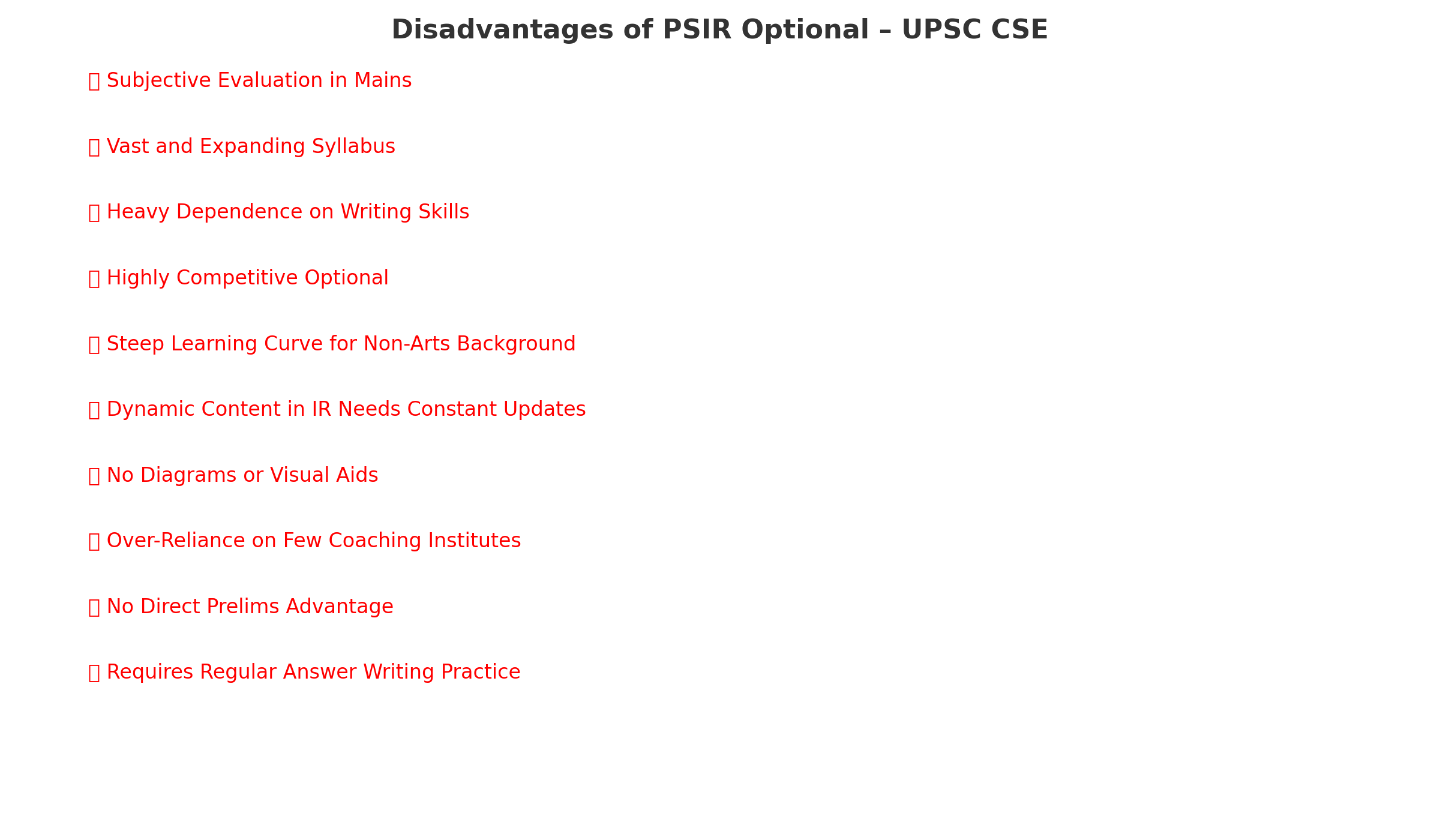
Disadvantages of PSIR Optional in UPSC CSE
Political Science and International Relations (PSIR) has long been considered a “safe” optional subject for the UPSC Civil Services Examination. With its overlap with General Studies, reputed teachers, and availability of resources, many aspirants consider it a first-choice optional. However, like any subject, PSIR comes with its own set of challenges and disadvantages that are often overlooked during the decision-making process.
This article highlights the less-talked-about cons of PSIR optional so that you can make a well-informed decision before investing your time and effort into this subject.
Sociology or Anthropology which is better optional
1. Subjectivity in Evaluation
One of the biggest drawbacks of PSIR is the inherent subjectivity in how answers are evaluated, especially in Paper 1 (Political Theory and Indian Politics). Unlike Mathematics or even optional subjects with defined models like Anthropology or Geography, PSIR answers often depend on:
- How well you argue your case
- How sophisticated your language is
- How balanced or “nuanced” your viewpoint appears
This subjectivity means that despite studying the same content, two aspirants may receive significantly different marks based on expression and articulation alone.
Best PSIR optional coaching online
Best teacher of PSIR optional for upsc
2. Vast Syllabus and Ever-Expanding Content
The PSIR syllabus is deceptively broad. While it’s true that the subject has four distinct sections, each segment is dense with theories, thinkers, events, and institutions. The overlap with General Studies gives a false sense of ease, but in reality:
- Paper 1 requires deep understanding of political philosophy and Indian political thought
- Paper 2 requires regular updates on evolving international relations and foreign policy
Students often find themselves overwhelmed trying to manage current developments in IR while also memorizing complex political ideologies like Marxism, Liberalism, and Feminism in Paper 1.
3. Heavy Dependence on Writing Skills
PSIR is a highly writing-intensive subject. Success is often dependent on:
- The ability to write fluidly under time pressure
- Use of quotes from thinkers like Hobbes, Rousseau, Gandhi, Ambedkar
- Building coherent arguments with multiple perspectives
Many aspirants—even those with good knowledge—struggle to put down their thoughts in a structured manner within 150–200 words per answer. The emphasis on presentation, balance, and value-adds like recent examples or quotes makes this subject very demanding in terms of writing practice.
4. Overcrowded Optional with Intense Competition
PSIR is one of the most popular optional subjects in UPSC. This has two consequences:
- Scaling might reduce individual advantage due to large number of average performances
- The subject is no longer a “hidden gem” — the bar is high
High competition also means that average answers are unlikely to fetch above-average marks. Aspirants need to demonstrate depth, contemporary relevance, and originality in answers — a challenge for many.
Graduation degree with IAS coaching
5. Low Utility for Some Backgrounds
Aspirants from engineering, medicine, or pure sciences often find PSIR difficult to relate to initially. With no formal exposure to abstract political theories or global diplomacy, many candidates find it hard to internalize concepts. For example:
- Understanding Hegelian Dialectics or Postmodernism may feel alien to someone with no humanities background
- IR theories like Realism, Constructivism, or Marxist interpretation of global order can feel abstract and disconnected
This learning curve can demotivate many non-arts students despite the supposed “popularity” of the subject.
6. Dynamic Portion Requires Constant Updates
Paper 2 (especially Section B on International Relations) requires you to stay updated on:
- Bilateral relations (e.g., India-US, India-China, India-Iran)
- Global groupings (e.g., BRICS, Quad, SCO)
- International treaties and evolving crises (Ukraine War, Indo-Pacific tensions, UN reforms)
This makes it hard to rely solely on static notes. Regular follow-up with The Hindu, ORF reports, MEA website, and analysis articles becomes necessary — increasing time pressure alongside General Studies preparation.
7. Lack of Diagrammatic Tools
Unlike Geography or even Anthropology, PSIR does not offer many tools like flowcharts, maps, or diagrams to make your answers visually appealing. Most content has to be written in long-form prose. This puts pressure on:
- Your language and grammar
- Your ability to summarize dense ideas quickly
Aspirants with weaker writing or slow composition speed find it difficult to attempt all 20 questions in 3 hours effectively.
8. Over-Reliance on a Few Coaching Institutes
PSIR coaching is dominated by a few big names, particularly in Delhi. While this can be advantageous for those who can access them, it becomes a challenge for:
- Students in remote or tier-3 towns
- Online learners who struggle with self-discipline or lack interaction
Moreover, many candidates end up using the same notes and keywords, making it harder to stand out in Mains evaluation. Without personalized mentorship, value-addition becomes difficult.
9. Mains-Heavy Subject with No Direct Prelims Benefit
PSIR offers almost no help in Prelims — unlike History, Geography, or Anthropology which have overlaps with GS Paper 1. Students need to prepare General Studies (Prelims) completely from scratch, making PSIR a Mains-centric investment.
Thus, the cost-benefit ratio needs to be carefully assessed, especially for first-attempt aspirants.
Best ias coaching in hindi medium
Bests mentorship programme for upsc
Best ias coaching in chandigarh
10. Requires Regular Answer Writing for Improvement
There is no shortcut to mastering PSIR. Even with the best notes, one must write 10–12 answers per week consistently for months to improve structure, balance, and time management. Without writing practice:
- Recall suffers
- Argument quality drops
- Speed lags during actual exam
This long gestation period is not suitable for every candidate, especially those with parallel jobs or family responsibilities.
Conclusion: Should You Choose PSIR as Your Optional?
PSIR remains a popular and rewarding optional subject. Many toppers in the last decade (like Tina Dabi, Junaid Ahmad, and Srushti Deshmukh) chose PSIR and succeeded. However, success depends on the depth of your preparation, not the popularity of the subject.
While PSIR offers overlap with GS, access to resources, and a good theoretical foundation for interviews, it also demands:
- Excellent writing skills
- Conceptual clarity
- Strong current affairs integration
- Endurance for a vast, nuanced syllabus
Choose PSIR if you enjoy reading political theory, global affairs, and can write well.
Avoid it if you want a subject that is more static, diagram-based, or scoring via exact answers (like Mathematics or Anthropology).
Ultimately, your passion, discipline, and answer-writing ability will determine your success — not the optional itself.
Choose wisely. Prepare diligently. And may your answers reflect both knowledge and wisdom.

- Women and Transgender Changemakers in Swachhata Mission - September 30, 2026
- चुनाव आयोग ने फॉर्म-6 से SIR घोषणा हटाई: UPSC-PCS के लिए महत्वपूर्ण बदलाव - September 30, 2026
- झारखंड डीजीपी नियुक्ति: सुप्रीम कोर्ट 9 अक्टूबर को सुनवाई, राज्य सरकार से जवाब तलब - September 30, 2026

No Comments