


18 Dec Discovery of Channa bhoi: Expanding the Frontiers of India’s Freshwater Biodiversity
This article covers “Daily Current Affairs” and From Discovery of Channa bhoi: Expanding the Frontiers of India’s Freshwater Biodiversity
SYLLABUS MAPPING
GS – 3 -Environment & Biodiversity – Discovery of Channa bhoi: Expanding the Frontiers of India’s Freshwater Biodiversity
FOR PRELIMS
Discuss the policy and governance implications of discovering new endemic freshwater species in India
FOR MAINS
Briefly discuss the ecological importance of apex predators in freshwater ecosystems.
Why in the News?
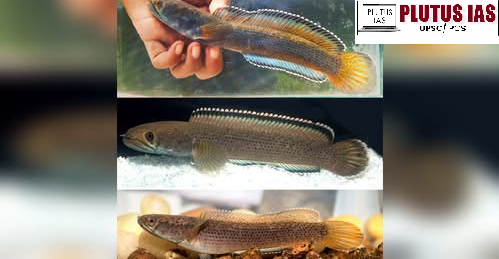
The identification of Channa bhoi, a new species of snakehead fish, underlines the rich but insufficiently explored freshwater biodiversity of India. At a time when inland aquatic ecosystems are under increasing pressure from human activity and climate change, such discoveries assume significance not only for taxonomy but also for ecological conservation, environmental governance and sustainable development.
Understanding Channa bhoi: Taxonomic and Biological Features
Place within the Channa Genus
- Belongs to the family Channidae, a group widely distributed across South and Southeast Asia.
- India hosts one of the highest diversities of snakehead fishes, reflecting varied freshwater habitats.
Adaptive Characteristics
- Air-breathing ability through a suprabranchial organ allows survival in oxygen-poor waters.
- High adaptability to wetlands, floodplains, slow-flowing rivers and swamps.
Evolutionary Importance
- Provides insights into speciation and adaptation in fragmented freshwater systems.
- Helps trace biogeographical evolution of inland fish species in the Indian subcontinent.
Ecological Significance of the Discovery
Role in Freshwater Food Webs: Snakeheads function as apex or meso-predators, regulating fish populations and maintaining trophic balance.
Indicator of Habitat Quality: Presence of diverse endemic species signals relatively intact freshwater ecosystems.
Ecosystem Services: Healthy fish diversity supports nutrient cycling, water quality regulation and ecosystem resilience.
Freshwater Biodiversity in India
Underexplored Ecosystems: Rivers, wetlands and floodplains receive less conservation focus compared to forests and wildlife.Many regions suffer from the taxonomic deficit (Linnaean shortfall).
Anthropogenic Pressures: Pollution, river regulation, sand mining and overfishing.Habitat fragmentation due to dams and embankments.
Climate Change Impacts: Altered flow regimes, rising water temperatures and extreme events affecting species survival.
Conservation Relevance of Species Discovery
Scientific Basis for Protection: Formal identification is a prerequisite for IUCN assessment and legal protection.
Strengthening Conservation Planning: Enables species-specific management strategies rather than generic ecosystem approaches.
Safeguarding Genetic Diversity: Conservation of endemic species preserves genetic resources crucial for long-term ecosystem stability.
Policy and Governance Dimensions
Alignment with Global Commitments: Supports India’s obligations under the Convention on Biological Diversity (CBD) and Kunming–Montreal Global Biodiversity Framework.
National Policy Linkages: Reinforces objectives of the National Biodiversity Action Plan and Wetlands (Conservation and Management) Rules.
Role of Institutions: Highlights the importance of Biodiversity Management Committees (BMCs) and State Biodiversity Boards.
Community and Livelihood Dimensions
Local Ecological Knowledge: Indigenous and local communities often possess detailed knowledge of freshwater species.
Livelihood Security: Sustainable fisheries support nutrition, income and rural livelihoods.
Participatory Conservation: Community involvement enhances monitoring, compliance and long-term conservation success.
Way Forward
Scientific and Research Measures: Expand systematic biodiversity surveys and taxonomic research. Promote interdisciplinary research linking ecology, hydrology and climate science.
Policy and Institutional Reforms: Integrate freshwater biodiversity explicitly into EIA processes. Improve coordination between environmental, fisheries and water resource agencies.
Conservation and Management Strategies: Protect critical habitats such as wetlands, floodplains and spawning grounds. Regulate pollution, sand mining and unsustainable fishing practices.
Community-Centric Approaches: Encourage co-management of aquatic resources with local communities. Promote awareness and capacity-building at the grassroots level.
Conclusion
The discovery of Channa bhoi is not merely a taxonomic milestone but a wake-up call for freshwater conservation in India. It underscores the need to shift attention towards inland aquatic ecosystems, strengthen biodiversity governance and adopt an integrated, people-centric conservation approach. Protecting such hidden biodiversity is essential for ecological balance, sustainable livelihoods and long-term environmental security.
Prelims question
Q. With reference to the recently discovered fish species Channa bhoi, consider the following statements:
1. It belongs to the snakehead fish genus Channa, which is native to South and Southeast Asia.
2. Snakehead fishes possess air-breathing capability, allowing them to survive in low-oxygen freshwater habitats.
3. The discovery of Channa bhoi highlights the rich but underexplored freshwater biodiversity of India.
Which of the statements given above are correct?
(A) 1 and 2 only
(B) 1 and 3 only
(C) 1, 2 and 3
(D) 2 and 3 only
Answer: C
Mains Question
Q. “The discovery of new freshwater species highlights both India’s rich biodiversity and the neglect of inland aquatic ecosystems.” Discuss with reference to Channa bhoi. (250 words)

- PRAGATI: A Decade of Cooperative, Outcome-Driven Governance - January 15, 2026
- Iran’s Large-Scale Protests: Political Stability, Public Dissent and Regional Implications - January 14, 2026
- India–Oman CEPA: A Strategic Trade Pact for Jobs, Exports and Regional Integration - January 10, 2026

No Comments