


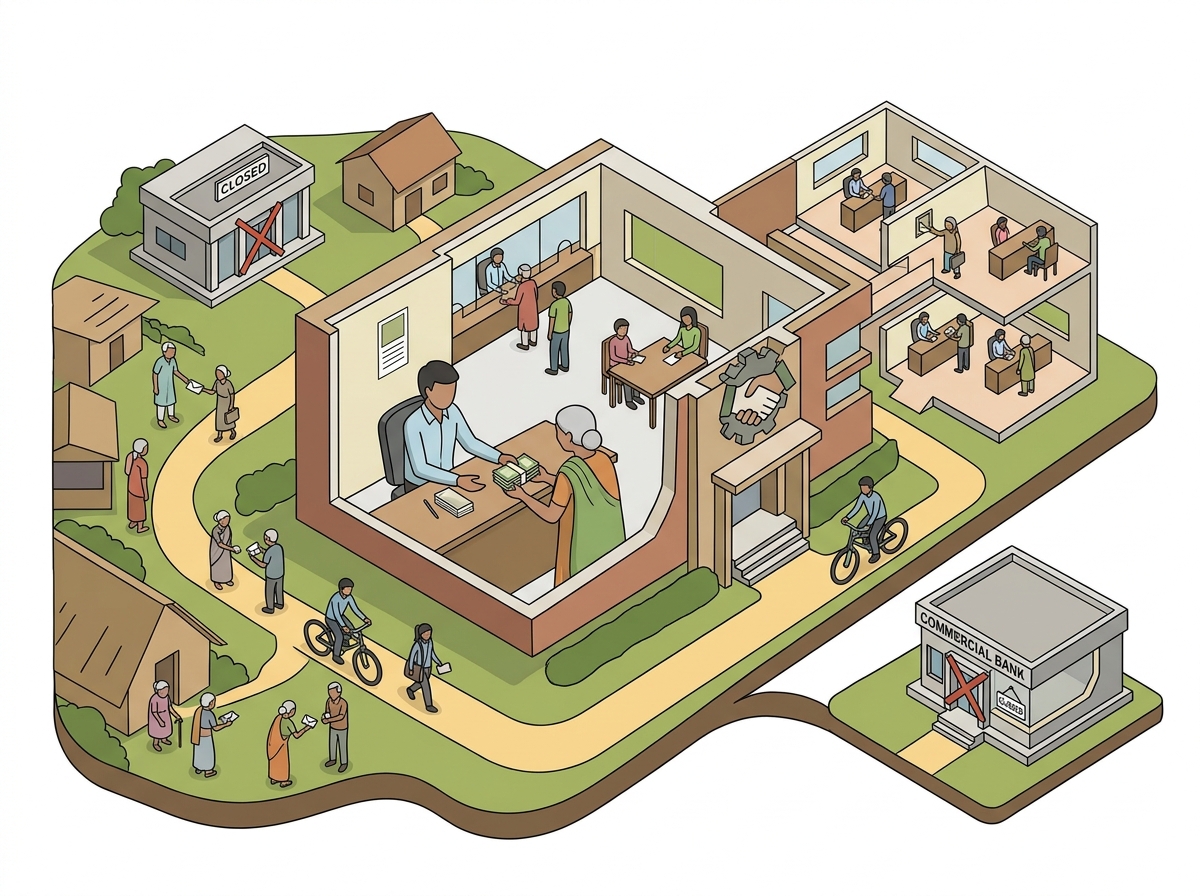
07 Aug Distribute welfare pensions only through cooperative banks: Kisan Janata
✎ Cooperative banks in India, particularly in states like Kerala, have historically ensured last-mile delivery of welfare pensions, but the shift to Aadhaar-linked commercial bank accounts risks marginalising elderly and vulnerable…
Subject Relevance — Where This Topic Fits
- GS Paper II — Welfare Schemes for Vulnerable Sections of the Population by the Centre and States and the Performance of these Schemes | GS Paper III — Indian Economy and Issues relating to Planning, Mobilisation of Resources, Growth, Development and Employment | GS Paper III — Role of Cooperative Societies in India’s Economic Development
- Prelims: Cooperative Banks, Direct Benefit Transfer (DBT), Aadhaar-enabled Payment System (AePS), Pradhan Mantri Kisan Samman Nidhi (PM-KISAN), Social Security Pensions, Rashtriya Janata Dal (RJD), Kerala State Cooperative Banks, Akshaya Centres
- Essay: The role of cooperative institutions in fostering inclusive growth and social justice, Efficiency vs. accessibility: The trade-offs in welfare delivery mechanisms
Quick Revision: Cooperative banks in India, particularly in states like Kerala, have historically ensured last-mile delivery of welfare pensions, but the shift to Aadhaar-linked commercial bank accounts risks marginalising elderly and vulnerable beneficiaries due to digital and infrastructural barriers.
Why is this in the news?
The Kisan Janata, an affiliate of the Rashtriya Janata Dal (RJD), has publicly opposed the Kerala government’s decision to disengage service cooperative banks from the distribution of social welfare pensions, advocating instead for the restoration of a cooperative-bank-mediated, doorstep delivery system. The organisation argues that the shift to Aadhaar-linked commercial bank accounts will disproportionately burden elderly and economically vulnerable beneficiaries, undermining the efficiency and inclusivity of the existing welfare architecture. This development underscores broader debates on institutional choice in welfare delivery, the operational constraints of cooperative banks, and the socio-economic implications of digital payment infrastructures in India.
Background
- The distribution of social welfare pensions in India has evolved from cash-based disbursements to digitally mediated systems, with the Direct Benefit Transfer (DBT) mechanism becoming the cornerstone of welfare delivery since 2013.
- Cooperative banks, particularly in states like Kerala, have historically played a pivotal role in rural and semi-urban financial inclusion, leveraging their grassroots presence to facilitate last-mile delivery of welfare benefits, including pensions.
- The Aadhaar-enabled Payment System (AePS) and Aadhaar-linked bank accounts have been integrated into pension disbursement frameworks to enhance transparency, reduce leakages, and streamline processes, though concerns persist regarding accessibility for marginalised groups.
- Kerala’s ‘Akshaya’ centres, a network of IT kiosks, have been utilised to bridge the digital divide in rural areas, offering services such as pension disbursement, digital literacy, and government-to-citizen transactions.
- The Rashtriya Janata Dal (RJD), a prominent political party in Bihar, has historically advocated for farmer-centric policies, including cooperative banking reforms, reflecting its alignment with rural socio-economic priorities.
- The debate reflects a broader tension between the efficiency gains of centralised digital systems and the socio-economic vulnerabilities of marginalised populations, particularly the elderly and those in remote areas.
What are Cooperative Banks and their Role in Welfare Delivery?
- Cooperative banks are financial institutions owned and operated by their members, governed by the Cooperative Societies Act, 1912, or respective state cooperative societies acts, and regulated by the Reserve Bank of India (RBI) under the Banking Regulation Act, 1949 (as applicable).
- They operate on the principles of mutual help, democratic control, and limited liability, with a primary focus on serving rural and semi-urban communities, thereby promoting financial inclusion.
- In India, cooperative banks are classified into three tiers: Primary Agricultural Credit Societies (PACS) at the village level, District Central Cooperative Banks (DCCBs) at the district level, and State Cooperative Banks (StCBs) at the state level, forming a hierarchical structure for rural credit delivery.
- Cooperative banks have been instrumental in disbursing welfare pensions, particularly in states like Kerala, where their extensive network ensures doorstep delivery, reducing the need for beneficiaries to travel to distant bank branches.
- The shift towards Aadhaar-linked commercial bank accounts and digital payment systems aims to enhance transparency and reduce leakages in welfare disbursements, aligning with the government’s broader Digital India and Direct Benefit Transfer (DBT) initiatives.
- However, the transition has raised concerns about the accessibility of digital infrastructure for elderly and economically backward populations, who may lack familiarity with digital payment systems or face challenges in accessing bank branches.
- The role of cooperative banks in welfare delivery is not merely financial but also socio-economic, as they often serve as community institutions that build trust and facilitate last-mile connectivity.
- The debate in Kerala exemplifies the broader challenge of balancing technological efficiency with social equity in welfare delivery mechanisms.
Key Features
| Feature | Significance |
|---|---|
| Doorstep pension delivery via cooperative banks | Ensures accessibility for elderly and economically disadvantaged beneficiaries, reducing transaction costs and physical hardship. |
| Aadhaar-linked commercial bank accounts for pension disbursement | Enhances transparency and reduces leakages in welfare distribution but may exclude beneficiaries without access to bank branches. |
| State government’s disengagement from cooperative banks | Aims to streamline pension distribution but risks disrupting an established, efficient delivery mechanism. |
| Long queues at Akshaya centres and commercial banks | Indicates systemic inefficiencies in digital payment infrastructure, particularly for rural and elderly populations. |
| Kisan Janata’s opposition to the policy change | Highlights the political and social dimensions of welfare delivery, emphasizing grassroots accountability. |
Why it Matters
Economic
- The shift to Aadhaar-linked commercial bank accounts may reduce administrative costs but could increase indirect costs for beneficiaries (e.g., travel, time loss).
- Cooperative banks often serve rural and marginalized communities, ensuring financial inclusion where commercial banks have limited reach.
- Pension disbursement efficiency directly impacts consumption demand in rural economies, influencing local economic cycles.
Social
- Elderly and economically backward beneficiaries face disproportionate hardship under the new system, exacerbating socio-economic inequalities.
- Doorstep delivery models through cooperative banks have historically improved trust in welfare schemes among rural populations.
- The policy change risks eroding public confidence in state-led welfare mechanisms if not accompanied by robust digital infrastructure.
Administrative
- The state’s decision reflects a broader trend toward digitalization of welfare delivery, aligning with national initiatives like Direct Benefit Transfer (DBT).
- However, administrative efficiency must be balanced with inclusivity, particularly for populations with limited digital literacy.
- The controversy underscores the need for inter-departmental coordination between social welfare, banking, and digital governance authorities.
Political
- Kisan Janata’s opposition highlights the role of farmers’ organizations in shaping welfare policies, particularly in agrarian states.
- The issue may influence electoral politics, as rural welfare delivery is a key determinant of voter behavior.
- The state government’s decision could face legal scrutiny if it is perceived as violating the Right to Life (Article 21) by excluding vulnerable groups.
Challenges
1. Digital Divide and Exclusion
- Beneficiaries without access to commercial banks or digital payment infrastructure face exclusion from welfare disbursement.
- Elderly populations may struggle with Aadhaar authentication and digital transactions, leading to disenfranchisement.
- Rural areas with poor internet connectivity or limited banking infrastructure are disproportionately affected.
UPSC Link: GS-II: Welfare Schemes
2. Inefficiency in Digital Payment Systems
- Long queues at Akshaya centres and bank branches indicate systemic bottlenecks in digital payment infrastructure.
- Lack of last-mile connectivity and digital literacy exacerbates delays and errors in pension disbursement.
- The state government’s reliance on Aadhaar-linked accounts assumes universal access, which is not uniformly true.
UPSC Link: GS-III: Science & Tech
3. Policy Discontinuity and Trust Erosion
- Frequent changes in welfare delivery mechanisms undermine public trust in state-led initiatives.
- Disengagement from cooperative banks risks alienating rural communities that rely on them for financial services.
- The policy shift may be perceived as prioritizing administrative efficiency over social equity.
UPSC Link: GS-II: Governance
4. Financial Exclusion of Marginalized Groups
- Economically backward beneficiaries, particularly women and elderly, may lack access to commercial banks or digital wallets.
- Cooperative banks often provide tailored financial services to rural populations, which commercial banks may not replicate.
- The shift could widen the financial inclusion gap, particularly in states with low banking penetration.
UPSC Link: GS-II: Social Justice
5. Legal and Constitutional Implications
- The policy change may violate the Right to Life (Article 21) if it leads to exclusion of vulnerable groups from essential welfare benefits.
- The state’s decision could face judicial review if it is deemed arbitrary or discriminatory.
- Constitutional principles of equality (Article 14) and non-discrimination (Article 15) may be implicated.
UPSC Link: GS-II: Fundamental Rights
Challenges — UPSC Perspective
| Issue | Concern |
|---|---|
| Digital literacy gaps | Beneficiaries lack skills to navigate Aadhaar-linked accounts and digital transactions. |
| Poor banking infrastructure in rural areas | Limited access to commercial banks forces beneficiaries to travel long distances. |
| Aadhaar authentication failures | Biometric mismatches or connectivity issues disrupt pension disbursement. |
| Elderly beneficiaries’ vulnerability | Physical and cognitive limitations hinder access to digital payment systems. |
| Trust deficit in state-led welfare mechanisms | Frequent policy changes erode public confidence in welfare delivery. |
| Inter-departmental coordination gaps | Lack of synergy between social welfare, banking, and digital governance authorities. |
Way Forward
- Conduct a pilot study to assess the impact of the new pension disbursement system on elderly and rural beneficiaries before full-scale implementation.
- Strengthen digital infrastructure in rural areas, including last-mile connectivity, banking correspondents, and digital literacy programs.
- Ensure interoperability between cooperative banks and commercial banks to maintain doorstep delivery options for vulnerable groups.
- Implement a grievance redressal mechanism with real-time monitoring to address delays or exclusions in pension disbursement.
- Expand the role of cooperative banks in welfare delivery by integrating them with Aadhaar-linked payment systems to ensure inclusivity.
- Conduct periodic audits of the new system to identify bottlenecks and ensure transparency in pension disbursement.
- Engage with farmers’ organizations like Kisan Janata to incorporate ground-level feedback into policy design and implementation.
UPSC Value Addition
Keywords for Mains Answer-Writing
Social welfare pensions · Aadhaar-enabled payment system · Cooperative banks · Doorstep delivery of welfare · Financial inclusion · Direct Benefit Transfer · Vulnerable sections of society · Kerala model of governance · Rashtriya Janata Dal · Agrarian distress · Pension disbursement mechanisms · Elderly and economically backward beneficiaries
Constitutional & Policy Linkages
- Article 21: Right to Life and Personal Liberty (welfare access as a component of dignified living).
- Article 14: Right to Equality (non-discriminatory welfare delivery).
- Article 15: Prohibition of Discrimination (protection for marginalized groups).
Concept Flow
State government disengages cooperative banks from pension disbursement → Transition to Aadhaar-linked commercial bank accounts → Elderly and rural beneficiaries face access barriers → Long queues and delays at Akshaya centres → Kisan Janata opposes the policy → Policy review and inclusivity concerns arise → Need for digital infrastructure and inter-departmental coordination.
Prelims Practice Questions
Q1. Consider the following statements regarding the Direct Benefit Transfer (DBT) mechanism in India:
1. DBT aims to transfer subsidies and welfare benefits directly to beneficiaries’ bank accounts.
2. The Aadhaar-enabled Payment System (AePS) is mandatory for all DBT transactions.
3. The system ensures 100% exclusion error in welfare delivery.
4. DBT has been widely adopted for the distribution of social welfare pensions.
How many of the above statements are correct?
- Only one
- Only two
- Only three
- All
Answer: Only three — Statements 1 and 4 are correct as DBT transfers welfare benefits directly to bank accounts and is used for pensions. Statement 2 is incorrect because AePS is not mandatory for all DBT transactions; it is an optional authentication method. Statement 3 is incorrect as DBT does not eliminate exclusion errors entirely.
Q2. Assertion (A): The Aadhaar-enabled Payment System (AePS) ensures financial inclusion by providing access to banking services to marginalised sections.
Reason (R): AePS allows beneficiaries to withdraw cash using Aadhaar authentication without the need for a physical bank account.
Options:
A. Both A and R are true, and R is the correct explanation of A.
B. Both A and R are true, but R is not the correct explanation of A.
C. A is true, but R is false.
D. A is false, but R is true.
Answer: ? — Assertion (A) is true as AePS facilitates financial inclusion by enabling cash withdrawals for those without traditional bank accounts. However, Reason (R) is false because AePS does not eliminate the need for a bank account; it merely allows authentication via Aadhaar for transactions within linked accounts.
Q3. Match the following welfare schemes with their respective implementing agencies:
Column I (Scheme) | Column II (Implementing Agency)
——————|—————————
A. MGNREGA | 1. Ministry of Rural Development
B. PM-KISAN | 2. Ministry of Agriculture and Farmers’ Welfare
C. Old Age Pension | 3. State Governments
D. Ayushman Bharat | 4. Ministry of Health and Family Welfare
Options:
A. A-1, B-2, C-3, D-4
B. A-2, B-1, C-4, D-3
C. A-3, B-2, C-1, D-4
D. A-1, B-3, C-2, D-4
- A
- B
- C
- D
Answer: A — MGNREGA is implemented by the Ministry of Rural Development (A-1). PM-KISAN is implemented by the Ministry of Agriculture and Farmers’ Welfare (B-2). Old Age Pension is typically implemented by State Governments (C-3). Ayushman Bharat is implemented by the Ministry of Health and Family Welfare (D-4).
Mains Practice Question
✍ The State government’s decision to disengage service cooperative banks from the distribution of social welfare pensions and transfer disbursements directly to Aadhaar-linked commercial bank accounts reflects a shift towards centralised, technology-driven welfare delivery. Critically examine the implications of this transition for financial inclusion, administrative efficiency, and the welfare of vulnerable sections. Also, analyse the constitutional and policy dimensions of such a move. (15 Marks)
Approach: MODEL-ANSWER SKELETON:
1. **Introduction (2 Marks)**: Define Direct Benefit Transfer (DBT) and its objectives under schemes like PM-KISAN, NSAP, and state-level pensions. Highlight the role of cooperative banks in grassroots financial inclusion.
2. **Financial Inclusion (3 Marks)**:
– Cooperative banks as last-mile delivery agents: their reach in rural and semi-urban areas.
– Aadhaar-enabled Payment System (AePS) and its limitations for elderly and marginalised groups.
– Risk of exclusion due to digital divide, lack of smartphones, and biometric authentication failures.
3. **Administrative Efficiency (3 Marks)**:
– DBT reduces leakages and pilferage but may increase transaction costs for beneficiaries.
– Cooperative banks provide doorstep delivery, reducing queues and hardships for elderly beneficiaries.
– Technology-driven systems require robust grievance redressal mechanisms.
4. **Welfare of Vulnerable Sections (3 Marks)**:
– Impact on elderly, differently-abled, and economically backward groups: reliance on intermediaries.
– Kerala’s model of cooperative banking as a case study in inclusive welfare delivery.
– Need for safeguards to prevent exclusion errors and ensure dignity in access.
5. **Constitutional and Policy Dimensions (4 Marks)**:
– **Constitutional**: Role of States vs. Union in welfare delivery (Article 246 read with Schedule VII).
– **Policy**: NITI Aayog’s recommendations on DBT and cooperative banks (e.g., NITI Aayog’s 2021 report on financial inclusion).
– **Judicial**: Supreme Court judgments on Aadhaar and welfare delivery (e.g., Justice K.S. Puttaswamy (2017) on proportionality and exclusion risks).
– **Federalism**: Centre-State coordination in welfare schemes and potential conflicts.
6. **Conclusion (2 Marks)**: Balance between technological efficiency and inclusive delivery. Recommend hybrid models (e.g., cooperative banks as last-mile partners in DBT) and robust grievance mechanisms.
Source: The Hindu
Generated by AanyaAi for educational purpose.

- Gujarat HC orders FIR in ITS officer’s 2023 custodial death - October 3, 2026
- डीआरआई ने मुंबई एयरपोर्ट पर सोने-हीरे की तस्करी गिरोह का किया पर्दाफाश, 8 गिरफ्तार - October 3, 2026
- Chhattisgarh CM Rural Bus Scheme: 850 Villages Connected in 1 Year - October 3, 2026

No Comments