


08 Aug DMK Moves SC Against Karnataka Over Cauvery Water Release: Key Facts for UPSC
✎ The Cauvery Water Disputes Tribunal’s award, as modified by the Supreme Court in 2018, allocates 177.25 TMC of water annually to Tamil Nadu, enforceable through the CWMA and CWRC under Article 262 of the Constitution.
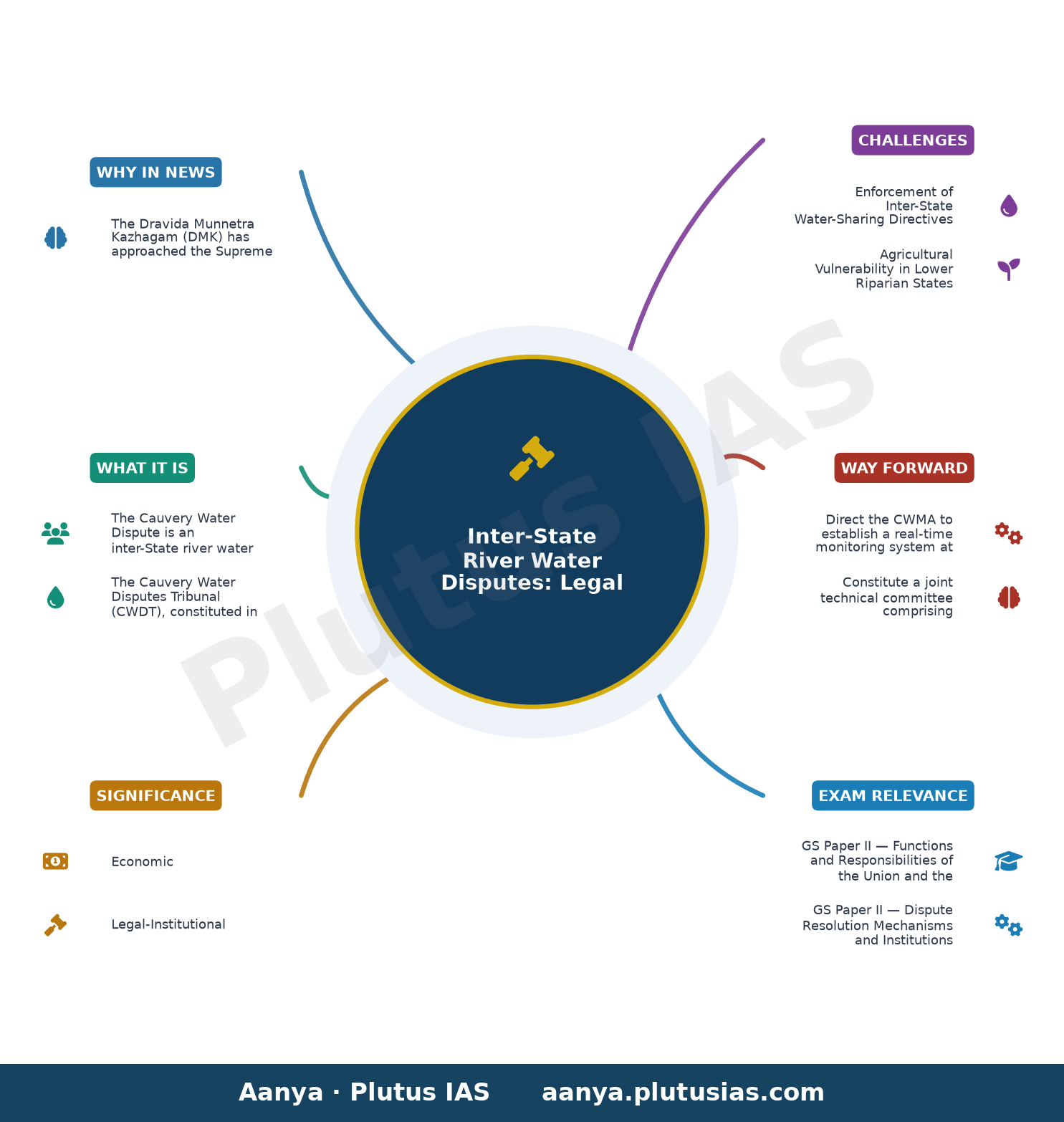
Subject Relevance — Where This Topic Fits
- GS Paper II — Functions and Responsibilities of the Union and the States, Issues and Challenges Pertaining to the Federal Structure, Devolution of Powers and Finances up to Local Levels | GS Paper II — Dispute Resolution Mechanisms and Institutions | GS Paper III — Conservation, Environmental Pollution and Degradation, Environmental Impact Assessment
- Prelims: Cauvery Water Disputes Tribunal (CWDT), Cauvery Water Management Authority (CWMA), Cauvery Water Regulation Committee (CWRC), Inter-State Water Disputes Act, 1956, Article 262 of the Constitution, Biligundlu inter-State contact point, cusecs, TMC (Thousand Million Cubic Feet), Mettur Dam, Kuruvai crop, Riparian rights
- Essay: Federalism in India: Balancing State Autonomy and National Integration, Environmental Governance and Sustainable Development: The Case of Inter-State River Disputes
Quick Revision: The Cauvery Water Disputes Tribunal’s award, as modified by the Supreme Court in 2018, allocates 177.25 TMC of water annually to Tamil Nadu, enforceable through the CWMA and CWRC under Article 262 of the Constitution.
Why is this in the news?
The Dravida Munnetra Kazhagam (DMK) has approached the Supreme Court seeking immediate intervention to enforce the release of Tamil Nadu’s statutory share of Cauvery water by Karnataka, as mandated by the Cauvery Water Regulation Committee (CWRC) and the Cauvery Water Management Authority (CWMA). The petition highlights Karnataka’s non-compliance with binding directions, the acute distress faced by Tamil Nadu’s agriculture-dependent communities, and the imminent loss of the kuruvai crop due to water scarcity. This development underscores the persistent challenges in inter-State water governance, the judicial role in resolving such disputes, and the socio-economic implications of delayed water releases in riparian states.
Background
- The Cauvery river basin is shared by Karnataka, Tamil Nadu, Kerala, and the Union Territory of Puducherry, with Karnataka and Tamil Nadu being the primary disputants over water allocation.
- The Cauvery Water Disputes Tribunal (CWDT), constituted in 1990 under the Inter-State Water Disputes Act, 1956, delivered its final award in 2007, allocating specific quantities of water to each basin state based on long-term averages and seasonal variations.
- The CWDT award was modified by the Supreme Court in 2018, which directed Karnataka to release 177.25 TMC of water annually to Tamil Nadu, including 14.75 TMC for environmental purposes, and upheld Karnataka’s share of 284.75 TMC.
- The Cauvery Water Management Authority (CWMA) and the Cauvery Water Regulation Committee (CWRC) were established in 2018 to implement the Tribunal’s award and monitor real-time water releases, respectively.
- The current dispute arises from Karnataka’s refusal to release the stipulated 3,500 cusecs per day at Biligundlu, citing deficient monsoon flows and internal water shortages, despite CWRC and CWMA directives.
- The non-release of water has exacerbated agricultural distress in Tamil Nadu’s delta districts, where the kuruvai crop is critical for livelihoods, with over 14.91 lakh acres and 10 million agricultural laborers dependent on Cauvery waters.
What is the Cauvery Water Dispute and its Legal Framework?
- The Cauvery Water Dispute is an inter-State river water sharing conflict between Karnataka and Tamil Nadu, with Kerala and Puducherry as other stakeholders, dating back to the 19th century but formalised under the Inter-State Water Disputes Act, 1956.
- The Cauvery Water Disputes Tribunal (CWDT), constituted in 1990, delivered its final award in 2007.
- The Supreme Court, in its 2018 judgment, upheld the Tribunal’s award but modified Karnataka’s share to 284.75 TMC and directed it to release 177.25 TMC to Tamil Nadu annually, including 14.75 TMC for environmental purposes.
- The Cauvery Water Management Authority (CWMA) was established in 2018 under the Ministry of Jal Shakti to implement the Tribunal’s award and ensure compliance with the Supreme Court’s directions.
- The Cauvery Water Regulation Committee (CWRC) functions under the CWMA to monitor real-time water releases at key inter-State contact points, such as Biligundlu, and to ensure adherence to the stipulated flows.
- The dispute resolution mechanism under Article 262 of the Constitution empowers the Parliament to enact laws to adjudicate inter-State water disputes, excluding the jurisdiction of courts under Article 262(2).
- The Inter-State Water Disputes Act, 1956, provides the legal framework for the constitution of Tribunals, their awards, and the enforcement of their decisions, though compliance remains a persistent challenge.
- The principle of ‘equitable apportionment’ guides inter-State water disputes, balancing the needs of upper and lower riparian states while considering historical usage, basin characteristics, and socio-economic factors.
Key Features
| Feature | Significance |
|---|---|
| Supreme Court intervention | Provides legal recourse to enforce inter-State water-sharing agreements under Article 131 of the Constitution. |
| Cauvery Water Regulation Committee (CWRC) | Statutory body constituted under the Inter-State River Water Disputes Act, 1956, to regulate water releases. |
| Cauvery Water Management Authority (CWMA) | Executive authority established to implement CWRC directives and ensure compliance. |
| Flow requirement at Biligundlu (3,500 cusecs/day) | Quantitative measure to ensure equitable distribution of Cauvery waters as per the 2007 Tribunal Award. |
| Backlog compensation (9.46 TMC) | Addresses cumulative shortfall in water releases, critical for agricultural sustainability in Tamil Nadu. |
Why it Matters
Economic
- Agricultural output in Tamil Nadu’s Cauvery delta, valued at over ₹20,000 crore annually, depends on timely water releases for the kuruvai (summer) crop.
- Failure to release water risks crop failure, displacing ~4 million farmers and ~10 million agricultural labourers, exacerbating rural distress.
- Non-compliance with water-sharing norms may trigger retaliatory agricultural policies, disrupting supply chains for rice, sugarcane, and other cash crops.
Legal-Institutional
- Reinforces the supremacy of the Cauvery Water Disputes Tribunal Award (2007) and subsequent CWRC/CWMA directives in resolving inter-State water disputes.
- Highlights the role of the Supreme Court in adjudicating disputes under Article 131, ensuring constitutional remedies for aggrieved States.
- Demonstrates the operational challenges in enforcing inter-State water-sharing agreements despite statutory and judicial backing.
Political-Social
- Exposes the tension between State-level political rhetoric (e.g., Karnataka’s public declarations) and constitutional obligations under water-sharing agreements.
- Underscores the socio-economic stakes for Tamil Nadu’s delta farmers, whose livelihoods are directly tied to Cauvery water availability.
- Raises questions about the efficacy of federal institutions (CWRC/CWMA) in mediating disputes amid political posturing.
Challenges
1. Enforcement of Inter-State Water-Sharing Directives
- Karnataka’s refusal to comply despite CWRC/CWMA directives, citing local water scarcity and political pressure.
- Lack of a robust monitoring mechanism to ensure real-time compliance with flow requirements at Biligundlu.
- Delays in judicial intervention, risking irreversible damage to standing crops in Tamil Nadu’s delta regions.
UPSC Link: GS-II: Federalism, Inter-State relations
2. Agricultural Vulnerability in Lower Riparian States
- Dependence of ~14.91 lakh acres on Mettur reservoir, whose inflows are contingent on Karnataka’s releases.
- Vulnerability of kuruvai crop to delayed water releases, threatening food security and rural employment.
- Absence of contingency plans for drought years, exacerbating farmer distress.
UPSC Link: GS-III: Agriculture, Water Resources
3. Institutional Efficacy of CWRC/CWMA
- Limited enforcement powers of CWRC/CWMA to override State-level resistance or political declarations.
- Lack of a unified basin-wide management strategy, leading to ad-hoc responses to water scarcity.
- Delays in dispute resolution due to bureaucratic and political bottlenecks.
UPSC Link: GS-II: Constitutional Bodies
4. Climate Variability and Water Scarcity
- Deficient southwest monsoon in 2026 reducing inflows into the Cauvery basin, intensifying inter-State disputes.
- Long-term climate projections indicating increased frequency of droughts, necessitating adaptive water management.
- Absence of integrated basin planning to mitigate the impact of climate change on water availability.
UPSC Link: GS-III: Environment, Climate Change
Challenges — UPSC Perspective
| Issue | Concern |
|---|---|
| Non-compliance by Karnataka | Political and administrative resistance to release Cauvery water despite judicial and statutory directives. |
| Agricultural distress in Tamil Nadu | Risk of crop failure, livelihood loss, and rural unemployment due to delayed water releases. |
| Institutional inefficacy | CWRC/CWMA’s limited powers to enforce compliance and resolve disputes expeditiously. |
| Climate-induced water scarcity | Reduced monsoon inflows exacerbating inter-State tensions and agricultural vulnerability. |
| Legal delays | Protracted judicial processes risking irreversible damage to standing crops and farmer livelihoods. |
Way Forward
- Direct the CWMA to establish a real-time monitoring system at Biligundlu to track water releases and ensure compliance with CWRC directives.
- Constitute a joint technical committee comprising representatives from Karnataka, Tamil Nadu, CWMA, and CWRC to assess basin-wide water availability and allocate releases dynamically.
- Enhance the enforcement powers of CWRC/CWMA by amending the Inter-State River Water Disputes Act, 1956, to include penalties for non-compliance.
- Develop a contingency plan for drought years, including water rationing, crop diversification, and alternative livelihood support for farmers.
- Strengthen basin-wide climate adaptation strategies, such as rainwater harvesting, groundwater recharge, and water-efficient irrigation techniques.
- Mandate the publication of quarterly compliance reports by States on water releases, with penalties for delays or non-compliance.
- Promote inter-State dialogue and confidence-building measures to reduce political posturing and foster cooperative federalism.
UPSC Value Addition
Keywords for Mains Answer-Writing
Inter-State river water disputes · Cauvery Water Management Authority (CWMA) · Cauvery Water Regulation Committee (CWRC) · Inter-State Water Disputes Act, 1956 · Biligundlu contact point · Distress sharing formula · Riparian rights · Inter-State Water Disputes Tribunal · Supreme Court’s constitutional jurisdiction · Agrarian distress and water scarcity · River basin management · Federalism and cooperative federalism
Constitutional & Policy Linkages
- Article 262: Adjudication of inter-State water disputes.
- Article 131: Original jurisdiction of the Supreme Court in disputes between States.
Concept Flow
Deficient southwest monsoon (2026) → Reduced inflows into Cauvery basin → Karnataka’s refusal to release water (political + local scarcity) → Tamil Nadu’s agricultural distress (kuruvai crop failure) → DMK files petition in Supreme Court → Supreme Court directs Karnataka to release 3,500 cusecs/day at Biligundlu → Enforcement challenges (CWRC/CWMA inefficacy) → Need for institutional reforms and climate adaptation.
Prelims Practice Questions
Q1. Consider the following statements regarding the Cauvery Water Management Authority (CWMA):
1. It was constituted under the Inter-State River Water Disputes Act, 1956.
2. It is empowered to implement and enforce the decisions of the Cauvery Water Regulation Committee (CWRC).
3. Its decisions are binding on the States of Karnataka, Tamil Nadu, Kerala, and Puducherry.
4. It has the power to suo motu initiate proceedings against any State for non-compliance.
How many of the above statements are correct?
- Only one
- Only two
- Only three
- All four
Answer: All four — Statements 1, 2, and 3 are correct. Statement 4 is incorrect as CWMA does not have suo motu powers; it acts on references or complaints from States.
Q2. Assertion (A): The Supreme Court of India has original jurisdiction to adjudicate disputes between States over the use of river waters.
Reason (R): Article 262 of the Constitution empowers Parliament to exclude the jurisdiction of courts in inter-State river water disputes.
Options:
A. Both A and R are true, and R is the correct explanation of A.
B. Both A and R are true, but R is not the correct explanation of A.
C. A is true, but R is false.
D. A is false, but R is true.
Answer: ? — Both A and R are true. The Supreme Court has original jurisdiction under Article 131 for disputes between States. Article 262 empowers Parliament to bar judicial review, but this does not negate the Supreme Court’s original jurisdiction.
Q3. Match the following institutions with their respective functions in the Cauvery water dispute:
Column I (Institution)
A. Cauvery Water Management Authority (CWMA)
B. Cauvery Water Regulation Committee (CWRC)
C. Inter-State Water Disputes Tribunal
D. Supreme Court of India
Column II (Function)
1. Constitutionally empowered to adjudicate disputes between States
2. Implements and enforces decisions of the Tribunal
3. Monitors daily water releases and compliance at Biligundlu
4. Constituted under the Inter-State River Water Disputes Act, 1956 to adjudicate disputes
- A-2, B-3, C-4, D-1
- A-3, B-2, C-1, D-4
- A-1, B-4, C-2, D-3
- A-4, B-1, C-3, D-2
Answer: A-2, B-3, C-4, D-1 — A-2 (CWMA implements Tribunal decisions), B-3 (CWRC monitors daily releases), C-4 (Tribunal constituted under the 1956 Act), D-1 (Supreme Court has original jurisdiction under Article 131).
Mains Practice Question
✍ The Cauvery Water Management Authority (CWMA) and the Cauvery Water Regulation Committee (CWRC) represent institutional mechanisms designed to resolve inter-State river water disputes. Critically examine the efficacy of these mechanisms in ensuring equitable water sharing between Karnataka and Tamil Nadu, with particular reference to the Supreme Court’s role in enforcing compliance. (15 Marks)
Approach: MODEL-ANSWER SKELETON:
1. **Institutional Framework**:
– Briefly explain the Inter-State River Water Disputes Act, 1956, and the constitutional basis for adjudication (Article 262 and Article 131).
– Define the roles of the Cauvery Water Disputes Tribunal (1990), its 2018 award, and the subsequent establishment of CWMA and CWRC under the Tribunal’s directions.
– Highlight the statutory powers of CWMA (Section 6A of the 1956 Act) and CWRC’s mandate to monitor daily releases at Biligundlu.
2. **Mechanisms for Equitable Sharing**:
– Explain the distress-sharing formula and the pro-rata allocation mechanism adopted by the Tribunal and enforced by CWMA/CWRC.
– Discuss the role of the Cauvery basin states’ dependence on monsoon variability and agricultural needs (e.g., Tamil Nadu’s delta agriculture vs. Karnataka’s upstream demands).
– Reference the July 2026 CWRC direction (3,500 cusecs/day) and the backlog of 9.46 TMC, linking to the current DMK petition.
3. **Supreme Court’s Role and Enforcement**:
– Examine the Supreme Court’s original jurisdiction (Article 131) and its power to issue directions (e.g., Cauvery Supervisory Committee’s role).
– Critique the efficacy of judicial enforcement: delays in Tribunal awards, non-compliance by States, and the Court’s intervention in 2018 and subsequent orders.
– Discuss the political economy of non-compliance (e.g., Karnataka’s public statements refusing release) and the limits of judicial coercion in federal disputes.
4. **Challenges and Critique**:
– **Federalism vs. Equity**: Argue that CWMA/CWRC mechanisms prioritise procedural compliance over substantive equity, often neglecting downstream agricultural needs.
– **Institutional Constraints**: Highlight the lack of suo motu powers for CWMA, dependence on State cooperation, and the absence of a permanent river basin authority.
– **Judicial Overreach vs. Necessity**: Assess whether the Supreme Court’s repeated interventions (e.g., 2018 order) are a corrective to institutional failures or an overreach into executive domain.
5. **Contemporary Context and Way Forward**:
– Link the current DMK petition to the broader issue of agrarian distress in Tamil Nadu’s delta districts and the failure of institutional mechanisms.
– Suggest reforms: empowering CWMA with suo motu powers, establishing a permanent Cauvery Basin Authority, or adopting a river basin management approach (e.g., National Water Policy 2020).
– Conclude with a balanced view: While CWMA/CWRC provide a framework, their efficacy is undermined by political resistance and institutional lacunae, necessitating stronger judicial and executive interventions.
Source: The Hindu
Generated by AanyaAi for educational purpose.

- बिहार सरकार का बड़ा फैसला: कारोबार शुरू करने में होगी आसानी, जानिए कैसे मिलेगा फायदा - September 23, 2026
- Bihar Launches Single Window Portal for 62 Business Services: UPSC & PCS Guide - September 23, 2026
- ग्रीनलैंड समझौता: अमेरिका को मिले अतिरिक्त रक्षा क्षेत्र, जानिए पूरा मामला - September 23, 2026

No Comments