


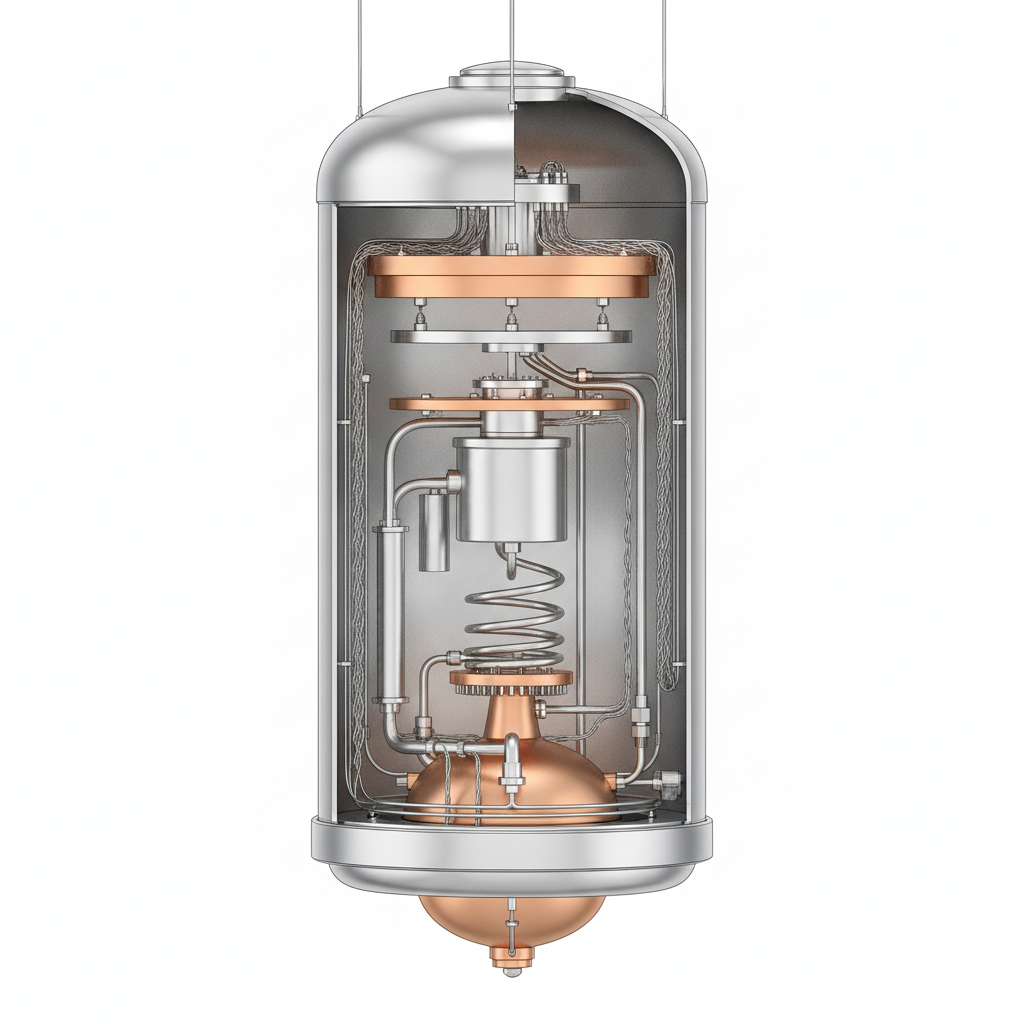
24 Sep DRDO Develops Indigenous 20 mK Dilution Refrigerator for Quantum Tech
✎ Dilution refrigerators are ultra-low temperature cryogenic systems essential for quantum technologies, and their indigenous development under the TDF Scheme marks a strategic step toward reducing import dependency and…
Subject Relevance — Where This Topic Fits
- GS Paper III — Science and Technology (Emerging Technologies, Defence Technology)
- Prelims: Dilution refrigerator, Cryogenics, Quantum computing, Defence Research and Development Organisation (DRDO), Technology Development Fund (TDF) Scheme, National Quantum Mission, Millikelvin temperature range, Cryogenic systems, Quantum applications, Strategic technology, Atmanirbhar Bharat, Startup ecosystem
- Essay: The role of indigenous innovation in securing strategic autonomy in critical technologies, Balancing technological self-reliance with global collaboration in emerging fields
Quick Revision: Dilution refrigerators are ultra-low temperature cryogenic systems essential for quantum technologies, and their indigenous development under the TDF Scheme marks a strategic step toward reducing import dependency and strengthening India’s quantum ecosystem.
Why is this in the news?
The Defence Research and Development Organisation (DRDO) has signed its first high-value deep-technology project agreement under the Technology Development Fund (TDF) Scheme with a startup, Zero MK India Private Limited, for the indigenous development of 20 millikelvin dilution refrigerators tailored for quantum applications. This initiative marks a significant milestone in India’s endeavour to build a self-reliant quantum ecosystem and reduce dependence on imported cryogenic infrastructure, aligning with the objectives of the National Quantum Mission (NQM).
Background
- The Technology Development Fund (TDF) Scheme, administered by DRDO, is a flagship programme under the Ministry of Defence aimed at fostering indigenous development of high-end defence technologies through collaboration with startups and MSMEs.
- Quantum technologies, including quantum computing, quantum communication, and quantum sensing, require ultra-low temperature environments (in the millikelvin range) for their operation and testing, necessitating advanced cryogenic systems like dilution refrigerators.
- Cryogenics, the science of producing and studying low-temperature phenomena, is a critical enabler for quantum technologies, superconductivity research, and advanced materials science.
- The indigenous development of dilution refrigerators aligns with the broader national agenda of Atmanbirbhar Bharat (Self-Reliant India) and reducing import dependency in strategic technologies.
- DRDO’s collaboration with startups under the TDF Scheme exemplifies the government’s push to integrate the defence industrial base with emerging technology ecosystems, fostering innovation and reducing time-to-market for critical technologies.
What is a Dilution Refrigerator and its Role in Quantum Technologies?
- A dilution refrigerator is a specialised cryogenic system designed to achieve and maintain ultra-low temperatures, typically in the millikelvin (mK) range (1 mK = 0.001 K), by utilising the principle of helium-3 and helium-4 mixture dilution.
- These refrigerators operate on the principle of adiabatic demagnetisation and dilution cooling, where a mixture of helium isotopes undergoes phase separation at temperatures below 0.8 K, enabling continuous cooling to sub-millikelvin levels.
- Dilution refrigerators are indispensable for quantum computing platforms, such as those based on superconducting qubits, trapped ions, or quantum dots, which require temperatures close to absolute zero to minimise thermal noise and enable coherent quantum operations.
- Beyond quantum computing, dilution refrigerators are critical for quantum communication systems, quantum sensors, and materials research, including studies of superconductivity, quantum Hall effects, and topological phases of matter.
- The 20 mK capacity of the indigenous dilution refrigerator being developed under this project ensures compatibility with state-of-the-art quantum technologies, including those envisaged under the National Quantum Mission.
- The development of such high-precision cryogenic systems underscores India’s capability to indigenously design, fabricate, and deploy advanced scientific instruments, reducing reliance on foreign suppliers for critical infrastructure.
- The project exemplifies the integration of defence research with civilian innovation, leveraging DRDO’s expertise in cryogenics and quantum technologies to support India’s broader scientific and industrial ecosystem.
Key Features
| Feature | Significance |
|---|---|
| Indigenous development of 20 mK dilution refrigerator | Reduces import dependence on critical cryogenic infrastructure for quantum applications |
| Technology Development Fund (TDF) Scheme under DRDO | Provides financial support for high-value deep-tech projects with start-ups and private sector |
| Partnership with Zero MK India Pvt Ltd | Leverages private sector innovation and accelerates commercialization of strategic technologies |
| Alignment with National Quantum Mission (NQM) | Supports India’s sovereign capability in quantum computing and allied technologies |
| Cryogenic systems operating at 20 millikelvin | Enables ultra-low temperature environments essential for quantum computing hardware and quantum sensors |
Why it Matters
Scientific and Technological
- Strengthens indigenous R&D capabilities in cryogenics, a high-precision engineering domain critical for quantum technologies
- Establishes India’s self-reliance in manufacturing ultra-low temperature refrigeration systems, a key enabler for quantum computing platforms
- Facilitates the development of quantum-ready infrastructure within the country, reducing reliance on foreign suppliers for specialized equipment
Strategic and Defence
- Enhances strategic autonomy in quantum technologies, which have dual-use applications in defence, communications, and computing
- Reduces vulnerabilities associated with import restrictions or supply chain disruptions in critical defence technologies
- Supports the integration of quantum sensors and quantum computing into defence systems for secure communications and advanced sensing
Economic and Industrial
- Promotes collaboration between DRDO, start-ups, and private industry, fostering a robust ecosystem for deep-tech innovation
- Encourages investment in high-technology manufacturing, potentially leading to job creation and export opportunities in niche sectors
- Demonstrates the scalability of TDF scheme in funding high-risk, high-reward technological projects
Policy and Governance
- Demonstrates the efficacy of mission-mode approaches (e.g., National Quantum Mission) in achieving technological sovereignty
- Showcases the role of public-private partnerships in advancing strategic technologies under government oversight
- Highlights the importance of targeted funding mechanisms (TDF) in bridging the valley of death for deep-tech start-ups
Challenges
1. Technological Complexity in Cryogenics
- Achieving and maintaining temperatures as low as 20 millikelvin requires precision engineering and advanced materials science
- Cryogenic systems demand stringent thermal insulation, vibration control, and long-term operational stability
- Scalability of laboratory prototypes to industrial-grade systems poses significant engineering challenges
UPSC Link: GS-III: Science & Tech
2. Funding and Risk Mitigation
- High capital expenditure and long gestation periods in deep-tech projects deter private investment without government support
- Ensuring sustained funding and risk-sharing mechanisms to prevent project abandonment due to technical or financial hurdles
- Balancing public investment with expected returns in strategic but non-revenue-generating technologies
UPSC Link: GS-III: Investment Models
3. Talent and Skill Development
- Shortage of specialized workforce in cryogenics, quantum physics, and ultra-low temperature engineering
- Need for interdisciplinary training programs to bridge gaps between academia, industry, and defence R&D
- Retention of skilled personnel in high-technology sectors amid global competition for talent
UPSC Link: GS-II: Skill Development
4. Regulatory and Standardization Hurdles
- Lack of domestic standards for cryogenic equipment and quantum hardware, necessitating alignment with international benchmarks
- Complexity in obtaining certifications for strategic technologies due to dual-use nature and export controls
- Ensuring compliance with safety and environmental regulations in handling cryogenic fluids
UPSC Link: GS-II: Regulatory Framework
5. Supply Chain and Infrastructure Bottlenecks
- Dependence on imported raw materials and components for high-precision cryogenic systems
- Limited domestic manufacturing capacity for specialized materials like superconductors and thermal insulators
- Need for dedicated cryogenic testing and validation infrastructure
UPSC Link: GS-III: Industrial Policy
Challenges — UPSC Perspective
| Issue | Concern |
|---|---|
| Precision Engineering | Maintaining 20 mK temperature stability over extended periods |
| Cost Overruns | High initial investment and long payback periods in deep-tech projects |
| Talent Shortage | Insufficient domestic expertise in cryogenics and quantum engineering |
| Regulatory Compliance | Navigating dual-use technology controls and export restrictions |
| Supply Chain Gaps | Reliance on imported critical components and materials |
| Scalability | Transitioning from prototype to mass production of cryogenic systems |
Government Initiatives — Must-Memorise for Prelims
- Technology Development Fund (TDF) Scheme
Way Forward
- Strengthen interdisciplinary research collaborations between DRDO, academic institutions, and private sector in cryogenics and quantum technologies
- Expand the scope of TDF scheme to include more high-risk, high-reward projects in strategic domains
- Establish dedicated centres of excellence for cryogenics and quantum technologies with state-of-the-art infrastructure
- Develop indigenous standards and certification frameworks for cryogenic systems to ensure quality and safety
- Promote skill development programs in partnership with IITs, NITs, and industry to address talent shortages
- Encourage public-private partnerships to scale up indigenous manufacturing of critical components
- Integrate quantum-ready infrastructure into national defence and civilian applications to maximize utility
- Monitor and evaluate the impact of TDF-funded projects to refine funding mechanisms and policy support
UPSC Value Addition
Keywords for Mains Answer-Writing
Defence Research and Development Organisation (DRDO) · Technology Development Fund (TDF) Scheme · Quantum Applications · Dilution Refrigerator · Cryogenic Systems · National Quantum Mission (NQM) · Self-reliance in Defence Technology · Deep-Technology Start-ups · Strategic Technologies · Cryogenic Infrastructure
Concept Flow
National Quantum Mission (NQM) identifies strategic need for indigenous cryogenic infrastructure → DRDO’s Technology Development Fund (TDF) Scheme provides financial and technical support for deep-tech projects → Partnership with Zero MK India Pvt Ltd leverages private sector innovation for 20 mK dilution refrigerator development → Indigenous development of cryogenic systems reduces import dependence and strengthens strategic autonomy → Deployment of quantum-ready infrastructure enables advancements in quantum computing, sensing, and communications → Enhanced technological sovereignty contributes to national security, economic growth, and global competitiveness
Prelims Practice Questions
Q1. Consider the following statements regarding the Technology Development Fund (TDF) Scheme:
1. The TDF Scheme is administered by the Defence Research and Development Organisation (DRDO).
2. It aims to promote indigenous development of defence technologies.
3. The scheme exclusively funds projects initiated by government agencies.
4. The TDF Scheme was introduced under the aegis of the National Quantum Mission.
How many of the above statements are correct?
- Only one
- Only two
- Only three
- All
Answer: Only three — Statements 1 and 2 are correct as the TDF Scheme is administered by DRDO and promotes indigenous defence technology development. Statement 3 is incorrect as the scheme funds projects initiated by start-ups and private entities alongside government agencies. Statement 4 is incorrect as the TDF Scheme is independent of the National Quantum Mission, though aligned with its objectives.
Q2. Assertion (A): A dilution refrigerator is a cryogenic system capable of achieving temperatures as low as 20 millikelvin.
Reason (R): Such ultra-low temperatures are essential for the operation and testing of quantum computing platforms.
Code:
A. Both A and R are true, and R is the correct explanation of A.
B. Both A and R are true, but R is NOT the correct explanation of A.
C. A is true, but R is false.
D. A is false, but R is true.
- A
- B
- C
- D
Answer: A — Both Assertion (A) and Reason (R) are true. A dilution refrigerator is indeed a cryogenic system capable of achieving temperatures as low as 20 millikelvin, and such ultra-low temperatures are critical for quantum computing platforms. R correctly explains A.
Q3. Match the following pairs related to strategic technologies and their applications:
Column I (Technology) | Column II (Application)
— | —
1. Dilution Refrigerator | A. Quantum Computing
2. Cryogenic Systems | B. Superconductivity Research
3. Quantum Sensors | C. Precision Navigation
4. Quantum Communication | D. Secure Data Transmission
Select the correct match:
- 1-A, 2-B, 3-C, 4-D
- 1-B, 2-A, 3-D, 4-C
- 1-A, 2-B, 3-D, 4-C
- 1-D, 2-C, 3-B, 4-A
Answer: 1-A, 2-B, 3-C, 4-D — 1-A: Dilution refrigerators are used in quantum computing to achieve ultra-low temperatures. 2-B: Cryogenic systems enable superconductivity research. 3-D: Quantum sensors are used in precision navigation. 4-C: Quantum communication enables secure data transmission.
Mains Practice Question
✍ The indigenous development of a 20 millikelvin dilution refrigerator under the Technology Development Fund (TDF) Scheme represents a significant milestone in India’s strategic technology landscape. Critically examine the significance of this achievement for India’s defence preparedness and technological self-reliance. Also, analyse how this aligns with the objectives of the National Quantum Mission (NQM). (15 Marks)
Approach: MODEL-ANSWER SKELETON:
1. **Strategic Significance of Cryogenic Systems in Defence** (3 Points)
– Role of ultra-low temperature systems in quantum computing, superconductivity, and secure communications.
– Relevance to India’s defence modernisation (e.g., quantum radar, secure communication networks).
– Comparison with global standards (e.g., US, China, EU) in cryogenic infrastructure.
2. **Indigenous Development and Self-Reliance** (4 Points)
– Explanation of the Technology Development Fund (TDF) Scheme: objectives, funding (₹500 crore corpus), and mandate.
– Importance of public-private partnerships (DRDO + Zero MK India Pvt Ltd) in deep-tech innovation.
– Reduction in import dependence for critical defence technologies.
– Potential for spin-offs in civilian sectors (e.g., medical imaging, space applications).
3. **Alignment with National Quantum Mission (NQM)** (4 Points)
– NQM’s goals: quantum computing, quantum communication, quantum sensing, and quantum materials.
– How dilution refrigerators enable quantum computing platforms (e.g., superconducting qubits).
– Synergy with other NQM initiatives (e.g., quantum communication networks, quantum sensors).
– Contribution to India’s goal of becoming a global leader in quantum technologies.
4. **Challenges and Future Roadmap** (4 Points)
– Technical challenges: achieving and maintaining millikelvin temperatures, scalability, and reliability.
– Institutional challenges: need for R&D infrastructure, skilled manpower, and sustained funding.
– Policy measures: integration with Make in India, Defence Production Policy, and international collaborations.
– Long-term vision: building a quantum-ready ecosystem and positioning India as a net exporter of quantum technologies.
Balance of Views:
– Optimistic: India’s progress in deep-tech innovation and strategic autonomy.
– Cautious: Need for sustained investment, interdisciplinary collaboration, and global competitiveness.
Source: PIB (Press Information Bureau)
Generated by AanyaAi for educational purpose.
Related guides on our sites
- Anthropology VS PSIR
- Best PSIR optional coaching
- Best PSIR optional coaching online
- Best PSIR optional teacher

- DRDO Develops Indigenous 20 mK Dilution Refrigerator for Quantum Tech - September 24, 2026
- भारत-आसियान व्यापार 128 अरब डॉलर तक पहुंचा, जानिए क्या हुआ 14वें पूर्वी एशिया शिखर सम्मेलन में - September 24, 2026
- UPSC Focus: India’s Role in 14th EAS & 23rd ASEAN-India Economic Meetings - September 24, 2026

No Comments