


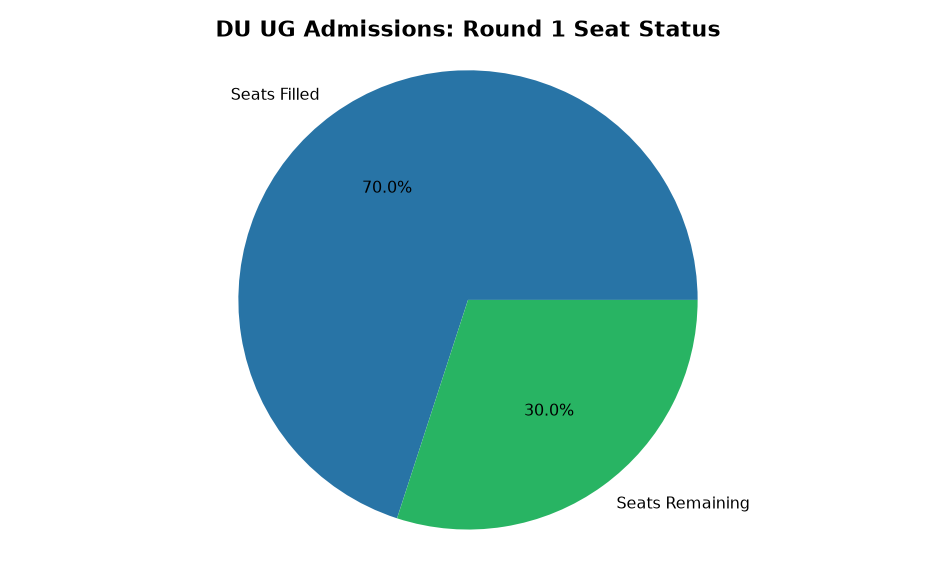
19 Jul DU Admissions 2026: 70% UG Seats Filled in Round 1, Implications for Aspirants
Subject Relevance — Where This Topic Fits
- GS Paper II — Social Justice: Issues relating to development and management of Social Sector/Services relating to Education, Human Resources. | GS Paper I — Social Empowerment. | GS Paper III — Indian Economy and issues relating to planning, mobilization of resources, growth, development and employment.
- Prelims: Common University Entrance Test (CUET), National Education Policy (NEP) 2020, Gross Enrolment Ratio (GER), Delhi University (DU) Admissions, Higher Education Financing Agency (HEFA), National Institutional Ranking Framework (NIRF), Affirmative Action, Skill India Mission, Digital India initiatives in education, Academic Bank of Credits (ABC)
- Essay: The Paradox of Merit: Access vs. Excellence in Indian Higher Education, Education as an Equalizer: Bridging Divides in a Competitive Landscape
Quick Revision: The intense competition for university admissions underscores the critical need for comprehensive reforms in India’s higher education system, focusing on capacity expansion, quality enhancement, and equitable access in line with NEP 2020 objectives.
Why is this in the news?
The recent news from Delhi University (DU) highlights a critical juncture in India’s higher education system, with nearly 70% of undergraduate seats filled in the first admission round for the 2026-27 academic session. This rapid uptake, particularly in popular courses like B.Com, Political Science, English Honours, and History Honours, underscores intense competition and limited availability for subsequent rounds. Concurrently, student protests by organisations like ABVP and KYS demanding an increase in seats for one-year postgraduate courses further illuminate systemic pressures concerning access and capacity in higher education institutions.
Background
- India possesses one of the largest higher education systems globally, comprising over 1,000 universities and 40,000 colleges, catering to millions of students.
- The National Education Policy (NEP) 2020 aims to increase the Gross Enrolment Ratio (GER) in higher education to 50% by 2035, from the current 27.3% (2019-20).
- The introduction of the Common University Entrance Test (CUET) from the 2022-23 academic session aimed to provide a single window opportunity for students to seek admission in participating universities across the country, reducing the burden of multiple entrance examinations.
- Delhi University, a premier central university, annually attracts a massive influx of applicants, making its admission process highly competitive and often a bellwether for national trends.
- The demand-supply gap in quality higher education institutions often leads to intense competition, particularly for popular courses in well-regarded universities.
- Affirmative action policies, including reservations for Scheduled Castes (SC), Scheduled Tribes (ST), Other Backward Classes (OBC), Economically Weaker Sections (EWS), and Persons with Disabilities (PwD), are integral to ensuring equitable access to higher education.
Understanding India’s Higher Education Admission Landscape
- **Central University Entrance Test (CUET):** A computer-based test introduced by the Ministry of Education for admission into all Undergraduate (UG) programmes in Central Universities and other participating institutions. It aims to standardise the admission process and reduce the burden on students.
- **Gross Enrolment Ratio (GER):** A statistical measure used in the education sector to determine the number of students enrolled in a given level of education (e.g., higher education) as a percentage of the population in the relevant age group. India’s target is 50% by 2035.
- **National Education Policy (NEP) 2020:** A comprehensive framework for the development of education in India, covering school education to higher education. Key reforms include multidisciplinary education, flexibility in course choices, vocational education integration, and increased GER.
- **Reservation Policies:** Constitutional provisions and legislative enactments ensure equitable access to education for historically disadvantaged groups, including SC, ST, OBC, EWS, and PwD, by reserving a certain percentage of seats.
- **Academic Bank of Credits (ABC):** A digital repository of academic credits earned by students, allowing for flexibility in pursuing education across different institutions and disciplines, facilitating credit transfer and multiple entry/exit options.
- **Funding Mechanisms:** Government funding, grants from bodies like UGC, and institutions like HEFA (Higher Education Financing Agency) play a crucial role in supporting infrastructure development, research, and faculty salaries in higher education institutions.
- **Quality Assurance:** Bodies like the National Assessment and Accreditation Council (NAAC) and the National Board of Accreditation (NBA) are responsible for assessing and accrediting higher education institutions and programmes, ensuring quality standards.
Key Features
| Feature | Significance |
|---|---|
| CUET Implementation | Standardises admission, reduces multiple exam burden, promotes pan-India access. |
| NEP 2020 Reforms | Aims for holistic, multidisciplinary education, increased GER, and skill development. |
| Reservation Policies | Ensures social equity and inclusive access for historically disadvantaged communities. |
| Demand-Supply Imbalance | Highlights the need for increased capacity and quality institutions to meet student aspirations. |
| Digitalisation of Admissions | Enhances transparency, efficiency, and accessibility of the admission process. |
| Student Protests | Indicates unmet demand for specific courses, particularly postgraduate, and calls for policy intervention. |
Why it Matters
Social Equity and Inclusion
- Reservation policies, enshrined in the Constitution, aim to correct historical injustices and ensure representation of marginalised communities (SC, ST, OBC, EWS, PwD) in higher education, fostering social mobility.
- Equitable access to quality education is a cornerstone of social justice, enabling individuals from diverse backgrounds to participate meaningfully in national development.
- The intense competition for limited seats, however, can exacerbate existing inequalities if not managed with robust support systems for vulnerable groups.
Human Capital Development
- A well-educated populace is fundamental to a nation’s economic growth and innovation. Higher education equips individuals with critical thinking, specialised skills, and research capabilities.
- Addressing the demand-supply gap in higher education is crucial for harnessing India’s demographic dividend, transforming its large youth population into a productive workforce.
- The focus on multidisciplinary education and vocational training under NEP 2020 aims to produce graduates who are industry-ready and adaptable to evolving economic landscapes.
Economic Implications
- The higher education sector is a significant contributor to the economy, generating employment, fostering research and development, and attracting international students.
- Investment in higher education yields long-term economic benefits through increased productivity, innovation, and global competitiveness.
- The financial burden of higher education, coupled with limited seats, can lead to brain drain or underemployment if quality education and relevant job opportunities are not adequately matched.
Governance and Policy Reforms
- The implementation of CUET and NEP 2020 reflects a concerted effort by the government to streamline and modernise the education system, making it more flexible, accessible, and aligned with global standards.
- The challenges highlighted by the DU admissions process underscore the need for continuous policy evaluation, capacity expansion, and resource allocation to meet the growing aspirations of students.
- Effective governance in higher education is vital for maintaining academic standards, ensuring transparency in admissions, and fostering an environment conducive to learning and research.
Challenges
1. Limited Capacity and Infrastructure
- Many premier institutions face severe capacity constraints, leading to high cut-offs and intense competition for limited seats.
- Infrastructure development, including classrooms, laboratories, libraries, and faculty housing, often lags behind the increasing student enrolment, impacting quality of education.
UPSC Link: GS II: Issues relating to development and management of Social Sector/Services relating to Education
2. Quality vs. Quantity Dilemma
- The rapid expansion of higher education institutions has sometimes come at the cost of quality, with concerns about faculty shortages, outdated curricula, and inadequate research facilities.
- Maintaining high academic standards while simultaneously increasing the Gross Enrolment Ratio (GER) poses a significant policy challenge.
UPSC Link: GS II: Human Resources
3. Regional Disparities and Access
- Access to quality higher education remains uneven across different regions of India, with urban centres often having better institutions and opportunities compared to rural areas.
- Digital divide and lack of internet access in remote areas can hinder participation in online admissions processes and access to digital learning resources.
UPSC Link: GS II: Social Justice
4. Faculty Shortages and Quality
- Many institutions suffer from a shortage of qualified faculty, particularly at the senior levels, impacting teaching quality and research output.
- Attracting and retaining high-quality faculty requires competitive salaries, research grants, and a conducive academic environment, which are often lacking.
UPSC Link: GS II: Human Resources
5. Curriculum Relevance and Employability
- A significant concern is the mismatch between the skills imparted by higher education institutions and the demands of the job market, leading to graduate unemployment.
- Curriculum updates are often slow, failing to incorporate emerging technologies and industry requirements, making graduates less competitive.
UPSC Link: GS III: Indian Economy and issues relating to employment
6. Financing Higher Education
- Funding for higher education remains a critical challenge, with institutions often reliant on government grants and student fees.
- The Higher Education Financing Agency (HEFA) aims to address this, but sustained investment is needed for infrastructure, research, and faculty development.
UPSC Link: GS III: Mobilization of resources
Challenges — UPSC Perspective
| Issue | Concern |
|---|---|
| High Competition for Seats | Leads to stress among students, potential for unfair practices, and limited access for many. |
| Demand-Supply Mismatch | Insufficient number of quality institutions and seats to cater to the growing student population. |
| Quality of Education | Concerns about faculty shortages, outdated curricula, and inadequate infrastructure in some institutions. |
| Regional Imbalances | Uneven distribution of quality higher education opportunities across states and rural-urban divide. |
| Employability of Graduates | Gap between academic skills and industry requirements, leading to graduate unemployment. |
| Funding Constraints | Limited financial resources for infrastructure development, research, and faculty remuneration. |
Government Initiatives — Must-Memorise for Prelims
- National Education Policy (NEP) 2020
- Common University Entrance Test (CUET)
- Pradhan Mantri Kaushal Vikas Yojana (PMKVY)
- Higher Education Financing Agency (HEFA)
- National Institutional Ranking Framework (NIRF)
- Study Webs of Active Learning for Young Aspiring Minds (SWAYAM)
- National Digital Library of India (NDLI)
- Scheme for Promotion of Academic and Research Collaboration (SPARC)
- Rashtriya Uchchatar Shiksha Abhiyan (RUSA)
- Academic Bank of Credits (ABC)
Way Forward
- **Capacity Expansion:** Strategically increase the number of seats in existing high-demand courses and establish new institutions, especially in underserved regions, through public-private partnerships.
- **Curriculum Modernisation:** Regularly update curricula to align with industry demands, integrate interdisciplinary approaches, and promote vocational and skill-based education as envisioned by NEP 2020.
- **Faculty Development:** Invest in recruiting, training, and retaining high-quality faculty through competitive remuneration, research grants, and professional development opportunities.
- **Leveraging Technology:** Expand the use of digital platforms for admissions, online learning (e.g., SWAYAM), and administrative processes to enhance accessibility, transparency, and efficiency.
- **Enhanced Funding:** Increase public expenditure on higher education, explore innovative financing models, and encourage philanthropic contributions and industry collaboration to bolster resources.
- **Quality Assurance and Accreditation:** Strengthen regulatory bodies like NAAC and NBA to ensure rigorous quality standards, promote accreditation, and foster a culture of continuous improvement in institutions.
- **Counselling and Guidance:** Implement robust career counselling and guidance services at the school level to help students make informed choices about higher education and career paths.
- **Promoting Research and Innovation:** Create an ecosystem that encourages cutting-edge research, innovation, and entrepreneurship within universities, linking academic pursuits with societal and industrial needs.
UPSC Value Addition
Keywords for Mains Answer-Writing
Higher Education Reforms · NEP 2020 Implementation · CUET Impact · Access and Equity · Quality Education · Employability Skills · Capacity Building · Digitalisation in Education · Human Capital Development · Social Justice · Funding Mechanisms · Regional Disparities
Constitutional & Policy Linkages
- **Article 21A:** Right to Education (for elementary education, but foundational to higher education access).
- **Article 45:** Provision for early childhood care and education to children below the age of six years (Directive Principle, indirectly influencing future educational trajectory).
- **Article 46:** Promotion of educational and economic interests of Scheduled Castes, Scheduled Tribes and other weaker sections (Directive Principle, directly supporting reservation policies).
- **Seventh Schedule (List I, Union List, Entry 66):** Coordination and determination of standards in institutions for higher education or research and scientific and technical institutions.
- **Seventh Schedule (List III, Concurrent List, Entry 25):** Education, including technical education, medical education and universities, subject to the provisions of entries 63, 64, 65 and 66 of List I.
- **National Education Policy (NEP) 2020:** A comprehensive policy framework, not a constitutional article, but a significant legislative and executive initiative guiding education reforms.
Concept Flow
High Student Aspirations → Limited Seats in Premier Institutions → Intense Competition (CUET) → Rapid Seat Filling (DU Example) → Demand for Capacity Expansion → Policy Interventions (NEP 2020) → Improved Access and Quality
Prelims Practice Questions
Q1. Consider the following statements regarding the Common University Entrance Test (CUET):
1. CUET is mandatory for admission to all undergraduate programs in all universities across India.
2. The National Education Policy (NEP) 2020 advocates for a single entrance examination for university admissions.
3. CUET aims to reduce the burden of multiple entrance examinations on students.
Which of the statements given above is/are correct?
- 1 and 2 only
- 2 and 3 only
- 3 only
- 1, 2 and 3
Answer: 2 and 3 only — Statement 1 is incorrect; CUET is mandatory for Central Universities and other participating institutions, not all universities across India. Statement 2 is correct; NEP 2020 indeed recommended a common entrance test. Statement 3 is correct; a primary objective of CUET is to simplify the admission process by reducing the need for multiple exams.
Q2. Which of the following is NOT a primary objective of the National Education Policy (NEP) 2020 in the context of higher education?
(A) Increasing the Gross Enrolment Ratio (GER) to 50% by 2035.
(B) Promoting multidisciplinary and holistic education.
(C) Mandating a single language of instruction across all higher education institutions.
(D) Integrating vocational education into mainstream education.
- A
- B
- C
- D
Answer: C — Option (C) is incorrect. NEP 2020 promotes multilingualism and flexibility in the medium of instruction, not a single mandated language. Options (A), (B), and (D) are all key objectives of NEP 2020 for higher education.
Mains Practice Question
✍ The recent trends in university admissions, particularly the rapid filling of seats in premier institutions, highlight both the aspirations of India’s youth and the systemic challenges within its higher education landscape. Critically analyse the implications of this demand-supply imbalance on social equity, human capital development, and the overall quality of education. Suggest comprehensive reforms, in light of the National Education Policy 2020, to address these challenges effectively. (250 words)
Approach: Begin by acknowledging the news context and the underlying issue of high demand for limited quality higher education seats. In the first part, analyse the implications: for social equity (exacerbating inequalities, impact on reservation policies), human capital development (potential for brain drain, skill mismatch), and quality of education (pressure on infrastructure, faculty). In the second part, suggest comprehensive reforms, drawing heavily from NEP 2020 principles: capacity expansion, curriculum modernisation, faculty development, leveraging technology (digital platforms), enhanced funding, and robust quality assurance mechanisms. Conclude with a forward-looking statement on the importance of equitable and quality higher education for national development.
Source: amarujala.com
Generated by AanyaAi for educational purpose.

- उत्तराखंड राज्यपाल की पीएम मोदी से महत्वपूर्ण बैठक: जानिए मुख्य बिंदु - October 23, 2026
- How India’s Rs 20,000 Cr CCUS Budget Can Drive Net-Zero Goals - October 23, 2026
- पंजाब-हरियाणा में पराली जलाने पर सीएक्यूएम की सख्त समीक्षा, तुरंत उठाये गये कदमों पर जोर - October 23, 2026

No Comments