


19 Jul DU Admissions 2026: 70% UG Seats Filled in Round 1, Limited Options Left
Subject Relevance — Where This Topic Fits
- GS Paper II — Social Justice: Issues relating to development and management of Social Sector/Services relating to Education, Human Resources. | GS Paper III — Indian Economy and issues relating to planning, mobilization of resources, growth, development and employment. | GS Paper IV — Ethics in Human Actions: Quality of service delivery, utilization of public funds, challenges of corruption.
- Prelims: Delhi University Admissions, Common University Entrance Test (CUET), Higher Education Policy, National Education Policy (NEP) 2020, Gross Enrolment Ratio (GER), Access to Higher Education, Equity in Education, Public Universities, Reservation Policy, Academic Autonomy.
- Essay: The Paradox of Merit: Access, Equity, and Excellence in Higher Education., Higher Education in India: A Pathway to Demographic Dividend or a Source of Discontent?
Quick Revision: The rapid filling of Delhi University undergraduate seats underscores a critical demand-supply imbalance and capacity constraint in India’s higher education system, necessitating comprehensive policy interventions for equitable access and quality enhancement aligned with NEP 2020 objectives.
Why is this in the news?
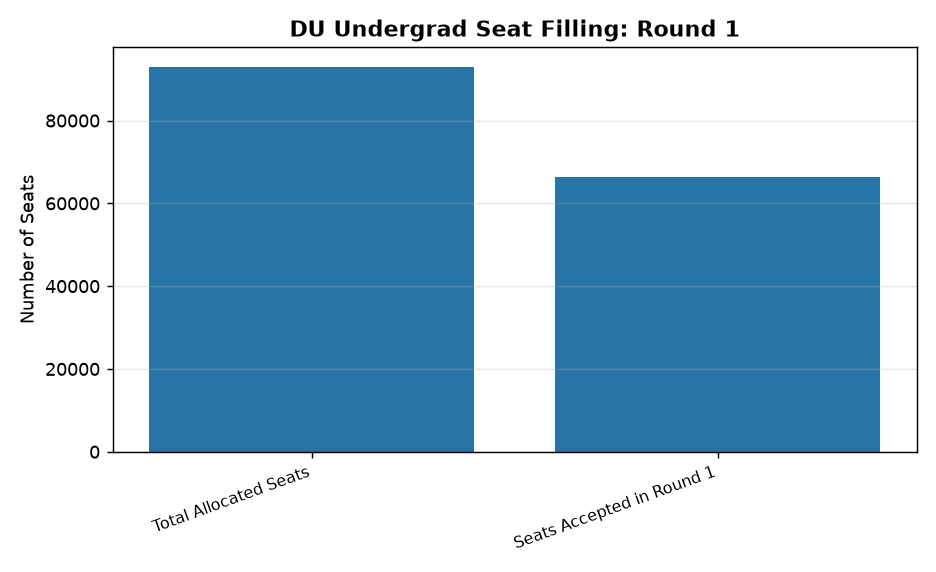
The Delhi University (DU) undergraduate admission process for the academic session 2026-27 witnessed approximately 70% of its seats filled within the first round of allocations. Out of 93,033 allocated seats, 66,251 were accepted within 24 hours. This rapid uptake, particularly in high-demand courses such as B.Com, Political Science (Hons), English (Hons), and History (Hons), indicates limited availability for subsequent admission rounds and highlights significant demand-supply imbalances in higher education, prompting student protests regarding seat availability in postgraduate courses.
Background
- Delhi University is a premier public central university in India, established in 1922, offering a wide range of undergraduate and postgraduate courses.
- Admissions to undergraduate courses in DU are currently conducted through the Common University Entrance Test (CUET), a standardized test introduced to ensure uniformity and reduce the burden of high cut-off marks based on Class 12 board examinations.
- The National Education Policy (NEP) 2020 advocates for increased access, equity, and inclusion in higher education, aiming to achieve a Gross Enrolment Ratio (GER) of 50% by 2035.
- The high demand for specific courses and institutions like DU reflects the aspirations of a large student population seeking quality higher education and better career prospects.
- Reservation policies, as mandated by the Constitution, ensure equitable access for various social categories (SC, ST, OBC, EWS, PwD) in public educational institutions.
- The current admission scenario underscores the persistent challenges in expanding capacity and ensuring equitable access to highly sought-after academic programs and institutions.
Common University Entrance Test (CUET)
- CUET is an all-India entrance examination conducted by the National Testing Agency (NTA) for admission to various undergraduate, integrated, postgraduate, diploma, certification courses, and research programs in central universities and participating state/private/deemed universities.
- It was introduced from the academic session 2022-23 for undergraduate admissions to central universities, including Delhi University.
- The primary objective of CUET is to provide a single window opportunity to students to seek admission in participating universities across the country.
- It aims to standardize the admission process, reduce the reliance on Class 12 board examination marks for university admissions, and promote equity by providing a common platform for assessment.
- CUET assesses candidates’ understanding of NCERT syllabus up to Class 12, general knowledge, and aptitude.
- The examination is conducted in multiple languages to ensure inclusivity and accessibility for students from diverse linguistic backgrounds.
- Scores from CUET are used by participating universities to generate merit lists for admissions, often followed by a counselling or seat allocation process.
- The introduction of CUET aligns with the recommendations of the National Education Policy (NEP) 2020 to reform the higher education admission system.
Key Features
| Feature | Significance |
|---|---|
| High Demand for Premier Institutions | Reflects aspirations for quality education and better career prospects; indicates a competitive environment. |
| CUET as Admission Criterion | Ensures standardized assessment, reduces board mark pressure, promotes uniformity across universities. |
| Rapid Seat Acceptance | Highlights student preference for allocated seats, potentially limiting options in subsequent rounds. |
| Course-Specific Demand | B.Com, Political Science (Hons), English (Hons), History (Hons) are consistently popular, indicating market relevance and academic interest. |
| Protests over PG Seat Availability | Underscores capacity constraints in postgraduate programs and student concerns regarding access to advanced studies. |
| Implementation of NEP 2020 Principles | Aims to enhance access, equity, and quality in higher education, though challenges remain in execution. |
Why it Matters
Social Significance
- Ensures a merit-based and standardized admission process through CUET, potentially reducing disparities arising from varied board examination standards.
- Highlights the aspirations of a large youth population for quality higher education, which is crucial for social mobility and empowerment.
- The demand-supply gap in prestigious institutions can exacerbate social inequalities if not addressed through equitable expansion of educational opportunities.
- Student protests underscore the importance of addressing student concerns regarding access and fairness in the education system.
Economic Significance
- A well-educated workforce is critical for India’s economic growth and leveraging its demographic dividend.
- High demand for specific courses indicates alignment with perceived market needs and employment opportunities, influencing skill development.
- Investment in higher education infrastructure and capacity expansion is essential for long-term economic productivity and innovation.
- The efficiency of the admission process impacts human resource allocation and the overall productivity of the education sector.
Policy and Governance Significance
- The success and challenges of CUET implementation provide valuable feedback for refining national education policies, particularly NEP 2020.
- Highlights the need for robust planning and resource allocation by educational authorities to match student demand with institutional capacity.
- The role of regulatory bodies like UGC and NTA in ensuring fair and transparent admission processes is critical.
- Government intervention is required to balance academic autonomy with the need for equitable access and quality standards across public universities.
Challenges
1. Demand-Supply Imbalance
- The number of aspirants far exceeds the available seats in premier institutions and popular courses, leading to intense competition.
- This imbalance can create stress among students and parents, potentially leading to mental health issues and a sense of exclusion.
UPSC Link: Social Justice, Human Resources
2. Capacity Constraints
- Existing infrastructure in many public universities is insufficient to accommodate the growing number of students seeking higher education.
- Expanding capacity requires significant financial investment, land availability, and qualified faculty, which are often scarce.
UPSC Link: Education, Infrastructure
3. Quality vs. Quantity Dilemma
- Rapid expansion of educational institutions without adequate quality control can dilute academic standards.
- Maintaining high-quality teaching, research, and infrastructure while increasing student intake is a persistent challenge.
UPSC Link: Quality of Education, Human Resource Development
4. Equitable Access and Inclusivity
- Despite reservation policies, students from marginalized sections may still face barriers due to lack of awareness, financial constraints, or inadequate preparatory education.
- Ensuring geographical equity and access for students from remote areas remains a challenge.
UPSC Link: Social Justice, Vulnerable Sections
5. Curriculum Relevance and Employability
- There is often a mismatch between the skills imparted by academic programs and the requirements of the job market.
- The high demand for certain courses suggests a perceived higher employability, while other valuable disciplines may be overlooked.
UPSC Link: Skill Development, Employment
6. Postgraduate Seat Availability
- The protests regarding limited postgraduate seats indicate a bottleneck in advanced education, hindering further specialization and research opportunities.
- Insufficient PG seats can impact the pipeline for research and academic careers.
UPSC Link: Higher Education, Research and Development
Challenges — UPSC Perspective
| Issue | Concern |
|---|---|
| Intense Competition | High stress levels among students, potential for exclusion of deserving candidates. |
| Limited Infrastructure | Inadequate classrooms, labs, libraries, and hostel facilities impacting learning environment. |
| Faculty Shortage | Compromises teaching quality and student-teacher ratio, affecting academic outcomes. |
| Regional Disparities | Uneven distribution of quality educational institutions across different regions. |
| Financial Barriers | High cost of living in metropolitan cities and tuition fees for some courses, despite public funding. |
| Digital Divide | Lack of access to digital resources and online learning tools for students from disadvantaged backgrounds. |
Government Initiatives — Must-Memorise for Prelims
- National Education Policy (NEP) 2020
- Samagra Shiksha Abhiyan
- Rashtriya Uchchatar Shiksha Abhiyan (RUSA)
- Pradhan Mantri Kaushal Vikas Yojana (PMKVY)
- Study Webs of Active Learning for Young Aspiring Minds (SWAYAM)
- National Institutional Ranking Framework (NIRF)
- IMPRINT India
- Scheme for Promotion of Academic and Research Collaboration (SPARC)
- National Research Foundation (NRF)
- Prime Minister’s Research Fellows (PMRF) Scheme
Way Forward
- Increase public investment in higher education infrastructure and faculty recruitment to expand institutional capacity.
- Promote the establishment of new universities and colleges, especially in underserved regions, to address regional disparities.
- Regularly review and update curricula to align with industry demands and foster interdisciplinary learning, as envisioned by NEP 2020.
- Strengthen career counselling and guidance services to help students make informed choices beyond traditional high-demand courses.
- Implement robust mechanisms for quality assurance and accreditation to ensure that expansion does not compromise academic standards.
- Leverage technology for blended learning models and online courses to enhance access and flexibility in higher education.
- Develop a transparent and efficient grievance redressal mechanism for students regarding admission processes and seat allocation.
- Encourage private sector participation and philanthropic contributions to augment resources for higher education, while ensuring regulatory oversight.
UPSC Value Addition
Keywords for Mains Answer-Writing
Higher Education Access, Equity in Education, National Education Policy 2020, Common University Entrance Test (CUET), Demographic Dividend, Skill Development, Quality Assurance, Institutional Capacity, Public Investment in Education, Employability, Social Justice, Educational Reforms.
Constitutional & Policy Linkages
- Article 21A: Right to Education (for elementary education, but spirit extends to access to education).
- Article 45: Provision for early childhood care and education to children below the age of six years (Directive Principle, guiding state policy).
- Article 46: Promotion of educational and economic interests of Scheduled Castes, Scheduled Tribes and other weaker sections (Directive Principle).
- Seventh Schedule (List III – Concurrent List): Education, including technical education, medical education and universities.
- University Grants Commission Act, 1956: Establishes UGC for coordination, determination and maintenance of standards of university education.
- National Education Policy 2020: Comprehensive policy framework for education in India.
Concept Flow
High student aspirations for quality education → Limited seats in premier institutions/courses → Intense competition via CUET → Rapid filling of allocated seats → Demand-supply imbalance and capacity constraints → Student protests and policy review for expansion/equity
Prelims Practice Questions
Q1. Which of the following statements regarding the Common University Entrance Test (CUET) is/are correct?
1. CUET is mandatory for admission to all private universities in India.
2. The National Testing Agency (NTA) is responsible for conducting CUET.
3. CUET aims to reduce the reliance on Class 12 board examination marks for university admissions.
Select the correct answer using the code given below:
- 1 and 2 only
- 2 and 3 only
- 1 and 3 only
- 1, 2 and 3
Answer: 2 and 3 only — Statement 1 is incorrect; CUET is mandatory for central universities and optional for other participating universities (state, private, deemed). Statement 2 is correct; NTA conducts CUET. Statement 3 is correct; a primary objective of CUET is to standardize admissions and reduce board mark dependence.
Q2. The National Education Policy (NEP) 2020 aims to achieve a Gross Enrolment Ratio (GER) in higher education of what percentage by 2035?
- 30%
- 40%
- 50%
- 60%
Answer: 50% — The NEP 2020 sets an ambitious target of increasing the GER in higher education to 50% by 2035, from approximately 26.3% in 2018.
Mains Practice Question
✍ “The rapid filling of undergraduate seats in premier institutions like Delhi University, despite the implementation of CUET, highlights persistent challenges in ensuring equitable access and quality in India’s higher education system.” Critically analyse this statement, discussing the underlying issues and suggesting comprehensive policy measures to address them. (250 words)
Approach: The answer should begin by acknowledging the trend of rapid seat filling and linking it to the high demand for quality education. It should then critically analyse the underlying issues, such as demand-supply imbalance, capacity constraints, quality vs. quantity dilemma, and equitable access challenges, even with CUET. The role of NEP 2020 and its objectives should be integrated. Finally, comprehensive policy measures should be suggested, focusing on increased investment, capacity expansion, curriculum relevance, technological integration, and robust quality assurance mechanisms. The conclusion should emphasize the need for a holistic approach to transform higher education.
Source: amarujala.com
Generated by AanyaAi for educational purpose.

- UPSC Alert: India Launches National Action Plan for Inland Small Fisheries - October 24, 2026
- विशेष अभियान 6: कपड़ा आयुक्त कार्यालय ने सफाई और दक्षता में बढ़ाया योगदान - October 24, 2026
- Inter-Caste Marriage Scheme: UPSC Exam Polity & Governance Insight - October 24, 2026

No Comments