


19 Jul DU Admissions 2026: Over 79,000 Accept Round 1 Seats; Next List July 25
Subject Relevance — Where This Topic Fits
- GS Paper II — Social Justice: Issues relating to development and management of Social Sector/Services relating to Education, Human Resources. | GS Paper II — Governance: Government policies and interventions for development in various sectors and issues arising out of their design and implementation.
- Prelims: Common Seat Allocation System (CSAS), National Testing Agency (NTA), Common University Entrance Test (CUET), National Education Policy (NEP) 2020, Higher Education Financing Agency (HEFA), University Grants Commission (UGC), Affirmative Action, Supernumerary Quota
- Essay: The democratisation of higher education: Challenges and opportunities in India., Equity, Access, and Excellence: Pillars of a robust education system.
Quick Revision: The CUET-CSAS system aims to democratise higher education admissions by standardising evaluation and centralising the process, aligning with NEP 2020’s goals of equity and access, despite facing challenges related to digital inclusion and implementation complexities.
Why is this in the news?
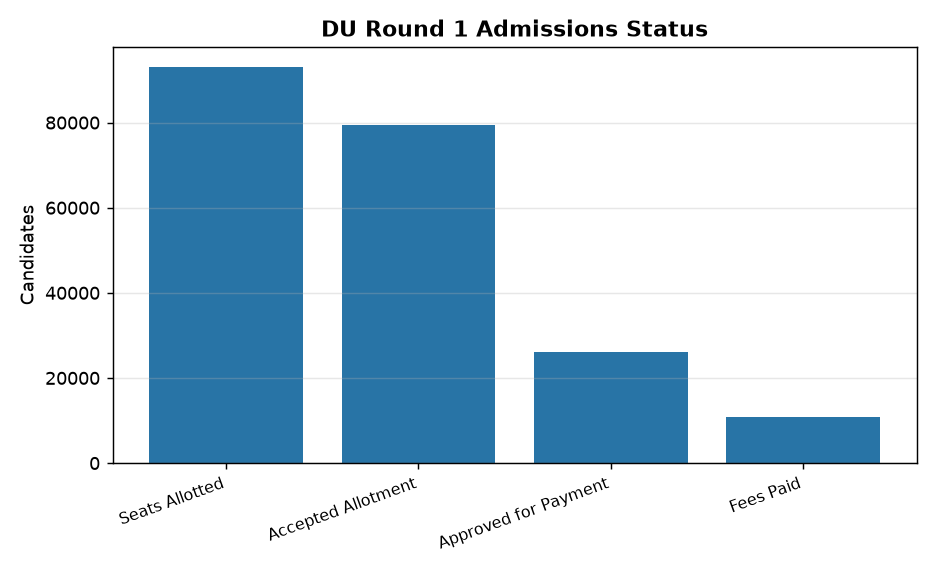
Delhi University’s undergraduate admission process for the 2026-27 academic session is currently underway, with over 79,000 candidates accepting Round 1 seat allotments through the Common Seat Allocation System (CSAS). This significant milestone highlights the scale and complexity of admissions into one of India’s premier higher education institutions, bringing into focus the efficacy of the new centralised admission mechanism and its implications for access, equity, and quality in higher education.
Background
- Historically, Delhi University admissions were based on Class XII board examination marks, leading to intense competition and ‘cut-off’ scores often exceeding 99% for popular courses.
- The introduction of the Common University Entrance Test (CUET) from the academic year 2022-23 marked a paradigm shift, aiming to standardise the admission process across central universities.
- The Common Seat Allocation System (CSAS) was subsequently implemented by Delhi University to manage the allocation of seats based on CUET scores, programme-college preferences, and various reservation policies.
- The National Testing Agency (NTA) is the nodal body responsible for conducting the CUET, ensuring a common platform for assessing candidates’ aptitude and subject knowledge.
- The current admission cycle involves multiple rounds of seat allocation, with provisions for candidates to ‘upgrade’ their preferences in subsequent lists, reflecting a dynamic and preference-driven system.
- Special category admissions, such as those for single girl child and orphan candidates, underscore the university’s commitment to inclusive education and social equity.
What is the Common Seat Allocation System (CSAS)?
- The Common Seat Allocation System (CSAS) is an online portal developed by Delhi University for undergraduate admissions, replacing the previous merit-based system derived solely from Class XII board marks.
- It is a three-phase process: Phase 1 involves registration on the CSAS portal, Phase 2 requires candidates to submit their programme and college preferences based on their CUET scores, and Phase 3 entails seat allocation, acceptance, and fee payment.
- CSAS integrates CUET (UG) scores as the primary criterion for merit, thereby standardising the assessment across diverse educational boards and reducing the pressure of exceptionally high board percentages.
- The system incorporates various reservation policies mandated by the Government of India, including those for Scheduled Castes (SC), Scheduled Tribes (ST), Other Backward Classes (OBC) – Non-Creamy Layer (NCL), Economically Weaker Sections (EWS), and Persons with Benchmark Disabilities (PwBD).
- It allows for the allocation of seats across 221 undergraduate programmes in 67 colleges affiliated with Delhi University, offering a wide array of academic choices.
- CSAS facilitates multiple rounds of allocation, enabling candidates to accept, freeze, or upgrade their allotted seats based on their evolving preferences and the availability of seats in subsequent rounds.
- The system also manages admissions under various supernumerary quotas, such as Sports, Extra-Curricular Activities (ECA), Kashmiri Migrants, and Single Girl Child, ensuring comprehensive coverage of diverse categories.
Key Features
| Feature | Significance |
|---|---|
| CUET-based Merit | Ensures a uniform evaluation standard across all applicants, mitigating disparities arising from varying board examination patterns and marking schemes. |
| Preference-based Allocation | Empowers students to choose their desired programmes and colleges, aligning admissions with individual academic aspirations and career goals. |
| Multiple Allocation Rounds | Provides flexibility for candidates to improve their choices or secure a preferred seat, reducing anxiety and offering second chances. |
| Online Verification and Payment | Streamlines the administrative process, enhancing efficiency and transparency while reducing the need for physical presence. |
| Supernumerary Quotas | Promotes inclusivity by reserving seats for specific categories like sports, ECA, and single girl children, fostering holistic development and social equity. |
| Centralised Data Management | Facilitates comprehensive data analysis for policy formulation and future improvements in the admission process, aiding evidence-based decision-making. |
Why it Matters
Enhancing Equity and Access
- The CUET-CSAS system aims to level the playing field for students from diverse socio-economic and geographical backgrounds, reducing the impact of ‘board marks inflation’ from certain states.
- It provides a single window for admission to central universities, potentially reducing the financial and logistical burden on students applying to multiple institutions.
- The inclusion of special categories like single girl child and orphan candidates reflects a commitment to affirmative action and supports vulnerable sections of society in accessing higher education.
Promoting Transparency and Efficiency
- The online, centralised nature of CSAS minimises human intervention and potential biases, fostering greater transparency in the allocation process.
- Digital verification and fee payment mechanisms streamline administrative procedures, making the admission journey more efficient for both students and colleges.
- The structured allocation rounds and upgrade options provide clarity and predictability, allowing candidates to make informed decisions.
Aligning with National Education Policy (NEP) 2020 Objectives
- The CUET-CSAS system aligns with NEP 2020’s vision of a holistic, multidisciplinary, and flexible higher education system, promoting a common entrance test for university admissions.
- It supports the NEP’s emphasis on equitable and inclusive education, ensuring that talent from all sections of society has an opportunity to pursue higher studies.
- By reducing the undue pressure of high-stakes board exams, it encourages a broader focus on learning and skill development rather than rote memorisation for marks.
Challenges
1. Digital Divide and Accessibility
- Students from remote areas or economically disadvantaged backgrounds may face challenges due to limited access to reliable internet, computers, or digital literacy skills required for online applications and preference filling.
- Technical glitches or server overloads during peak application periods can disproportionately affect those with limited resources or backup options.
UPSC Link: GS Paper II — Social Justice: Issues relating to poverty and hunger.
2. Complexity of Preference Filling
- With 221 programmes and 67 colleges, candidates must navigate a vast array of choices, requiring careful research and strategic preference ordering, which can be daunting for first-time applicants.
- Lack of adequate guidance or counselling services can lead to suboptimal choices, potentially impacting a student’s academic trajectory.
UPSC Link: GS Paper II — Governance: Transparency and accountability and institutional and other measures.
3. CUET’s Evolving Nature and Fairness
- As a relatively new examination, concerns regarding the standardisation of difficulty levels across different subject domains and shifts, as well as the normalisation process, persist.
- The effectiveness of CUET in truly assessing aptitude and potential across diverse academic streams is still under scrutiny, with some arguing it may favour certain types of learners.
UPSC Link: GS Paper II — Social Justice: Issues relating to development and management of Social Sector/Services relating to Education.
4. Impact on Regional Universities
- The centralisation of admissions through CUET might draw a disproportionate number of high-achieving students to a few premier central universities, potentially impacting the quality and enrolment in state and private universities.
- This could exacerbate regional imbalances in educational quality and resource distribution.
UPSC Link: GS Paper II — Federalism: Functions and responsibilities of the Union and the States.
5. Infrastructure and Resource Strain
- Managing a large-scale, centralised admission process for over 2 lakh candidates requires robust IT infrastructure, trained personnel, and efficient grievance redressal mechanisms, which can strain university resources.
- The verification process by colleges, especially for supernumerary quotas, can be time-consuming and resource-intensive.
UPSC Link: GS Paper II — Governance: e-governance- applications, models, successes, limitations, and potential.
Challenges — UPSC Perspective
| Issue | Concern |
|---|---|
| Digital Divide | Exclusion of students lacking digital access or literacy, exacerbating existing inequalities. |
| Preference Complexity | Difficulty for students to make optimal choices among numerous programmes and colleges, leading to suboptimal placements. |
| CUET Standardisation | Ensuring fairness and comparability of scores across varied subjects and examination slots. |
| Regional Disparity | Potential brain drain from state universities to central universities, impacting regional educational ecosystems. |
| Administrative Burden | Strain on university and college resources for managing large-scale online admissions and verifications. |
| Grievance Redressal | Ensuring timely and effective resolution of student queries and complaints during the dynamic admission process. |
Government Initiatives — Must-Memorise for Prelims
- National Education Policy (NEP) 2020
- Pradhan Mantri Uchchatar Shiksha Protsahan Yojana (PM-USP)
- Higher Education Financing Agency (HEFA)
- National Institutional Ranking Framework (NIRF)
- Study Webs of Active Learning for Young Aspiring Minds (SWAYAM)
- National Academic Depository (NAD)
- Rashtriya Uchchatar Shiksha Abhiyan (RUSA)
- Scholarships for Higher Education for Young Achievers Scheme (SHREYAS)
- Prime Minister’s Research Fellows (PMRF) Scheme
- Eklavya Model Residential Schools (EMRS)
Way Forward
- Strengthening digital infrastructure and providing access points in rural areas to bridge the digital divide, possibly through Common Service Centres (CSCs).
- Developing comprehensive online and offline counselling services to guide students through the preference filling process, especially for first-generation learners.
- Continuously refining the CUET examination structure, normalisation process, and grievance redressal mechanisms to enhance its fairness and credibility.
- Investing in capacity building for state and private universities to improve their infrastructure and academic offerings, reducing over-reliance on a few central institutions.
- Leveraging Artificial Intelligence and Machine Learning for predictive analytics in admissions to streamline processes and identify potential bottlenecks.
- Promoting multilingual support for the admission portal and CUET to cater to linguistic diversity and enhance inclusivity.
- Conducting regular feedback surveys from students, parents, and faculty to identify areas for improvement in the CSAS and CUET systems.
- Enhancing collaboration between NTA, UGC, and universities to ensure seamless integration and effective implementation of national education policies.
UPSC Value Addition
Keywords for Mains Answer-Writing
Higher Education Reforms · Equity and Access · Centralised Admissions · Digital Divide · NEP 2020 Implementation · Standardisation of Assessment · Inclusive Education · Governance in Education · Human Resource Development · Affirmative Action · Transparency and Efficiency · Skill Development
Constitutional & Policy Linkages
- Article 21A: Right to Education (for children 6-14 years, foundational for higher education access)
- Article 45: Provision for early childhood care and education to children below the age of six years (DPSP, indirectly supports education continuum)
- Article 46: Promotion of educational and economic interests of Scheduled Castes, Scheduled Tribes and other weaker sections (DPSP, basis for reservations)
- Seventh Schedule (List I, Entry 66): Coordination and determination of standards in institutions for higher education or research and scientific and technical institutions (Union’s role)
- Seventh Schedule (List III, Entry 25): Education, including technical education, medical education and universities (Concurrent List, shared responsibility)
- National Education Policy 2020: Comprehensive policy framework for education in India.
Concept Flow
NEP 2020 Vision for Higher Education → Introduction of CUET for Central Universities → Delhi University’s CSAS for UG Admissions → Online Registration & Preference Submission → Merit-based Seat Allocation (CUET scores) → Acceptance, Verification & Fee Payment → Commencement of Academic Session
Prelims Practice Questions
Q1. Consider the following statements regarding the Common University Entrance Test (CUET) and the Common Seat Allocation System (CSAS):
1. CUET is conducted by the University Grants Commission (UGC) for admissions to all state universities in India.
2. CSAS is an admission portal specifically designed by Delhi University for undergraduate admissions based on CUET scores.
3. The National Education Policy (NEP) 2020 advocates for a common entrance test for university admissions.
- 1 and 2 only
- 2 and 3 only
- 1 and 3 only
- 1, 2 and 3
Answer: 2 and 3 only — Statement 1 is incorrect: CUET is conducted by the National Testing Agency (NTA), not UGC, and is primarily for central universities, though state/private universities can opt in. Statement 2 is correct: CSAS is indeed Delhi University’s portal for managing admissions based on CUET scores. Statement 3 is correct: NEP 2020 recommends a common entrance exam for university admissions to reduce the burden on students and promote equity.
Q2. Which of the following are considered supernumerary quotas in Delhi University’s admission process?
1. Sports Quota
2. Economically Weaker Sections (EWS) Quota
3. Single Girl Child Quota
4. Persons with Benchmark Disabilities (PwBD) Quota
- 1 and 3 only
- 2 and 4 only
- 1, 3 and 4 only
- 1, 2, 3 and 4
Answer: 1 and 3 only — Supernumerary quotas are seats over and above the sanctioned intake, typically for specific categories like Sports, ECA, Kashmiri Migrants, and Single Girl Child. EWS and PwBD quotas are part of the regular reservation policy within the sanctioned intake, not supernumerary. Therefore, 1 and 3 are correct.
Mains Practice Question
✍ The introduction of the Common University Entrance Test (CUET) and the Common Seat Allocation System (CSAS) represents a significant reform in India’s higher education admission landscape. Critically analyse the potential benefits and challenges associated with this centralised approach, particularly in the context of achieving equity, access, and excellence as envisioned by the National Education Policy (NEP) 2020. (250 words)
Approach: Begin by briefly introducing CUET and CSAS as key reforms in higher education admissions. In the first part, discuss the benefits, focusing on how these systems promote equity (standardised evaluation, reduced board marks pressure), access (single window, special categories), and efficiency (online process, transparency). In the second part, critically examine the challenges, such as the digital divide, complexity of choices, concerns about CUET’s fairness, and potential impact on regional institutions. Conclude by suggesting a way forward that balances centralisation with local needs, ensuring inclusivity and quality in line with NEP 2020’s objectives.
Source: The Indian Express
Generated by AanyaAi for educational purpose.

- GRP Chiefs Conference 2024: Intelligence-Led Policing & RPF-GRP Coordination Focus - October 24, 2026
- केरल में बच्चों की कुपोषण और उपेक्षा से मृत्यु रोकने की तैयारी, जानिए कैसे - October 24, 2026
- Liechtenstein Prince’s India Visit: Key Agreements & Bilateral Focus - October 24, 2026

No Comments