


19 Jul DU UG Admission 2026: First Allotment List for 71,000+ Seats Released
Subject Relevance — Where This Topic Fits
- GS Paper II — Governance, Social Justice, Education | GS Paper III — Indian Economy (Human Capital Development)
- Prelims: Common University Entrance Test (CUET), National Education Policy (NEP) 2020, Delhi University, Higher Education Institutions (HEIs), Central Universities, Admission Process Reforms, Digital Governance, Equity in Education, UGC
- Essay: Reforming Higher Education in India: Challenges and Opportunities, Digital Transformation and its Impact on Governance and Public Services
Quick Revision: The Common Seat Allocation System (CSAS) in Delhi University, leveraging CUET scores, is a digital governance initiative aimed at enhancing transparency, equity, and efficiency in undergraduate admissions, aligning with the National Education Policy 2020, despite facing challenges related to digital access and technical robustness.
Why is this in the news?
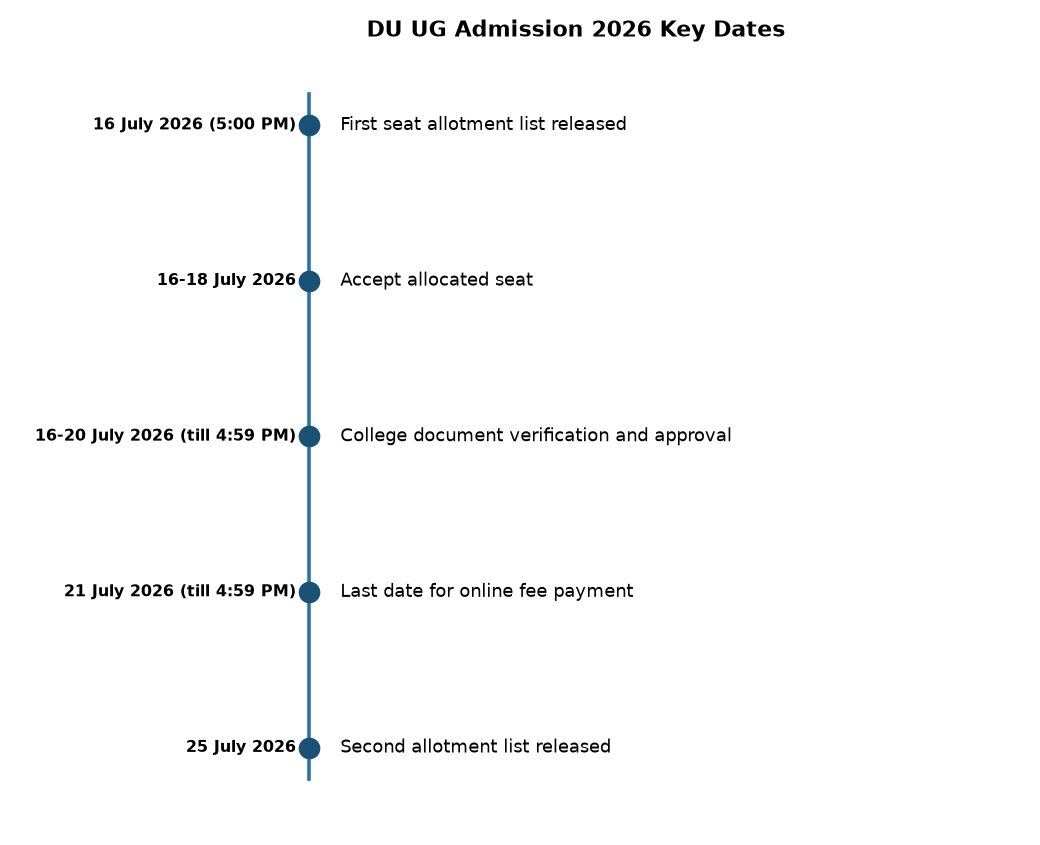
Delhi University is set to release its first seat allotment list for undergraduate admissions for the academic year 2026-27 today, July 16, 2026. This marks a crucial stage in the admission process, which is being conducted through the Common Seat Allocation System (CSAS) based on the Common University Entrance Test (CUET) scores. Over 71,000 seats across various colleges are expected to be filled, highlighting the scale and significance of this centralized admission mechanism.
Background
- Historically, admissions to Delhi University’s undergraduate programmes were based on Class XII board examination marks, leading to exceptionally high cut-offs and often disadvantaging students from diverse boards.
- The National Education Policy (NEP) 2020 advocated for a holistic, multidisciplinary education system and emphasized the need for common entrance examinations for university admissions.
- The University Grants Commission (UGC) mandated the Common University Entrance Test (CUET) for admission to all undergraduate programmes in Central Universities from the academic year 2022-23.
- Delhi University subsequently adopted CUET and introduced the Common Seat Allocation System (CSAS) as its centralized portal for managing the admission process, from application to seat allotment.
- The CSAS portal integrates CUET scores, candidate preferences for courses and colleges, and reservation policies to ensure a transparent and merit-based allocation.
- The current news signifies the operational maturity of CSAS, now in its third year, streamlining admissions for a large number of students into one of India’s premier higher education institutions.
What is the Common Seat Allocation System (CSAS)?
- The Common Seat Allocation System (CSAS) is an online, centralized admission portal implemented by Delhi University for undergraduate admissions.
- It was introduced in alignment with the National Education Policy (NEP) 2020 and the University Grants Commission (UGC) mandate for the Common University Entrance Test (CUET).
- CSAS serves as a single window for applicants to apply to Delhi University’s various colleges and courses after appearing for CUET (UG).
- The system comprises three main phases: submission of the CSAS application form, selection of programmes and colleges, and seat allocation and admission.
- Seat allocation is primarily based on the CUET (UG) scores, the candidate’s preferences for courses and colleges, the availability of seats, and applicable reservation policies.
- It aims to bring transparency, equity, and efficiency to the admission process, reducing the burden on students and colleges.
- The system facilitates multiple rounds of seat allocation, allowing for adjustments based on vacant seats, withdrawals, and rejections, ensuring optimal seat utilization.
- CSAS also incorporates a robust document verification process by colleges, followed by online fee payment to confirm admission.
Key Features
| Feature | Significance |
|---|---|
| Centralized Online Portal | Streamlines the entire admission process, making it accessible from anywhere and reducing physical paperwork. |
| CUET (UG) Score Integration | Ensures a standardized, merit-based admission criterion, promoting fairness across diverse educational backgrounds. |
| Preference Filling Mechanism | Allows candidates to prioritize their desired courses and colleges, giving them agency in their academic choices. |
| Multiple Allocation Rounds | Maximizes seat utilization by reallocating vacant seats, accommodating withdrawals, and ensuring more students get admitted. |
| Automated Seat Allotment | Reduces human error and bias, enhancing transparency and objectivity in the allocation process. |
| Integrated Document Verification | Facilitates efficient and secure verification of academic and reservation documents by the respective colleges. |
Why it Matters
Enhancing Equity and Access
- By relying on CUET scores, CSAS provides a level playing field for students from different state boards and backgrounds, mitigating the disparities arising from varied marking schemes of Class XII examinations.
- The online nature of the system improves accessibility for students from remote areas, reducing the need for physical travel during the application phase.
Promoting Transparency and Meritocracy
- The automated, rule-based allocation system minimizes discretionary power and potential for bias, fostering a more transparent admission environment.
- Merit, as determined by CUET scores, becomes the primary determinant for admission, reinforcing the principle of meritocracy in higher education.
Streamlining Administrative Processes
- CSAS significantly reduces the administrative burden on individual colleges by centralizing application processing, data management, and seat allocation.
- It optimizes resource utilization for both the university and applicants, making the admission cycle more efficient and less time-consuming.
Alignment with National Education Policy (NEP) 2020
- The system aligns with NEP 2020’s vision of a holistic, multidisciplinary education and the emphasis on common entrance examinations for university admissions, promoting national integration in education.
- It supports the policy’s goal of ensuring equitable access to quality higher education across the country.
Challenges
1. Digital Divide and Infrastructure
- Students from socio-economically disadvantaged backgrounds or rural areas may face challenges due to limited access to reliable internet connectivity and digital literacy.
- Ensuring equitable access to the online portal and support for all applicants remains a concern.
UPSC Link: GS Paper II — Social Justice (Vulnerable Sections); GS Paper III — Infrastructure (Digital)
2. Technical Glitches and System Overload
- High traffic during peak admission periods can lead to server issues, slow response times, or technical errors, causing anxiety and inconvenience for applicants.
- Robust IT infrastructure and contingency plans are crucial to manage such demands.
UPSC Link: GS Paper II — E-governance; GS Paper III — Science and Technology
3. Complexity of Preference Filling
- The vast number of courses and colleges can make the preference-filling process complex for students, especially those unfamiliar with the university’s offerings.
- Adequate guidance and counseling are essential to help students make informed choices.
UPSC Link: GS Paper II — Education (Guidance and Counselling)
4. Gaps in CUET Preparation and Awareness
- Despite efforts, awareness about CUET and its preparation resources may still be uneven, potentially disadvantaging students from less privileged educational backgrounds.
- Bridging this information gap is vital for true equity.
UPSC Link: GS Paper II — Education (Access to Quality Education)
5. Post-Allotment Logistics
- The tight deadlines for accepting seats, document verification, and fee payment can be challenging for students, particularly those traveling from distant locations.
- Coordination between the central system and individual colleges for verification needs to be seamless.
UPSC Link: GS Paper II — Governance (Service Delivery)
Challenges — UPSC Perspective
| Issue | Concern |
|---|---|
| Digital Access Disparity | Exclusion of students lacking internet/device access, exacerbating existing inequalities. |
| Technical Reliability | System crashes or slowdowns during critical phases can disrupt the admission process and cause stress. |
| Information Asymmetry | Lack of comprehensive guidance for students on CUET, CSAS, and course/college choices. |
| Verification Bottlenecks | Potential delays or inconsistencies in physical/online document verification by colleges. |
| Student Mobility | Challenges for outstation students in managing multiple rounds of allocation and physical requirements. |
| Grievance Redressal | Need for a robust and responsive mechanism to address student queries and complaints promptly. |
Government Initiatives — Must-Memorise for Prelims
- National Education Policy (NEP) 2020
- Samagra Shiksha Abhiyan
- Digital India Programme
- National Digital Education Architecture (NDEAR)
- PM e-VIDYA
- Study Webs of Active Learning for Young Aspiring Minds (SWAYAM)
- National Scholarship Portal
- Pradhan Mantri Kaushal Vikas Yojana (PMKVY)
- Rashtriya Uchchatar Shiksha Abhiyan (RUSA)
- National Research Foundation (NRF)
Way Forward
- Strengthening digital infrastructure and providing common service centers in rural and remote areas to bridge the digital divide.
- Developing user-friendly interfaces and multilingual support for the CSAS portal to enhance accessibility for all linguistic groups.
- Implementing robust IT security measures and load balancing techniques to ensure system stability and prevent technical glitches during peak periods.
- Launching extensive awareness campaigns and counseling programmes, both online and offline, to educate students about CUET, CSAS, and career options.
- Establishing a dedicated, responsive grievance redressal mechanism with clear timelines for resolving student queries and complaints.
- Conducting regular feedback surveys from students and colleges to identify pain points and continuously improve the CSAS functionality and user experience.
- Exploring partnerships with state governments and NGOs to provide digital literacy training and access to necessary resources for underprivileged students.
- Standardizing and simplifying the document verification process across colleges to reduce delays and ensure consistency.
UPSC Value Addition
Keywords for Mains Answer-Writing
Higher Education Reforms · National Education Policy 2020 · Common University Entrance Test (CUET) · Digital Governance · Equity and Access · Transparency in Admissions · Meritocracy · Administrative Efficiency · Human Capital Development · Inclusive Education · E-governance Challenges · Skill Development
Constitutional & Policy Linkages
- Article 21A — Right to Education
- Article 45 — Provision for early childhood care and education to children below the age of six years
- Article 46 — Promotion of educational and economic interests of Scheduled Castes, Scheduled Tribes and other weaker sections
- Seventh Schedule (List III – Concurrent List) — Education, including technical education, medical education and universities
- University Grants Commission Act, 1956 — Establishment and regulation of universities
- National Education Policy 2020 — Policy framework for education sector
Concept Flow
NEP 2020 & UGC Mandate for Common Entrance → Introduction of CUET (UG) for Central Universities → Delhi University Adopts CUET & Develops CSAS → Students Apply via CSAS with CUET Scores & Preferences → Automated Seat Allotment based on Merit & Reservation → College Verification & Online Fee Payment → Admission Confirmation & Commencement of Academic Session
Prelims Practice Questions
Q1. Consider the following statements regarding the Common Seat Allocation System (CSAS) for undergraduate admissions in Delhi University:
1. CSAS was introduced as a direct consequence of the National Education Policy (NEP) 2020’s recommendations.
2. Admission through CSAS is solely based on Class XII board examination marks, replacing the previous system.
3. The system aims to enhance transparency and equity in the admission process by utilizing Common University Entrance Test (CUET) scores.
Which of the statements given above is/are correct?
- A. 1 only
- B. 2 and 3 only
- C. 1 and 3 only
- D. 1, 2 and 3
Answer: C. 1 and 3 only — Statement 1 is correct: NEP 2020 advocated for common entrance tests, which led to CUET and subsequently CSAS. Statement 2 is incorrect: CSAS is based on CUET scores, not Class XII board marks. Statement 3 is correct: CSAS, by using CUET scores, aims to bring transparency and equity.
Q2. Which of the following is NOT a primary objective of the Common Seat Allocation System (CSAS) in Delhi University?
- A. To provide a centralized online platform for admissions.
- B. To ensure merit-based admissions using CUET scores.
- C. To replace the need for any document verification by colleges.
- D. To streamline the admission process and reduce administrative burden.
Answer: C. To replace the need for any document verification by colleges. — Options A, B, and D are primary objectives of CSAS. Option C is incorrect because CSAS integrates document verification by colleges as a crucial step, it does not replace it. The system facilitates verification but does not eliminate the need for it.
Mains Practice Question
✍ The Common Seat Allocation System (CSAS) in Delhi University represents a significant reform in India’s higher education admission landscape, aligning with the vision of NEP 2020. Critically analyze the potential of CSAS to foster equity and transparency, while also discussing the key challenges in its implementation and suggesting measures for further improvement. (250 words)
Approach: Begin by briefly introducing CSAS and its context within NEP 2020 and CUET. In the first part, analyze its potential to foster equity (level playing field, access) and transparency (merit-based, automated). In the second part, discuss challenges such as the digital divide, technical glitches, complexity for students, and post-allotment logistics. Conclude by suggesting concrete measures for improvement, focusing on digital infrastructure, awareness campaigns, grievance redressal, and continuous feedback mechanisms, linking back to the broader goals of inclusive and quality higher education.
Source: amarujala.com
Generated by AanyaAi for educational purpose.

- How India’s Rs 20,000 Cr CCUS Budget Can Drive Net-Zero Goals - October 23, 2026
- पंजाब-हरियाणा में पराली जलाने पर सीएक्यूएम की सख्त समीक्षा, तुरंत उठाये गये कदमों पर जोर - October 23, 2026
- UNEP Report 2026 Warns: Paris 1.5°C Target Slipping Away - October 23, 2026

No Comments