


22 Jul DU UG Admission 2026 Round 2: Key Facts for UPSC & State PCS
Subject Relevance — Where This Topic Fits
- GS Paper II — Governance, Administration and Policies (Higher Education)
- Prelims: Common Seat Allocation System (CSAS), CUET UG 2026, Delhi University Admissions, Freeze and Upgrade Options, UG Admission Rounds
Quick Revision: CSAS 2026 operates in rounds, with candidates having the option to ‘Freeze’, ‘Upgrade’, or ‘Withdraw’ their allocated seats; the second round begins on 25 July 2026, and classes start on 28 July 2026.
Why is this in the news?
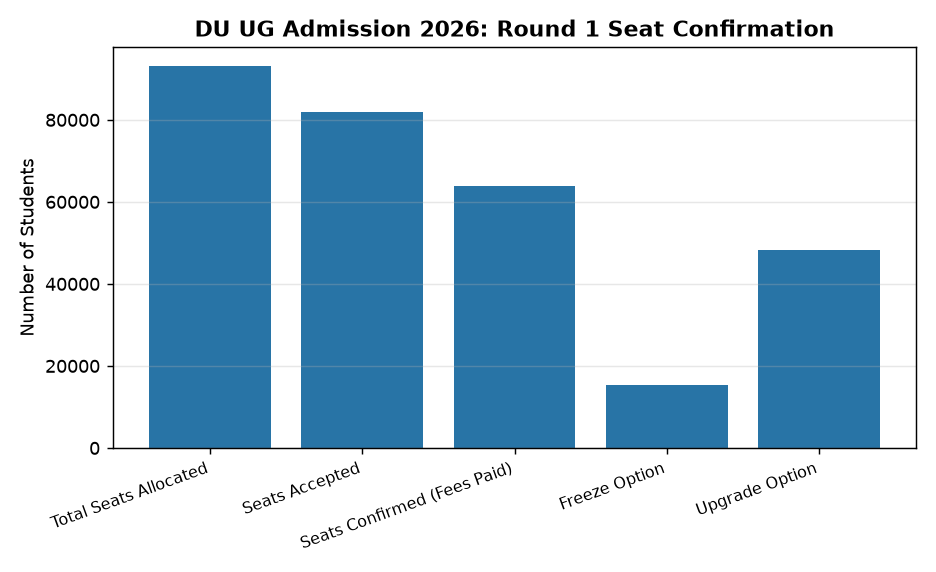
The Delhi University (DU) has released official data for the first round of undergraduate admissions under the Common Seat Allocation System (CSAS 2026), revealing that 63,756 students confirmed their seats by depositing fees out of 93,033 allocated seats. This development is significant as it marks the progression of the admission cycle for the academic session 2026-27, with the second round commencing on 25 July 2026 and classes scheduled to begin on 28 July 2026. The data also highlights the utilisation of ‘Freeze’ and ‘Upgrade’ options, which are critical for aspirants to understand for strategic decision-making in subsequent rounds.
Background
- The Common Seat Allocation System (CSAS) was introduced by Delhi University in 2022 to streamline the undergraduate admission process by integrating multiple entrance examinations, including CUET UG, into a single platform.
- CSAS operates in multiple rounds, allowing candidates to either freeze their allocated seat, upgrade to a higher preference, or withdraw from the process.
- Delhi University offers over 71,000 undergraduate seats across 67 colleges and 221 programmes, making it one of the largest higher education institutions in India.
- The CUET UG 2026 examination serves as the primary eligibility criterion for admission to DU undergraduate programmes, replacing the erstwhile merit-based system.
- The admission process is conducted entirely online, with candidates required to register, submit preferences, and confirm seats through the CSAS portal.
- The academic session for DU typically commences in July-August, aligning with the national higher education calendar.
What is the Common Seat Allocation System (CSAS)?
- CSAS is a centralised admission system implemented by Delhi University to allocate undergraduate seats based on CUET UG 2026 scores and candidate preferences.
- The system operates in multiple rounds, allowing candidates to modify their choices or confirm their allocations at each stage.
- Candidates can choose from three options: ‘Freeze’ (accept the allocated seat and exit the process), ‘Upgrade’ (retain the current seat while waiting for a higher preference in subsequent rounds), or ‘Withdraw’ (opt out of the process entirely).
- The allocation is based on a combination of CUET UG scores, category-wise reservation policies, and the order of preferences submitted by candidates.
- CSAS ensures transparency and reduces the administrative burden on both candidates and the university by automating seat allocation and fee confirmation processes.
- The system is designed to maximise seat utilisation while providing candidates with multiple opportunities to secure their preferred programmes.
- DU’s CSAS portal (ugadmission.uod.ac.in) serves as the primary interface for candidates to check allocations, download admit cards, and complete fee payments.
Key Features
| Feature | Significance |
|---|---|
| CSAS 2026 Process | The Common Seat Allocation System (CSAS) 2026 ensures a transparent, merit-based, and centralised allocation of undergraduate seats across 67 colleges and 221 courses in Delhi University, reducing discretionary admissions and enhancing fairness. |
| Round-wise Seat Confirmation | The first round confirms 63,756 seats through fee submission, demonstrating the efficiency of the digital admission system and the preparedness of candidates for the academic session. |
| Freeze vs Upgrade Options | The ‘Freeze’ option secures a candidate’s current seat, while ‘Upgrade’ allows them to retain eligibility for higher-preference allocations in subsequent rounds, balancing stability and aspirational mobility. |
| Timeline Alignment | The second round commencing on 25 July 2026 and classes starting on 28 July 2026 ensures minimal academic disruption and aligns with the National Education Policy’s emphasis on timely admissions. |
| Digital Infrastructure | The DU UG Admission Portal (ugadmission.uod.ac.in) exemplifies the integration of technology in higher education administration, enabling real-time updates and reducing manual intervention. |
Why it Matters
Administrative Efficiency
- The CSAS 2026 system streamlines the admission process, reducing the administrative burden on colleges and ensuring a uniform policy across institutions.
- Digital fee submission and seat confirmation enhance transparency and reduce corruption risks associated with manual processes.
Academic Continuity
- The early commencement of classes on 28 July 2026 aligns with the NEP 2020’s recommendation for timely academic sessions, minimising delays in curriculum delivery.
- Round-wise admissions allow for iterative adjustments, ensuring that seats are filled optimally without last-minute vacancies.
Student Aspirations & Mobility
- The ‘Upgrade’ option reflects a progressive approach, allowing students to pursue higher-preference courses without losing their current seat, thus balancing risk and reward.
- High participation in the first round (63,756 confirmations) indicates robust student confidence in the DU admission system.
Policy Integration
- The CSAS model aligns with the National Education Policy 2020’s vision of standardised, technology-driven admissions, setting a precedent for other universities.
- The system’s scalability demonstrates the potential for replication in other state and central universities, enhancing national higher education governance.
Challenges
1. Digital Divide and Accessibility
- Students from socio-economically disadvantaged backgrounds may face challenges in accessing the online portal due to limited internet connectivity or device availability.
- Language barriers in the portal interface could disadvantage non-Hindi-speaking candidates, necessitating multilingual support.
UPSC Link: GS2: E-governance & GS1: Social Justice
2. Seat Allocation Disparities
- Disproportionate allocation of seats across colleges and courses may exacerbate existing regional or socio-economic disparities in access to higher education.
- Merit-based allocation could inadvertently disadvantage candidates from weaker academic backgrounds if reservation policies are not effectively implemented.
UPSC Link: GS2: Reservation Policies
3. Technical Glitches and Cybersecurity
- Server downtimes or technical errors during peak admission periods could disrupt the process, leading to delays and candidate grievances.
- Data privacy concerns arise from the centralised storage of student information, requiring robust cybersecurity measures.
UPSC Link: GS3: Cybersecurity & GS2: Fundamental Rights
4. Financial Constraints
- Fee submission deadlines may pose financial challenges for economically weaker sections, potentially leading to seat forfeiture.
- Hidden costs (e.g., relocation, hostel fees) post-admission could deter candidates from lower-income groups.
UPSC Link: GS1: Poverty & GS2: Education
Challenges — UPSC Perspective
| Issue | Concern |
|---|---|
| Digital Infrastructure Gaps | Limited internet access and device availability may exclude marginalised candidates from the admission process. |
| Language Barriers | Non-Hindi-speaking candidates may struggle with portal navigation, affecting their admission experience. |
| Seat Allocation Inequities | Disproportionate seat distribution across colleges could perpetuate regional or socio-economic disparities. |
| Technical Vulnerabilities | Server failures or cyber threats during peak periods could disrupt the admission timeline. |
| Financial Burden | Fee deadlines and post-admission costs may create barriers for economically weaker students. |
Way Forward
- Enhance digital infrastructure in rural and semi-urban areas to ensure equitable access to the admission portal.
- Introduce multilingual support (e.g., English, Hindi, regional languages) in the DU UG Admission Portal to cater to diverse linguistic backgrounds.
- Strengthen cybersecurity protocols to safeguard student data and prevent technical disruptions during critical phases.
- Expand financial assistance schemes (e.g., fee waivers, scholarships) for economically disadvantaged candidates to mitigate fee-related barriers.
- Monitor seat allocation trends to identify and address disparities across colleges and courses, ensuring fair representation.
- Conduct pre-admission awareness campaigns to educate students on portal navigation, fee submission, and upgrade options.
- Establish a dedicated grievance redressal mechanism for technical and administrative issues during the admission process.
UPSC Value Addition
Keywords for Mains Answer-Writing
Delhi University Undergraduate Admissions 2026 · Common Seat Allocation System (CSAS) 2026 · CUET UG 2026 · University Admission Rounds · Seat Freeze and Upgrade Options · UG Admission Process · Higher Education Admissions · Centralised Admission Portal
Constitutional & Policy Linkages
- Article 14: Equality before law (fair admission process)
- Article 15(4): Special provisions for backward classes (reservation policies)
- Article 19(1)(g): Right to profession/occupation (admission to educational institutions)
- Article 21: Right to education (timely and accessible admissions)
Concept Flow
CUET UG 2026 Examination → Merit-based ranking → CSAS 2026 Allocation → First Round Seat Confirmation (63,756 students) → Second Round Upgrades → Final Seat Allocation → Academic Session Commencement (28 July 2026) → Policy Framework (NEP 2020) → Digital Governance (E-governance) → Centralised Admission System (CSAS) → Transparent Seat Allocation → Student Mobility (Freeze/Upgrade) → Academic Continuity → Student Registration → CUET Score Submission → College/Course Preference Filling → Merit List Generation → Seat Allocation → Fee Submission → Seat Confirmation → Class Commencement → Administrative Efficiency → Reduced Corruption → Enhanced Transparency → Public Trust in Higher Education System → Policy Replication in Other Universities → Digital Divide → Access Barriers → Socio-economic Disparities → Policy Interventions (e.g., digital infrastructure, scholarships) → Inclusive Admission System → Technical Glitches → Server Downtime → Candidate Grievances → Cybersecurity Measures → Robust Admission Infrastructure → Financial Constraints → Fee Submission Delays → Seat Forfeiture → Need for Financial Assistance → Equitable Access to Education
Prelims Practice Questions
Q1. Consider the following statements regarding Delhi University’s UG Admission 2026 process under CSAS 2026:
1. The first round of admission saw 63,756 students confirm their seats by paying fees.
2. Students who opted for the ‘Freeze’ option cannot participate in subsequent rounds.
3. The second round of seat allocation begins on 25 July 2026.
Which of the statements given above is/are correct?
- 1 and 2 only
- 2 and 3 only
- 1 and 3 only
- 1, 2 and 3
Answer: 1, 2 and 3 — All three statements are correct. The first round confirmed 63,756 seats via fee payment. The ‘Freeze’ option locks the allotted seat, preventing participation in further rounds. The second round of CSAS UG 2026 begins on 25 July 2026.
Q2. Which of the following is NOT a feature of Delhi University’s Common Seat Allocation System (CSAS) for UG admissions?
- Centralised seat allocation across colleges
- Provision for seat ‘Freeze’ and ‘Upgrade’ options
- Mandatory CUET UG 2026 score for all UG programmes
- Offline submission of application forms
Answer: Offline submission of application forms — CSAS 2026 mandates online application submission via the centralised portal (ugadmission.uod.ac.in). Offline forms are not accepted. The other options are correct features of CSAS.
Mains Practice Question
✍ Examine the significance of Delhi University’s Common Seat Allocation System (CSAS) 2026 in streamlining undergraduate admissions. How does the ‘Freeze’ and ‘Upgrade’ mechanism enhance the flexibility and efficiency of the admission process? Critically analyse.
Approach: Begin by defining CSAS 2026 and its objectives in centralising UG admissions for Delhi University. Discuss the role of CUET UG 2026 as the qualifying examination and the standardised merit-based allocation process. Analyse the ‘Freeze’ option, which allows students to secure their allotted seat immediately, ensuring stability for both students and institutions. Explain the ‘Upgrade’ mechanism, which provides students the flexibility to improve their seat allocation in subsequent rounds based on higher preferences. Critically evaluate the efficiency gains, such as reduced administrative burden and transparency, while acknowledging potential challenges like technical glitches or delays in subsequent rounds. Conclude by highlighting the system’s contribution to meritocracy and equitable access in higher education.
Source: amarujala.com
Generated by AanyaAi for educational purpose.

- PM Modi inaugurates RBI’s new Data Centre & Cyber Security Institute in Bhubaneswar - October 25, 2026
- आरबीआई के भुवनेश्वर केंद्र से भारत में डिजिटल बैंकिंग क्रांति की शुरुआत - October 25, 2026
- UP Vice President to attend Andhra Pradesh’s Ruby Jubilee event - October 25, 2026

No Comments