


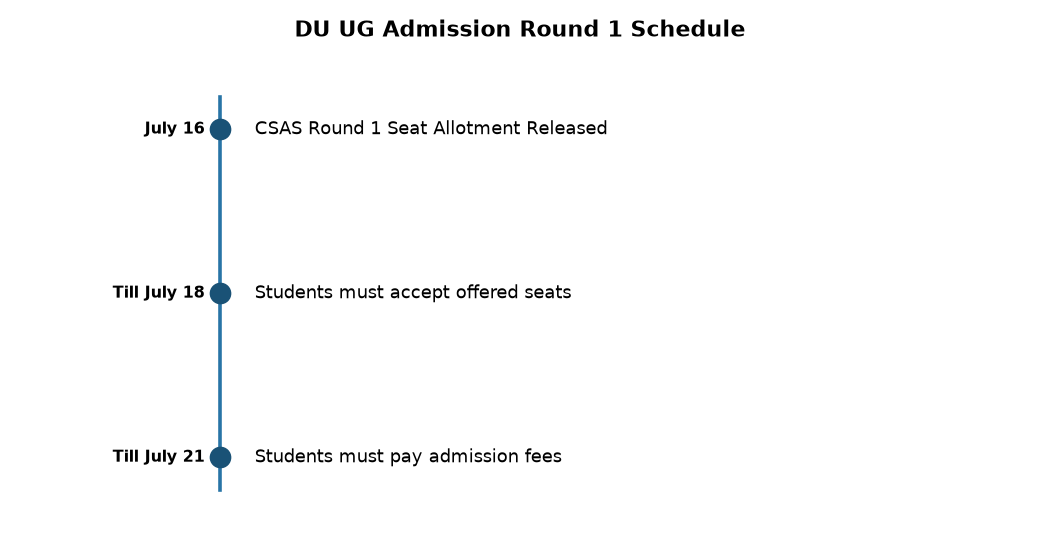
19 Jul DU UG CSAS Round 1 Allotment: 93,033 Students Offered Seats
Subject Relevance — Where This Topic Fits
- GS Paper II — Governance, Social Justice, Education | GS Paper III — Human Resource Development
- Prelims: Common Seat Allocation System (CSAS), Central University Entrance Test (CUET), National Education Policy (NEP) 2020, Higher Education Financing Agency (HEFA), Gross Enrolment Ratio (GER), Reservation Policies, Digital India, Skill India Mission, Equity in Education, Affirmative Action
- Essay: The Role of Technology in Enhancing Educational Access and Equity, Higher Education in India: Challenges and Opportunities for a Demographic Dividend
Quick Revision: Delhi University’s CSAS, powered by CUET scores, is a pivotal step towards democratising higher education access, enhancing transparency, and streamlining admissions, though it must address challenges like the digital divide and equitable reservation implementation for true success.
Why is this in the news?
Delhi University (DU) recently released the first seat allotment list under its Common Seat Allocation System (CSAS) for undergraduate admissions, offering seats to over 93,000 students out of 2.18 lakh applicants. This significant development marks a crucial phase in the admission cycle, highlighting the operationalisation of a centralised, merit-based system designed to streamline the admission process and enhance transparency in one of India’s most sought-after higher education institutions.
Background
- Historically, admissions to Delhi University’s undergraduate programmes were based solely on Class XII board examination marks, leading to inflated cut-offs and intense competition.
- The introduction of the Central University Entrance Test (CUET) in 2022 by the National Testing Agency (NTA) aimed to standardise the evaluation process for admissions into all Central Universities, including DU.
- The Common Seat Allocation System (CSAS) was subsequently implemented by Delhi University to facilitate admissions based on CUET scores, replacing the previous merit-list based system.
- CSAS operates in multiple phases, including application submission, preference filling for courses and colleges, and subsequent seat allocation rounds.
- The system incorporates government-mandated reservation policies for various categories, ensuring equitable access to higher education.
- The current news pertains to the first round of seat allocation for the 2026 academic session, indicating the successful processing of a large volume of applications through the digital platform.
What is the Common Seat Allocation System (CSAS)?
- The Common Seat Allocation System (CSAS) is an online platform developed by Delhi University for undergraduate admissions, integrating CUET scores as the primary criterion for merit.
- It is a three-phase process: Phase I involves submitting the CSAS application form; Phase II requires students to select their preferred courses and colleges; and Phase III involves seat allocation, admission, and fee payment.
- CSAS aims to provide a single-window system for admissions, reducing the complexity and stress associated with applying to multiple colleges individually.
- The system uses a sophisticated algorithm to match student preferences with available seats, considering CUET scores, reservation policies, and programme/college eligibility criteria.
- It ensures transparency by publishing detailed allocation lists and providing a clear timeline for acceptance, document verification, and fee payment.
- CSAS operates in multiple rounds, allowing for subsequent allocations to fill vacant seats and accommodate students who may have upgraded their preferences.
- The system is designed to align with the broader objectives of the National Education Policy (NEP) 2020, promoting equity, access, and quality in higher education.
- It also incorporates provisions for special categories such as Single Girl Child and Orphan students, reflecting an inclusive approach to admissions.
Key Features
| Feature | Significance |
|---|---|
| CUET-based Merit | Ensures a standardised, nationwide assessment of aptitude, reducing disparities arising from varying board examination patterns and marking schemes. |
| Online Application & Preference Filling | Streamlines the application process, enhances accessibility for students from remote areas, and reduces administrative burden on colleges. |
| Algorithm-driven Seat Allocation | Minimises human intervention, increases objectivity, and efficiently matches student preferences with available seats based on merit and reservation. |
| Multi-round Allocation | Provides flexibility for students to upgrade choices and for the university to fill maximum seats, optimising resource utilisation. |
| Integrated Document Verification | Facilitates a smooth transition from allocation to admission, ensuring authenticity of student credentials. |
| Reservation Policy Implementation | Ensures compliance with constitutional mandates for affirmative action, promoting social justice and inclusivity in higher education. |
Why it Matters
Enhancing Equity and Access
- By relying on CUET, CSAS provides a level playing field for students from diverse educational backgrounds across India, mitigating the ‘marks inflation’ issue prevalent in various state boards.
- The online nature of the system democratises access, allowing students from remote and underserved regions to apply to premier institutions like DU without geographical barriers.
- Effective implementation of reservation policies (UR, OBC, SC, ST, EWS, PwBD) ensures that historically marginalised communities gain representation in higher education, aligning with constitutional principles of social justice.
Promoting Transparency and Efficiency
- The algorithm-based allocation system reduces discretion and potential for bias, fostering greater trust in the admission process among applicants and parents.
- A centralised system eliminates the need for students to apply to multiple colleges individually, saving time, effort, and financial resources.
- Clear timelines for seat acceptance, document verification, and fee payment enhance operational efficiency and predictability for both students and the university administration.
Alignment with National Education Policy (NEP) 2020
- CSAS, in conjunction with CUET, embodies NEP 2020’s vision of a holistic, multidisciplinary, and equitable education system by standardising entrance and promoting fair access.
- The emphasis on technology-driven solutions for admissions aligns with NEP’s focus on leveraging digital platforms for educational governance and delivery.
- By facilitating admissions to a wide array of courses and colleges, CSAS supports the NEP’s goal of offering greater flexibility and choice to students in their academic pursuits.
Challenges
1. Digital Divide and Accessibility
- Despite its online nature, students from rural areas or economically weaker sections may face challenges due to limited access to reliable internet, computers, or digital literacy.
- Navigating complex online portals and understanding technical instructions can be daunting for first-generation learners or those without adequate support systems.
UPSC Link: GS Paper II — Social Justice (Digital Literacy)
2. Technical Glitches and System Overload
- High traffic during peak application or allocation periods can lead to server issues, slow website performance, or errors, causing anxiety and inconvenience for applicants.
- Ensuring the robustness and security of the online platform against cyber threats and data breaches is a continuous challenge.
UPSC Link: GS Paper III — Cyber Security, Infrastructure
3. Preference Filling Complexity
- With millions of possible course-college combinations, students often struggle to make informed choices, leading to suboptimal allocations or missed opportunities.
- Lack of adequate career counselling and guidance can exacerbate this issue, particularly for students from less privileged backgrounds.
UPSC Link: GS Paper II — Education (Guidance and Counselling)
4. Reservation Policy Implementation Gaps
- While reservation is mandated, disparities in seat filling rates across categories (e.g., ST and PwBD categories showing lower fill rates) indicate underlying issues in outreach, eligibility, or awareness.
- Ensuring the authenticity of reservation certificates and preventing fraudulent claims remains a challenge for verification authorities.
UPSC Link: GS Paper II — Social Justice (Affirmative Action)
5. Impact on College Autonomy
- Some colleges may perceive a reduction in their autonomy over the admission process, as CSAS centralises decision-making regarding seat allocation.
- The system may not fully account for unique college-specific criteria or preferences that were historically part of their admission process.
UPSC Link: GS Paper II — Governance (Autonomy of Institutions)
Challenges — UPSC Perspective
| Issue | Concern |
|---|---|
| Digital Access Disparity | Exclusion of students lacking internet/device access, exacerbating existing inequalities. |
| Technical Reliability | System crashes or errors during critical phases can disrupt admissions and cause distress. |
| Informed Choice Deficit | Students’ inability to optimally choose preferences due to lack of guidance or information. |
| Reservation Gaps | Lower seat filling rates in certain reserved categories indicate systemic barriers or awareness issues. |
| Document Verification Burden | Manual verification of a large volume of documents can be time-consuming and prone to errors. |
| Post-Allocation Grievances | Managing appeals and grievances from dissatisfied students requires robust redressal mechanisms. |
Government Initiatives — Must-Memorise for Prelims
- National Education Policy (NEP) 2020
- Digital India Programme
- Skill India Mission
- Pradhan Mantri Kaushal Vikas Yojana (PMKVY)
- National Scholarship Portal
- Scheme for Promotion of Academic and Research Collaboration (SPARC)
- Impactful Policy Research in Social Science (IMPRESS)
- Rashtriya Uchchatar Shiksha Abhiyan (RUSA)
- Higher Education Financing Agency (HEFA)
- National Programme on Technology Enhanced Learning (NPTEL)
Way Forward
- Strengthening digital infrastructure and promoting digital literacy, especially in rural and remote areas, to ensure equitable access to online admission platforms.
- Developing user-friendly interfaces and providing multilingual support for the CSAS portal to cater to a diverse student population.
- Implementing robust grievance redressal mechanisms and dedicated helplines to assist students with technical issues and admission-related queries.
- Enhancing career counselling and guidance services, perhaps through AI-powered tools or dedicated mentorship programmes, to help students make informed course and college choices.
- Conducting targeted outreach programmes to raise awareness about CUET and CSAS, particularly among students from historically underserved categories, to improve reservation utilisation.
- Regularly auditing the CSAS algorithm and processes to identify and rectify any biases or inefficiencies, ensuring fairness and transparency.
- Exploring the integration of blockchain technology for secure and tamper-proof document verification, reducing the administrative burden and enhancing trust.
- Fostering greater collaboration between universities, NTA, and state education boards to streamline data exchange and ensure a seamless transition for students.
UPSC Value Addition
Keywords for Mains Answer-Writing
Higher Education Reforms · Digital Governance · Equity and Access · Social Justice · NEP 2020 Implementation · Standardised Testing · Centralised Admissions · Affirmative Action · Human Resource Development · Transparency in Governance · Inclusivity in Education · Technological Integration
Constitutional & Policy Linkages
- Article 15: Prohibition of discrimination
- Article 16: Equality of opportunity in public employment
- Article 21A: Right to Education (for children 6-14, but spirit extends to access)
- Article 46: Promotion of educational and economic interests of SCs, STs, and other weaker sections
- 103rd Constitutional Amendment Act: EWS reservation
- The Central Educational Institutions (Reservation in Admission) Act, 2006: Statutory basis for reservations
Concept Flow
NEP 2020 Vision for Equitable Education → Introduction of CUET for Standardised Assessment → DU’s CSAS for Centralised Online Admissions → Algorithm-based Seat Allocation (Merit + Reservation) → Enhanced Transparency and Efficiency → Increased Access and Equity in Higher Education → Contribution to National Human Resource Development
Prelims Practice Questions
Q1. Consider the following statements regarding the Common Seat Allocation System (CSAS) for undergraduate admissions in Central Universities:
1. CSAS is implemented by the National Testing Agency (NTA) for all Central Universities.
2. Admission through CSAS is primarily based on the scores obtained in the Central University Entrance Test (CUET).
3. The system incorporates government-mandated reservation policies for various categories.
Which of the statements given above is/are correct?
- 1 and 2 only
- 2 and 3 only
- 3 only
- 1, 2 and 3
Answer: 2 and 3 only — Statement 1 is incorrect: CSAS is implemented by individual Central Universities (like DU), while CUET is conducted by NTA. Statement 2 is correct: CUET scores are the primary basis for merit in CSAS. Statement 3 is correct: CSAS adheres to all government-mandated reservation policies.
Q2. Which of the following is NOT a direct objective of implementing a centralised online admission system like CSAS in higher education?
(A) To reduce the digital divide among students.
(B) To enhance transparency in the admission process.
(C) To streamline the application and allocation procedures.
(D) To ensure equitable access to higher education.
- A
- B
- C
- D
Answer: A — While a centralised online system aims to provide access, it does not directly reduce the digital divide; rather, it can expose or exacerbate it if not accompanied by complementary measures. Its direct objectives are transparency, streamlining, and equitable access through a standardised process.
Mains Practice Question
✍ The introduction of the Common Seat Allocation System (CSAS) in conjunction with the Central University Entrance Test (CUET) represents a significant reform in India’s higher education admission landscape. Critically analyse the potential of this system to enhance equity, transparency, and efficiency in university admissions, while also discussing the key challenges in its effective implementation. (250 words)
Approach: Begin by briefly introducing CSAS and CUET as reforms aligning with NEP 2020. In the first part, discuss how CSAS enhances equity (standardised merit, reservation implementation, wider access), transparency (algorithm-based, reduced discretion), and efficiency (centralised, online process). In the second part, critically analyse challenges such as the digital divide, technical glitches, complexity of preference filling, and gaps in reservation utilisation. Conclude with a forward-looking statement on the need for continuous refinement and supportive measures to realise the full potential of these reforms.
Source: amarujala.com
Generated by AanyaAi for educational purpose.

- DFPD extends Special Campaign 6 to achieve governance targets - October 24, 2026
- डीडीडब्ल्यूएस ने जल जीवन मिशन 2.0 के तहत सामुदायिक जल प्रबंधन को मजबूत किया - October 24, 2026
- J&K’s Drug-Free Model & Welfare Schemes: A Blueprint for UPSC Exam - October 24, 2026

No Comments