


11 Oct EAM’s Africa Visit: Key Outcomes for UPSC & State PCS Aspirants
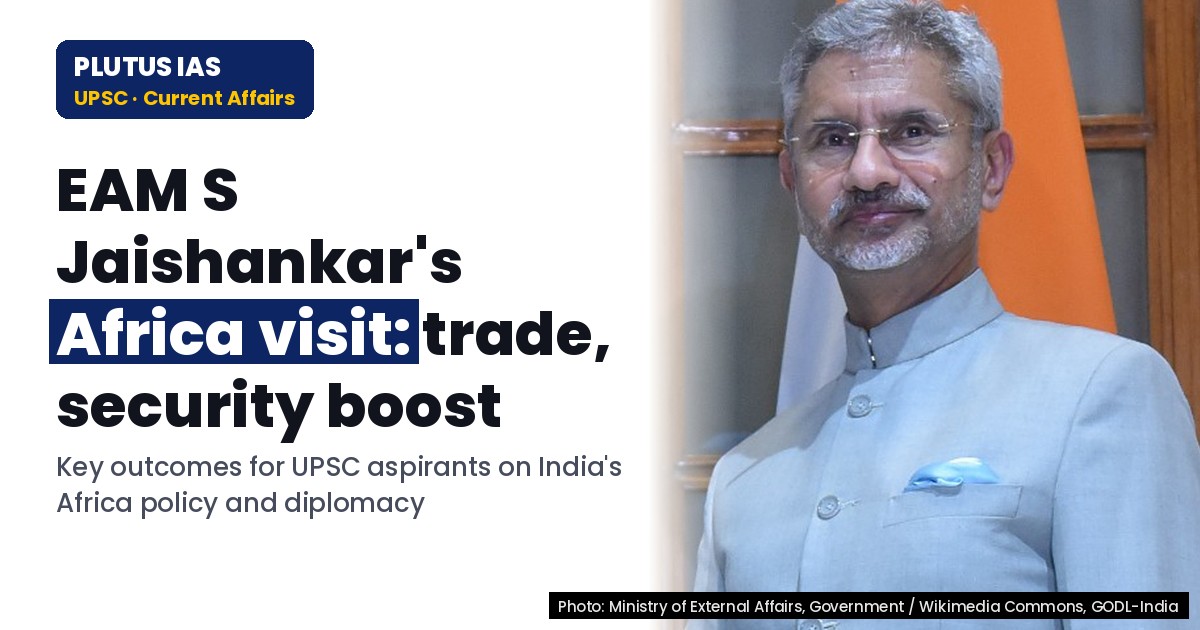
✎ The External Affairs Minister’s visit to Ghana, Côte d’Ivoire, and Ethiopia underscores India’s strategic focus on West Africa and the Horn of Africa, with key priorities in maritime security, trade, investment, and diaspora…
Subject Relevance — Where This Topic Fits
- GS Paper II — International Relations: India-Africa Partnership, Indian Ocean Region (IOR), Maritime Security, South-South Cooperation, Diaspora Engagement | GS Paper II — International Relations: India’s Engagement with West Africa and the Horn of Africa
- Prelims: AfCFTA (African Continental Free Trade Area), Blue Economy, Indian Ocean Rim Association (IORA), Diaspora engagement policy, Maritime security cooperation, India-Africa Forum Summit (IAFS), UNCLOS (United Nations Convention on the Law of the Sea), G20 Common Framework for Debt Treatment
- Essay: The evolving contours of India-Africa relations in the 21st century, Maritime security as a cornerstone of India’s foreign policy in the Indian Ocean
Quick Revision: The External Affairs Minister’s visit to Ghana, Côte d’Ivoire, and Ethiopia underscores India’s strategic focus on West Africa and the Horn of Africa, with key priorities in maritime security, trade, investment, and diaspora engagement.
Why is this in the news?
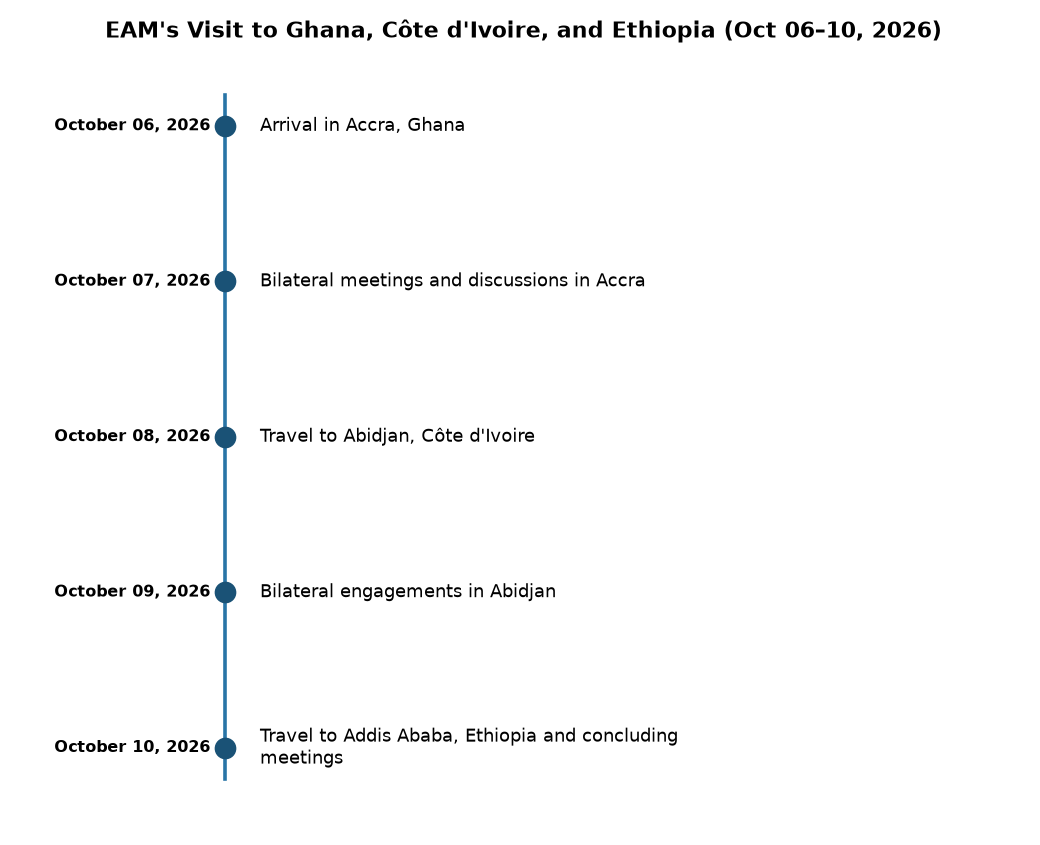
The External Affairs Minister’s visit to Ghana, Côte d’Ivoire, and Ethiopia from October 6–10, 2026, underscores India’s sustained diplomatic engagement with key African nations. This visit, occurring in the context of evolving global geopolitical dynamics, highlights India’s strategic interests in West Africa and the Horn of Africa, including maritime security, trade, and diaspora welfare. The visit also aligns with India’s broader policy of deepening partnerships with African nations through institutional mechanisms such as the India-Africa Forum Summit (IAFS) and the African Union’s Agenda 2063.
Background
- India’s engagement with Africa has historically been rooted in historical ties, shared colonial experiences, and the Non-Aligned Movement (NAM). Post-independence, India’s policy towards Africa has evolved from solidarity-based diplomacy to a strategic partnership focused on trade, investment, and development cooperation.
- The Indian Ocean Region (IOR) is a critical maritime domain for India, with over 90% of India’s trade by volume and 70% by value transiting through the Indian Ocean. Ensuring maritime security in the IOR is a key strategic priority for India.
- India has expressed support for AfCFTA and seeks to leverage it for enhanced trade and investment.
- The Horn of Africa, including Ethiopia, is strategically located along key maritime trade routes, including the Bab el-Mandeb Strait and the Gulf of Aden. Ensuring stability and security in this region is vital for India’s maritime interests.
- India’s diaspora in Africa, particularly in Ghana, Côte d’Ivoire, and Ethiopia, plays a significant role in fostering people-to-people ties and economic linkages. The Indian community in these countries contributes to local economies through trade, entrepreneurship, and professional services.
- The India-Africa Forum Summit (IAFS) serves as the primary institutional mechanism for India-Africa engagement.
Contextualising the External Affairs Minister’s Visit to Ghana, Côte d’Ivoire, and Ethiopia
- The visit to Ghana, Côte d’Ivoire, and Ethiopia is part of India’s broader strategy to strengthen diplomatic, economic, and security ties with African nations. These countries are key partners in West Africa and the Horn of Africa, regions of strategic importance for India.
- Ghana is a significant partner in West Africa, with a stable democracy and a growing economy. It is also home to a large Indian diaspora, which contributes to bilateral trade and investment. Ghana’s strategic location along the Gulf of Guinea makes it a key partner for maritime security cooperation.
- Côte d’Ivoire is a rising economic powerhouse in West Africa, with a robust agricultural sector and growing industrial base. It is a member of the Economic Community of West African States (ECOWAS) and plays a pivotal role in regional economic integration.
- Ethiopia, located in the Horn of Africa, is the second-most populous country in Africa and a key player in regional geopolitics. It is a founding member of the African Union and hosts the African Union Commission in Addis Ababa. Ethiopia’s strategic location and economic potential make it a critical partner for India.
- Maritime security is a key focus of the visit, given the strategic importance of the Indian Ocean and the Red Sea. India seeks to enhance cooperation with these countries on issues such as piracy, illegal fishing, and maritime domain awareness.
- Trade and investment are central to the visit, with both sides expected to explore opportunities in sectors such as agriculture, pharmaceuticals, renewable energy, and infrastructure. India’s pharmaceutical industry, in particular, has a strong presence in these countries.
- Diaspora engagement is another critical aspect of the visit. The Indian diaspora in these countries plays a vital role in fostering people-to-people ties and economic linkages. The visit is likely to include interactions with the Indian community to strengthen these bonds.
- The visit also aligns with India’s broader foreign policy objectives, including the promotion of South-South cooperation, the strengthening of multilateral institutions, and the pursuit of a rules-based international order.
Key Features
| Feature | Significance |
|---|---|
| Diplomatic Engagement with West Africa and East Africa | Demonstrates India’s proactive foreign policy in regions critical for maritime security, energy supplies, and diaspora interests. |
| Focus on Maritime Security and Counter-Piracy | Aligns with India’s broader strategy to safeguard Indian Ocean trade routes and counter non-state threats. |
| Enhancement of Development Partnership | Reinforces India’s commitment to capacity-building in Africa through lines of credit, grants, and technical cooperation. |
| Strengthening of Cultural and Educational Ties | Promotes people-to-people exchanges, scholarships, and academic collaborations under the Indian Technical and Economic Cooperation (ITEC) framework. |
| Exploration of Trade and Investment Opportunities | Seeks to diversify trade partners and reduce reliance on traditional markets amid global economic uncertainties. |
Why it Matters
Economic Significance
- Africa represents a growing market for Indian exports, particularly pharmaceuticals, IT services, and engineering goods.
- Ghana, Côte d’Ivoire, and Ethiopia are key agricultural producers, offering opportunities for Indian agro-processing and food security partnerships.
- Development projects in these nations can create demand for Indian infrastructure firms, including in renewable energy and urban planning.
- Enhanced trade corridors may reduce India’s import dependency on China for critical minerals and raw materials.
Strategic Significance
- Strengthens India’s presence in the Indian Ocean Region (IOR) amid China’s expanding influence through the Belt and Road Initiative (BRI).
- Supports India’s SAGAR (Security and Growth for All in the Region) doctrine by fostering maritime cooperation with African littoral states.
- Facilitates counter-piracy operations and joint naval exercises, ensuring safe passage for Indian merchant vessels.
- Bolsters India’s voice in multilateral forums like the UN, AU, and WTO on issues such as climate finance and global governance.
Diplomatic Significance
- Reinforces India’s ‘Act East’ policy by deepening engagement with African nations beyond traditional partners like South Africa and Nigeria.
- Demonstrates India’s commitment to South-South cooperation and solidarity with the Global South.
- Provides a platform to address shared challenges such as terrorism, climate change, and sustainable development.
- Enhances India’s soft power through cultural diplomacy, scholarships, and capacity-building initiatives.
Geopolitical Significance
- Balances China’s economic and military footprint in Africa, ensuring a multipolar engagement model.
- Strengthens partnerships with nations that share democratic values and institutional stability.
- Aligns with India’s vision of a ‘rules-based international order’ by engaging with like-minded African states.
- Creates opportunities for trilateral and quadrilateral cooperation with partners like the US, EU, and Japan in Africa.
Challenges
1. Competition from Other Major Powers
- China’s extensive investments in infrastructure, loans, and trade agreements pose a strategic challenge to India’s engagement.
- The European Union and the US also prioritise Africa, leading to a crowded diplomatic and economic landscape.
- Limited financial resources compared to China may constrain India’s ability to match concessional financing offers.
UPSC Link: GS II: Bilateral Groupings
2. Infrastructure and Logistics Constraints
- Poor transport connectivity within Africa hampers the efficient movement of goods and services.
- High transaction costs and bureaucratic hurdles in African nations slow down project implementation.
- Inadequate port infrastructure in some West and East African states limits trade expansion.
UPSC Link: GS III: Infrastructure
3. Security and Stability Concerns
- Political instability in parts of West and East Africa, such as coups or insurgencies, risks investment security.
- Terrorism and piracy in the Gulf of Guinea and Horn of Africa threaten maritime trade routes.
- Ethnic and communal tensions may disrupt development projects and bilateral relations.
UPSC Link: GS III: Security Challenges
4. Trade Imbalance and Protectionism
- India’s trade deficit with Africa persists due to limited market access for Indian goods in some sectors.
- Non-tariff barriers, such as stringent quality standards, impede the entry of Indian products.
- Dependence on raw material exports from Africa limits value addition in India’s trade basket.
UPSC Link: GS III: Trade
5. Cultural and Linguistic Barriers
- Diverse languages and cultural norms in Africa require tailored diplomatic and business strategies.
- Limited awareness of African markets among Indian businesses hinders deeper economic engagement.
- Historical colonial legacies in some African nations may influence perceptions of Indian engagement.
UPSC Link: GS II: Soft Power
Challenges — UPSC Perspective
| Issue | Concern |
|---|---|
| Geopolitical Rivalry | Competition with China and other powers for influence in Africa. |
| Infrastructure Gaps | Poor transport and logistics networks hinder trade and investment. |
| Political Instability | Coups, insurgencies, and weak governance threaten project continuity. |
| Trade Protectionism | Non-tariff barriers and tariffs limit market access for Indian goods. |
| Maritime Security Risks | Piracy and terrorism in the Gulf of Guinea and Horn of Africa endanger trade routes. |
| Cultural Misalignment | Diverse languages and customs complicate diplomatic and business interactions. |
Way Forward
- Enhance maritime security cooperation through joint naval exercises and information-sharing mechanisms with Ghana, Côte d’Ivoire, and Ethiopia.
- Expand lines of credit and grants for infrastructure projects in Africa, focusing on renewable energy, agriculture, and healthcare.
- Promote Indian Technical and Economic Cooperation (ITEC) and e-ITEC initiatives to boost skill development and capacity-building.
- Leverage the African Continental Free Trade Area (AfCFTA) to diversify trade and reduce tariff barriers for Indian exports.
- Strengthen cultural diplomacy by expanding scholarships, student exchange programs, and Hindi/African language training initiatives.
- Collaborate with African nations to develop blue economy strategies, including sustainable fishing and coastal tourism.
- Establish a dedicated Africa desk in the Ministry of External Affairs to streamline policy coordination and implementation.
- Encourage Indian businesses to adopt a long-term approach, investing in local partnerships and supply chains in Africa.
UPSC Value Addition
Keywords for Mains Answer-Writing
Indian Foreign Policy · Neighbourhood First Policy · Africa Policy · Engagement with West Africa · Indian Ocean Region · Soft Power Diplomacy · Economic Diplomacy · Cultural Diplomacy · Strategic Partnerships · Multilateralism · Bilateral Agreements · Global South Cooperation
Concept Flow
India’s proactive foreign policy under ‘Act East’ and ‘SAGAR’ doctrines necessitates deeper engagement with Africa. → Economic interests in African markets drive the need for trade diversification and investment opportunities. → Strategic interests in maritime security and counter-piracy require cooperation with African littoral states. → Diplomatic engagement through high-level visits strengthens bilateral ties and multilateral partnerships. → Capacity-building initiatives and soft power tools enhance India’s influence and long-term presence in Africa. → Implementation of development projects and trade agreements translates diplomatic engagement into tangible outcomes. → Sustained political will and resource allocation ensure the durability of India-Africa partnerships amid global competition.
Prelims Practice Questions
Q1. Consider the following statements regarding India’s engagement with African nations:
1. India’s Neighbourhood First Policy explicitly includes African countries within its ambit.
2. The India-Africa Forum Summit (IAFS) is a triennial event aimed at deepening India-Africa cooperation.
3. The African Union is the only regional bloc with which India has signed a Free Trade Agreement.
How many of the above statements are correct?
- Only one
- Only two
- All three
- None
Answer: Only two — Statement 1 is incorrect: India’s Neighbourhood First Policy primarily focuses on South Asian countries. Statement 2 is correct: The India-Africa Forum Summit (IAFS) is held triennially. Statement 3 is incorrect: India has not signed a Free Trade Agreement with the African Union.
Q2. Assertion (A): The Indian Ocean Region is of strategic importance due to its geopolitical and economic significance.
Reason (R): The region accounts for nearly 30% of the world’s oil trade and hosts major shipping lanes.
In the context of the above two statements, which of the following is correct?
- Both A and R are true, and R is the correct explanation of A
- Both A and R are true, but R is not the correct explanation of A
- A is true, but R is false
- A is false, but R is true
Answer: Both A and R are true, but R is not the correct explanation of A — Assertion (A) is true: The Indian Ocean Region is strategically vital. Reason (R) is also true and correctly explains the assertion, as the region’s oil trade share and shipping lanes contribute to its geopolitical importance.
Q3. Match the following pairs of African countries with their respective regional economic communities:
Column I (Country) | Column II (Regional Economic Community)
Ghana | A. East African Community (EAC)
Côte d’Ivoire | B. Economic Community of West African States (ECOWAS)
Ethiopia | C. Southern African Development Community (SADC)
Choose the correct match:
- 1-B, 2-A, 3-C
- 1-C, 2-B, 3-A
- 1-B, 2-C, 3-A
- 1-A, 2-B, 3-C
Answer: 1-B, 2-A, 3-C — Ghana is part of ECOWAS (West Africa), Côte d’Ivoire is also part of ECOWAS, and Ethiopia is part of the EAC (East Africa).
Mains Practice Question
✍ The recent visit of the External Affairs Minister (EAM) to Ghana, Côte d’Ivoire, and Ethiopia underscores India’s growing engagement with West Africa and the Horn of Africa. In this context, critically examine India’s Africa policy, highlighting its strategic, economic, and diplomatic dimensions. Also, assess the role of soft power and cultural diplomacy in strengthening India-Africa relations. (15 Marks)
Approach: MODEL-ANSWER SKELETON:
1. **Introduction**: Briefly define India’s Africa policy, its evolution, and the significance of the EAM’s visit to Ghana, Côte d’Ivoire, and Ethiopia (October 2026).
2. **Strategic Dimensions**:
– Discuss India’s strategic interests in Africa, including the Indian Ocean Region (IOR) and maritime security.
– Highlight India’s role in the Indian Ocean Rim Association (IORA) and its engagement with African nations on counter-terrorism and piracy.
– Reference India’s participation in the Quadrilateral Security Dialogue (Quad) and its implications for Africa.
3. **Economic Dimensions**:
– Examine India’s trade and investment ties with Africa, including the role of the EXIM Bank and Lines of Credit (LoCs).
– Discuss the India-Africa Trade Agreement and its impact on bilateral economic relations.
– Highlight sectors such as agriculture, pharmaceuticals, and renewable energy where India’s engagement is prominent.
4. **Diplomatic Dimensions**:
– Outline the institutional framework of India-Africa relations, including the India-Africa Forum Summit (IAFS) and its outcomes.
– Discuss the role of the African Union (AU) in shaping India’s engagement with the continent.
– Assess the impact of recent diplomatic initiatives, such as the India-Africa Health Summit and the India-Africa Youth Summit.
5. **Soft Power and Cultural Diplomacy**:
– Explain the role of soft power in India’s Africa policy, including the Indian Technical and Economic Cooperation (ITEC) programme and the Indian Council for Cultural Relations (ICCR).
– Discuss the significance of people-to-people ties, including the Indian diaspora in Africa and cultural exchanges.
– Highlight the role of Bollywood, yoga, and traditional Indian medicine (AYUSH) in fostering cultural diplomacy.
6. **Challenges and Criticisms**:
– Identify challenges such as competition with other global powers (e.g., China, USA) in Africa.
– Discuss criticisms of India’s Africa policy, including the lack of a cohesive long-term strategy and limited trade diversification.
7. **Conclusion**: Summarize the key points and provide a balanced assessment of India’s Africa policy, emphasizing its strengths and areas for improvement.
Source: Ministry of External Affairs
Generated by AanyaAi for educational purpose.
Related guides on our sites
- Current affairs for upsc 2026
- Best PSIR optional coaching for upsc
- Best PSIR optional teacher for upsc
- Best teacher of PSIR optional for upsc

- सुप्रीम कोर्ट ने शिक्षक भर्ती में ट्रांसजेंडर्स को शामिल न करने पर सरकार से पूछा सवाल - October 20, 2026
- SBI SCO 2026 Recruitment: AI & Tech Posts Open for Experts - October 20, 2026
- दिल्ली में प्रदूषण नियंत्रण: 1 नवंबर से लागू होंगे 10 प्रमुख उपाय - October 20, 2026

No Comments