


29 Sep ECINET & ERONET: Election Commission’s Electoral Roll Systems Explained
✎ ERONET and ECINET are centralised digital platforms of the Election Commission designed to manage electoral rolls, but concerns persist over the centralisation of decision-making authority, which may undermine the statutory…
Subject Relevance — Where This Topic Fits
- GS Paper II — Constitutional and Statutory Bodies (Election Commission of India) | GS Paper III — Electoral Reforms, Governance and Transparency in Public Institutions
- Prelims: ERONET, ECINET, Electoral Registration Officer (ERO), Special Intensive Revision (SIR), Representation of the People Act, 1950, Registration of Electors Rules, 1960, Section 21(3) RP Act, decentralised electoral roll management, centralised database
- Essay: Electoral Integrity and Democratic Governance: The Role of Technology in Ensuring Transparency and Accountability
Quick Revision: ERONET and ECINET are centralised digital platforms of the Election Commission designed to manage electoral rolls, but concerns persist over the centralisation of decision-making authority, which may undermine the statutory powers of Electoral Registration Officers (EROs) during the Special Intensive Revision process.
Why is this in the news?
The Election Commission’s digital platforms for electoral roll management—ERONET and ECINET—have come under scrutiny following concerns raised by Election Commissioners regarding the curtailment of statutory powers of Electoral Registration Officers (EROs) during the Special Intensive Revision (SIR) process. A recent investigation and subsequent correspondence from the Maharashtra Chief Electoral Officer highlight systemic issues in the software’s design, including the centralisation of decision-making authority and the marginalisation of EROs’ discretionary powers, which are constitutionally and statutorily mandated under the Representation of the People Act, 1950, and the Registration of Electors Rules, 1960.
Background
- The Election Commission of India (ECI) is constitutionally mandated (Article 324) to supervise, direct, and control the preparation of electoral rolls and the conduct of elections in India.
- Electoral rolls are revised periodically to ensure accuracy, inclusivity, and the removal of duplicate, deceased, or ineligible entries. The process includes both summary revisions (annual updates) and intensive revisions (fresh preparation of rolls) as directed by the ECI under Section 21(3) of the Representation of the People Act, 1950.
- Historically, electoral roll management was decentralised, with state and district-level officers (ERO) exercising significant discretion in updating rolls based on local verification and public hearings.
- The introduction of digital platforms like ERONET and ECINET aimed to streamline processes, reduce errors, and enhance efficiency by consolidating multiple legacy systems into a centralised framework.
- The Special Intensive Revision (SIR) process is a critical phase in electoral roll preparation, involving door-to-door verification and public hearings to address discrepancies and ensure the inclusion of genuine voters.
What are ECINET and ERONET, and how do they function within the electoral roll management ecosystem?
- ECINET (Electoral Commission Integrated Network) is the Election Commission’s centralised software platform designed to integrate and manage electoral roll data across states, replacing 36 disparate legacy systems. It serves as the backbone for data storage, processing, and analytics related to voter registration, migration, and deletion.
- ERONET (Electoral Roll Online Network) is a centralised form-processing system that enables Electoral Registration Officers (EROs) to handle voter registration, migration requests, and deletion of names from electoral rolls. It is intended to assist EROs in executing their statutory duties under the Representation of the People Act, 1950, and the Registration of Electors Rules, 1960.
- Both platforms are part of the ECI’s broader digital transformation initiative to modernise electoral roll management, improve accuracy, and reduce manual errors in the preparation and revision of electoral rolls.
- ERONET and ECINET are interconnected: ERONET processes individual applications (e.g., new registrations, corrections, deletions), while ECINET aggregates and stores this data centrally, enabling cross-state comparisons and analytics.
- The platforms utilise digital signatures, Aadhaar-based authentication, and geospatial mapping to verify voter identities and addresses, aligning with the ECI’s goal of leveraging technology for electoral integrity.
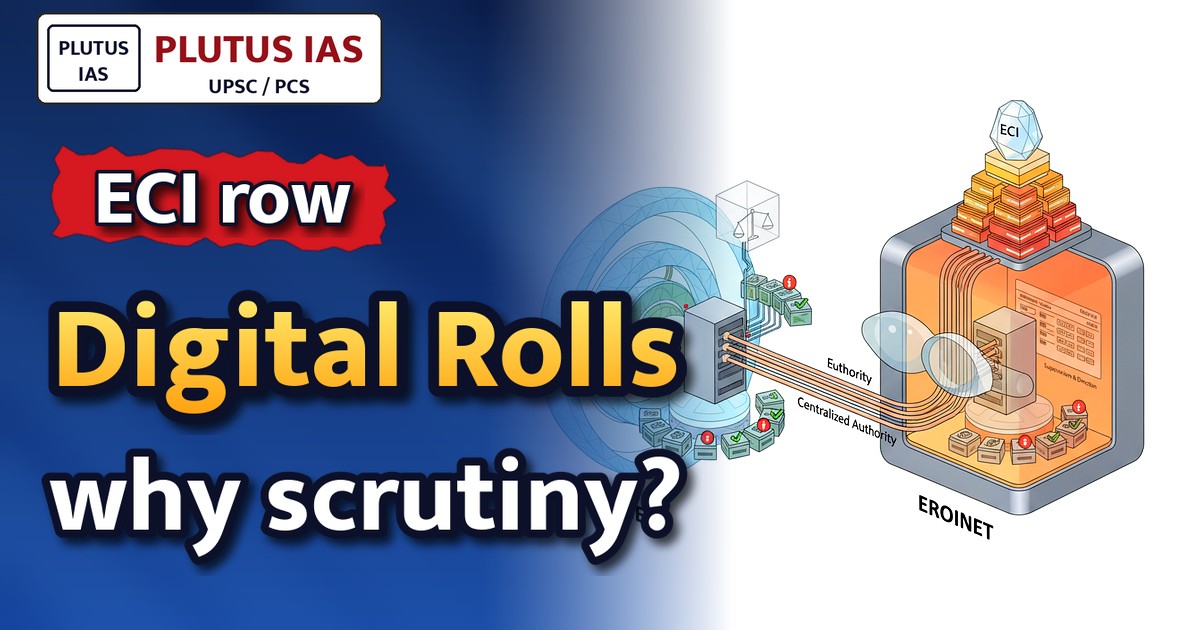
- Critically, the software’s design has been scrutinised for centralising decision-making authority, where final approvals for name inclusions, deletions, or corrections are routed through centralised nodes in New Delhi rather than being delegated to EROs, who are statutorily empowered to make these decisions at the local level.
- The Special Intensive Revision (SIR) process relies heavily on these platforms for data collection, verification, and public hearings, making their functionality and governance structure pivotal to the integrity of the electoral roll.
Key Features
| Feature | Significance |
|---|---|
| ERONET (Electoral Roll Online Network and Tracking) | Centralized digital platform replacing 36 disparate state systems for voter registration, migration, and deletion, ensuring uniformity and reducing duplication in electoral roll management. |
| ECINET (Electoral Commission Information Network) | Integrated platform linking ERONET with backend databases, enabling real-time data sharing between the Election Commission, state electoral authorities, and district-level EROs for seamless roll revision. |
| Special Intensive Revision (SIR) Module | Dedicated sub-system within ECINET/ERONET for conducting intensive electoral roll revisions under Section 21(3) of the Representation of the People Act, 1950, with provisions for public hearings and grievance redressal. |
| Logical Discrepancy Detection | AI-driven algorithm within ECINET that flags inconsistencies in voter data (e.g., duplicate entries, mismatched addresses) for manual review by EROs, reducing human error in roll preparation. |
| Decentralized Decision-Making Interface | Proposed enhancement to ECINET allowing EROs to exercise statutory powers (e.g., finalizing deletions/additions) without central approval, restoring local autonomy in electoral roll management. |
Why it Matters
Electoral Integrity
- Ensures accuracy and timeliness of electoral rolls, a critical prerequisite for free and fair elections under Article 324 of the Constitution.
- Reduces systemic errors in voter registration through centralized validation, mitigating risks of disenfranchisement or fraudulent inclusions.
- Facilitates transparency by enabling public scrutiny of roll revisions through digital interfaces and grievance redressal mechanisms.
Administrative Efficiency
- Replaces fragmented state-level systems with a unified platform, streamlining data exchange between 36 disparate databases and reducing administrative overhead.
- Automates routine tasks (e.g., address updates, migration requests), allowing EROs to focus on complex cases requiring manual intervention.
- Enables real-time monitoring of roll revision progress, improving accountability in the SIR process.
Technological Governance
- Demonstrates the Election Commission’s adoption of digital governance tools to modernize electoral processes, aligning with the ‘Digital India’ vision.
- Highlights challenges in balancing automation with statutory autonomy, particularly in decentralized democratic systems like India’s.
- Serves as a case study for other constitutional bodies in leveraging technology for citizen-centric service delivery.
Challenges
1. Centralization vs. Decentralization
- Concerns over ‘gradual centralisation’ of electoral roll data, which may undermine the statutory autonomy of EROs under the Representation of the People Act, 1950.
- Risk of over-reliance on algorithmic decisions in ECINET, potentially sidelining local discretion in resolving voter disputes.
- Need to balance efficiency gains from centralization with the constitutional mandate for decentralized electoral administration.
UPSC Link: GS2: Constitutional bodies
2. Data Integrity and Security
- Vulnerability of centralized databases to cyber threats, given the sensitivity of voter data and the potential for electoral manipulation.
- Challenges in ensuring interoperability between ECINET/ERONET and legacy state systems, risking data inconsistencies or corruption.
- Requirement for robust audit trails to prevent unauthorized alterations to electoral rolls during revision processes.
UPSC Link: GS3: Cybersecurity
3. Public Trust and Transparency
- Perception of opacity in algorithmic decision-making within ECINET, particularly in cases of logical discrepancies or voter deletions.
- Need for proactive disclosure of data sources, validation criteria, and appeal mechanisms to maintain public confidence in electoral rolls.
- Addressing concerns raised by political stakeholders regarding perceived bias in software-driven roll revisions.
UPSC Link: GS2: Election Commission
4. Capacity Building and Training
- Inadequate training for EROs and state officials on ECINET/ERONET, leading to underutilization or misuse of the platform’s features.
- Requirement for continuous upskilling to adapt to evolving technological demands in electoral roll management.
- Need for standardized operating procedures across states to ensure consistent implementation of the SIR process.
UPSC Link: GS2: Governance
5. Legal and Procedural Gaps
- Ambiguity in the Representation of the People Act, 1950, and Registration of Electors Rules, 1960, regarding the extent of EROs’ powers in software-driven revisions.
- Lack of clear guidelines on the role of the Election Commission in overriding ERO decisions via ECINET, leading to jurisdictional conflicts.
- Need for legislative or regulatory amendments to codify the use of digital tools in electoral roll management.
UPSC Link: GS2: Constitutional provisions
Challenges — UPSC Perspective
| Issue | Concern |
|---|---|
| Algorithmic Bias | Risk of ECINET’s logical discrepancy detection disproportionately flagging certain voter segments (e.g., marginalized communities) for manual review. |
| Data Localization | Challenges in synchronizing ECINET with state-specific voter databases, particularly in states with distinct linguistic or demographic profiles. |
| Appeal Redressal Delays | Potential bottlenecks in processing appeals against ECINET-driven deletions/additions due to centralized decision-making. |
| Hardware and Connectivity | Dependence on robust internet infrastructure and hardware at the grassroots level, which may be lacking in remote or resource-constrained areas. |
| Stakeholder Skepticism | Resistance from political parties or civil society groups to software-driven roll revisions, citing concerns over electoral fairness. |
| Regulatory Lag | Outdated legal frameworks failing to address the nuances of digital electoral roll management, creating compliance ambiguities. |
Way Forward
- Amend the Representation of the People Act, 1950, and Registration of Electors Rules, 1960, to explicitly delineate the powers of EROs in software-driven revisions, ensuring statutory autonomy.
- Conduct independent audits of ECINET/ERONET’s algorithms to identify and mitigate biases, with results published in the public domain.
- Establish a multi-stakeholder committee comprising EROs, technologists, and civil society representatives to oversee the implementation of digital tools in electoral rolls.
- Launch nationwide capacity-building programs for EROs and state officials on ECINET/ERONET, with periodic refresher courses to adapt to technological updates.
- Develop a standardized manual for the SIR process, incorporating digital tools while preserving the principles of transparency and public participation.
- Enhance cybersecurity protocols for ECINET/ERONET, including encryption, multi-factor authentication, and regular penetration testing.
- Introduce a grievance redressal portal linked to ECINET, enabling voters to track the status of their appeals in real time.
- Pilot decentralized decision-making modules in select states to evaluate their efficacy before nationwide rollout.
UPSC Value Addition
Keywords for Mains Answer-Writing
Electoral Rolls · Election Commission of India · ERONET · ECINET · Special Intensive Revision (SIR) · Electoral Registration Officer (ERO) · Representation of the People Act, 1950 · Registration of Electors Rules, 1960 · decentralisation of electoral rolls · digital governance in elections · voter registration systems · electoral roll management · Section 21(3) RP Act · statutory powers of EROs · electoral roll integrity
Constitutional & Policy Linkages
- [‘Article 324: Superintendence of elections by the Election Commission.’]
- [‘Article 325: Prohibition of discrimination in electoral rolls.’]
- [‘Article 326: Elections to the House of the People and Legislative Assemblies on the basis of adult suffrage.’]
Concept Flow
Constitutional Mandate for Electoral Rolls → Representation of the People Act, 1950 (Section 21(3)) and Registration of Electors Rules, 1960 authorize EROs to prepare and revise rolls. → Statutory Powers of EROs → EROs (typically SDMs) hear claims/objections and finalize voter inclusions/deletions under decentralized administration. → Fragmentation of Systems → Pre-ERONET/ECINET era: 36 disparate state databases led to inconsistencies, duplication, and inefficiencies in roll management. → Digital Transformation → ERONET centralizes voter registration/migration/deletion; ECINET integrates backend databases for real-time data sharing. → Algorithmic Intervention → ECINET’s logical discrepancy detection flags inconsistencies, but raises concerns over centralization of decision-making. → Public Scrutiny and Grievances → SIR process involves hearings and appeals, with transparency requirements under electoral law. → Way Forward → Amendments to laws, audits, capacity building, and decentralized modules to balance technology with statutory autonomy.
Prelims Practice Questions
Q1. Consider the following statements regarding the Special Intensive Revision (SIR) of electoral rolls in India:
1. The SIR process is mandated under Section 21(3) of the Representation of the People Act, 1950.
2. The SIR process involves preparing the electoral roll afresh for a constituency.
3. The SIR process is conducted annually and before each Lok Sabha and state Assembly election.
How many of the above statements are correct?
- Only one
- Only two
- Only three
- None
Answer: Only three — Statements 1 and 2 are correct. Statement 3 is incorrect because the SIR process is not conducted annually; it is conducted as and when directed by the Election Commission of India.
Q2. Assertion (A): The Election Commission of India has recently centralised the management of electoral rolls through digital platforms like ERONET and ECINET.
Reason (R): The centralisation is intended to streamline the voter registration process and reduce discrepancies in electoral rolls.
- Both A and R are true, and R is the correct explanation of A
- Both A and R are true, but R is not the correct explanation of A
- A is true, but R is false
- A is false, but R is true
Answer: Both A and R are true, but R is not the correct explanation of A — Both the assertion and reason are true. The centralisation of electoral roll management through ERONET and ECINET is aimed at streamlining the process and reducing discrepancies, as highlighted in recent reports.
Q3. Match the following electoral roll systems with their respective functions:
Column I
A. ERONET
B. ECINET
C. Special Intensive Revision (SIR)
Column II
1. Centralised form processing system for handling voter registration, migration, and deletion
2. Digital platform for managing and revising electoral rolls, including the SIR process
3. Process of preparing the electoral roll afresh as directed by the Election Commission
- {‘A’: ‘1’, ‘B’: ‘2’, ‘C’: ‘3’}
- {‘A’: ‘1’, ‘B’: ‘3’, ‘C’: ‘2’}
- {‘A’: ‘2’, ‘B’: ‘1’, ‘C’: ‘3’}
- {‘A’: ‘3’, ‘B’: ‘2’, ‘C’: ‘1’}
Answer: {‘A’: ‘1’, ‘B’: ‘2’, ‘C’: ‘3’} — ERONET is a centralised form processing system (A-1). ECINET is a digital platform for managing and revising electoral rolls (B-2). The Special Intensive Revision (SIR) is a process of preparing the electoral roll afresh (C-3).
Mains Practice Question
✍ The Election Commission of India has recently introduced digital platforms such as ERONET and ECINET to manage and revise electoral rolls. Critically examine the implications of this centralisation on the statutory powers of the Electoral Registration Officers (EROs) and the integrity of the electoral roll preparation process. Also, analyse the constitutional and statutory framework governing the revision of electoral rolls in India. (15 Marks)
Approach: MODEL-ANSWER SKELETON:
1. **Constitutional and Statutory Framework**:
– Reference Section 21(3) of the Representation of the People Act, 1950, which empowers the Election Commission to direct a special revision of electoral rolls.
– Cite the Registration of Electors Rules, 1960, which governs the process of electoral roll revision, including intensive and summary revisions.
– Highlight the role of the Electoral Registration Officer (ERO) as a statutory authority responsible for preparing and updating the electoral roll (Representation of the People Act, 1950; Registration of Electors Rules, 1960).
2. **Digital Platforms and Centralisation**:
– Explain ERONET as a centralised form processing system for voter registration, migration, and deletion.
– Describe ECINET as a digital platform for managing and revising electoral rolls, including the Special Intensive Revision (SIR) process.
– Discuss the implications of centralisation on the ERO’s statutory powers, including concerns raised about the curtailment of EROs’ decision-making authority (as reported in recent news).
3. **Impact on Electoral Roll Integrity**:
– Analyse the potential benefits of digitalisation, such as reduced discrepancies, improved efficiency, and enhanced transparency.
– Examine the risks associated with centralisation, including the erosion of decentralised decision-making, challenges in addressing localised discrepancies, and the need for robust oversight mechanisms.
4. **Balancing Centralisation and Decentralisation**:
– Discuss the importance of maintaining a balance between centralised digital platforms and the need for localised decision-making to address ground-level realities.
– Reference recent concerns raised by Election Commissioners about the ‘gradual centralisation’ of the electoral roll database and its impact on the integrity of the electoral process.
5. **Conclusion**:
– Summarise the need for a balanced approach that leverages digital platforms while preserving the statutory autonomy of EROs.
– Emphasise the importance of transparency, accountability, and periodic review to ensure the integrity of the electoral roll preparation process.
Source: The Indian Express
Generated by AanyaAi for educational purpose.
Related guides on our sites
- Anthropology VS PSIR
- Best PSIR optional coaching
- Best PSIR optional coaching online
- Best PSIR optional teacher

- India-South Korea Defence Logistics: 10th Joint Committee Meeting Outcomes - September 30, 2026
- एनजीटी ने हजारीबाग जिलाधिकारी को दिया नोटिस, ओकनी तालाब पुनरुद्धार में हुई लापरवाही - September 30, 2026
- Women and Transgender Changemakers in Swachhata Mission - September 30, 2026

No Comments