


05 Sep ECLGS 5.0: Govt Boosts ₹2.55L Cr Credit for MSMEs & Airlines
✎ ECLGS 5.0 is a government-backed credit guarantee scheme providing 100% guarantees to member lending institutions for additional working capital loans to eligible businesses, including MSMEs and scheduled passenger airlines, with…
Subject Relevance — Where This Topic Fits
- GS Paper III — Indian Economy: Growth, Development and Employment | GS Paper III — Government Budgeting and Fiscal Policy | GS Paper III — MSMEs and Industrial Policy | GS Paper III — Banking Sector Reforms and Financial Inclusion
- Prelims: Emergency Credit Line Guarantee Scheme (ECLGS), National Credit Guarantee Trustee Company (NCGTC), MSMEs, Working Capital, Credit Guarantee, Liquidity Support, Supply Chain Resilience, Scheduled Passenger Airlines
- Essay: Economic resilience in the face of global disruptions: The role of targeted fiscal interventions, Balancing fiscal prudence and economic stimulus: Lessons from India’s credit guarantee schemes
Quick Revision: ECLGS 5.0 is a government-backed credit guarantee scheme providing 100% guarantees to member lending institutions for additional working capital loans to eligible businesses, including MSMEs and scheduled passenger airlines, with a target of facilitating ₹2.55 lakh crore in additional credit flow.
Why is this in the news?
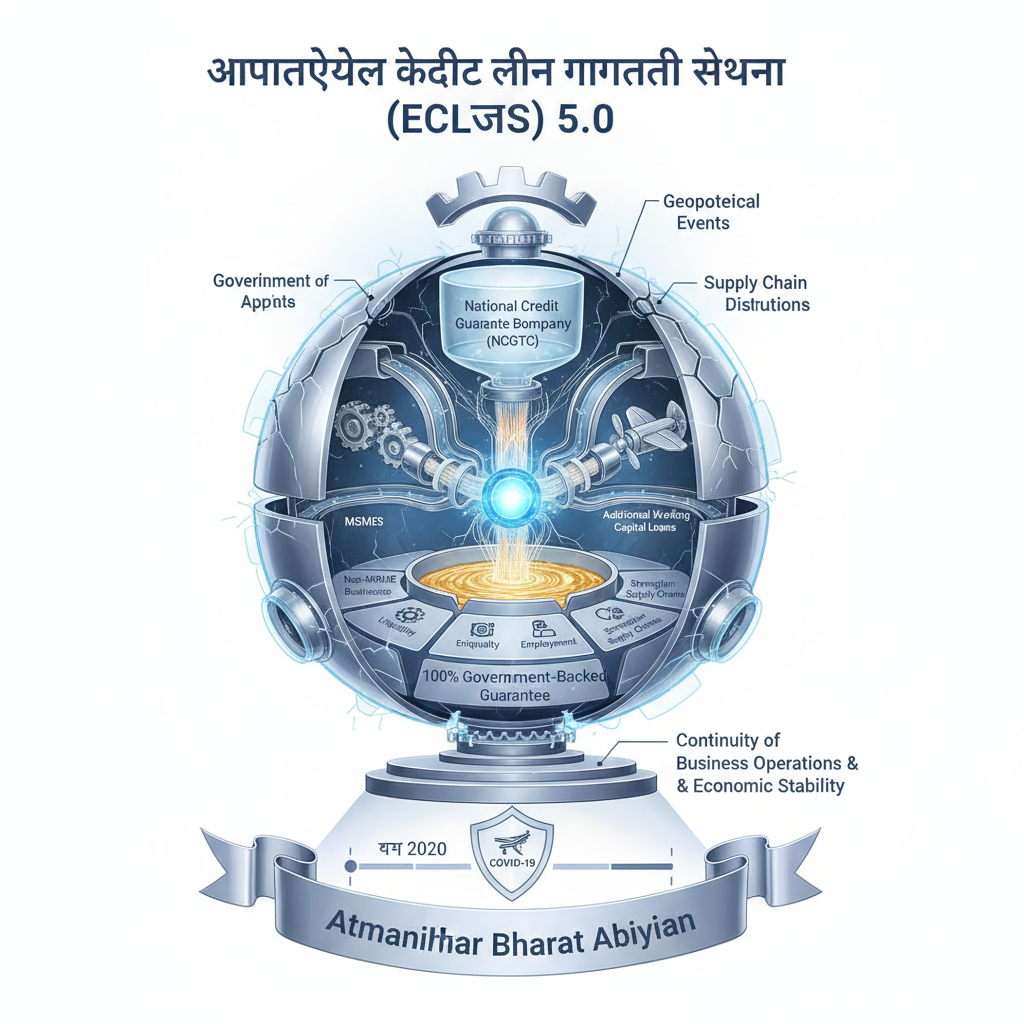
The Government of India has approved the Emergency Credit Line Guarantee Scheme (ECLGS) 5.0 to provide targeted credit guarantee support to businesses affected by external economic disruptions. Implemented by the National Credit Guarantee Trustee Company (NCGTC), this scheme aims to enhance liquidity, safeguard employment, and strengthen supply chains by facilitating additional working capital loans to eligible borrowers, including MSMEs, non-MSME businesses, and scheduled passenger airlines. The scheme is designed to address challenges arising from geopolitical events and supply chain disruptions, ensuring continuity of business operations and economic stability.
Background
- The ECLGS was launched in वर्ष 2020 under the Atmanirbhar Bharat Abhiyan to mitigate the financial distress caused by the COVID-19 pandemic, providing 100% government-backed guarantees to member lending institutions for additional credit to eligible borrowers.
- The scheme has evolved through four phases (ECLGS 1.0 to 4.0), expanding its coverage to include MSMEs, non-MSME businesses, healthcare infrastructure, hospitality, travel, tourism, aviation, and other sector-specific needs based on evolving economic conditions.
- External economic shocks, such as geopolitical tensions, supply chain disruptions, and logistical cost escalations, continue to pose risks to business operations, liquidity, and employment, necessitating targeted interventions like ECLGS 5.0.
- The scheme is implemented by the National Credit Guarantee Trustee Company (NCGTC).
- ECLGS 5.0 aligns with the broader objective of enhancing India’s economic resilience by ensuring uninterrupted domestic production, flexible supply chains, and sustained employment during periods of external disruptions.
What is the Emergency Credit Line Guarantee Scheme (ECLGS) 5.0?
- ECLGS 5.0 is a government-backed credit guarantee scheme designed to provide additional working capital loans to eligible businesses affected by external economic disruptions, including geopolitical events and supply chain challenges.
- The scheme is implemented by the National Credit Guarantee Trustee Company (NCGTC), which offers 100% government-backed guarantees to member lending institutions for loans extended to eligible borrowers.
- Eligible borrowers include MSMEs, non-MSME businesses, and scheduled passenger airlines, with a focus on ensuring liquidity support, employment preservation, and supply chain resilience.
- The scheme aims to facilitate additional credit flow of up to ₹2.55 lakh crore, subject to eligibility and credit assessment by member lending institutions.
- ECLGS 5.0 builds on the foundations of ECLGS 1.0 to 4.0, which were launched during the COVID-19 pandemic to support businesses facing financial distress and liquidity constraints.
- Digital access to the scheme is facilitated through the Jan Samarth portal, enhancing transparency, accessibility, and ease of application for eligible borrowers.
- The scheme is part of a broader fiscal strategy to balance economic stimulus with fiscal prudence, ensuring targeted support to sectors most vulnerable to external disruptions.
Key Features
| Feature | Significance |
|---|---|
| Eligibility Expansion | Includes MSMEs, non-MSME businesses, and scheduled passenger airlines affected by external disruptions, broadening sectoral coverage beyond pandemic-specific phases. |
| Credit Guarantee Mechanism | Government-backed 100% credit guarantee to member lending institutions reduces their risk, enabling disbursal of additional working capital loans up to ₹2.55 lakh crore. |
| Digital Accessibility | Facilitated through the Jan Samarth portal, ensuring streamlined application and disbursement processes for borrowers. |
| Liquidity Support | Aims to address short-term operational and financial commitments, safeguarding employment and supply chains during external economic shocks. |
| Sector-Specific Focus | Prioritises sectors vulnerable to geopolitical and supply chain disruptions, such as hospitality, aviation, and healthcare infrastructure. |
Why it Matters
Macroeconomic Stability
- Mitigates liquidity crunch in critical sectors, preventing cascading disruptions in supply chains and employment.
- Enhances resilience of MSMEs and allied industries, which contribute ~30% to India’s GDP and employ ~110 million workers.
- Reduces systemic risk in financial institutions by absorbing credit shocks through sovereign-backed guarantees.
Structural Reforms
- Demonstrates adaptive policymaking, evolving from pandemic-specific interventions (ECLGS 1.0–4.0) to a broader risk-mitigation framework.
- Strengthens institutional credit access for underserved segments, aligning with the ‘Atmanirbhar Bharat’ vision of self-reliance.
- Leverages digital public infrastructure (Jan Samarth portal) to improve transparency and reduce transaction costs.
Global Context
- Addresses vulnerabilities exposed by geopolitical tensions (e.g., supply chain fragmentation, inflationary pressures).
- Aligns with global best practices in counter-cyclical credit guarantees, as seen in programmes like the US Paycheck Protection Program.
- Supports India’s commitment to maintaining growth momentum amid external headwinds, as articulated in the IMF’s Article IV consultations.
Challenges
1. Credit Disbursement Bottlenecks
- Risk of delayed or incomplete loan disbursals due to bureaucratic hurdles in member lending institutions.
- Potential exclusion of micro-enterprises lacking formal documentation or digital access.
UPSC Link: Economic Survey: Credit Market Imperfections
2. Fiscal Sustainability
- Long-term fiscal burden from sovereign guarantees, particularly if default rates exceed projections.
- Need for robust monitoring mechanisms to prevent misuse of funds under the guarantee scheme.
UPSC Link: FRBM Act: Fiscal Responsibility
3. Sectoral Imbalances
- Disproportionate benefit to larger firms within eligible sectors, exacerbating MSME competitiveness gaps.
- Limited coverage for informal or unorganised sectors critical to employment generation.
UPSC Link: NITI Aayog: MSME Growth Strategy
4. Regulatory Arbitrage
- Possibility of regulatory arbitrage by lending institutions exploiting loopholes in eligibility criteria.
- Need for stringent post-disbursal audits to ensure funds are utilised for intended purposes.
UPSC Link: RBI: Priority Sector Lending Guidelines
Challenges — UPSC Perspective
| Issue | Concern |
|---|---|
| Eligibility Ambiguity | Risk of misclassification of borrowers, leading to either exclusion of deserving entities or inclusion of ineligible ones. |
| Guarantee Utilisation | Potential underutilisation of the ₹2.55 lakh crore corpus due to risk-averse lending practices by banks. |
| Digital Divide | Exclusion of micro-enterprises in rural or remote areas lacking access to Jan Samarth portal or formal banking channels. |
| Default Risk | Higher default probabilities in sectors with volatile cash flows (e.g., hospitality, aviation) post-guarantee expiry. |
| Monitoring Gaps | Lack of real-time tracking of loan utilisation and end-use, raising concerns over fund leakage. |
Way Forward
- Institutionalise a real-time dashboard for tracking loan disbursements, utilisation, and repayment under ECLGS 5.0 to enhance transparency.
- Expand digital literacy programmes for MSMEs to ensure equitable access to the Jan Samarth portal and reduce exclusion risks.
- Conduct periodic stress tests of member lending institutions to assess their capacity to absorb potential defaults under the guarantee scheme.
- Integrate ECLGS 5.0 with existing schemes like the Credit Guarantee Fund Trust for Micro and Small Enterprises (CGTMSE) for seamless coverage.
- Establish a dedicated grievance redressal mechanism for borrowers facing delays or rejections in loan applications.
- Align ECLGS 5.0 with the Reserve Bank of India’s (RBI) guidelines on priority sector lending to prevent regulatory arbitrage.
- Develop sector-specific guidelines for utilisation of funds to ensure alignment with broader economic resilience goals.
- Mandate quarterly reviews of the scheme’s impact on employment and supply chain stability, with findings published in the Economic Survey.
UPSC Value Addition
Keywords for Mains Answer-Writing
Emergency Credit Line Guarantee Scheme (ECLGS) · National Credit Guarantee Trustee Company (NCGTC) · MSME sector · Credit guarantee mechanism · Liquidity support for businesses · Supply chain resilience · Atmanirbhar Bharat Abhiyan · Working capital financing · Government-backed credit guarantees · Economic resilience during external shocks · Scheduled passenger airlines · Non-MSME eligible borrowers · Digital access through Jan Samarth portal · Business continuity during disruptions · Credit risk mitigation for lenders
Concept Flow
External economic shocks (geopolitical tensions, supply chain disruptions) → Liquidity crunch in businesses → Reduced operational capacity and employment risks → Government intervention via ECLGS 5.0 → Credit guarantee mechanism to member lending institutions → Additional working capital disbursal → Business continuity and supply chain resilience → Macroeconomic stability and sustained growth.
Prelims Practice Questions
Q1. Consider the following statements regarding the Emergency Credit Line Guarantee Scheme (ECLGS):
1. ECLGS is implemented by the National Credit Guarantee Trustee Company (NCGTC).
2. ECLGS provides 100% government-backed guarantees to lenders for additional credit to MSMEs and eligible non-MSME borrowers.
3. ECLGS 5.0 specifically targets businesses affected by external disruptions such as geopolitical events.
4. The scheme is designed to provide long-term capital investments rather than working capital support.
How many of the above statements are correct?
- Only one
- Only two
- Only three
- All four
Answer: Only three — Statements 1, 2, and 3 are correct. Statement 4 is incorrect as ECLGS is designed to provide additional working capital support, not long-term capital investments.
Q2. Assertion (A): The Emergency Credit Line Guarantee Scheme (ECLGS) was initially launched under the Atmanirbhar Bharat Abhiyan to address the financial distress caused by the COVID-19 pandemic.
Reason (R): ECLGS provides government-backed guarantees to lenders, enabling them to extend additional credit to businesses with minimal credit risk.
In the context of the above two statements, which one of the following is correct?
- Both A and R are true, and R is the correct explanation of A.
- Both A and R are true, but R is not the correct explanation of A.
- A is true, but R is false.
- A is false, but R is true.
Answer: Both A and R are true, and R is the correct explanation of A. — Both A and R are true, and R correctly explains A. ECLGS was indeed launched under the Atmanirbhar Bharat Abhiyan to address pandemic-induced financial distress, and the government-backed guarantees reduce credit risk for lenders.
Q3. Match the following phases of the Emergency Credit Line Guarantee Scheme (ECLGS) with their key features:
Column I (Phase) | Column II (Key Feature)
1. ECLGS 1.0 | A. Focused on hospitality, travel, tourism, and civil aviation sectors
2. ECLGS 2.0 | B. Covered MSMEs, business enterprises, and individual business loans
3. ECLGS 3.0 | C. Expanded to 26 stressed sectors and healthcare
4. ECLGS 4.0 | D. Strengthened healthcare infrastructure during the pandemic
Select the correct match:
- 1-B, 2-C, 3-A, 4-D
- 1-A, 2-B, 3-C, 4-D
- 1-D, 2-C, 3-A, 4-B
- 1-C, 2-A, 3-D, 4-B
Answer: 1-B, 2-C, 3-A, 4-D — The correct match is: ECLGS 1.0 (B), ECLGS 2.0 (C), ECLGS 3.0 (A), ECLGS 4.0 (D).
Mains Practice Question
✍ The Emergency Credit Line Guarantee Scheme (ECLGS) represents a significant intervention by the Government of India to mitigate liquidity constraints faced by businesses during external economic shocks. Critically examine the design, evolution, and impact of ECLGS with reference to its role in enhancing business resilience and economic stability. Also, analyse the challenges in its implementation and suggest measures for its further effectiveness. (15 Marks)
Approach: MODEL-ANSWER SKELETON:
1. **Introduction (2 Marks)**
– Define ECLGS: A government-backed credit guarantee scheme launched under the Atmanirbhar Bharat Abhiyan to provide liquidity support to businesses, particularly MSMEs and non-MSME borrowers.
– Context: External economic shocks (e.g., COVID-19 pandemic, geopolitical disruptions) leading to liquidity crunches, supply chain disruptions, and employment risks.
2. **Design and Evolution (3 Marks)**
– **ECLGS 1.0 (May 2020):** 100% government guarantee for additional credit up to ₹3 lakh crore; covered MSMEs, business enterprises, and individual business loans with outstanding credit up to ₹50 crore as of 29 Feb 2020 and overdue up to 60 days.
– **ECLGS 2.0:** Expanded to 26 stressed sectors (Kamath Committee recommendations) and healthcare; covered loans up to ₹500 crore.
– **ECLGS 3.0:** Targeted hospitality, travel, tourism, and civil aviation sectors.
– **ECLGS 4.0:** Focused on healthcare infrastructure (hospitals, oxygen manufacturers, etc.).
– **ECLGS 5.0 (2026):** Extended to support businesses affected by external disruptions; aims to facilitate ₹2.55 lakh crore in additional credit flow.
– **Implementation:** Executed by the National Credit Guarantee Trustee Company (NCGTC); digital access via Jan Samarth portal.
3. **Impact and Role in Economic Stability (4 Marks)**
– **Liquidity Support:** Enabled businesses to meet short-term operational and financial commitments, preventing insolvency.
– **Employment Protection:** Helped maintain employment levels by ensuring business continuity.
– **Supply Chain Resilience:** Supported uninterrupted domestic production and flexible supply chains during disruptions.
– **Credit Access:** Reduced credit risk for lenders, encouraging them to extend credit to viable but stressed borrowers.
– **Data:** Cumulative guarantees issued under ECLGS 1.0 to 4.0: ₹3.68 lakh crore covering 1.19 crore borrowers (as of 31 Mar 2023).
4. **Challenges in Implementation (3 Marks)**
– **Eligibility Constraints:** Strict criteria (e.g., outstanding credit limits, overdue periods) excluded many viable businesses.
– **Awareness and Reach:** Despite digital portals, many MSMEs lacked awareness or access to formal credit channels.
– **Risk of Moral Hazard:** Government guarantees may incentivize reckless lending or borrowing.
– **Sectoral Bias:** Initial phases disproportionately benefited certain sectors (e.g., healthcare in ECLGS 4.0), leaving others underserved.
– **Timeliness:** Delays in disbursement due to bureaucratic processes or lender discretion.
5. **Measures for Further Effectiveness (3 Marks)**
– **Expand Eligibility:** Broaden criteria to include more sectors and businesses with higher overdue periods or larger outstanding credits.
– **Enhance Awareness:** Strengthen outreach through MSME clusters, industry associations, and digital literacy campaigns.
– **Streamline Processes:** Reduce bureaucratic delays in guarantee approvals and disbursements.
– **Monitoring and Evaluation:** Establish robust monitoring mechanisms to track utilisation, defaults, and economic impact.
– **Integrate with Other Schemes:** Align ECLGS with schemes like the Credit Guarantee Fund Trust for Micro and Small Enterprises (CGTMSE) for comprehensive support.
– **Flexible Guarantee Caps:** Adjust guarantee percentages based on sectoral risk profiles and economic conditions.
6. **Conclusion (2 Marks)**
– ECLGS has been a critical tool in mitigating liquidity risks and fostering economic resilience during crises.
– While successful in its initial phases, its long-term effectiveness depends on addressing implementation challenges and adapting to evolving economic conditions.
– The scheme underscores the importance of government-backed interventions in stabilising the MSME sector and broader economy during external shocks.
Source: PIB (Press Information Bureau)
Generated by AanyaAi for educational purpose.
Related guides on our sites
- Best PSIR optional coaching for upsc
- Best economics optional coaching for upsc
- Best PSIR optional teacher for upsc
- Best teacher of PSIR optional for upsc

- 37,500 करोड़ रुपये की कोयला गैसीकरण योजना: आवेदन प्रक्रिया अभी जारी, जानिए पूरी जानकारी - September 5, 2026
- 37,500 करोड़ रुपये की सतही कोयला गैसीकरण योजना: आवेदन प्रक्रिया और स्थिति - September 5, 2026
- भारत ने संयुक्त राष्ट्र के नक्शा सुधार प्रस्ताव का किया समर्थन, जानिए पूरा मामला - September 5, 2026

No Comments