


26 Jul Election Commission’s Special Intensive Revision (SIR) of Voter Lists: Ensuring Secure & Accurate Electoral Rolls
Subject Relevance — Where This Topic Fits
- GS Paper II — Constitutional and Non-Constitutional Bodies (Election Commission of India) | GS Paper II — Electoral Reforms and Representation of the People Act, 1950 | GS Paper III — Electoral Processes and Governance
- Prelims: Electoral Rolls, Election Commission of India (ECI), Form 6, 7, and 8, Representation of the People Act, 1950, Booth Level Officer (BLO), Model Code of Conduct, Voter Verification, Electoral Disputes Redressal
- Essay: Electoral Integrity and Democratic Governance, The Role of Technology in Strengthening Electoral Processes
Quick Revision: The Special Intensive Revision (SIR) of electoral rolls is a constitutionally mandated, phased process by the ECI to ensure electoral rolls are accurate, inclusive, and free from errors, with robust safeguards to prevent the erroneous exclusion of eligible voters.
Why is this in the news?
The Election Commission of India (ECI) is currently undertaking a Special Intensive Revision (SIR) of electoral rolls across India in a phased manner to ensure accuracy, inclusivity, and integrity. This initiative, which follows the Supreme Court’s validation of the SIR process in *Association for Democratic Reforms v. ECI* (2026), aims to eliminate duplicate, ineligible, or erroneous entries while safeguarding the inclusion of eligible voters. The process involves door-to-door verification, public scrutiny, and robust grievance redressal mechanisms, reflecting the ECI’s commitment to free and fair elections under Article 324 of the Constitution.
Background
- The Electoral Rolls are the foundational document for conducting elections in India, governed by the Representation of the People Act, 1950, and the Election Commission of India (ECI).
- The ECI, a constitutional body under Article 324, is responsible for the preparation and revision of electoral rolls, ensuring they are accurate, updated, and free from errors.
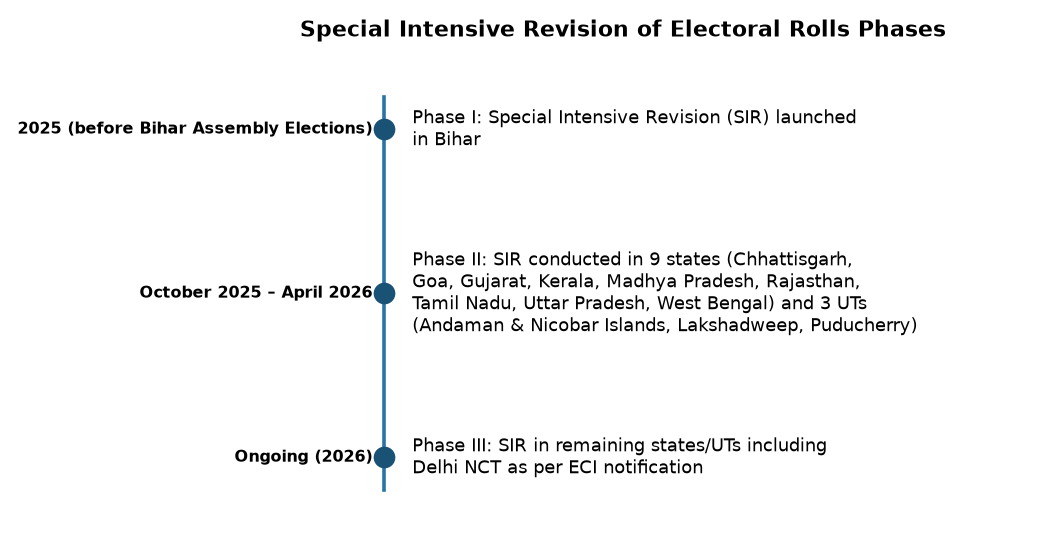
- The SIR process was initiated in phases, beginning with Bihar in 2025 ahead of state assembly elections, followed by nine states and three Union Territories in Phase II (October 2025–April 2026).
- The Supreme Court, in *Association for Democratic Reforms v. ECI* (WPD(C) 640/2025, 2026), upheld the legality of the SIR process, affirming its alignment with the ECI’s statutory mandate under the Representation of the People Act, 1950, and the constitutional duty to ensure free and fair elections.
- The ECI has implemented multi-layered safeguards to prevent the erroneous deletion of eligible voters, including cross-verification, public disclosure, and grievance redressal mechanisms.
- The SIR process is distinct from the routine revision of electoral rolls and is designed to address systemic inaccuracies through intensive, door-to-door verification and technological validation.
What is the Special Intensive Revision (SIR) of Electoral Rolls?
- The SIR is a systematic, phased process of revising electoral rolls to eliminate inaccuracies, duplicates, and ineligible entries while ensuring no eligible voter is excluded.
- The process involves door-to-door verification by Booth Level Officers (BLOs), who conduct house-to-house enumeration to verify voter details, including deaths, permanent migration, and duplicate registrations.
- A draft electoral roll is published, followed by a statutory period for filing claims (Form 6) and objections (Form 7 and 8), allowing stakeholders to scrutinise and correct discrepancies.
- The ECI employs cross-verification mechanisms, including random audits of deleted entries, supervision by observer officers, and public disclosure of draft and final rolls for transparency.
- Safeguards to prevent erroneous deletion include mandatory prior intimation to voters, multiple attempts to locate missing voters, and adherence to the *Voter Registration Rules, 1960* before any deletion.
- Political parties are permitted to deploy Booth Level Agents (BLAs) to monitor the process, ensuring political neutrality and public accountability.
- The ECI has established a multi-tier grievance redressal system, including appeals to the District Magistrate, Chief Electoral Officer, and further legal recourse, aligning with the *Representation of the People Act, 1950*.
- The SIR process is conducted in adherence to the constitutional mandate of the ECI under Article 324, which empowers it to superintend, direct, and control the conduct of elections.
Key Features
| Feature | Significance |
|---|---|
| Systematic Revision of Electoral Rolls (SIR) | Ensures accuracy, timeliness, and integrity of electoral rolls by eliminating duplicates, deceased voters, and non-residents, thereby upholding the principle of universal adult franchise. |
| House-to-House Enumeration by Booth Level Officers (BLOs) | Facilitates direct verification of voter details, reducing errors and enhancing transparency in the revision process. |
| Publication of Draft Rolls and Statutory Objection Period | Allows stakeholders—voters, political parties, and civil society—to scrutinise and contest discrepancies before finalisation, ensuring inclusivity. |
| Random Audit and Cross-Verification Mechanisms | Institutional checks via supervisors and political party agents minimise arbitrary deletions and maintain electoral fairness. |
| Appeal and Grievance Redressal Framework | Provides multi-tiered recourse (District Magistrate, Chief Electoral Officer) to address legitimate concerns, reinforcing democratic accountability. |
Why it Matters
Electoral Integrity
- SIR reinforces the constitutional mandate under Article 324 for free and fair elections by ensuring accurate voter rolls, thereby preventing disenfranchisement or manipulation.
- Eliminates systemic errors such as duplicate registrations, deceased voters, and non-resident entries, which could otherwise distort electoral outcomes.
- Enhances public trust in electoral processes by institutionalising transparency through draft publication and statutory objection periods.
Democratic Accountability
- The statutory framework under the Representation of the People Act, 1950, and the Election Symbols (Reservation and Allotment) Order, 1968, empowers the Election Commission to conduct SIR as a sovereign function.
- Judicial validation (e.g., Supreme Court’s order in W.P.(C) 640/2025) underscores the constitutional legitimacy of SIR, reinforcing its role in safeguarding democratic principles.
Operational Efficiency
- Phased implementation across states/UTs ensures systematic coverage without overwhelming administrative capacities, aligning with the Commission’s resource optimisation goals.
- Digital dissemination of draft and final rolls, along with BLO reports, facilitates real-time public scrutiny and reduces delays in electoral preparations.
Challenges
1. Ensuring Inclusivity and Preventing Disenfranchisement
- Risk of eligible voters being inadvertently excluded due to procedural lapses or inadequate BLO outreach, particularly among marginalised communities.
- Need for sustained awareness campaigns to educate voters about the SIR process and their rights to file claims or objections.
UPSC Link: GS-II: Electoral Reforms
2. Logistical and Administrative Bottlenecks
- Coordinating house-to-house enumeration across diverse terrains (e.g., hilly, remote, or urban slum areas) poses significant operational challenges.
- Ensuring timely publication of draft rolls and resolution of objections requires robust inter-departmental coordination between the Election Commission, state governments, and local authorities.
UPSC Link: GS-II: Governance
3. Political Interference and Partisan Objections
- Potential for frivolous objections or politically motivated challenges to the electoral rolls, necessitating strict adherence to the statutory framework.
- Balancing transparency with the need to prevent misuse of the objection period to delay or disrupt electoral preparations.
UPSC Link: GS-II: Role of Political Parties
4. Data Privacy and Security Concerns
- Handling sensitive voter data during enumeration and digital publication requires stringent protocols to prevent breaches or misuse.
- Ensuring compliance with the Digital Personal Data Protection Act, 2023, while maintaining public accessibility of electoral rolls.
UPSC Link: GS-III: Cyber Security
5. Resource Constraints and Capacity Building
- Limited availability of trained BLOs and supervisory staff in certain regions may compromise the quality of enumeration and verification.
- Need for continuous capacity-building programs to equip election officials with the latest tools and methodologies for efficient SIR implementation.
UPSC Link: GS-II: Civil Services
Challenges — UPSC Perspective
| Issue | Concern |
|---|---|
| Inadequate BLO Coverage | Incomplete house-to-house enumeration may lead to omissions of eligible voters, particularly in remote or densely populated areas. |
| Delayed Publication of Draft Rolls | Prolonged delays in releasing draft rolls reduce the time available for stakeholders to file objections, undermining transparency. |
| Political Exploitation of Objection Period | Parties may file frivolous objections to create logistical hurdles or discredit the electoral process. |
| Data Discrepancies in Urban Areas | High population density and frequent migration in cities increase the likelihood of errors in voter rolls. |
| Limited Public Awareness | Low voter participation in the objection process due to lack of awareness about SIR timelines and procedures. |
| Cybersecurity Risks | Digital publication of electoral rolls exposes sensitive data to potential cyber threats or unauthorised access. |
Way Forward
- Strengthen BLO training programs with a focus on inclusivity, particularly in tribal, coastal, and urban slum areas, to ensure comprehensive enumeration.
- Leverage technology (e.g., GIS mapping, mobile apps) to streamline house-to-house verification and reduce human errors in data collection.
- Conduct pre-SIR awareness campaigns in collaboration with civil society organisations to educate voters about the process and their rights.
- Establish dedicated grievance redressal cells at the district level to expedite the resolution of objections and appeals.
- Implement random digital audits of deleted entries to identify patterns of systemic bias or procedural lapses.
- Enhance inter-departmental coordination between the Election Commission, state governments, and local bodies to ensure timely publication of draft rolls.
- Develop a national helpline and multilingual portals for voters to report discrepancies or seek clarifications during the SIR process.
- Integrate SIR data with the National Population Register (NPR) and Aadhaar for real-time verification, subject to privacy safeguards.
UPSC Value Addition
Keywords for Mains Answer-Writing
Electoral Rolls Special Intensive Revision (SIR) · Article 324 of the Constitution · Representation of the People Act, 1950 · Election Commission of India (ECI) · Voter Registration Rules, 1960 · Form 6, Form 7, Form 8 · Booth Level Officers (BLO) · Political Party Agents · Electoral Reforms · Voter Verification Process · Electoral Disputes Redressal · Right to Vote · Free and Fair Elections · Voter Deletion Criteria · Draft Electoral Rolls · Objection Period · Appeal Mechanism · Supreme Court Judgment on SIR · Electoral Roll Quality Assurance
Constitutional & Policy Linkages
- Article 324: Superintendence, direction, and control of elections vested in the Election Commission.
Concept Flow
Constitutional Mandate (Article 324) → Election Commission’s Statutory Authority (RP Act, 1950) → Systematic Revision of Electoral Rolls (SIR) → Phased Implementation (States/UTs) → House-to-House Enumeration by BLOs → Draft Roll Publication → Statutory Objection Period → Random Audits & Cross-Verification → Finalisation of Electoral Rolls → Judicial Validation (Supreme Court) → Enhanced Electoral Integrity.
Prelims Practice Questions
Q1. Which of the following is NOT a valid ground for deletion of a voter’s name from the electoral rolls under the Representation of the People Act, 1950?
- A. Death of the voter
- B. Permanent shifting of residence outside the constituency
- C. Temporary absence from the constituency for more than six months
- D. Duplicate registration of the same voter at multiple locations
Answer: C. Temporary absence from the constituency for more than six months — Under the Representation of the People Act, 1950, voter deletion is permitted only for death, permanent shift of residence, duplicate registration, or persistent absence despite verification attempts. Temporary absence alone is not a valid ground for deletion.
Q2. The Special Intensive Revision (SIR) of electoral rolls is conducted by the Election Commission of India under which constitutional provision?
- A. Article 324
- B. Article 325
- C. Article 326
- D. Article 327
Answer: A. Article 324 — Article 324 of the Constitution empowers the Election Commission of India to superintend, direct, and control the preparation of electoral rolls and the conduct of elections, thereby providing the constitutional basis for SIR.
Q3. Which form is used by an eligible voter to file an objection against the inclusion of a duplicate name in the electoral rolls?
- A. Form 6
- B. Form 7
- C. Form 8
- D. Form 26
Answer: B. Form 7 — Form 7 is specifically designed for filing objections against the inclusion of names in the electoral rolls, including duplicate entries.
Mains Practice Question
✍ Examine the significance of the Special Intensive Revision (SIR) of electoral rolls in ensuring free and fair elections in India. Critically analyse the safeguards prescribed by the Election Commission of India to prevent erroneous deletion of eligible voters’ names, with reference to constitutional and statutory provisions.
Approach: Begin by defining the SIR process and its constitutional mandate under Article 324. Highlight its role in maintaining accurate and updated electoral rolls. Discuss the statutory framework under the Representation of the People Act, 1950, and the Voter Registration Rules, 1960, governing the SIR. Critically evaluate the safeguards such as door-to-door verification by BLOs, statutory objection periods (Forms 6, 7, 8), appeal mechanisms, and cross-verification by political party agents. Conclude by assessing the effectiveness of these measures in balancing electoral integrity with the protection of voters’ rights, supported by judicial validation (e.g., Supreme Court judgment in WPD(C) 640/2025).
Source: PIB (Press Information Bureau)
Generated by AanyaAi for educational purpose.

- यूपीएससी तैयारी: विशेष अभियान 6 के लिए समर्पित वेब-पोर्टल का शुभारंभ करेंगे केंद्रीय मंत्री - September 15, 2026
- Union Minister to Launch Special Campaign 6 Web-Portal on 16 Sept 2026 - September 15, 2026
- UPSC Civil Services (Main) Examination 2026 — Tamil Literature Paper I: Question Paper | Plutus IAS - September 15, 2026

No Comments