


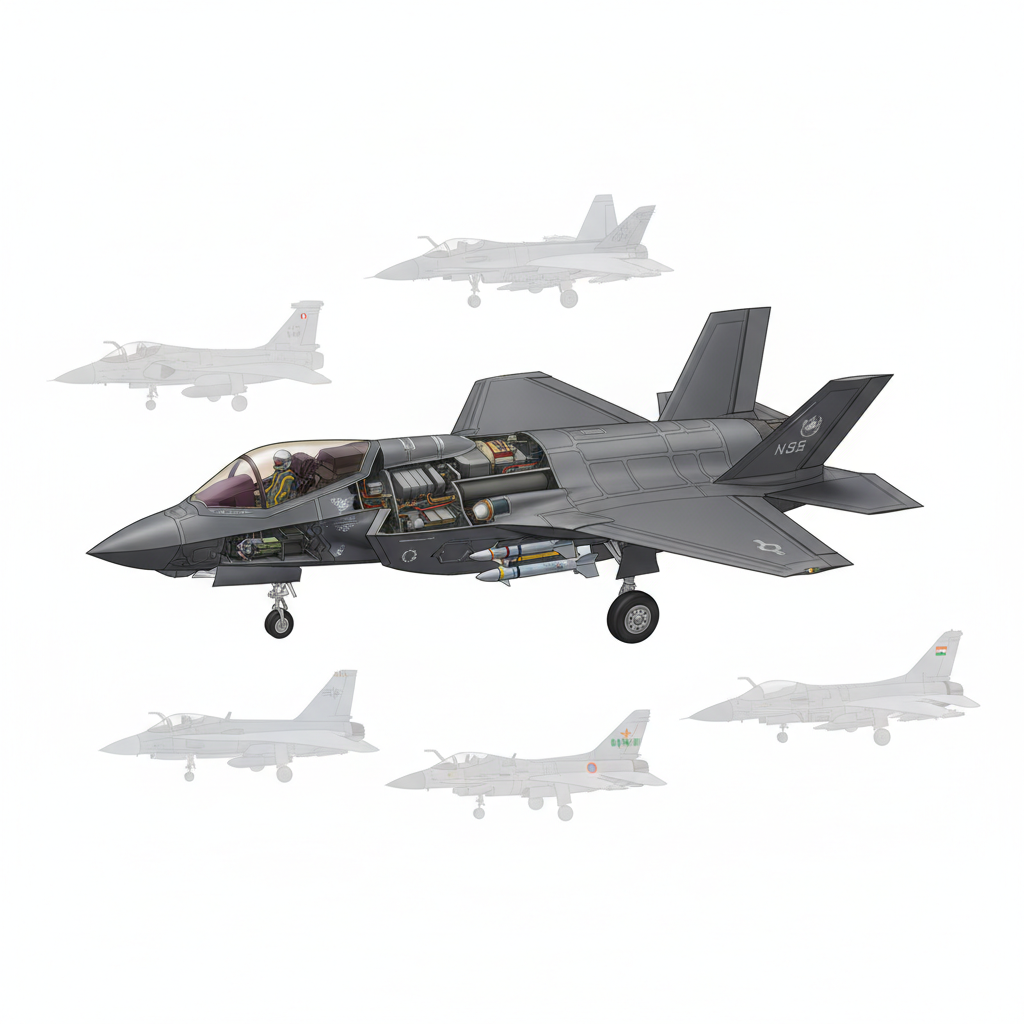
22 Sep F-35 Stealth Fighter to Feature in India’s Tarang Shakti 2026 Exercise
✎ Exercise Tarang Shakti is a multilateral air exercise hosted by the IAF to enhance interoperability and strategic partnerships, featuring advanced platforms like the F-35, Rafale, and Tejas.
Subject Relevance — Where This Topic Fits
- GS Paper II — International Relations: Defence Cooperation and Multilateral Exercises | GS Paper III — Security: Joint Military Exercises and Indigenous Defence Capabilities
- Prelims: Multilateral military exercises, Stealth technology in combat aircraft, Interoperability in defence operations, Defence diplomacy, Indigenous fighter programmes
- Essay: The Role of Military Diplomacy in Contemporary International Relations, Indigenous Defence Manufacturing: Self-Reliance in India’s Strategic Ecosystem
Quick Revision: Exercise Tarang Shakti is a multilateral air exercise hosted by the IAF to enhance interoperability and strategic partnerships, featuring advanced platforms like the F-35, Rafale, and Tejas.
Why is this in the news?
Exercise Tarang Shakti, India’s premier multilateral air exercise, is scheduled to be held at Jodhpur Air Force Station from September 26 to October 12, 2026. The event will feature participation from seven foreign air forces, including the United States, France, Germany, Australia, Bangladesh, Sri Lanka, and the United Arab Emirates, alongside India’s indigenous and advanced fighter platforms. The inclusion of the US F-35 stealth fighter for the first time in this exercise underscores its significance as a platform for showcasing interoperability, technological prowess, and strategic partnerships in the Indo-Pacific region.
Background
- Exercise Tarang Shakti is a biennial multilateral air exercise initiated by the Indian Air Force (IAF) to enhance operational synergy and interoperability among participating nations.
- The maiden edition was conducted in 2024 in two phases, with the Jodhpur leg featuring aircraft from the UK, Germany, and France, demonstrating India’s commitment to fostering defence cooperation beyond bilateral frameworks.
- The exercise follows the Veer Guardian bilateral air exercise with Japan, held at the same venue from September 9–22, 2026, highlighting India’s active engagement in structured defence diplomacy.
- India’s participation in global air exercises aligns with its broader strategic objectives under the ‘Act East Policy’ and ‘SAGAR’ (Security and Growth for All in the Region) doctrine to enhance regional security architecture.
- The inclusion of advanced platforms such as the F-35, Rafale, and Tejas reflects India’s dual focus on integrating global defence technologies while simultaneously advancing its indigenous defence manufacturing ecosystem.
- Multilateral exercises serve as force-multipliers for the IAF, providing operational exposure to complex joint tactical manoeuvres and fostering trust among participating air forces.
What is Exercise Tarang Shakti?
- Exercise Tarang Shakti is a multilateral air exercise hosted by the Indian Air Force, designed to enhance interoperability, joint operational capabilities, and strategic partnerships among participating nations.
- The exercise serves as a platform for showcasing advanced aerial platforms, including indigenous fighters like the Tejas and Su-30 MKI, alongside foreign aircraft such as the US F-35, French Rafale, and UAE’s F-16.
- Participating nations engage in high-octane joint tactical manoeuvres, including air combat, air-to-air refuelling, precision strikes, and electronic warfare simulations, to improve operational synergy.
- The exercise is structured over two weeks, allowing for extensive training, knowledge exchange, and familiarisation with diverse air doctrines and technologies.
- India’s participation in such exercises is aligned with its broader defence diplomacy, aimed at strengthening ties with strategic partners while projecting its indigenous defence capabilities.
- The inclusion of stealth platforms like the F-35 highlights the evolving nature of air combat and the importance of integrating fifth-generation technologies into joint operations.
- Exercise Tarang Shakti also underscores India’s role as a net security provider in the Indo-Pacific, fostering regional stability through collaborative defence engagements.
- The exercise is part of a broader trend of multilateral military engagements by India, complementing bilateral exercises such as Malabar and Varuna.
Key Features
| Feature | Significance |
|---|---|
| Multilateral air exercise ‘Exercise Tarang Shakti’ | Demonstrates India’s commitment to fostering defence diplomacy and interoperability with global air forces. |
| Participation of F-35 stealth fighter (US) | Showcases cutting-edge fifth-generation combat capabilities and enhances tactical integration with allied forces. |
| Inclusion of Rafale, Mirage-2000, Tejas, and Su-30 MKI (India) | Highlights indigenous and foreign-acquired platforms, reinforcing India’s aerial combat readiness and technological diversity. |
| Two-week operational phase (Sep 26–Oct 12, 2026) | Provides extended exposure for joint tactical manoeuvres, enhancing operational synergy among participating nations. |
| Sequential conduct after Veer Guardian (India-Japan bilateral) | Demonstrates India’s structured approach to defence engagement, balancing bilateral and multilateral exercises. |
Why it Matters
Strategic Diplomacy
- Facilitates defence cooperation with seven nations, including traditional allies (US, France) and regional partners (Bangladesh, Sri Lanka).
- Enhances India’s role as a net security provider in the Indo-Pacific through multilateral engagements.
- Strengthens interoperability frameworks, critical for joint operations under UN mandates or regional security initiatives.
Defence Modernisation
- Showcases India’s evolving air combat doctrine through the integration of fifth-generation (F-35, Rafale) and fourth-generation platforms (Mirage-2000, Su-30 MKI).
- Provides a platform for evaluating indigenous platforms (Tejas) against advanced foreign systems, informing future procurement and R&D priorities.
- Exposes IAF pilots to diverse combat scenarios, accelerating tactical learning and operational adaptability.
Regional Security Architecture
- Demonstrates India’s proactive engagement with South Asian and Middle Eastern partners, fostering trust and reducing regional security dilemmas.
- Reinforces India’s strategic autonomy by balancing engagements with multiple global powers without exclusive alignments.
- Serves as a confidence-building measure, particularly in the context of evolving geopolitical dynamics in the Indian Ocean Region.
Technological and Industrial Collaboration
- Opportunity for defence industries (e.g., HAL, DRDO) to benchmark indigenous technologies against global benchmarks.
- Potential for joint R&D initiatives or technology transfer agreements post-exercise evaluation.
- Enhances India’s attractiveness as a defence manufacturing hub for foreign original equipment manufacturers (OEMs).
Challenges
1. Interoperability Gaps
- Differences in communication protocols, data links, and weapons systems may hinder seamless joint operations.
- Requires pre-exercise standardization of procedures to mitigate risks during high-intensity manoeuvres.
- Long-term challenge: Sustaining interoperability beyond exercises through structured training and joint doctrine development.
UPSC Link: GS3: Defence Technology
2. Logistical and Operational Constraints
- Managing diverse aircraft types, maintenance schedules, and fuel requirements across seven nations.
- Ensuring airspace deconfliction and real-time coordination amid high-density operations.
- Risk of operational overreach if exercises are not aligned with national security priorities.
UPSC Link: GS3: Logistics in Defence
3. Geopolitical Balancing Act
- Risk of perceived alignment with specific blocs, potentially straining relations with non-participating states.
- Need to balance engagements with adversarial and allied nations to avoid strategic misperceptions.
- Challenge of maintaining neutrality while maximizing defence diplomacy benefits.
UPSC Link: GS2: International Relations
4. Cost and Resource Allocation
- High financial burden on host nation (India) for infrastructure, security, and operational support.
- Opportunity cost of diverting resources from other critical defence modernization projects.
- Sustainability concerns: Ensuring long-term funding without compromising operational readiness.
UPSC Link: GS3: Defence Budget
Challenges — UPSC Perspective
| Issue | Concern |
|---|---|
| Standardization of Procedures | Lack of common doctrines may limit operational effectiveness during joint manoeuvres. |
| Airspace Management | Risk of mid-air collisions or restricted access due to overlapping flight paths. |
| Maintenance and Spare Parts | Diverse aircraft fleets may face delays in obtaining compatible spares during the exercise. |
| Data Security Protocols | Sensitive tactical data exchange requires robust cybersecurity measures to prevent leaks. |
| Public Perception and Misinformation | Risk of misinterpretation of exercise objectives by domestic or international observers. |
Way Forward
- Establish a dedicated interoperability cell within the IAF to standardize procedures for future multilateral exercises.
- Develop a phased roadmap for integrating indigenous platforms (e.g., Tejas, AMCA) into global defence exercises.
- Conduct pre-exercise joint workshops to align communication protocols, data links, and weapons compatibility.
- Enhance logistics support by pre-positioning spares, fuel, and maintenance teams to minimize operational delays.
- Incorporate cybersecurity protocols into exercise planning to safeguard sensitive tactical data.
- Leverage post-exercise debriefs to identify gaps and refine joint doctrine for real-world contingencies.
- Explore public-private partnerships to offset exercise costs while promoting indigenous defence manufacturing.
- Strengthen bilateral and multilateral agreements to institutionalize defence cooperation beyond one-off events.
UPSC Value Addition
Keywords for Mains Answer-Writing
Exercise Tarang Shakti · Jodhpur Air Force Station · multilateral air exercise · interoperability · defence diplomacy · stealth technology · F-35 Joint Strike Fighter · Rafale fighter jets · Indian Air Force · defence cooperation · joint tactical manoeuvres · strategic partnerships · defence modernisation · global air assets
Concept Flow
India’s proactive defence diplomacy → Initiation of multilateral air exercise ‘Tarang Shakti’ → Inclusion of advanced global platforms (F-35, Rafale) → Joint tactical manoeuvres → Enhanced interoperability and strategic trust → Long-term defence modernization and regional security architecture.
Prelims Practice Questions
Q1. Consider the following statements regarding Exercise Tarang Shakti:
1. It is a multilateral air exercise hosted by the Indian Air Force.
2. The second edition of the exercise is scheduled to be held in Jodhpur from September 26 to October 12.
3. The exercise includes participation from the United States, France, Germany, Australia, Bangladesh, Sri Lanka, and the UAE.
4. The F-35 stealth fighter jet will participate in the exercise for the second consecutive time.
How many of the above statements are correct?
- Only one
- Only two
- Only three
- All
Answer: Only three — Statements 1, 2, and 3 are correct. Statement 4 is incorrect as the F-35 will be participating for the first time in Exercise Tarang Shakti, though it participated in Aero India 2025.
Q2. Assertion (A): The F-35 Joint Strike Fighter is a multi-role stealth fighter jet developed by the United States.
Reason (R): Stealth technology enables an aircraft to evade radar detection, enhancing its survivability in contested environments.
Options:
A. Both A and R are true, and R is the correct explanation of A.
B. Both A and R are true, but R is not the correct explanation of A.
C. A is true, but R is false.
D. A is false, but R is true.
Answer: ? — Both the assertion and reason are true. The F-35 is indeed a multi-role stealth fighter jet, and stealth technology is designed to reduce radar cross-section, thereby enhancing survivability.
Q3. Match the following aircraft with their respective countries of origin:
Column I
1. Rafale
2. F-16
3. C-130J
4. Tejas
Column II
A. United States
B. France
C. India
D. United Arab Emirates
- 1-B, 2-A, 3-D, 4-C
- 1-B, 2-D, 3-A, 4-C
- 1-C, 2-A, 3-B, 4-D
- 1-D, 2-A, 3-C, 4-B
Answer: 1-B, 2-A, 3-D, 4-C — Rafale is a French aircraft (1-B), F-16 is of US origin (2-A), C-130J is a US transport aircraft (3-A), and Tejas is an Indian light combat aircraft (4-C).
Mains Practice Question
✍ The participation of advanced stealth platforms like the F-35 in multilateral exercises such as Exercise Tarang Shakti reflects India’s evolving defence diplomacy and strategic partnerships. Critically examine the significance of such exercises for India’s defence modernisation and interoperability with global air forces. (15 Marks)
Approach: MODEL-ANSWER SKELETON:
1. **Introduction (2 marks)**: Define multilateral air exercises and their role in defence diplomacy. Mention Exercise Tarang Shakti as a flagship initiative.
2. **Defence Modernisation (4 marks)**:
– Discuss how participation in such exercises facilitates technology absorption (e.g., stealth, avionics).
– Highlight the role of indigenous platforms like Tejas and their integration.
– Reference the Defence Acquisition Procedure (DAP) 2020 and Make in India initiatives.
3. **Interoperability and Strategic Partnerships (4 marks)**:
– Explain interoperability as a key objective of multilateral exercises.
– Discuss standardisation of communication protocols, joint tactical doctrines, and mutual logistics support.
– Cite examples of past exercises (e.g., Exercise Indra, Malabar) and their outcomes.
4. **Challenges and Limitations (3 marks)**:
– Address logistical and operational constraints (e.g., compatibility of systems, training gaps).
– Discuss the balance between reliance on foreign platforms and indigenous development.
5. **Conclusion (2 marks)**: Summarise the strategic value of such exercises in enhancing India’s defence posture and global standing. Provide a balanced view on future prospects.
Source: orissapost.com
Rajasthan PCS (RPSC / RAS) — State PCS Practice
Prelims: Which of the following exercises, scheduled to be held in Jodhpur, Rajasthan, will feature the US stealth fighter F-35 among its global air assets?
- A. Exercise Vayu Shakti
- B. Exercise Tarang Shakti
- C. Exercise Indradhanush
- D. Exercise Malabar
Answer: B. Exercise Tarang Shakti — Exercise Tarang Shakti, to be conducted in Jodhpur, Rajasthan, will include the US stealth fighter F-35 among its global air assets.
Mains: Discuss the strategic significance of hosting Exercise Tarang Shakti in Jodhpur, Rajasthan, with particular reference to its impact on India’s defense diplomacy and indigenous aerospace capabilities.
Generated by AanyaAi for educational purpose.
Related guides on our sites
- How to prepare for GS paper 1 for UPSC CSE mains exam
- Best UPSC coaching for IFOS exam
- Best mentorship programme for upsc
- UPSC+BA degree

- केरल में मानव-वन्यजीव संघर्ष मुआवज़े के लिए दिशा-निर्देश तैयार करेगा विशेषज्ञ पैनल - September 22, 2026
- Kerala forms expert panel to streamline wildlife conflict compensation guidelines - September 22, 2026
- कर्नाटक विधानमंडल ने केंद्र से ईएसए को अधिसूचित वन तक सीमित रखने की मांग का प्रस्ताव पारित किया - September 22, 2026

No Comments