


28 Jul FAME-II Scheme: ₹912.5 Cr Allocated for EV Charging Stations Nationwide
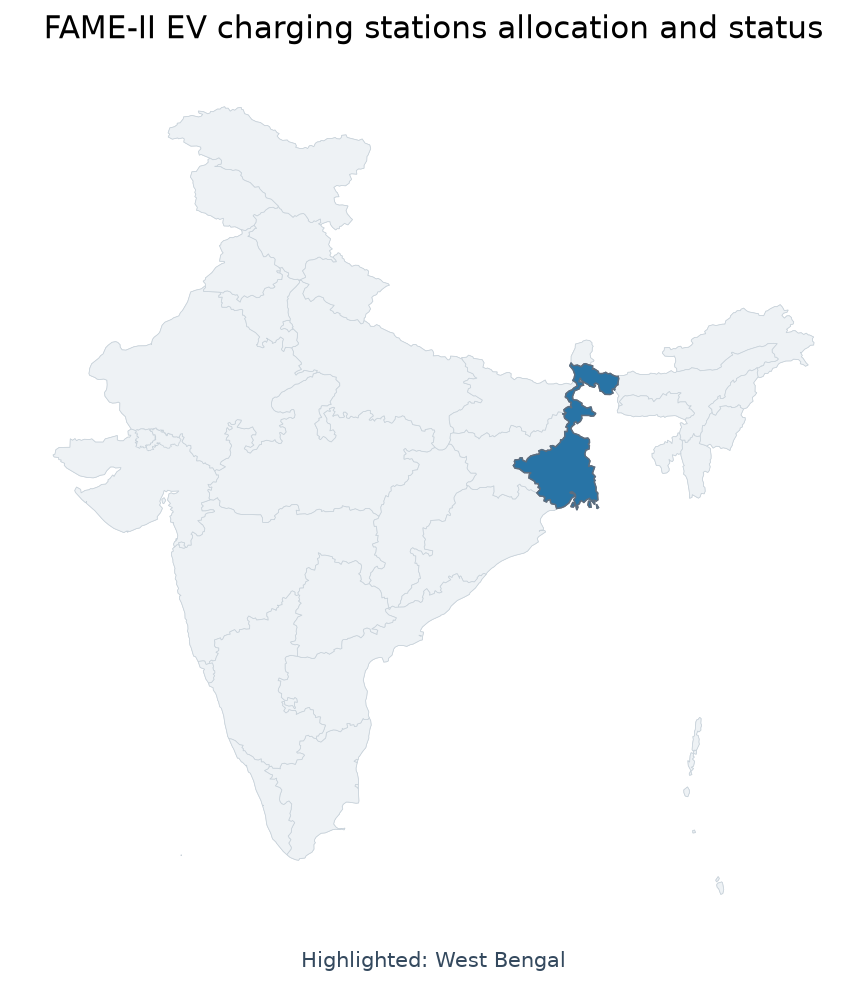
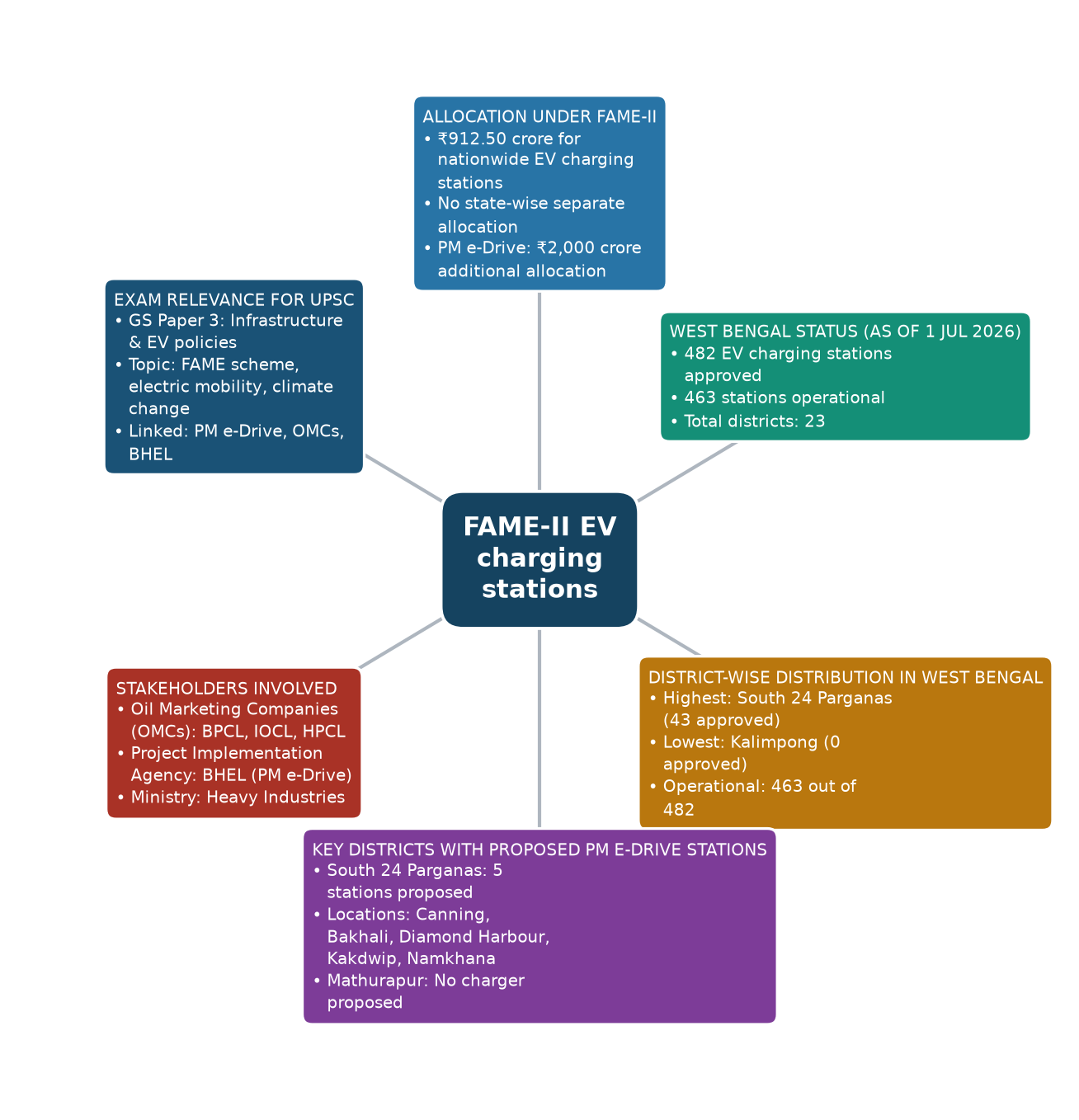
Map & concept mind-map: FAME-II EV charging stations allocation and status
Subject Relevance — Where This Topic Fits
- GS Paper III — Environment, Ecology, Bio-diversity and Climate Change | GS Paper III — Science and Technology — Developments and their Applications and Effects in Everyday Life | GS Paper III — Infrastructure: Energy
- Prelims: FAME-II Scheme, EV Charging Infrastructure, Oil Marketing Companies (OMCs), PM-eDrive Scheme, Bharat Heavy Electricals Limited (BHEL), Electric Mobility Promotion
- Essay: The Role of Public-Private Partnership in India’s Energy Transition, Sustainable Urban Mobility: Challenges and Opportunities
Quick Revision: FAME-II is a demand-driven incentive scheme under the Ministry of Heavy Industries, providing subsidies for EV purchases and charging infrastructure development, with a recent ₹912.50 crore allocation to boost public EV charging stations across India.
Why is this in the news?
The Ministry of Heavy Industries has allocated ₹912.50 crore under the FAME-II scheme for the establishment of public electric vehicle (EV) charging stations across India. This allocation is part of a broader push to accelerate EV adoption and reduce carbon emissions. The release highlights the status of EV charging infrastructure in West Bengal, where 482 charging stations have been sanctioned, with 463 operational as of 1 July 2026. Additionally, the PM-eDrive scheme, with a ₹2,000 crore allocation, complements FAME-II, while also noting that the establishment of EV charging stations is a license-free activity in India.
Background
- The Faster Adoption and Manufacturing of (Hybrid &) Electric Vehicles in India (FAME-II) scheme was launched in 2019 under the National Electric Mobility Mission Plan (NEMMP) to promote the adoption of electric vehicles (EVs) and hybrid vehicles in India.
- FAME-II, administered by the Ministry of Heavy Industries, provides demand-side incentives for EV purchases and subsidies for the establishment of charging infrastructure.
- The scheme aims to reduce vehicular emissions, improve energy security, and foster indigenous manufacturing of EV components.
- Oil Marketing Companies (OMCs) such as Indian Oil Corporation Limited (IOCL), Bharat Petroleum Corporation Limited (BPCL), and Hindustan Petroleum Corporation Limited (HPCL) are key stakeholders in the deployment of EV charging infrastructure.
- The establishment of EV charging stations in India is governed by guidelines issued by the Ministry of Power, which classify it as a license-free activity, allowing private entities to set up and operate charging stations without prior approval.
What is the FAME-II Scheme?
- The FAME-II scheme is a demand-driven incentive mechanism launched by the Government of India to accelerate the adoption of electric and hybrid vehicles in the country.
- It provides financial incentives for the purchase of EVs, including two-wheelers, three-wheelers, electric and hybrid cars, and buses, with varying subsidy amounts based on vehicle type and battery capacity.
- The scheme also supports the development of public charging infrastructure through subsidies for the establishment of charging stations, with a focus on urban and intercity connectivity.
- FAME-II is implemented by the Ministry of Heavy Industries in collaboration with state governments, OMCs, and private sector entities.
- The scheme mandates the establishment of charging stations at intervals of 25 km on both sides of highways and in all major cities with a population of over 4 million.
- The scheme aligns with India’s broader commitments under the Paris Agreement to reduce carbon emissions and promote sustainable mobility.
Key Features
| Feature | Significance |
|---|---|
| Allocation under FAME-II Scheme | A total of ₹912.50 crore has been allocated for the establishment of public EV charging stations across India under Phase-II of the Faster Adoption and Manufacturing of Hybrid and Electric Vehicles (FAME-II) scheme, with no state-wise bifurcation of funds. |
| Implementation by Oil Marketing Companies (OMCs) | Public Sector Undertakings (PSUs) such as Bharat Petroleum Corporation Limited (BPCL), Indian Oil Corporation Limited (IOCL), and Hindustan Petroleum Corporation Limited (HPCL) are key implementing agencies for the deployment of EV charging infrastructure. |
| Operational Status in West Bengal | As of 1 July 2026, West Bengal has 482 approved public EV charging stations (EVPCS) under FAME-II, with 463 operational. District-wise data indicates near-universal operationalisation in most districts, with minor discrepancies in a few. |
| PM-eDrive Scheme Complementarity | The PM-eDrive scheme, with an allocation of ₹2,000 crore, complements FAME-II by supporting additional EV charging infrastructure, though no financial assistance has been disbursed to West Bengal under this scheme as of the reporting date. |
| Licence-Free Deployment of EVCS | The establishment, operation, and maintenance of EV charging stations (EVCS) is a licence-free activity in India, allowing private entities and individuals to deploy infrastructure without regulatory barriers. |
Why it Matters
Economic and Industrial
- Accelerates the transition to electric mobility by addressing critical infrastructure gaps, thereby reducing dependence on fossil fuels and lowering vehicular emissions.
- Stimulates demand for electric vehicles (EVs) by enhancing user confidence through accessible charging networks, particularly in urban and peri-urban areas.
- Promotes indigenous manufacturing and technological innovation in the EV ecosystem, aligning with the ‘Make in India’ initiative and reducing import dependency in the automotive sector.
Environmental
- Supports India’s commitment to the Paris Agreement and Sustainable Development Goals (SDGs) by reducing greenhouse gas emissions from the transport sector.
- Contributes to improved air quality in metropolitan regions such as Kolkata, where vehicular pollution is a significant health concern.
Policy and Governance
- Demonstrates the Centre’s commitment to inter-ministerial coordination, with multiple schemes (FAME-II and PM-eDrive) operating in tandem to achieve common objectives.
- Highlights the role of PSUs in public infrastructure delivery, leveraging their existing operational networks for rapid deployment.
Social and Urban Planning
- Facilitates equitable access to EV charging infrastructure across districts, though disparities in operational status (e.g., Kalimpong with zero stations) warrant attention.
- Encourages last-mile connectivity solutions, particularly in coastal and remote districts of West Bengal, such as South 24 Parganas.
Challenges
1. Uneven Geographical Distribution
- Significant variation in the number of operational EV charging stations across districts in West Bengal, with some districts (e.g., Kalimpong) having no stations despite approvals.
- Coastal and remote districts face logistical and infrastructural challenges in deploying charging stations, necessitating targeted interventions.
UPSC Link: GS-III: Infrastructure
2. Operational and Maintenance Bottlenecks
- Discrepancies between approved and operational stations (e.g., 19 stations approved but not operational) indicate challenges in timely commissioning and maintenance.
- Dependence on OMCs for deployment may lead to delays in scaling up infrastructure in non-core areas.
UPSC Link: GS-III: Infrastructure
3. Financial and Scheme Coordination Gaps
- No financial assistance disbursed under PM-eDrive to West Bengal as of the reporting date, despite proposals being received, highlighting coordination gaps between schemes.
- Lack of state-wise allocation under FAME-II may lead to suboptimal resource utilisation in states with lower institutional capacity.
UPSC Link: GS-II: Centre-State Relations
4. Technological and Standardisation Issues
- Absence of a unified national standard for EV charging connectors and payment systems may create interoperability challenges for users.
- Limited adoption of advanced charging technologies (e.g., fast-charging, battery-swapping) in the current deployment strategy.
UPSC Link: GS-III: Science & Tech
5. Public Awareness and Behavioural Barriers
- Low consumer awareness about the availability and location of charging stations may hinder adoption despite infrastructure deployment.
- Perceived reliability and safety concerns associated with public charging stations may deter potential EV users.
UPSC Link: GS-IV: Ethics & Human Values
Challenges — UPSC Perspective
| Issue | Concern |
|---|---|
| Geographical Imbalance | Lack of charging stations in remote and hilly districts such as Kalimpong. |
| Operational Delays | 19 approved stations not operational as of 1 July 2026. |
| Scheme Coordination | No disbursement under PM-eDrive despite proposals received. |
| Technological Fragmentation | Diverse charging standards may limit interoperability. |
| Public Perception | Low awareness and safety concerns deter EV adoption. |
Government Initiatives — Must-Memorise for Prelims
- Faster Adoption and Manufacturing of Hybrid and Electric Vehicles (FAME-II) Scheme
Way Forward
- Conduct a district-wise gap analysis to identify and address disparities in charging infrastructure deployment, prioritising remote and underserved regions.
- Strengthen inter-ministerial coordination between the Ministry of Heavy Industries and state governments to ensure timely disbursement of funds under PM-eDrive.
- Standardise EV charging infrastructure specifications and payment systems to enhance interoperability and user convenience.
- Launch targeted awareness campaigns to educate consumers on the location, usage, and safety of public EV charging stations.
- Encourage private sector participation through incentives such as tax rebates and viability gap funding to accelerate infrastructure deployment.
- Integrate EV charging infrastructure planning with urban mobility policies to ensure seamless last-mile connectivity.
- Promote research and development in advanced charging technologies, including fast-charging and battery-swapping solutions.
- Establish a real-time monitoring dashboard for tracking the operational status of EV charging stations to ensure accountability and transparency.
UPSC Value Addition
Keywords for Mains Answer-Writing
Faster Adoption and Manufacturing of Hybrid and Electric Vehicles (FAME) Phase-II · Electric Vehicle Public Charging Stations (EVPCS) · National Electric Mobility Mission Plan (NEMMP) 2020 · Phased Manufacturing Programme (PMP) for EV components · Battery Swapping Policy for Electric Vehicles · Charging Infrastructure for Electric Vehicles – Guidelines and Standards 2019 · State-wise EV adoption and infrastructure gaps · Public-Private Partnership (PPP) in EV ecosystem · Lithium-ion battery technology and supply chain · Renewable energy integration with EV charging stations
Concept Flow
Policy Imperative for EV Adoption → Formulation of FAME-II and PM-eDrive schemes to incentivise EV infrastructure. → Fund Allocation and Implementation → ₹912.50 crore under FAME-II and ₹2,000 crore under PM-eDrive for EV charging stations. → Deployment by OMCs → BPCL, IOCL, and HPCL leverage existing networks to establish charging stations. → Geographical Distribution → Uneven deployment across districts in West Bengal, with operational gaps in remote areas. → Operational Challenges → Delays in commissioning and maintenance, exacerbated by lack of state-wise allocation. → User Adoption Barriers → Low awareness and technological fragmentation hinder EV uptake despite infrastructure growth. → Policy Feedback Loop → Addressing gaps through targeted interventions to achieve sustainable mobility goals.
Prelims Practice Questions
Q1. Which of the following is NOT a key objective of the FAME-II scheme in India?
- To incentivize the purchase of electric and hybrid vehicles
- To establish a robust public charging infrastructure for EVs
- To mandate 100% electrification of public transport buses by 2030
- To promote indigenous manufacturing of EV components
Answer: To mandate 100% electrification of public transport buses by 2030 — The FAME-II scheme primarily focuses on demand incentives for EV purchases and charging infrastructure development, not a blanket mandate for public transport electrification. The 100% electrification target is part of broader policy goals but not explicitly stated in FAME-II.
Q2. Under the FAME-II scheme, the establishment of public EV charging stations is classified as:
- A state-subject requiring separate state-level approvals
- A license-free activity open to private entities
- A centrally sponsored scheme with 100% central funding
- A mandatory requirement for all urban local bodies
Answer: A license-free activity open to private entities — The PIB release explicitly states that the establishment of EV charging stations is a license-free activity, allowing any entity—including private players—to set up, operate, and maintain charging infrastructure without prior approvals.
Q3. Which of the following agencies is NOT involved in the implementation of EV charging infrastructure under FAME-II or PM e-DRIVE?
- Bharat Heavy Electricals Limited (BHEL)
- Indian Oil Corporation Limited (IOCL)
- Bharat Petroleum Corporation Limited (BPCL)
- National Thermal Power Corporation (NTPC)
Answer: National Thermal Power Corporation (NTPC) — NTPC is not mentioned in the PIB release as an implementing agency for EV charging infrastructure under FAME-II or PM e-DRIVE. The other three entities (BHEL, IOCL, BPCL) are explicitly referenced in the context of EVPCS deployment.
Mains Practice Question
✍ Analyse the role of FAME-II in accelerating India’s transition to electric mobility. Critically evaluate the challenges in scaling up public EV charging infrastructure, with special reference to inter-state disparities and the role of state governments.
Approach: Begin by outlining the key provisions of FAME-II, including its financial outlay, incentives, and targets for EV adoption and charging infrastructure. Examine the challenges in scaling up charging stations, such as high capital costs, land acquisition issues, and grid integration constraints. Discuss inter-state disparities using the West Bengal data as a case study, highlighting gaps in district-wise distribution and operational challenges. Critique the absence of state-specific allocations under FAME-II and argue for a more decentralized, state-led approach to address local needs. Conclude by suggesting policy measures, such as public-private partnerships, battery swapping policies, and renewable energy integration, to overcome these barriers.
Source: PIB (Press Information Bureau)
Generated by AanyaAi for educational purpose.

- आईआईडब्ल्यूडब्ल्यू 2026: जल सुरक्षा के लिए नवाचार, जलवायु-लचीलेपन और डिजिटल समाधान - September 24, 2026
- IIWW 2026: AI & Climate-Resilient Water Solutions for UPSC Mains - September 24, 2026
- राजस्थान पंचायत चुनाव 2026: सरपंच-वार्ड पदों की आरक्षण लॉटरी आज, जानिए आरक्षण तय करने की प्रक्रिया - September 24, 2026

No Comments