


27 Sep From Grassroots to Growth: The Rising Role of Cooperatives in India
This article covers “Daily Current Affairs” and Topic details From Grassroots to Growth: The Rising Role of Cooperatives in India
SYLLABUS MAPPING
GS– 3 – Indian Economy- From Grassroots to Growth: The Rising Role of Cooperatives in India
FOR PRELIMS
What are cooperatives? Explain their importance in India’s rural economy.
FOR MAINS
What are the constitutional provisions related to cooperatives in India?
Why in the News?
The cooperative movement is making headlines as India pushes for stronger, more inclusive cooperatives. The National Cooperative Policy 2025 aims to modernize governance and boost the sector’s contribution to the economy. Punjab has lifted restrictions on new cooperative societies, empowering local communities. Digital reforms, like Aadhaar-enabled services in cooperative banks, are improving rural financial inclusion. Cooperatives are also driving women’s empowerment, with thousands benefiting from milk producer organizations in Uttar Pradesh. Globally, 2025 has been declared the International Year of Cooperatives by the UN, emphasizing their role in sustainable development and poverty reduction.

Constitutional Provisions
The 97th Constitutional Amendment Act of 2011 was a landmark in recognizing the significance of cooperatives in India’s governance framework. Key provisions include:
Article 19(1)(c): Recognizes the right of citizens to form cooperative societies as a fundamental right.
Article 43B: Directs the State to promote the formation and operation of cooperative societies.
Part IXB: Introduces a new part in the Constitution dedicated to cooperative societies, detailing their incorporation, regulation, and winding up.
Role of Cooperatives in India
1. Agricultural Support: Primary Agricultural Credit Societies (PACS) and cooperative farming societies provide farmers with credit, seeds, fertilizers, and market linkages.
2. Dairy and Livestock Development: Cooperatives like AMUL have transformed milk production, improving rural livelihoods.
3. Financial Inclusion: Urban and rural cooperative banks enable access to banking services for underserved populations.
4. Women Empowerment: Women self-help groups (SHGs) and cooperatives foster entrepreneurship and gender equality.
5. Employment Generation: Cooperatives create local employment in agriculture, handicrafts, handlooms, and fisheries.
6. Consumer Services: Consumer cooperatives ensure affordable goods and prevent exploitation by middlemen.
7. Social Development: Cooperatives promote education, healthcare, and skill development in rural areas.
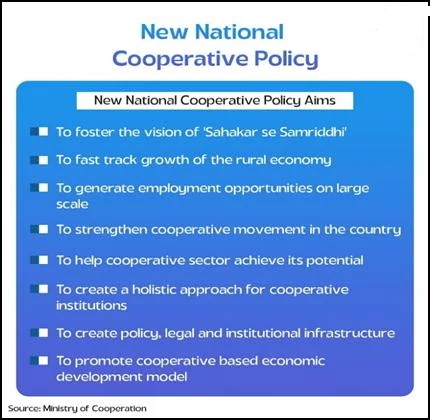
Policy Measures to Promote Cooperatives
1. National Cooperative Policy 2025: Focuses on expanding cooperatives, professional management, and cooperative exports.
2. Financial Assistance: Credit support and grants for capacity building and cooperative infrastructure.
3. Legal Framework Strengthening: Implementing provisions of the 97th Constitutional Amendment and Part IXB to protect cooperative autonomy.
4. State-Level Reforms: Examples: Punjab lifting restrictions on new cooperatives; Karnataka introducing caste and gender-based leadership quotas.
5. Training & Education: Cooperative training institutes and programs to improve governance and managerial skills.
6. Technology Integration: Encouraging digital platforms for marketing, accounting, and member communication.
7. Promotion of Sector-Specific Cooperatives: Emphasis on dairy, fisheries, handlooms, and housing to meet local needs.
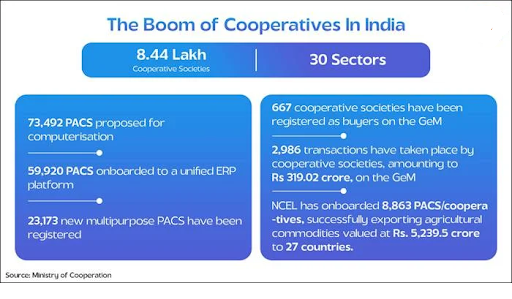
Issues and Constraints in Cooperatives
1. Political Interference: Excessive involvement of local politics often leads to favoritism in elections, misallocation of resources, and undermines cooperative autonomy.
2. Poor Management: Many cooperatives lack trained managers and financial experts, leading to weak strategic planning, delayed project implementation, and inefficient operations.
3. Financial Limitations: Limited access to institutional credit, high dependence on government loans, and inadequate capitalization restrict growth and innovation.
4. Low Member Participation: Members often remain passive, resulting in decisions that benefit a few rather than the cooperative as a whole, weakening accountability.
5. Inefficient Governance: Corruption, favoritism, and bureaucratic red tape impede transparency and operational efficiency.
6. Regional Imbalances: While some states like Gujarat and Maharashtra have strong cooperative sectors, others lag behind, creating uneven economic benefits.
7. Market Challenges: Cooperatives face intense competition from private companies, especially in dairy, agriculture, and consumer goods sectors, limiting profitability.
Way Forward
1. Professional Capacity Building: Conduct regular training programs in management, finance, and digital tools to improve leadership skills. Encourage hiring professional managers where feasible.
2. Enhanced Financial Support: Provide easier access to institutional credit, microfinance, insurance, and grants. Encourage public-private partnerships to fund cooperative initiatives.
3. Strengthening Autonomy: Implement policy measures that reduce political interference, ensure democratic governance, and protect cooperative decision-making.
4. Digital Transformation: Promote the adoption of technology for accounting, e-governance, digital marketing, and mobile apps to improve transparency and reach.
5. Inclusive Membership: Actively promote participation of women, youth, marginalized communities, and small farmers to enhance equity and representation.
6. Sectoral Diversification: Expand cooperatives into emerging sectors like renewable energy, agro-processing, fisheries, handlooms, and rural tourism to increase sustainability and income sources.
7. Awareness & Advocacy: Conduct awareness campaigns to educate communities about the benefits of cooperatives and encourage membership and active participation.
Conclusion
The cooperative movement in India holds immense potential to drive inclusive and sustainable development. By addressing existing challenges and leveraging the supportive constitutional and policy framework, cooperatives can emerge as key players in India’s socio-economic transformation. The recent policy initiatives and reforms indicate a positive trajectory towards realizing this vision.
Prelims Question
Q. With reference to ‘Urban Cooperative Banks’ in India, consider the following statements: (UPSC 2021)
1. They are supervised and regulated by local boards established by State Governments.
2. They can issue equity shares and preference shares.
3. They were brought under the purview of the Banking Regulation Act, 1949, through a 1966 Amendment.
Which of the above statements are correct?
(a) 1 only
(b) 2 and 3 only
(c) 1 and 3 only
(d) 1, 2 and 3
Answer: (b)
Mains Question
Q. In the villages itself no form of credit organisation will be suitable except the cooperative society.” – All India Rural Credit Survey. Discuss this statement in the background of agricultural finance in India. What constraints and challenges do financial institutions supplying agricultural finance face? How can technology be used to better reach and serve rural clients? (UPSC 2014)
(250 words)

- Elderly in India: Population, Challenges, and Government Initiatives - October 29, 2025
- Jal Jeevan Mission (JJM): Ensuring Tap Water to Every Rural Household - October 27, 2025
- National Blockchain Framework: Strengthening Governance through Blockchain Technology - October 25, 2025

No Comments