


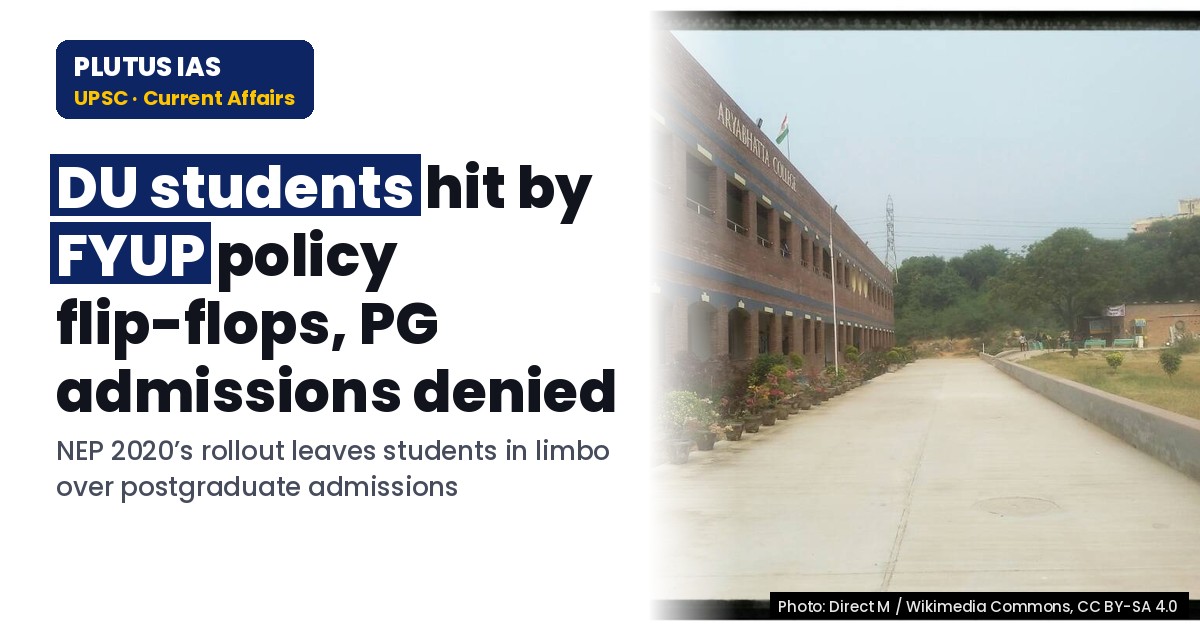
29 Oct FYUP Chaos: Students Suffer Due to Policy Confusion in Higher Education
✎ The Four-Year Undergraduate Programme (FYUP) under NEP 2020 aims to provide a flexible, multi-disciplinary, and credit-based education system with multiple entry and exit options, but its implementation is hindered by policy…
Subject Relevance — Where This Topic Fits
- GS Paper II — Governance, Administration and Policies | GS Paper IV — Ethics, Integrity and Aptitude in Governance
- Prelims: Four-Year Undergraduate Programme (FYUP), National Education Policy (NEP) 2020, University Grants Commission (UGC), Academic Bank of Credits (ABC), Choice-Based Credit System (CBCS), Graduation Eligibility Criteria, Postgraduate Admission Norms, Higher Education Governance, Curriculum Design and Implementation, Student Rights and Grievance Redressal
- Essay: Higher education reforms in India: Balancing access, quality, and employability, The role of policy ambiguity in undermining educational equity and excellence
Quick Revision: The Four-Year Undergraduate Programme (FYUP) under NEP 2020 aims to provide a flexible, multi-disciplinary, and credit-based education system with multiple entry and exit options, but its implementation is hindered by policy ambiguity, inconsistent guidelines, and inadequate infrastructure.
Why is this in the news?
The implementation of the Four-Year Undergraduate Programme (FYUP) in the University of Delhi has recently faced significant challenges, particularly concerning the admission of fourth-year graduates to one-year postgraduate programmes. Students, who were promised streamlined pathways under FYUP, have been denied admission due to unclear and evolving eligibility criteria, leading to legal disputes and administrative confusion. This issue underscores broader concerns about policy formulation, implementation gaps, and the governance of higher education reforms in India, particularly in the context of the National Education Policy (NEP) 2020.
Background
- The FYUP was first introduced in the University of Delhi in 2013 as part of broader higher education reforms under the UGC, aligning with the recommendations of the Yash Pal Committee and the National Knowledge Commission.
- The programme was later revised and expanded under the National Education Policy (NEP) 2020, which advocates for a multi-disciplinary, flexible, and credit-based undergraduate education system to enhance employability and academic mobility.
- The NEP 2020 introduces the Academic Bank of Credits (ABC) and endorses the Choice-Based Credit System (CBCS) to enable students to accumulate and transfer credits across institutions, facilitating a more flexible and inclusive higher education framework.
- The UGC has issued multiple guidelines and circulars to operationalise FYUP, including the 2022 guidelines for the implementation of the four-year undergraduate programme, but these have often been amended or reinterpreted, leading to confusion among stakeholders.
- The FYUP model has been criticised for its lack of clarity in transition pathways to postgraduate programmes, particularly for students completing the fourth year, who face uncertainty regarding eligibility for one-year master’s programmes.
- Legal disputes have emerged as students challenge university decisions on admission criteria, highlighting the need for transparent and consistent policy enforcement in higher education.
What is the Four-Year Undergraduate Programme (FYUP)?
- The FYUP is a structured undergraduate degree programme designed to provide students with a comprehensive and multi-disciplinary education over four years, in contrast to the traditional three-year bachelor’s degree.
- The programme is structured around a credit-based system, allowing students to accumulate credits through core, elective, and skill-based courses, aligning with the principles of the Choice-Based Credit System (CBCS) and the Academic Bank of Credits (ABC).
- FYUP includes a foundation year, disciplinary major, and a choice of minors or interdisciplinary courses, with provisions for research and project work in the final year, aimed at enhancing critical thinking and employability.
- The programme is intended to facilitate seamless vertical mobility, enabling students to transition from undergraduate to postgraduate studies without the need for a separate entrance examination, subject to meeting eligibility criteria.
- Under NEP 2020, FYUP is positioned as a key reform to align higher education with global standards, promote multi-disciplinary learning, and address the employability gap by integrating skill-based and vocational courses.
- The UGC has outlined multiple exit options within FYUP, including a certificate after one year, diploma after two years, and a bachelor’s degree after three or four years, depending on the student’s academic progress and choices.
- The programme also introduces the concept of ‘multiple entry and exit’ points, allowing students to re-enter the education system after gaps, provided they meet the prescribed credit requirements.
- Implementation challenges arise from the lack of standardised guidelines across universities, leading to disparities in curriculum design, credit allocation, and transition pathways to postgraduate programmes.
Key Features
| Feature | Significance |
|---|---|
| Four-Year Undergraduate Programme (FYUP) | Introduces a structured 4-year undergraduate degree with provisions for multiple exit and entry points, aiming to enhance academic flexibility and employability. |
| One-Year Postgraduate Programme | Proposed as a seamless transition for FYUP graduates, intended to reduce the time-to-degree while maintaining academic rigour. |
| Vocational and Applied Courses (VAC) | Mandated under NEP 2020 to align higher education with market demands, though implementation challenges persist. |
| Credit-Based System | Facilitates mobility across institutions and disciplines, enabling interdisciplinary learning and skill acquisition. |
| Exit and Re-entry Options | Allows students to leave and re-enter the system with recognised certifications, promoting lifelong learning. |
Why it Matters
Educational Reforms
- FYUP represents a paradigm shift from the traditional 3-year undergraduate model, aligning with global higher education trends such as the Bologna Process.
- Aims to address the employability gap by integrating vocational training and skill development within academic programmes.
- Introduces a credit-based framework to enhance academic mobility and interdisciplinary learning, fostering holistic development.
Policy Implementation Challenges
- Frequent policy revisions without adequate infrastructure or faculty preparedness lead to operational ambiguities and student discontent.
- Lack of synchronisation between central guidelines (NEP 2020) and state-level or institutional regulations creates implementation bottlenecks.
- Insufficient capacity in universities to absorb FYUP graduates into one-year postgraduate programmes due to resource constraints.
Economic Implications
- Extended duration of undergraduate programmes increases the financial burden on students, particularly in institutions with high fee structures.
- Potential misalignment between graduate output and labour market demands may exacerbate underemployment or skill mismatches.
- Opportunity cost of prolonged education delays entry into the workforce, impacting individual earnings and economic productivity.
Challenges
1. Policy Ambiguity and Regulatory Gaps
- Inconsistent interpretation of NEP 2020 guidelines across universities leads to confusion in programme design and implementation.
- Delayed formulation of rules post-programme launch creates operational uncertainties for students and faculty.
- Lack of a unified regulatory framework for credit transfer and recognition hampers academic mobility.
UPSC Link: GS2: Regulatory bodies in higher education
2. Infrastructure and Resource Constraints
- Inadequate laboratory, library, and faculty resources in many institutions impede the delivery of FYUP’s interdisciplinary and skill-based components.
- Limited capacity in postgraduate programmes to accommodate FYUP graduates due to constrained infrastructure and faculty strength.
- High student-teacher ratios dilute the quality of mentorship and academic support.
UPSC Link: GS2: Higher education infrastructure
3. Student Uncertainty and Discontent
- Frequent changes in programme structure and exit criteria erode student confidence in the academic system.
- Denial of admission to one-year postgraduate programmes due to arbitrary priority parameters exacerbates frustration.
- Lack of clear grievance redressal mechanisms leaves students with limited recourse for policy-induced grievances.
UPSC Link: GS2: Student rights and grievance redressal
4. Curriculum Design and Pedagogical Challenges
- Overemphasis on vocational courses (VAC) risks diluting the academic rigour of traditional disciplines.
- Interdisciplinary courses often lack coherence due to fragmented faculty expertise and resource constraints.
- Assessment mechanisms for skill-based learning remain underdeveloped, complicating evaluation and certification.
UPSC Link: GS2: Curriculum design and pedagogy
5. Financial Burden and Accessibility
- Extended duration of programmes increases tuition fees, disproportionately affecting economically disadvantaged students.
- Limited scholarships and financial aid for FYUP students exacerbate socio-economic disparities in higher education access.
- Opportunity costs of prolonged education may deter students from marginalised communities from pursuing higher studies.
UPSC Link: GS2: Inclusive education and financial accessibility
Challenges — UPSC Perspective
| Issue | Concern |
|---|---|
| Policy Inconsistency | Frequent revisions without adequate preparation create operational ambiguities and student insecurity. |
| Infrastructure Deficits | Limited resources impede the delivery of interdisciplinary and skill-based components of FYUP. |
| Regulatory Gaps | Absence of a unified framework for credit transfer and recognition hampers academic mobility. |
| Financial Accessibility | Extended programme duration increases costs, disproportionately affecting marginalised students. |
| Curriculum Rigidity | Overemphasis on vocational courses risks diluting academic rigour in traditional disciplines. |
| Student Grievances | Lack of clear redressal mechanisms exacerbates discontent among affected students. |
Way Forward
- Establish a unified regulatory authority to harmonise NEP 2020 implementation across states and institutions.
- Invest in faculty training and infrastructure development to support interdisciplinary and skill-based learning under FYUP.
- Develop transparent and consistent criteria for admission to one-year postgraduate programmes, ensuring equitable access.
- Strengthen grievance redressal mechanisms, including dedicated ombudsman offices for higher education institutions.
- Expand scholarships and financial aid to mitigate the economic burden on students pursuing extended undergraduate programmes.
- Conduct periodic reviews of FYUP’s implementation, incorporating feedback from students, faculty, and industry stakeholders.
- Promote public-private partnerships to augment infrastructure and resource capacity in universities.
- Enhance career counselling and placement support to align FYUP graduates with labour market demands.
UPSC Value Addition
Keywords for Mains Answer-Writing
Four-Year Undergraduate Programme (FYUP) · National Education Policy (NEP) 2020 · University of Delhi · higher education reforms · employability-driven curriculum · interdisciplinary education · vocational and academic courses integration · higher education governance · academic policy implementation challenges · student-centric reforms · credit-based education system · university autonomy vs. regulatory oversight · higher education infrastructure gaps · market-aligned education policies · academic policy confusion and student grievances
Concept Flow
Policy Initiation: NEP 2020 introduces FYUP to align higher education with market demands and global standards. → Programme Design: FYUP incorporates a 4-year structure with exit options, credit-based system, and vocational courses. → Implementation Challenges: Ambiguities in guidelines, infrastructure deficits, and resource constraints hinder smooth execution. → Student Impact: Policy confusion and operational gaps lead to uncertainty, financial burden, and discontent among students. → Regulatory Response: Courts and institutional bodies intervene to address grievances, highlighting the need for reform. → Policy Revision: Calls for harmonised regulations, enhanced infrastructure, and financial support to stabilise FYUP.
Prelims Practice Questions
Q1. Consider the following statements regarding the Four-Year Undergraduate Programme (FYUP) in India:
1. FYUP was first introduced in the University of Delhi under the National Education Policy (NEP) 2020.
2. The programme aims to integrate vocational and academic courses to enhance employability.
3. FYUP mandates a mandatory fourth year for all undergraduate students across Indian universities.
4. The programme has faced implementation challenges due to unclear guidelines and infrastructure gaps.
How many of the above statements are correct?
- Only one
- Only two
- Only three
- All
Answer: Only three — Statement 1 is incorrect: FYUP was first introduced in the University of Delhi in 2013 under the UPA government, predating NEP 2020. Statement 2 is correct: FYUP integrates vocational and academic courses to align education with employability. Statement 3 is incorrect: FYUP does not mandate a fourth year for all students; it is an optional pathway. Statement 4 is correct: FYUP has faced implementation challenges due to unclear guidelines and infrastructure gaps.
Q2. Assertion (A): The National Education Policy (NEP) 2020 advocates for a shift towards a four-year undergraduate programme to enhance interdisciplinary learning and employability.
Reason (R): The NEP 2020 emphasizes the integration of vocational education with traditional academic courses to align higher education with the demands of the knowledge economy.
In the context of the above two statements, which of the following is correct?
- Both A and R are true, and R is the correct explanation of A
- Both A and R are true, but R is not the correct explanation of A
- A is true, but R is false
- A is false, but R is true
Answer: Both A and R are true, and R is the correct explanation of A — Assertion (A) is true: NEP 2020 advocates for a four-year undergraduate programme to promote interdisciplinary learning and employability. Reason (R) is also true and correctly explains the assertion, as NEP 2020 explicitly emphasizes the integration of vocational education with academic courses to align higher education with the knowledge economy.
Q3. Match the following policies/programmes with their respective years of implementation or proposal:
Column I (Policy/Programme) | Column II (Year)
1. Four-Year Undergraduate Programme (FYUP) Version 1.0 | A. 2013
2. National Education Policy (NEP) 2020 | B. 2000
3. Report on a Policy Framework for Reforms in Education (Ambani-Birla Report) | C. 2020
4. National Education Policy (NEP) 1986 | D. 1986
- 1-A, 2-C, 3-B, 4-D
- 1-B, 2-C, 3-A, 4-D
- 1-D, 2-A, 3-C, 4-B
- 1-C, 2-B, 3-D, 4-A
Answer: 1-A, 2-C, 3-B, 4-D — 1-A: FYUP Version 1.0 was introduced in the University of Delhi in 2013 under the UPA government. 2-C: NEP 2020 was released in 2020. 3-B: The Ambani-Birla Report was submitted in 2000. 4-D: NEP 1986 was released in 1986.
Mains Practice Question
✍ The implementation of the Four-Year Undergraduate Programme (FYUP) in the University of Delhi has exposed systemic challenges in higher education governance, including policy confusion, infrastructure gaps, and student grievances. Critically examine the factors contributing to these challenges and assess the extent to which NEP 2020 addresses them. (15 Marks)
Approach: Define FYUP and its objectives under NEP 2020, highlighting its aim to integrate vocational and academic courses for employability. [‘Policy confusion: Frequent changes in guidelines and lack of clarity in rules of engagement for students and faculty.’, ‘Infrastructure gaps: Weak institutional capacity to support FYUP, including inadequate faculty, classrooms, and laboratory facilities.’, ‘Governance issues: Lack of coordination between central and state authorities, and between universities and regulatory bodies like UGC.’, ‘Market-aligned curriculum: Overemphasis on employability leading to depoliticisation of education and neglect of foundational disciplines.’, ‘Student grievances: Inconsistent implementation of FYUP pathways, such as the denial of admission to one-year postgraduate programmes for fourth-year students.’] [“NEP 2020’s emphasis on flexibility and multidisciplinary education aligns with FYUP’s goals, but implementation remains uneven.”, “The policy’s call for vocational integration is positive, but lacks detailed roadmaps for execution, exacerbating confusion.”, “NEP 2020’s focus on autonomy for higher education institutions (HEIs) may help address local challenges but risks regulatory arbitrage.”, “The policy’s vision for employability-driven education is laudable but requires stronger institutional support and resource allocation.”, ‘Critiques of NEP 2020 highlight its market-oriented approach, which may undermine the broader goals of higher education.’] [‘Proponents argue that FYUP and NEP 2020 are necessary reforms to align Indian higher education with global standards and economic demands.’, ‘Critics contend that these reforms prioritise marketability over critical thinking and academic rigour, leading to systemic inefficiencies.’] Conclude with a balanced assessment: While FYUP and NEP 2020 aim to modernise higher education, their success hinges on robust governance, adequate infrastructure, and a nuanced approach to balancing employability with foundational learning.
Source: The Indian Express
Generated by AanyaAi for educational purpose.
Related guides on our sites
- Best PSIR optional coaching in delhi
- Best PSIR optional coaching in delhi for UPSC
- Anthropology VS PSIR
- Best PSIR optional coaching online

- NAMASTE Scheme: Enhancing Sanitation Workers’ Livelihoods & Safety - November 14, 2026
- एमएसएमई का विशेष अभियान 6.0: स्वच्छता और लंबित मामलों का निपटारा - November 14, 2026
- Sea Vigil-26: Coastal Defence Drills Off Visakhapatnam - November 14, 2026

No Comments