


22 Dec GeM Forward Auctions: Digitalising Government Asset Disposal for Transparent and Efficient Governance
This article covers “Daily Current Affairs” and From GeM Forward Auctions: Digitalising Government Asset Disposal for Transparent and Efficient Governance
SYLLABUS MAPPING
GS-3 – Indian Economy & Investment Models – GeM Forward Auctions: Digitalising Government Asset Disposal for Transparent and Efficient Governance
FOR PRELIMS
Explain how digital platforms like GeM contribute to good governance in India.
FOR MAINS
Discuss the environmental benefits of disposing government scrap and e-waste through digital auction platforms like GeM.
Why in the News?

The Government e-Marketplace (GeM) has significantly expanded its role beyond procurement through its Forward Auction module, enabling fully digital, transparent, and rule-based disposal of Government assets. Between December 2021 and November 2025, assets worth over ₹2,200 crore have been auctioned, highlighting a structural reform in public asset management aligned with the vision of Minimum Government, Maximum Governance.
Evolving Paradigm of Public Asset Management
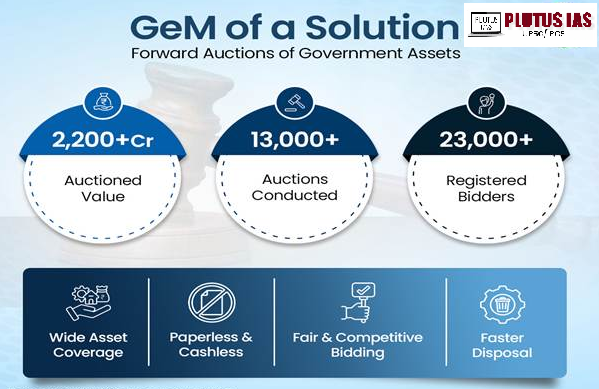
Traditional Challenges in Asset Disposal: Manual disposal processes were opaque, slow, and value-destructive. They often resulted in undervaluation and allegations of favouritism.
Emergence of Forward Auctions: GeM’s forward auction module introduces competitive digital bidding. It transforms disposal into a transparent market-driven process.
Technology as a Governance Enabler: Digital platforms replace discretion with predefined rules. This improves trust and efficiency in public administration.
Shift from Disposal to Value Creation: Asset disposal is now viewed as fiscal and strategic activity. It contributes to revenue generation and resource optimisation.
Relevance to Public Financial Management: Efficient asset monetisation strengthens non-tax revenues. It improves overall fiscal discipline of the State.
Forward Auctions as a Tool of Good Governance
Rule-Based Decision Making: Auction rules are standardised and digitally enforced. This limits arbitrariness and administrative discretion.
Transparency in Public Transactions: All bids are visible on the platform in real time. This enhances public trust and institutional credibility.
Accountability of Departments: Digital records ensure traceability of every transaction. Officials are accountable for reserve prices and outcomes.
Reduction in Corruption Risks: Limited human interface reduces rent-seeking behaviour. It curtails cartelisation and collusive practices.
Strengthening Institutional Integrity: Fair and open competition reinforces ethical governance. It aligns with constitutional values of equality and fairness.
Economic and Fiscal Significance
Efficient Price Discovery: Competitive bidding ensures assets fetch market-aligned prices. Often, final bids exceed reserve prices.
Augmenting Non-Tax Revenue: Proceeds from auctions add to government revenues. This reduces dependence on taxation and borrowing.
Optimal Utilisation of Idle Assets: Unused land, scrap, and vehicles are monetised efficiently. This improves overall resource productivity.
Support to Fiscal Consolidation: Asset monetisation complements budgetary reforms. It supports sustainable fiscal management.
Market Integration: A single digital platform connects buyers nationwide. This widens participation and improves outcomes.
Environmental and Social Dimensions
Scientific Disposal of E-Waste: Digital auctions ensure disposal through authorised channels. This reduces environmental hazards and pollution.
Promotion of Circular Economy: Scrap and obsolete materials are recycled and reused. This aligns with sustainable development goals.
Inclusive Participation of MSMEs: Small traders and enterprises can participate equally. It democratises access to government asset markets.
Regional Economic Opportunities: Local bidders gain access to national auctions. This supports decentralised economic activity.
Social Equity in Asset Allocation: Transparent auctions prevent elite capture. They ensure fair access across socio-economic groups.
Alignment with Broader Governance Reforms and Associated Challenges
| Theme / Dimension | Governance Reform Linkage | Expanded Explanation & Significance |
|---|---|---|
| Digital India Mission | End-to-end digitisation of asset disposal | Forward auctions extend the Digital India vision beyond service delivery to public asset management. By enabling online discovery, bidding, and allocation, they institutionalise transparency and data-driven decision-making, strengthening India’s overall digital governance ecosystem. |
| Ease of Doing Business | Reduction in procedural and transaction costs | Online participation eliminates physical inspections, discretionary approvals, and informal networks. This lowers entry barriers for bidders, improves predictability, and enhances the credibility of government as a market participant, aligning with ease-of-doing-business reforms. |
| Minimum Government, Maximum Governance | Automation and rule-based administration | Automated auction processes reduce human discretion in valuation and allocation. This limits rent-seeking, ensures objective outcomes, and reflects the principle of efficient governance with minimal administrative intervention. |
| Cooperative Federalism | Common digital platform for Centre and States | A unified auction platform allows central ministries, PSUs, and state governments to follow standardised procedures. This promotes harmonisation of governance norms, shared learning, and inter-governmental coordination in asset monetisation. |
| Public Sector Modernisation | Transition from legacy systems to digital tools | Forward auctions replace manual registers, paper-based tenders, and negotiated sales. This modernises administrative culture, encourages performance orientation, and embeds technology as a permanent governance instrument in the public sector. |
| Uneven Adoption Across Departments | Implementation gap in reform diffusion | While some departments actively use digital auctions, others remain dependent on traditional disposal methods. This uneven adoption dilutes reform impact and reflects institutional inertia and resistance to change. |
| Capacity Constraints | Skill gaps in valuation and auction design | Many officials lack specialised knowledge in asset valuation, market assessment, and digital auction mechanics. This can lead to inappropriate reserve prices and suboptimal outcomes, necessitating targeted capacity-building initiatives. |
| Asset Quality Disclosure | Transparency and information asymmetry | Inadequate or incomplete asset descriptions reduce bidder confidence and competition. High-quality disclosure is essential to ensure fair price discovery and uphold the transparency objectives of digital auctions. |
| Digital Divide | Unequal access to digital infrastructure | Small vendors, informal players, and bidders from remote areas may face challenges in accessing online platforms. Without digital facilitation and handholding, digital reforms risk excluding marginal participants. |
| Regulatory Oversight | Accountability and system integrity | As digital auctions scale up, robust oversight mechanisms are required to prevent collusion, data manipulation, or procedural misuse. Institutional checks must evolve to match the complexity and volume of digital transactions. |
Way Forward
Creation of Public Asset Registry: A unified database of government assets is needed. It will enable systematic identification for disposal.
Capacity Building of Officials: Training in valuation and digital auctioning is essential. This ensures informed and effective participation.
Standardisation of Valuation Norms: Uniform reserve pricing guidelines should be developed. This improves bidder confidence and outcomes.
Expansion of Asset Monetisation: Leasing and subletting models can be scaled up. This complements the National Monetisation Pipeline.
Strengthening Monitoring Mechanisms: Real-time audits and analytics should be used. They ensure integrity and continuous improvement.
Conclusion
GeM’s Forward Auction module marks a decisive shift in the way the State manages and monetises its assets. By replacing opaque, manual procedures with a transparent, competitive, and fully digital mechanism, it ensures higher value realisation, faster disposal, and greater public trust. The integration of efficiency, accountability, and sustainability within a single platform reflects the essence of Minimum Government, Maximum Governance. As adoption expands across departments, forward auctions have the potential to become a cornerstone of modern public financial management and technology-driven good governance in India.
Q. How do forward auctions on the Government e-Marketplace (GeM) strengthen transparency and accountability in public asset disposal? Examine their role in advancing the principle of “Minimum Government, Maximum Governance”.

- PRAGATI: A Decade of Cooperative, Outcome-Driven Governance - January 15, 2026
- Iran’s Large-Scale Protests: Political Stability, Public Dissent and Regional Implications - January 14, 2026
- India–Oman CEPA: A Strategic Trade Pact for Jobs, Exports and Regional Integration - January 10, 2026

No Comments