


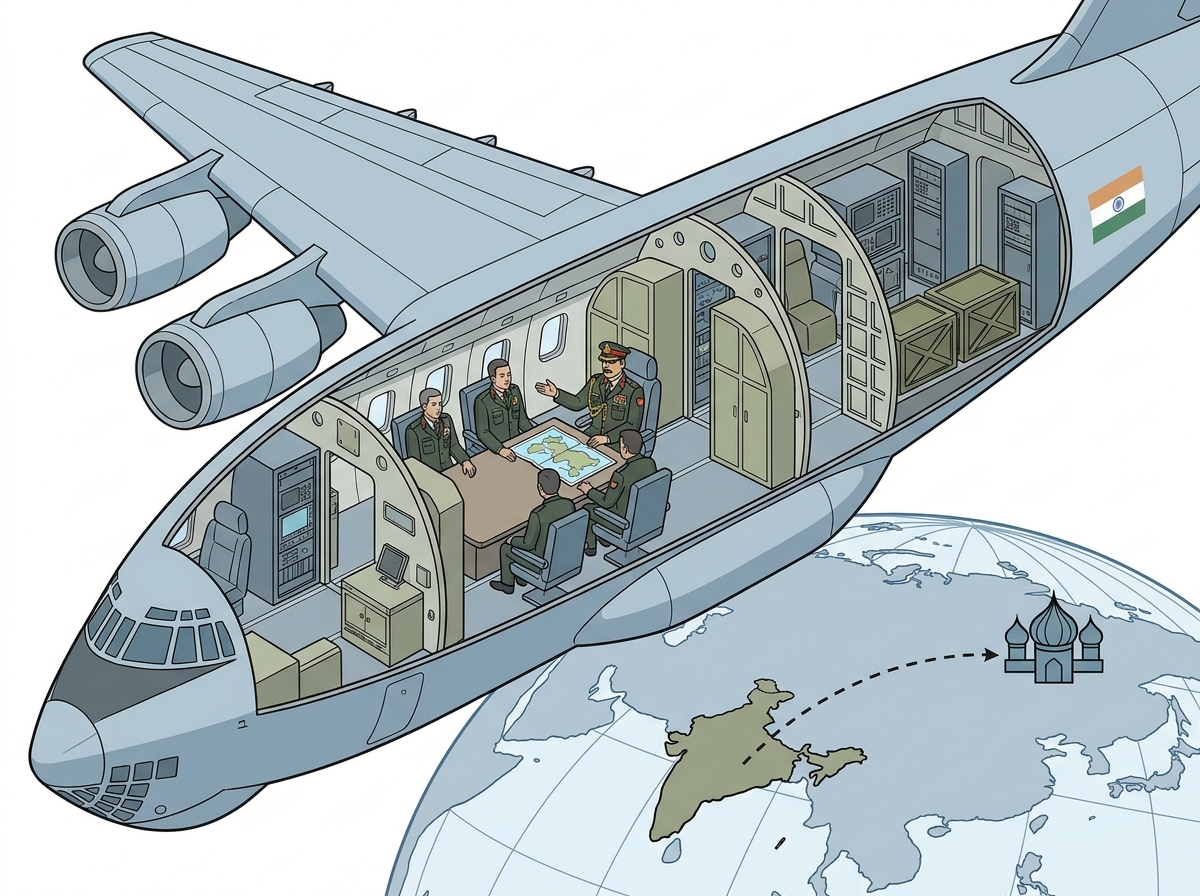
16 Sep General Dhiraj Seth’s Russia Visit: Strengthening India-Russia Defence Ties
✎ The Chief of Army Staff’s visit to Russia (16–18 September 2026) is a critical diplomatic engagement aimed at reinforcing India-Russia defence cooperation through institutional dialogue, strategic exchanges, and capacity-building…
Subject Relevance — Where This Topic Fits
- GS Paper II — International Relations: Bilateral, Regional and Global Groupings and Agreements involving India and/or affecting India’s interests | GS Paper III — Security Challenges and their Management: Linkages between Development and Spread of Extremism | GS Paper III — Various Security Forces and Agencies and their Mandate
- Prelims: Joint Military Exercises, Defence Procurement, Chief of Army Staff (COAS), Military Diplomacy, Defence Industrial Cooperation
- Essay: The Role of Military Diplomacy in Contemporary International Relations, Strategic Autonomy in India’s Foreign Policy: Balancing Global Partnerships
Quick Revision: The Chief of Army Staff’s visit to Russia (16–18 September 2026) is a critical diplomatic engagement aimed at reinforcing India-Russia defence cooperation through institutional dialogue, strategic exchanges, and capacity-building initiatives.
Why is this in the news?
The official visit of the Chief of the Army Staff (COAS), General Dhiraj Seth, to Russia from 16 to 18 September 2026, has been prominently highlighted in official communications as a significant diplomatic and defence engagement. The visit underscores the enduring strategic partnership between India and Russia, particularly in the domain of defence cooperation, and reflects the ongoing efforts to institutionalise military diplomacy through high-level exchanges, institutional visits, and strategic dialogues.
Background
- India and Russia share a long-standing defence partnership, rooted in historical ties, technological collaboration, and mutual strategic interests, dating back to the Cold War era and formalised through the Indo-Soviet Treaty of Peace, Friendship and Cooperation (1971).
- The bilateral defence relationship encompasses defence equipment supply, joint research and development, military exercises, and capacity-building initiatives, with Russia being one of India’s largest defence partners.
- The institutional framework for defence cooperation includes the India-Russia Inter-Governmental Commission on Military Technical Cooperation (IRIGC-MTC) and regular high-level visits by defence and military leadership.
- Recent geopolitical shifts, including the rise of new defence partnerships and the diversification of India’s defence procurement sources, have necessitated a reaffirmation of the India-Russia defence relationship to ensure strategic continuity.
- Military diplomacy has emerged as a critical tool for crisis management, confidence-building, and enhancing interoperability between armed forces of partner nations.
- The visit aligns with India’s broader foreign policy objectives of strategic autonomy, multi-alignment, and maintaining equidistance in global power dynamics.
What is the Strategic Significance of the Chief of Army Staff’s Visit to Russia?
- The visit aims to strengthen bilateral defence cooperation and military relations, particularly in the context of evolving global security architectures and regional dynamics.
- The COAS will engage with senior Russian defence officials, including the Commander-in-Chief of the Russian Ground Forces, to discuss mutual interests such as military training, joint exercises, and defence industrial collaboration.
- The visit includes a formal Guard of Honour and a tribute at the Tomb of the Unknown Soldier in Moscow, symbolising respect for the sacrifices of military personnel and reinforcing the shared history of the two nations.
- The COAS will visit the National Defence Control Centre in Moscow, which serves as a critical node for strategic decision-making and crisis response, highlighting the importance of institutional dialogue in defence governance.
- Meetings with the Deputy Defence Minister of Russia, responsible for defence industry and procurement, indicate a focus on enhancing defence trade, technology transfer, and joint manufacturing initiatives.
- The visit to the Mikhailovskaya Military Artillery Academy in St. Petersburg underscores the commitment to academic and professional exchanges, fostering long-term institutional linkages between military academies.
- The visit is part of a broader diplomatic effort to sustain high-level military engagement, ensuring that defence cooperation remains a cornerstone of the strategic partnership between India and Russia.
- The timing of the visit, amidst evolving global security challenges, reflects India’s proactive approach to maintaining robust defence ties with a trusted partner while navigating a multipolar world order.
Key Features
| Feature | Significance |
|---|---|
| Official visit by Chief of Army Staff (COAS) | Demonstrates India’s commitment to high-level military diplomacy and strategic engagement with key partners in the defence sector. |
| Formal Guard of Honour and homage at Tomb of the Unknown Soldier | Symbolises mutual respect for fallen soldiers and reinforces the shared history of military valour between India and Russia. |
| Bilateral discussions with Russian Army Chief (Colonel General Andrei Mordvichev) | Provides a platform to assess current military cooperation, identify new areas for collaboration, and strengthen interoperability in training and operations. |
| Visit to National Defence Control Centre, Moscow | Enables exchange of perspectives on emerging military developments and enhances situational awareness in real-time strategic decision-making. |
| Meeting with senior Russian Defence Ministry officials, including Deputy Defence Minister Vasily Osmakov | Facilitates dialogue on defence industrial cooperation, procurement processes, and long-term strategic partnerships in defence manufacturing. |
| Visit to Mikhailovskaya Military Artillery Academy, St. Petersburg | Highlights India’s interest in academic and technical exchanges in artillery and military education, fostering institutional linkages between defence academies. |
Why it Matters
Strategic Partnership
- Reinforces the India-Russia defence relationship, which has endured since the Cold War era and remains a cornerstone of India’s strategic autonomy.
- Demonstrates India’s diversified defence partnerships amid evolving global geopolitical dynamics, including the rise of new defence suppliers.
- Serves as a mechanism to address mutual security concerns, including border stability, counter-terrorism, and regional security in Eurasia.
- Strengthens India’s position in defence technology transfer and joint research initiatives, particularly in areas like artillery systems and military logistics.
Defence Diplomacy
- Highlights the role of military diplomacy in maintaining strategic stability and fostering trust between nations with historical defence ties.
- Provides an opportunity to review existing defence agreements and explore new frameworks for joint exercises, technology sharing, and capacity building.
- Enhances India’s soft power through military-to-military engagements, which are critical for projecting influence in global security forums.
- Supports India’s ‘Act East’ and ‘Neighbourhood First’ policies by ensuring a stable and predictable defence partnership in the Indo-Pacific region.
Institutional Cooperation
- Strengthens institutional linkages between the Indian Army and Russian Armed Forces, including joint training programmes and academic exchanges.
- Facilitates knowledge transfer in military education, doctrine development, and operational best practices through visits to defence academies.
- Promotes interoperability between the two militaries, which is essential for future joint operations or humanitarian assistance missions.
Challenges
1. Geopolitical Constraints
- The evolving global defence landscape, marked by the rise of new suppliers (e.g., USA, France, Israel), may limit the exclusivity of the India-Russia defence partnership.
- Sanctions or geopolitical pressures on Russia could impact the timely delivery of defence equipment or technology transfers to India.
- Differing strategic priorities between India and Russia in regions like West Asia or the Indo-Pacific may create friction in defence cooperation.
UPSC Link: GS-II: Bilateral groupings
Challenges — UPSC Perspective
| Issue | Concern |
|---|---|
| Defence Procurement Dependence | Over-reliance on Russian defence imports may expose India to supply chain disruptions or geopolitical vulnerabilities. |
| Technology Transfer Delays | Protracted negotiations or bureaucratic hurdles in defence technology transfer agreements could hinder India’s indigenous defence manufacturing goals. |
| Currency and Payment Mechanisms | Fluctuations in the rouble-rupee exchange rate or sanctions-related payment restrictions may complicate financial transactions in defence deals. |
| Intellectual Property Rights (IPR) Issues | Ensuring fair and transparent IPR agreements in joint defence projects remains a challenge, particularly in high-tech sectors like artillery systems. |
| Operational Interoperability | Differences in military doctrines, equipment standards, and communication systems may impede seamless joint operations between the two forces. |
Way Forward
- Conclude and operationalise existing defence agreements to ensure timely delivery of defence equipment and technology transfers.
- Expand joint military exercises and training programmes to enhance interoperability and operational readiness between the Indian and Russian armies.
- Strengthen institutional linkages by increasing academic exchanges between defence academies, including faculty and student exchanges.
- Explore new areas of defence cooperation, such as cybersecurity, space-based military applications, and artificial intelligence in defence.
- Establish a dedicated bilateral mechanism for regular reviews of defence cooperation to address emerging challenges and opportunities.
- Leverage India’s ‘Make in India’ initiative to collaborate on co-development and co-production of defence equipment with Russian partners.
- Enhance transparency in defence procurement processes to build trust and ensure long-term strategic alignment.
UPSC Value Addition
Keywords for Mains Answer-Writing
India-Russia defence cooperation · military diplomacy · Chief of Army Staff · defence industrial collaboration · strategic partnership · military training and exchanges · defence procurement · bilateral military engagements · Army-to-Army cooperation · Russia-India strategic alliance · defence cooperation framework · military institutional visits
Concept Flow
India and Russia’s historical defence partnership → Evolving global geopolitical dynamics → Need for high-level military diplomacy → Official visit by COAS to Russia → Bilateral discussions on defence cooperation → Exchange of perspectives on military developments → Strengthening institutional linkages → Enhanced interoperability and strategic stability → Long-term defence partnership
Prelims Practice Questions
Q1. Consider the following statements regarding India-Russia defence cooperation:
1. India and Russia have maintained a long-standing defence partnership since the Cold War era.
2. The Chief of Army Staff of India is visiting Moscow to attend the National Defence Control Centre of Russia.
3. The visit includes a scheduled meeting with the Russian Defence Minister to discuss defence procurement and industrial collaboration.
How many of the above statements are correct?
- Only one
- Only two
- Only three
- None
Answer: Only three — Statements 1 and 2 are correct. Statement 3 is incorrect as the visit includes a meeting with the Deputy Defence Minister responsible for defence industry and procurement, not the Defence Minister.
Q2. Assertion (A): The Chief of Army Staff of India is visiting Russia to strengthen bilateral military ties and defence cooperation.
Reason (R): India and Russia have historically collaborated in defence manufacturing, technology transfer, and military training.
In the context of the above statements, which of the following is correct?
- Both A and R are true, and R is the correct explanation of A.
- Both A and R are true, but R is not the correct explanation of A.
- A is true, but R is false.
- A is false, but R is true.
Answer: Both A and R are true, but R is not the correct explanation of A. — Both the assertion and reason are true. The visit aims to strengthen bilateral military ties, and India-Russia defence cooperation has historically included manufacturing, technology transfer, and military training.
Q3. Match the following military institutions with their respective countries:
Column I
A. Mikhaylovskaya Military Artillery Academy
B. National Defence Control Centre
C. Russian Ground Forces Headquarters
Column II
1. India
2. Russia
3. Both India and Russia
Select the correct match:
- A-2, B-2, C-2
- A-2, B-3, C-2
- A-1, B-2, C-2
- A-2, B-2, C-1
Answer: A-2, B-3, C-2 — A. Mikhaylovskaya Military Artillery Academy is in Russia. B. National Defence Control Centre is in Russia. C. Russian Ground Forces Headquarters is in Russia.
Mains Practice Question
✍ Discuss the significance of high-level military diplomacy in the context of India-Russia strategic partnership. How does such engagement contribute to India’s defence preparedness and long-term strategic autonomy? (15 Marks)
Approach: MODEL-ANSWER SKELETON:
1. **Contextual Framework**:
– Define India-Russia strategic partnership: historical depth (since Cold War), defence trade (e.g., BrahMos, AK-203 rifles), and institutional ties (e.g., joint military exercises like INDRA).
– Role of high-level military diplomacy: visits by service chiefs, defence ministers, and institutional exchanges.
2. **Contributions to Defence Preparedness**:
– **Technology Transfer and Indigenous Development**: Reference BrahMos joint venture, licensed production of T-90 tanks, and S-400 systems.
– **Military Training and Exchanges**: Joint training programs, exchange of cadets, and exposure to Russian military doctrines (e.g., Arctic warfare, artillery tactics).
– **Defence Procurement and Industrial Collaboration**: Long-term contracts (e.g., AK-203 rifles, frigates), offsets, and co-development (e.g., Fifth Generation Fighter Aircraft).
3. **Strategic Autonomy**:
– **Diversification of Defence Partners**: India’s multi-alignment policy (e.g., S-400 from Russia, Rafale from France, indigenous platforms like Tejas).
– **Counterbalance to Regional Challenges**: Addressing China-Pakistan axis and ensuring a stable supply chain for critical defence inputs.
– **Geopolitical Leverage**: Use of defence partnerships to navigate global power shifts (e.g., Indo-Pacific strategy, Quad engagements).
4. **Challenges and Limitations**:
– **Dependence on Russian Systems**: Risks due to sanctions (e.g., CAATSA) and delays in deliveries.
– **Technological Gaps**: Need for indigenization (e.g., Atmanirbhar Bharat in defence manufacturing).
– **Alternative Partnerships**: Growing defence ties with the US, France, and Israel as a hedge.
5. **Conclusion**:
– High-level military diplomacy with Russia remains critical for India’s defence preparedness and strategic autonomy, but must be balanced with diversified partnerships and indigenous capabilities.
Source: PIB (Press Information Bureau)
Generated by AanyaAi for educational purpose.
Related guides on our sites
- Anthropology VS PSIR
- Best PSIR optional coaching
- Best PSIR optional coaching online
- Best PSIR optional teacher

- General Dhiraj Seth’s Russia Visit: Strengthening India-Russia Defence Ties - September 16, 2026
- औषध विभाग ने मनाया ‘स्वच्छता पखवाड़ा’, स्वच्छ भारत अभियान को मिला बल - September 16, 2026
- UPSC Alert: Department of Pharmaceuticals launches ‘Swachhta Pakhwada’ 2026 for clean governance - September 16, 2026

No Comments