


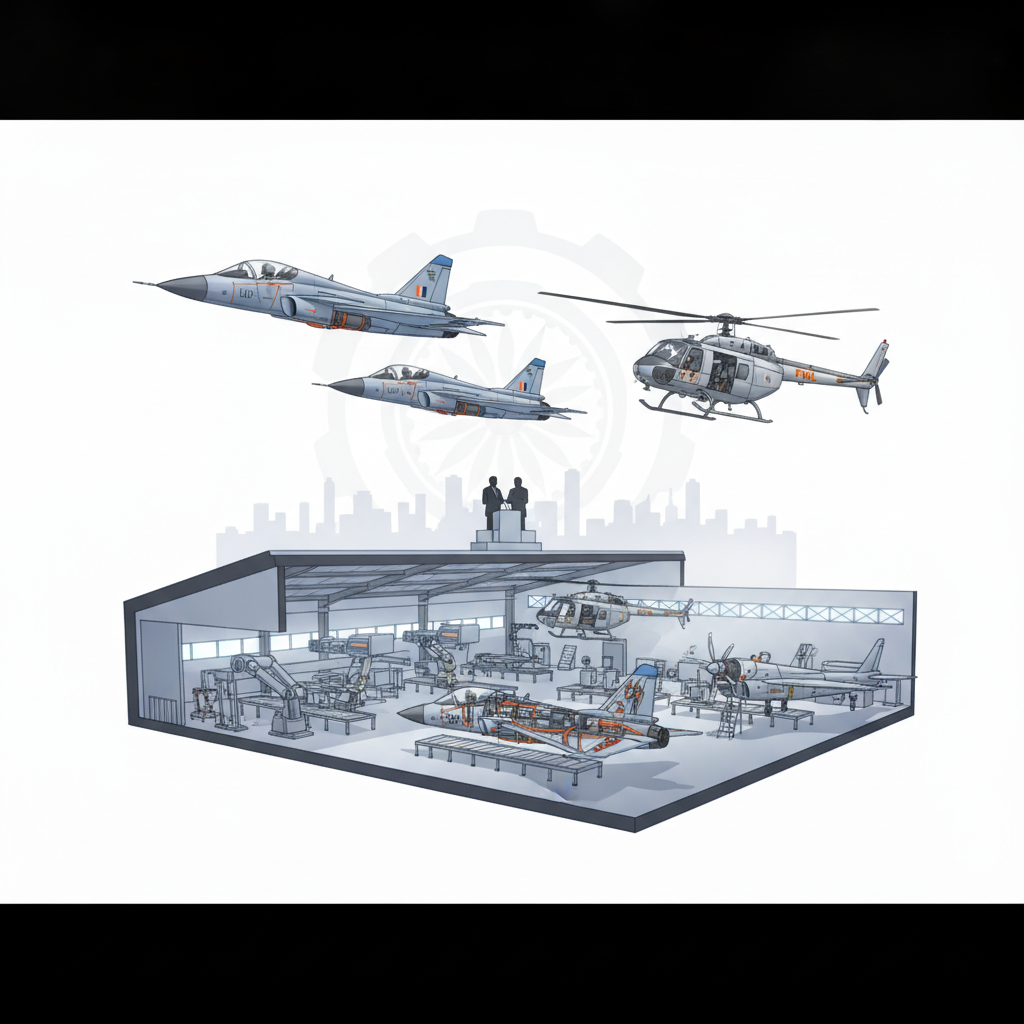
18 Sep HAL transfers LCA Tejas, HTT-40 trainers & Dhruv NG to IAF, PHL
✎ The delivery of LCA Tejas Twin-Seat Trainer, HTT-40 Basic Trainer, and Dhruv NG Helicopter to the IAF and PHL marks a significant stride in India’s journey towards indigenous defence manufacturing under the 'Atmanirbhar Bharat'…
Subject Relevance — Where This Topic Fits
- GS Paper III — Security: Defence Technology, Indigenous Manufacturing, and Self-Reliance in Defence Production
- Prelims: Light Combat Aircraft (LCA) Tejas, HTT-40 Basic Trainer Aircraft, Dhruv NG Helicopter, Hindustan Aeronautics Limited (HAL), Pawan Hans Limited (PHL), Defence Procurement Procedure (DPP), Strategic Partnership Model, Make in India, Defence Research and Development Organisation (DRDO), Offset Policy in Defence
- Essay: The Imperative of Indigenous Innovation in National Security, Balancing Strategic Autonomy and Global Partnerships in Defence Manufacturing
Quick Revision: The delivery of LCA Tejas Twin-Seat Trainer, HTT-40 Basic Trainer, and Dhruv NG Helicopter to the IAF and PHL marks a significant stride in India’s journey towards indigenous defence manufacturing under the ‘Atmanirbhar Bharat’ initiative.
Why is this in the news?
On 18 September 2026, Hindustan Aeronautics Limited (HAL) formally handed over the twin-seat LCA Tejas Trainer and HTT-40 Basic Trainer Aircraft to the Indian Air Force (IAF), and the Dhruv Next Generation (NG) Helicopter to Pawan Hans Limited (PHL), in Bengaluru. The event, attended by the Defence Minister and the Minister of Civil Aviation, marks a critical milestone in India’s indigenous defence manufacturing capabilities and underscores the progress under the ‘Atmanirbhar Bharat’ initiative in the aerospace sector.
Background
- The Government of India has accorded high priority to indigenous design, development, and manufacturing in the aerospace and defence sectors to reduce import dependence and enhance strategic autonomy.
- The ‘Atmanirbhar Bharat’ initiative, launched in 2020, aims to transform India into a global manufacturing hub by leveraging domestic capabilities across critical sectors, including defence.
- Hindustan Aeronautics Limited (HAL), a Defence Public Sector Undertaking (DPSU), is the nodal agency for the development and production of military and civil aircraft in India.
- Pawan Hans Limited (PHL), a helicopter service provider, operates under the Ministry of Civil Aviation and plays a key role in civil and para-military helicopter operations.
Key Indigenous Platforms Delivered: Features and Significance
- LCA Tejas Twin-Seat Trainer: A twin-seat variant of the Light Combat Aircraft (LCA) Tejas, designed for advanced fighter training and operational conversion. It enhances the IAF’s training infrastructure and reduces reliance on foreign trainer aircraft.
- HTT-40 Basic Trainer Aircraft: A turboprop trainer developed indigenously by HAL for basic flight training of pilots. It is cost-effective, easy to maintain, and suitable for the initial stages of pilot training.
- Dhruv NG (Next Generation) Helicopter: An upgraded variant of the Dhruv Advanced Light Helicopter (ALH), featuring improved avionics, engine performance, and multi-role capabilities for civil and para-military operations.
- Indigenous Design and Development: All platforms are designed, developed, and manufactured in India, demonstrating the growing maturity of the domestic aerospace industry.
- Civil-Military Dual-Use: The platforms are designed for both military and civil applications, enhancing their utility and economic viability.
- Role in Self-Reliance: The delivery of these platforms is a strategic step toward reducing import dependence in critical aerospace technologies and strengthening India’s defence industrial base.
- Collaborative Ecosystem: The development of these platforms involves partnerships with private sector entities, research institutions, and regulatory agencies, fostering a robust aerospace ecosystem.
- Operational Integration: The inclusion of these platforms in the IAF and PHL fleets will enhance training efficiency, operational readiness, and mission capabilities.
Key Features
| Feature | Significance |
|---|---|
| LCA Tejas Twin-Seater Trainer | Indigenous 4.5-generation light combat aircraft designed for advanced training and operational conversion; enhances IAF’s indigenous fighter pilot training pipeline. |
| HTT-40 Basic Trainer Aircraft | Indigenously developed turboprop trainer for basic flight training; reduces reliance on foreign-origin platforms for initial pilot training. |
| Dhruv NG Helicopter (Pawan Hans Ltd) | Next-generation utility helicopter with improved avionics and payload capacity; supports civil and para-military roles including coastal surveillance and disaster management. |
| HAL’s Role in Ecosystem | Demonstrates India’s capability in end-to-end aerospace manufacturing, from design to delivery, fostering private sector participation under ‘Make in India’. |
| Multi-Stakeholder Participation | Event highlights collaboration between Ministry of Defence, Ministry of Civil Aviation, IAF, HAL, Pawan Hans Ltd., and regulatory agencies to strengthen domestic aerospace value chain. |
Why it Matters
Strategic Autonomy
- Reduces dependence on foreign defence imports by operationalising indigenous platforms in critical segments like fighter training and utility helicopters.
- Strengthens India’s position in global aerospace supply chains through demonstrated design, development, and manufacturing capabilities.
- Enhances operational readiness of the Indian Air Force by integrating locally produced trainers and combat aircraft into training curricula.
Economic Impact
- Promotes job creation and skill development in high-technology sectors through domestic aerospace manufacturing and ancillary industries.
- Supports MSMEs and private sector firms in the aerospace ecosystem by providing opportunities for component manufacturing and system integration.
- Potential for export earnings from surplus production capacity and adherence to global aerospace quality standards.
Technological Advancement
- Showcases India’s progress in aerospace R&D, particularly in avionics, composite materials, and engine technology for military and civil applications.
- Facilitates technology transfer and indigenisation of critical sub-systems, reducing reliance on imported components.
- Demonstrates dual-use capability, with platforms like Dhruv NG serving both defence and civilian sectors such as disaster relief and medical evacuation.
Policy Alignment
- Directly aligns with the ‘Atmanirbhar Bharat’ initiative, which prioritises self-reliance in defence production and reduces import dependency.
- Supports the ‘Make in India’ programme by promoting indigenous manufacturing and reducing the defence import bill.
- Complements the ‘Defence Production and Export Promotion Policy (DPEPP) 2020’ by accelerating the indigenisation of defence platforms.
Challenges
1. Indigenisation of Critical Components
- Many aerospace sub-systems (e.g., avionics, engines, sensors) still rely on foreign suppliers, posing risks to supply chain resilience.
- Need for sustained investment in R&D to achieve parity with global aerospace technology standards.
- Limited domestic capacity for high-precision manufacturing of complex aerospace components.
UPSC Link: GS3: Industrial policy & technology
2. Cost Competitiveness
- Domestic production often faces higher costs compared to established global manufacturers due to economies of scale.
- Balancing affordability with advanced features while maintaining competitive pricing for domestic and export markets.
- Subsidies and incentives may be required to offset initial cost disadvantages in the short term.
UPSC Link: GS3: Industrial policy & subsidies
3. Regulatory and Certification Hurdles
- Stringent certification processes by agencies like DGCA and CEMILAC require significant time and resources.
- Harmonising domestic standards with international aerospace regulations (e.g., FAA, EASA) to facilitate exports.
- Ensuring compliance with environmental and safety norms without compromising on performance.
UPSC Link: GS2: Regulatory bodies & governance
4. Skilled Manpower Development
- Shortage of specialised aerospace engineers, technicians, and pilots trained in indigenous platforms.
- Need for industry-academia collaboration to develop tailored training programmes and certification pathways.
- Retention of skilled personnel in a competitive global job market.
UPSC Link: GS2: Education & skill development
5. Market and Export Barriers
- Competition from established global aerospace manufacturers with established brand recognition and after-sales support.
- Geopolitical sensitivities and export restrictions imposed by other nations on dual-use technologies.
- Building trust among international customers regarding reliability and after-sales service.
UPSC Link: GS2: International relations & trade
Challenges — UPSC Perspective
| Issue | Concern |
|---|---|
| Supply Chain Dependence | Reliance on imported raw materials and components for aerospace manufacturing. |
| R&D Investment Gaps | Insufficient funding for cutting-edge aerospace technologies compared to global peers. |
| Certification Delays | Lengthy approval processes for indigenous platforms due to stringent regulatory requirements. |
| Human Capital Shortage | Limited availability of aerospace engineers and technicians with specialised skills. |
| Export Market Penetration | Difficulty in competing with established global aerospace firms in international markets. |
| Cost Overruns | Higher production costs due to small-scale manufacturing and lack of economies of scale. |
Way Forward
- Accelerate indigenisation of critical aerospace components through targeted R&D grants and PPP models.
- Strengthen industry-academia linkages to develop specialised training programmes for aerospace professionals.
- Streamline certification processes by enhancing inter-agency coordination (e.g., CEMILAC, DGCA) and adopting digital tools.
- Expand export promotion initiatives by participating in global aerospace expos and bilateral trade agreements.
- Invest in advanced manufacturing infrastructure (e.g., composite material facilities, additive manufacturing) to improve cost competitiveness.
- Develop a national aerospace innovation hub to foster collaboration between startups, MSMEs, and large defence PSUs.
- Enhance skill development through apprenticeship programmes and specialised courses in aerospace engineering.
- Establish a dedicated fund for aerospace startups to support prototype development and scaling of indigenous technologies.
UPSC Value Addition
Keywords for Mains Answer-Writing
Atmanirbhar Bharat · Defence Indigenisation · HAL (Hindustan Aeronautics Limited) · Light Combat Aircraft (LCA) Tejas · HTT-40 Basic Trainer Aircraft · Dhruv NG Helicopter · Defence Research and Development Organisation (DRDO) · Strategic Partnership Model · Defence Procurement Procedure (DPP) · Aerospace and Defence Ecosystem · Self-Reliance in Defence Manufacturing · Indian Air Force (IAF) · Public Sector Undertakings (PSUs) in Defence · Offsets in Defence Contracts · Defence Industrial Base
Constitutional & Policy Linkages
- [‘Article 51A(h): Fundamental Duty to develop scientific temper’, ‘Promotes indigenous technology and innovation.’]
Concept Flow
Domestic aerospace ecosystem development → Government prioritisation of ‘Atmanirbhar Bharat’ → Investment in R&D and manufacturing → HAL and Pawan Hans Ltd. deliver indigenous platforms → Integration into IAF training and operational roles → Reduced import dependency → Strengthened strategic autonomy and economic growth.
Prelims Practice Questions
Q1. Consider the following statements regarding the Light Combat Aircraft (LCA) Tejas:
1. The LCA Tejas is a single-engine, delta-wing, multirole light fighter designed by the Aeronautical Development Agency (ADA) under the Defence Research and Development Organisation (DRDO).
2. The twin-seater variant of the LCA Tejas is primarily used for training purposes and operational conversion of pilots.
3. The LCA Tejas has been inducted into the Indian Air Force as a replacement for the MiG-21 fleet.
4. The LCA Tejas is manufactured exclusively by the private sector in India.
How many of the above statements are correct?
- Only one
- Only two
- Only three
- All
Answer: All — Statements 1, 2, and 3 are correct. Statement 4 is incorrect as the LCA Tejas is manufactured by Hindustan Aeronautics Limited (HAL), a Public Sector Undertaking (PSU).
Q2. Assertion (A): The Defence Procurement Procedure (DPP) 2020 introduced the Strategic Partnership Model to promote indigenous manufacturing in the defence sector.
Reason (R): The Strategic Partnership Model aims to identify a few Indian private companies as Strategic Partners who would initially tie up with global Original Equipment Manufacturers (OEMs) to seek technology transfers and subsequently endeavour to enhance indigenisation.
In the context of the above two statements, which one of the following is correct?
- Both A and R are true, and R is the correct explanation of A
- Both A and R are true, but R is NOT the correct explanation of A
- A is true, but R is false
- A is false, but R is true
Answer: Both A and R are true, but R is NOT the correct explanation of A — The DPP 2020 introduced the Strategic Partnership Model to promote indigenous manufacturing by identifying Indian private companies as Strategic Partners to tie up with global OEMs for technology transfer and indigenisation. Hence, both A and R are true, and R correctly explains A.
Q3. Match the following aircraft/helicopters with their respective manufacturers:
Column I (Aircraft/Helicopter) | Column II (Manufacturer)
1. LCA Tejas Twin-Seater Trainer | A. Hindustan Aeronautics Limited (HAL)
2. HTT-40 Basic Trainer Aircraft | B. Hindustan Aeronautics Limited (HAL)
3. Dhruv NG Helicopter | C. Hindustan Aeronautics Limited (HAL)
4. Advanced Light Helicopter (ALH) Dhruv | D. Hindustan Aeronautics Limited (HAL)
Choose the correct match:
- 1-A, 2-B, 3-C, 4-D
- 1-A, 2-B, 3-D, 4-C
- 1-B, 2-A, 3-C, 4-D
- 1-B, 2-A, 3-D, 4-C
Answer: 1-A, 2-B, 3-D, 4-C — All listed aircraft and helicopters are manufactured by Hindustan Aeronautics Limited (HAL).
Mains Practice Question
✍ The transfer of the LCA Tejas twin-seater trainer, HTT-40 basic trainer aircraft, and Dhruv NG helicopter to the Indian Air Force and Pawan Hans Limited respectively marks a significant milestone in India’s journey towards self-reliance in defence manufacturing. Critically examine the role of public sector undertakings (PSUs) like HAL in achieving the objectives of Atmanirbhar Bharat in the aerospace and defence sector. Also, analyse the challenges faced by the domestic defence industrial base in realising its full potential. (15 Marks)
Approach: MODEL-ANSWER SKELETON:
1. **Role of PSUs in Atmanirbhar Bharat:**
– **Indigenous Design and Development:** Highlight HAL’s role in designing, developing, and manufacturing platforms like LCA Tejas, HTT-40, and Dhruv NG, reducing dependence on imports (e.g., MiG-21 replacements, basic training aircraft).
– **Strategic Partnership Model (SPM):** Explain how SPM under DPP 2020 leverages PSUs like HAL to collaborate with global OEMs for technology transfer and indigenisation (cite examples such as the Sukhoi-30MKI or Tejas Mk-1A).
– **Capacity Building:** Discuss HAL’s role in creating a robust aerospace ecosystem, including Tier-2 and Tier-3 suppliers, and its contribution to the ‘Make in India’ initiative.
– **Export Potential:** Mention HAL’s export achievements (e.g., Dhruv helicopter exports to countries like Ecuador, Mauritius) and its alignment with the ‘Defence Exports’ push under Atmanirbhar Bharat.
2. **Challenges to Domestic Defence Industrial Base:**
– **Technological Gaps:** Discuss delays in indigenisation due to technological complexities (e.g., jet engine development, avionics, composite materials) and reliance on foreign components.
– **Funding and Infrastructure:** Highlight constraints in R&D funding, modernisation of production facilities, and the need for private sector investment (cite the role of DRDO and ISRO as comparators).
– **Bureaucratic Hurdles:** Explain procedural delays in procurement, offsets, and clearances under DPP 2020, which impact timelines (e.g., LCA Tejas Mk-1A induction delays).
– **Skilled Manpower:** Address shortages in skilled labour, engineering talent, and the need for industry-academia collaborations (cite examples like the HAL Skill Development Centre).
– **Global Competition:** Discuss the challenge of competing with established global defence manufacturers (e.g., Boeing, Airbus, Lockheed Martin) in terms of cost, quality, and delivery timelines.
3. **Way Forward:**
– **Enhanced R&D Investment:** Propose increased budgetary allocation for R&D in aerospace and defence (cite the Defence R&D Budget as a % of GDP).
– **Private Sector Integration:** Advocate for greater private sector participation under the SPM framework to diversify manufacturing capabilities.
– **Policy Reforms:** Suggest streamlining procurement processes, simplifying offset clauses, and incentivising MSMEs to participate in the defence supply chain.
– **Skill Development:** Emphasise the need for targeted skill development programs in collaboration with IITs, NITs, and vocational training institutes.
– **Export Promotion:** Strengthen defence export policies to leverage India’s growing capabilities (cite the ‘Defence Exports Strategy’ under the Atmanirbhar Bharat package).
4. **Conclusion:**
– Summarise the critical role of PSUs like HAL in achieving self-reliance while acknowledging the structural challenges that need to be addressed for sustainable growth. Conclude with a balanced view: PSUs are indispensable but require systemic reforms and private sector synergy to realise Atmanirbhar Bharat’s full potential.
Source: PIB (Press Information Bureau)
Karnataka PCS (KPSC) — State PCS Practice
Prelims: Which of the following aircraft was recently inducted into the Indian Air Force (IAF) under the ‘Make in India’ initiative, as part of the ‘Atmanirbhar Bharat’ campaign, during an event in Bengaluru attended by the Union Defence Minister and Civil Aviation Minister?
- A) Tejas Mk-1 Trainer
- B) HTT-40 Basic Trainer Aircraft
- C) Sukhoi-30 MKI
- D) Light Combat Helicopter (LCH)
Answer: B) HTT-40 Basic Trainer Aircraft — The HTT-40 Basic Trainer Aircraft was inducted into the IAF during the event in Bengaluru, aligning with the ‘Atmanirbhar Bharat’ initiative.
Mains: Discuss the significance of the induction of the HTT-40 Basic Trainer Aircraft and the LCA Tejas Twin-Seater Trainer for the Indian Air Force in the context of Karnataka’s role in India’s defence manufacturing ecosystem. Highlight the contributions of Hindustan Aeronautics Limited (HAL) and the state’s potential in furthering self-reliance in defence production.
Generated by AanyaAi for educational purpose.

- संयुक्त राष्ट्र महासभा अध्यक्ष का Rohingya संकट से सीख: विश्वास और AI पर बल - September 19, 2026
- UNGA President’s Rohingya Crisis Lessons for UPSC: Trust & AI Challenges - September 19, 2026
- HAL ने IAF को दो LCA ट्रेनर विमान सौंपे: सुरक्षा तैयारी में बड़ा कदम - September 19, 2026

No Comments