


19 Jul Himachal CM Slams Union Budget 2026-27 as ‘Inequitable’; Finance Commission Report Under Fire
Subject Relevance — Where This Topic Fits
- GS Paper II — Indian Constitution, Functions and Responsibilities of the Union and the States, Issues and Challenges Pertaining to the Federal Structure, Devolution of Powers and Finances up to Local Levels and Challenges Therein | GS Paper III — Indian Economy and Issues Relating to Planning, Mobilization of Resources, Growth, Development and Employment, Government Budgeting
- Prelims: Finance Commission, Fiscal Federalism, Revenue Deficit Grants, Article 275, Special Category Status, Union Budget, State Finances, Vertical Devolution, Horizontal Devolution, GST Compensation
- Essay: Fiscal Federalism and Cooperative Governance in India: Balancing Autonomy and Equity, The Evolving Landscape of State Finances: Challenges and Opportunities for Sustainable Development
Quick Revision: The Finance Commission is a constitutional body crucial for fiscal federalism, recommending tax devolution and grants to states, while the Union Budget outlines national financial priorities; recent concerns highlight challenges for special category states like Himachal Pradesh regarding Revenue Deficit Grants and equitable resource distribution.
Why is this in the news?
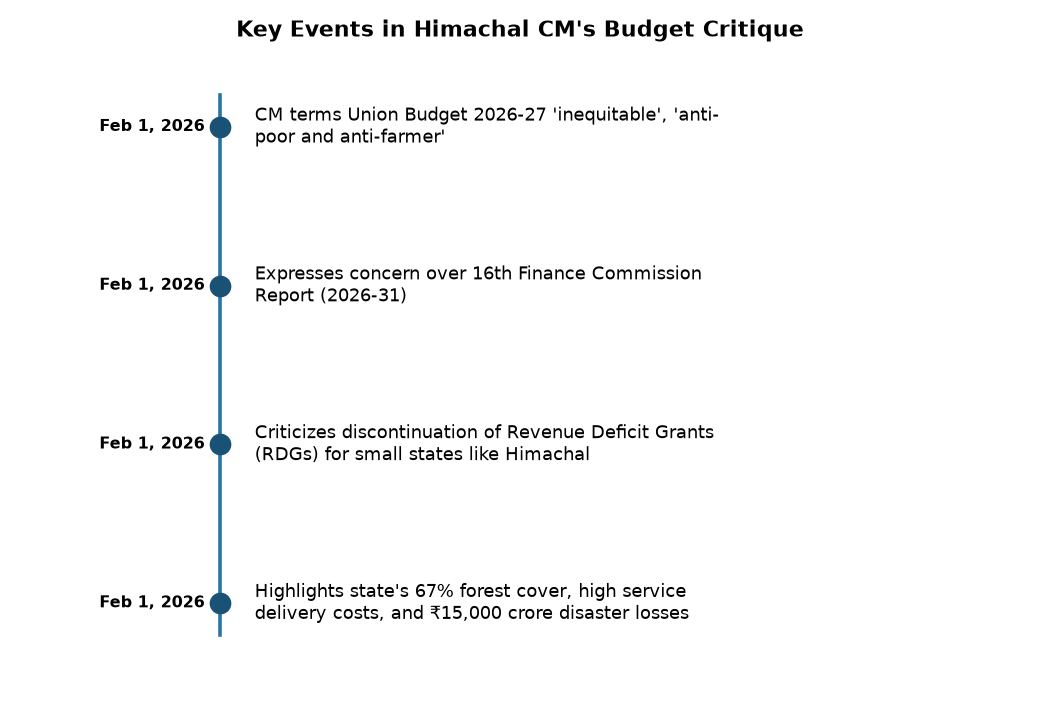
The Chief Minister of Himachal Pradesh, Sukhvinder Singh Sukhu, has termed the Union Budget 2026-27 as ‘inequitable’ and ‘anti-poor and anti-farmer’, expressing significant disappointment over its perceived neglect of the state’s concerns. Concurrently, he raised serious reservations regarding the recently tabled 16th Finance Commission (FC-XVI) Report for the period 2026-31, specifically criticising the discontinuation of Revenue Deficit Grants (RDGs) for smaller states, including Himachal Pradesh.
Background
- The Finance Commission is a constitutional body established under Article 280 of the Indian Constitution, tasked with recommending the distribution of tax revenues between the Union and the States, and among the States themselves.
- Revenue Deficit Grants (RDGs) are provided under Article 275(1) of the Constitution to states that face a revenue deficit post-devolution of taxes, aiming to bridge the gap between their revenue and expenditure.
- Historically, RDGs have been a crucial component of fiscal support for states, particularly those with structural fiscal handicaps, ensuring their ability to deliver essential public services.
- Himachal Pradesh, as a special category hill state, faces unique fiscal challenges due to its difficult mountainous terrain, fragile ecology, susceptibility to natural disasters, and a limited own-revenue base.
- The Union Budget outlines the government’s financial plans for the upcoming fiscal year, including revenue generation, expenditure allocation, and policy priorities, impacting states through various transfers and schemes.
- The 15th Finance Commission (FC-XV) had recommended RDGs for several states, acknowledging their specific fiscal needs and structural constraints, setting a precedent for such support.
The Finance Commission of India
- The Finance Commission is a quasi-judicial body constituted by the President of India every five years or earlier, as deemed necessary.
- Its primary mandate is to recommend the distribution of net proceeds of taxes between the Union and the States (vertical devolution) and the allocation of shares among the States (horizontal devolution).
- It also recommends the principles governing grants-in-aid to the States by the Centre out of the Consolidated Fund of India, including Revenue Deficit Grants under Article 275.
- The Commission’s recommendations aim to address fiscal imbalances and promote fiscal federalism, ensuring equitable distribution of financial resources across different tiers of government.
- It also advises on measures needed to augment the Consolidated Fund of a State to supplement the resources of Panchayats and Municipalities on the basis of the recommendations made by the State Finance Commission.
- The 16th Finance Commission was constituted in December 2023, with its report expected to cover the period of five years commencing April 1, 2026.
- Its terms of reference typically include reviewing the fiscal position of the Union and the States, recommending a fiscal consolidation roadmap, and examining the impact of GST on state finances.
Key Features
| Feature | Significance |
|---|---|
| Constitutional Mandate (Article 280) | Ensures a regular, institutionalised mechanism for fiscal transfers, promoting stability and predictability in inter-governmental financial relations. |
| Vertical Devolution | Determines the share of divisible pool of taxes to be transferred from the Union to the States, impacting the overall resource availability for states. |
| Horizontal Devolution | Establishes criteria for distributing the states’ share among individual states, addressing inter-state disparities based on factors like population, area, income distance, and fiscal capacity. |
| Grants-in-Aid (Article 275) | Provides specific grants, including Revenue Deficit Grants, to states in need, to bridge fiscal gaps and support essential public services. |
| Local Bodies’ Finances | Recommends measures to augment state consolidated funds for supplementing resources of Panchayats and Municipalities, strengthening decentralised governance. |
| Fiscal Consolidation Roadmap | Suggests strategies for both Union and State governments to manage their fiscal deficits and debt, ensuring long-term macroeconomic stability. |
Why it Matters
Fiscal Federalism and Equity
- The Finance Commission’s recommendations are pivotal in shaping India’s fiscal federalism, aiming to balance the financial autonomy of states with the need for national cohesion and equitable development.
- It seeks to reduce vertical and horizontal fiscal imbalances, ensuring that all states, irrespective of their economic size or geographical location, have adequate resources to provide public services.
- The provision of grants, especially RDGs, has historically been crucial for states with limited own-revenue bases or specific structural disadvantages, promoting a more equitable distribution of resources.
State Fiscal Health and Service Delivery
- Adequate fiscal transfers and grants enable states to maintain fiscal sustainability, preventing excessive reliance on borrowing and mitigating the risk of increased indebtedness.
- Sufficient financial resources empower states to invest in critical sectors like healthcare, education, infrastructure, and social welfare, directly impacting the quality of life of their citizens.
- The absence or reduction of grants, particularly for states with inherent fiscal handicaps, can severely constrain their ability to deliver essential public services and undertake developmental projects.
Regional Development and Special Category States
- The Finance Commission often considers the unique challenges faced by special category states, such as difficult terrain, fragile ecology, and susceptibility to natural disasters, in its recommendations.
- Targeted fiscal support for these states is vital for their socio-economic development, disaster preparedness, and environmental conservation, contributing to balanced regional growth.
- Discontinuation of specific grants for such states can exacerbate their developmental challenges and widen regional disparities.
Challenges
1. Discontinuation of Revenue Deficit Grants (RDGs)
- The decision by the 16th Finance Commission to discontinue RDGs for small states like Himachal Pradesh is perceived as a significant withdrawal of fiscal support.
- This move overlooks the structural fiscal handicaps faced by these states, including higher per-capita cost of service delivery in mountainous terrain and vulnerability to natural disasters.
- It could force states to make difficult choices between maintaining essential public services and increasing indebtedness, potentially compromising fiscal sustainability.
UPSC Link: Fiscal Federalism; State Finances
2. Impact on Special Category States
- Special category hill states, like Himachal Pradesh, face unique challenges such as difficult terrain, fragile ecology, and limited own-revenue bases.
- Stronger fiscal support, including a clear framework for continued RDGs, is critical for these states to maintain fiscal balance, deliver essential public services, and sustain social welfare commitments.
- The absence of such support can hinder their developmental trajectory and increase their vulnerability to economic shocks and natural calamities.
UPSC Link: Regional Disparities; Special Category Status
3. Inadequate Response to National Issues in Union Budget
- The Union Budget 2026-27 is criticised for failing to adequately address critical national issues such as unemployment, poverty, and escalating prices.
- This indicates a potential disconnect between national policy priorities and the on-ground realities and needs of various sections of society.
- Such an approach can lead to dissatisfaction among states and specific economic sectors, hindering inclusive growth.
UPSC Link: Government Budgeting; Economic Growth
4. Neglect of Specific State Economic Sectors
- The Union Budget’s perceived neglect of vital state-specific economic sectors, such as the apple growers of Himachal Pradesh, who contribute significantly to the state’s economy, raises concerns.
- Lack of recognition or support for such sectors can undermine local economies, impact livelihoods, and contribute to regional economic distress.
- It highlights the need for a more nuanced and responsive approach in national budgeting that considers regional economic diversity.
UPSC Link: Agriculture; Regional Economy
5. Fiscal Autonomy vs. Centralisation
- The debate around fiscal transfers and grants often touches upon the delicate balance between states’ fiscal autonomy and the centralisation of financial powers.
- While the Union government aims for fiscal prudence, states advocate for greater financial flexibility and assured transfers to meet their unique developmental needs.
- Disputes over the quantum and nature of transfers can strain Union-State relations and impact cooperative federalism.
UPSC Link: Union-State Relations; Fiscal Autonomy
Challenges — UPSC Perspective
| Issue | Concern |
|---|---|
| Discontinuation of Revenue Deficit Grants (RDGs) | Potential for increased fiscal stress and indebtedness for states, particularly those with structural handicaps. |
| Neglect of Special Category State Challenges | Hindrance to development, service delivery, and disaster management in states with difficult terrain and fragile ecology. |
| Union Budget’s Broader Economic Impact | Failure to address national issues like unemployment and poverty, potentially exacerbating socio-economic disparities. |
| Lack of Support for State-Specific Sectors | Adverse impact on regional economies and livelihoods, exemplified by the concerns of apple growers in Himachal Pradesh. |
| Fiscal Sustainability vs. Service Delivery | States may be forced to compromise on essential public services due to insufficient funds, impacting citizen welfare. |
| Erosion of Cooperative Federalism | Disputes over financial allocations can strain Union-State relations and undermine the spirit of cooperative governance. |
Government Initiatives — Must-Memorise for Prelims
- Pradhan Mantri Gram Sadak Yojana (PMGSY)
- National Health Mission (NHM)
- Mahatma Gandhi National Rural Employment Guarantee Act (MGNREGA)
- Jal Jeevan Mission (JJM)
- Pradhan Mantri Awas Yojana (PMAY)
- National Education Mission (NEM)
- Rashtriya Krishi Vikas Yojana (RKVY)
- Special Assistance to States for Capital Expenditure
- Scheme for Financial Assistance to States for Swachh Bharat Mission (Urban)
- Atal Mission for Rejuvenation and Urban Transformation (AMRUT)
Way Forward
- The 16th Finance Commission should reconsider the provision of Revenue Deficit Grants for states with demonstrable structural fiscal handicaps, ensuring a robust safety net.
- A comprehensive framework for fiscal support to special category states must be established, acknowledging their unique developmental challenges and higher cost of service delivery.
- The Union Budget formulation process should incorporate a more granular assessment of state-specific economic contributions and challenges, ensuring targeted support for vital sectors.
- Enhance dialogue and consultation between the Union and State governments on fiscal matters to foster greater trust and strengthen cooperative federalism.
- Promote fiscal discipline and efficiency in expenditure management at both Union and State levels to optimise resource utilisation and achieve sustainable development goals.
- Explore innovative financing mechanisms and encourage states to diversify their own-revenue bases to reduce reliance on central transfers.
- Strengthen disaster relief and rehabilitation funds with clear guidelines for allocation to states frequently affected by natural calamities.
- Implement robust monitoring and evaluation mechanisms for central schemes to ensure effective utilisation of funds and achievement of intended outcomes.
UPSC Value Addition
Keywords for Mains Answer-Writing
Fiscal Federalism · Revenue Deficit Grants · Special Category Status · Union-State Financial Relations · Cooperative Federalism · Fiscal Sustainability · Horizontal Equity · Vertical Equity · Devolution of Funds · State Finances · Public Service Delivery · Regional Disparities
Constitutional & Policy Linkages
- Article 275(1): Grants from the Union to certain States
- Article 280: Finance Commission
- Article 282: Expenditure defrayable by the Union or a State out of its revenues
- Seventh Schedule: Distribution of legislative powers between the Union and States (Union List, State List, Concurrent List)
- Article 293: Borrowing by States
- Article 360: Provisions as to financial emergency
Concept Flow
Fiscal Disparities among States → Finance Commission Recommendations → Union Budget Allocations → Grants-in-Aid & Tax Devolution → State Fiscal Health & Service Delivery → Economic Development & Welfare
Prelims Practice Questions
Q1. Which of the following statements regarding the Finance Commission of India is/are correct?
1. It is a statutory body constituted under Article 280 of the Constitution.
2. It recommends the distribution of net proceeds of taxes between the Union and the States.
3. Its recommendations are binding on the Union Government.
Select the correct answer using the code given below:
- 1 only
- 2 only
- 2 and 3 only
- 1, 2 and 3
Answer: 2 only — Statement 1 is incorrect: The Finance Commission is a constitutional body, not a statutory body. Statement 2 is correct: Its primary function is to recommend the distribution of tax revenues. Statement 3 is incorrect: Its recommendations are advisory in nature, though usually accepted by the government.
Q2. Revenue Deficit Grants (RDGs) are provided to states under which Article of the Indian Constitution?
- Article 280
- Article 275(1)
- Article 268
- Article 293
Answer: Article 275(1) — Article 275(1) specifically provides for grants from the Union to certain states, which includes Revenue Deficit Grants, to bridge their revenue deficits and enable them to meet their expenditure commitments.
Mains Practice Question
✍ Critically analyse the role of the Finance Commission in addressing fiscal imbalances between the Union and the States. In light of the recent concerns raised by Himachal Pradesh regarding the 16th Finance Commission’s recommendations and the Union Budget 2026-27, discuss the challenges faced by special category states and suggest measures to strengthen fiscal federalism in India. (250 words)
Approach: Begin by explaining the constitutional mandate and primary functions of the Finance Commission in promoting fiscal federalism and addressing vertical and horizontal imbalances. Then, detail the specific concerns raised by Himachal Pradesh, focusing on the discontinuation of Revenue Deficit Grants and the unique challenges faced by special category states. Subsequently, discuss the broader implications of such decisions on state finances, service delivery, and regional development. Conclude by suggesting concrete measures to enhance the effectiveness of the Finance Commission’s recommendations, improve Union-State fiscal relations, and strengthen the overall framework of fiscal federalism in India, ensuring equitable and sustainable development for all states.
Source: The Hindu
Generated by AanyaAi for educational purpose.

- UNEP Report 2026 Warns: Paris 1.5°C Target Slipping Away - October 23, 2026
- पूर्व आईएएस अधिकारी हत्या मामले में आईएएस एसोसिएशन की मुख्यमंत्री से मुलाकात - October 23, 2026
- UPSC Exam: Rare Glimpse of Ritwik Ghatak’s Cinematic Legacy at 4-Day Festival - October 23, 2026

No Comments