


19 Jul Himachal CM Slams Union Budget, Questions 16th Finance Commission Report
Subject Relevance — Where This Topic Fits
- GS Paper II — Indian Constitution: Functions and Responsibilities of the Union and the States, Issues and Challenges Pertaining to the Federal Structure, Devolution of Powers and Finances up to Local Levels and Challenges Therein. | GS Paper III — Indian Economy and Issues Relating to Planning, Mobilization of Resources, Growth, Development and Employment; Government Budgeting.
- Prelims: Finance Commission, Article 275(1), Revenue Deficit Grants, Fiscal Federalism, Special Category States, Union Budget, Vertical Devolution, Horizontal Devolution
- Essay: Fiscal Federalism: Balancing Autonomy and Equity in India’s Growth Story, The Role of Constitutional Bodies in Shaping India’s Federal Structure
Quick Revision: The 16th Finance Commission’s discontinuation of Revenue Deficit Grants raises significant concerns for states with structural fiscal handicaps, challenging India’s fiscal federalism and potentially impacting state finances and public service delivery.
Why is this in the news?
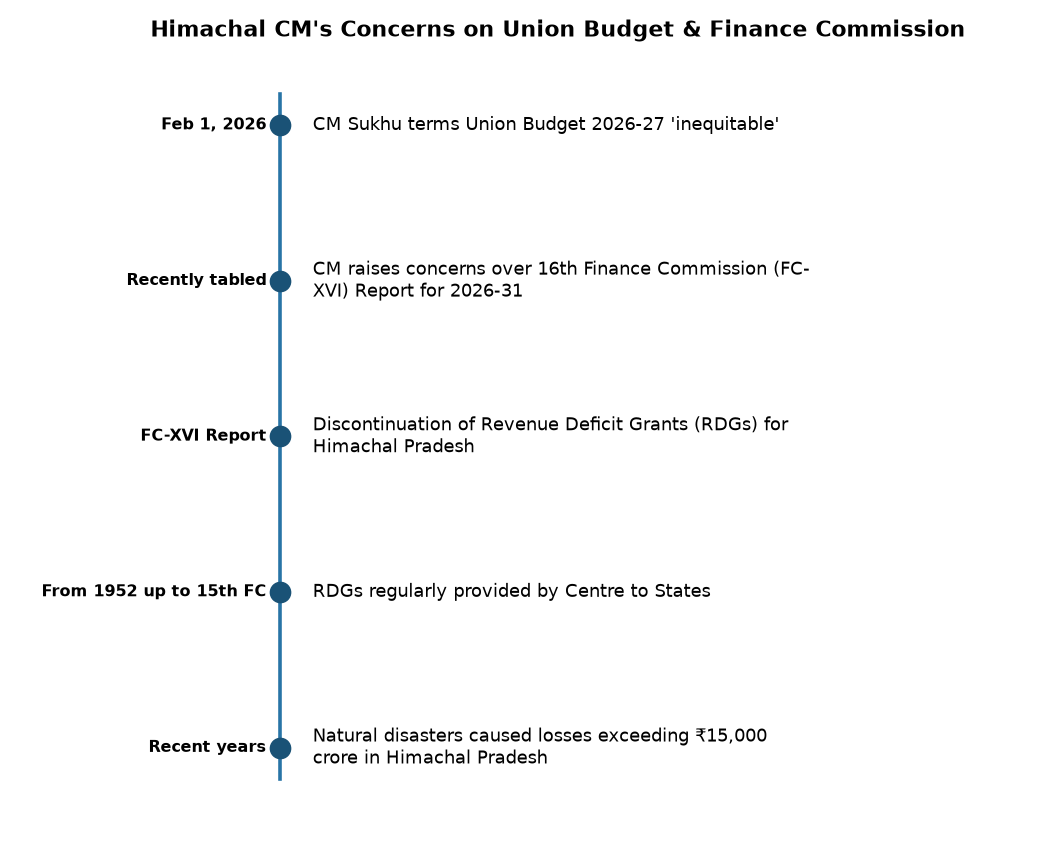
Himachal Pradesh Chief Minister Sukhvinder Singh Sukhu recently termed the Union Budget 2026-27 ‘inequitable’ and ‘anti-poor and anti-farmer’, expressing significant concerns regarding the recently tabled 16th Finance Commission (FC-XVI) Report for the period 2026-31. His primary contention revolves around the Commission’s decision to discontinue Revenue Deficit Grants (RDGs) for states like Himachal Pradesh, arguing that this overlooks the unique fiscal handicaps faced by special category hill states and could severely impact their ability to deliver essential public services and maintain fiscal sustainability.
Background
- The Finance Commission is a constitutional body established under Article 280 of the Indian Constitution, primarily tasked with recommending the distribution of tax revenues between the Union and the States (vertical devolution) and among the States themselves (horizontal devolution).
- Revenue Deficit Grants (RDGs) are provided under Article 275(1) of the Constitution to states that face a revenue deficit post-devolution, aiming to bridge the gap between their revenue and expenditure.
- Historically, Finance Commissions from the 1st to the 15th have regularly recommended RDGs to states requiring them, recognizing structural fiscal imbalances.
- Himachal Pradesh, as a special category hill state, faces inherent challenges such as difficult terrain, fragile ecology, frequent natural disasters, and a limited own-revenue base, making it reliant on central fiscal support.
- The Union Budget 2026-27, presented by the central government, outlines the government’s financial plan for the upcoming fiscal year, including allocations and policy priorities.
- The 16th Finance Commission (FC-XVI) was constituted to make recommendations for the period 2026-31, and its report’s implications for state finances are now being debated.
What is the Finance Commission and its Role in Fiscal Federalism?
- The Finance Commission is a quasi-judicial body constituted by the President of India every five years or earlier, as deemed necessary.
- Its primary mandate is to recommend the distribution of net proceeds of taxes between the Union and the States (vertical devolution) and the allocation of these proceeds among the States (horizontal devolution).
- It also recommends the principles governing grants-in-aid of the revenues of the States out of the Consolidated Fund of India, including Revenue Deficit Grants (RDGs) under Article 275(1).
- The Commission advises on measures needed to augment the Consolidated Fund of a State to supplement the resources of Panchayats and Municipalities in the State.
- Its recommendations are advisory in nature but are generally accepted by the Union Government to maintain fiscal harmony and federal balance.
- The Finance Commission plays a crucial role in operationalizing fiscal federalism by ensuring an equitable and efficient distribution of financial resources across different tiers of government.
- It considers various factors like population, area, forest and ecology, income distance, and fiscal capacity while determining devolution formulae.
- The 16th Finance Commission, constituted in 2023, is tasked with making recommendations for the period 2026-31, building upon the work of its predecessors.
Key Features
| Feature | Significance |
|---|---|
| Constitutional Body (Art. 280) | Ensures its recommendations carry constitutional weight and promotes fiscal stability. |
| Vertical Devolution | Determines the share of central taxes to be transferred to states, crucial for state finances. |
| Horizontal Devolution | Allocates the state’s share among individual states based on various criteria, promoting equity. |
| Grants-in-Aid (Art. 275) | Provides specific grants, including Revenue Deficit Grants, to address state-specific needs and fiscal imbalances. |
| Local Bodies’ Finances | Recommends measures to augment state funds for Panchayats and Municipalities, strengthening grassroots governance. |
| Periodicity (Every 5 years) | Allows for regular review and adjustment of fiscal arrangements based on evolving economic realities and state needs. |
Why it Matters
For Fiscal Federalism
- Ensures a fair and equitable distribution of financial resources between the Union and States, fostering cooperative federalism.
- Promotes fiscal autonomy of states by providing them with a predictable share of central taxes, enabling better planning and expenditure.
- Addresses regional disparities by recommending specific grants and devolution formulae that consider the unique challenges and needs of different states.
For State Finances
- Provides a significant portion of states’ revenue, reducing their dependence on central schemes and discretionary grants.
- Helps states manage their revenue deficits and maintain fiscal sustainability, especially for those with limited own-revenue bases.
- Enables states to invest in critical public services like health, education, and infrastructure, contributing to overall development.
For Governance and Development
- Strengthens the financial capacity of local self-governments, empowering them to deliver services effectively at the grassroots level.
- Encourages fiscal discipline among states by linking grants to performance and fiscal reforms.
- Contributes to national cohesion by ensuring that all regions, including those with inherent disadvantages, receive adequate financial support for their development.
Challenges
1. Discontinuation of Revenue Deficit Grants (RDGs)
- States with structural fiscal handicaps, such as Himachal Pradesh (high forest cover, mountainous terrain, disaster proneness), may face severe financial strain.
- Could force states to cut essential public services or resort to increased borrowing, impacting fiscal sustainability and development.
- Goes against the historical practice of providing RDGs to bridge revenue gaps, potentially creating an unprecedented challenge for fiscally weaker states.
- May exacerbate existing regional disparities if states with lower own-revenue generation capacity are left without adequate support.
UPSC Link: GS Paper II — Issues and Challenges Pertaining to the Federal Structure
2. Inadequate Recognition of State-Specific Challenges
- The unique challenges of special category states (e.g., difficult terrain, fragile ecology, high per-capita cost of service delivery) may not be fully addressed by the devolution formula alone.
- Natural disasters, like those in Himachal Pradesh causing significant losses, require specific and sustained financial support beyond general grants.
- Sector-specific concerns, such as the apple growers’ issues in Himachal, often require targeted interventions that may not be adequately covered by broad fiscal transfers.
UPSC Link: GS Paper II — Devolution of Powers and Finances up to Local Levels and Challenges Therein
3. Impact on Fiscal Sustainability and Indebtedness
- Without RDGs, states might struggle to meet their recurring expenditures, leading to increased revenue deficits.
- Forced reliance on market borrowings to cover revenue gaps could push states into a debt trap, compromising long-term fiscal health.
- The absence of a clear framework for continued RDGs creates uncertainty for states in their medium-term fiscal planning.
UPSC Link: GS Paper III — Government Budgeting; Mobilization of Resources
4. Political Implications and Federal Tensions
- Decisions perceived as ‘inequitable’ can strain Union-State relations and lead to political discontent.
- States may feel their voices and unique circumstances are not adequately considered in national fiscal policy-making.
- Could lead to demands for greater fiscal autonomy or a re-evaluation of the Finance Commission’s mandate and criteria.
UPSC Link: GS Paper II — Functions and Responsibilities of the Union and the States
Challenges — UPSC Perspective
| Issue | Concern |
|---|---|
| Discontinuation of RDGs | Fiscal stress for revenue-deficit states, especially special category ones like HP. |
| Structural Fiscal Handicaps | High per-capita cost of service delivery in mountainous regions, limited own-revenue base, ecological cover. |
| Natural Disaster Losses | Significant economic damage (e.g., ₹15,000 crore in HP) requiring special central assistance. |
| Impact on Public Services | Potential cuts in essential services (health, education) due to lack of funds. |
| Increased Indebtedness | States forced to borrow more to meet revenue gaps, risking fiscal unsustainability. |
| Equity and Federal Balance | Perception of ‘injustice’ and ‘inequitable’ treatment, straining Union-State relations. |
Government Initiatives — Must-Memorise for Prelims
- Centrally Sponsored Schemes (CSS)
- Central Sector Schemes (CS)
- Special Central Assistance (SCA) to State Plans
- Pradhan Mantri Gram Sadak Yojana (PMGSY)
- National Health Mission (NHM)
- Jal Jeevan Mission (JJM)
- Mahatma Gandhi National Rural Employment Guarantee Act (MGNREGA)
- National Disaster Response Fund (NDRF)
- State Disaster Response Fund (SDRF)
- Green India Mission (GIM)
Way Forward
- The 16th Finance Commission should reconsider the provision of Revenue Deficit Grants, especially for states with demonstrable structural fiscal handicaps and low own-revenue generation capacity.
- A robust framework for disaster relief and rehabilitation, with clear central funding mechanisms, must be established to support states frequently affected by natural calamities.
- The Commission’s devolution formula should adequately incorporate indicators that reflect the unique challenges of special category states, such as difficult terrain, ecological fragility, and higher service delivery costs.
- Enhance dialogue and consultation between the Union government, the Finance Commission, and state governments to ensure that state-specific concerns are heard and addressed effectively.
- Explore innovative financing mechanisms and performance-linked grants to incentivize fiscal reforms and sustainable development practices in states.
- States should also focus on strengthening their own-revenue base through administrative reforms, better tax collection, and exploring new revenue streams.
- The Union Budget should complement the Finance Commission’s recommendations by providing targeted support to critical sectors and vulnerable populations in states.
- Promote greater transparency and accountability in the utilization of central transfers and grants by states to ensure optimal impact.
UPSC Value Addition
Keywords for Mains Answer-Writing
Fiscal Federalism · Revenue Deficit Grants · Finance Commission · Article 275(1) · Vertical Devolution · Horizontal Devolution · Special Category States · Fiscal Sustainability · Union-State Relations · Constitutional Body · Grants-in-Aid · Regional Disparities
Constitutional & Policy Linkages
- Article 280: Constitution of Finance Commission
- Article 275(1): Grants from the Union to certain States
- Article 268-279: Provisions relating to distribution of revenues between the Union and the States
- Seventh Schedule: Distribution of legislative powers (Union, State, Concurrent Lists)
- Article 243G & 243W: Powers, authority and responsibilities of Panchayats and Municipalities
- Article 360: Financial Emergency provisions
Concept Flow
Finance Commission constituted (Art. 280) → Recommends tax devolution & grants-in-aid (including RDGs) → Union Budget allocates funds based on recommendations → States receive funds for expenditure & development → States face fiscal challenges (e.g., revenue deficit, disasters) → Discontinuation of RDGs by FC-XVI → States like HP face fiscal strain, potential service cuts & increased debt
Prelims Practice Questions
Q1. Which of the following statements regarding the Finance Commission in India is/are correct?
1. It is a statutory body constituted by an Act of Parliament.
2. It recommends the distribution of net proceeds of taxes between the Union and the States.
3. Revenue Deficit Grants are provided under Article 275(1) of the Constitution based on its recommendations.
Select the correct answer using the code given below:
- A. 1 and 2 only
- B. 2 and 3 only
- C. 1 and 3 only
- D. 1, 2 and 3
Answer: B. 2 and 3 only — Statement 1 is incorrect; the Finance Commission is a constitutional body established under Article 280, not a statutory body. Statement 2 is correct, as its primary function is vertical and horizontal devolution of taxes. Statement 3 is correct, as Article 275(1) provides for grants-in-aid, including Revenue Deficit Grants, based on the Finance Commission’s recommendations.
Q2. Consider the following factors that may contribute to a state’s ‘structural fiscal handicaps’:
1. High forest and ecological cover.
2. Mountainous terrain leading to higher per-capita cost of service delivery.
3. Frequent natural disasters.
4. High population density.
Which of the factors mentioned above are relevant in the context of a state like Himachal Pradesh raising concerns about fiscal support?
- A. 1 and 4 only
- B. 2, 3 and 4 only
- C. 1, 2 and 3 only
- D. 1, 2, 3 and 4
Answer: C. 1, 2 and 3 only — Statements 1, 2, and 3 are explicitly mentioned in the news article as reasons for Himachal Pradesh’s fiscal handicaps and higher costs. High population density (Statement 4) is generally associated with higher revenue generation potential and lower per-capita costs in some contexts, and is not cited as a ‘handicap’ for a state like Himachal Pradesh in this context, which is characterized by difficult terrain and sparse population in many areas.
Mains Practice Question
✍ The recent concerns raised by the Himachal Pradesh Chief Minister regarding the 16th Finance Commission’s report and the Union Budget highlight critical issues in India’s fiscal federalism. In light of this, critically analyze the role of the Finance Commission in ensuring equitable resource distribution and discuss the implications of discontinuing Revenue Deficit Grants for states, particularly those with unique geographical and ecological challenges. (250 words)
Approach: Begin by briefly introducing the Finance Commission’s constitutional mandate and its role in fiscal federalism. Elaborate on how it ensures equitable resource distribution through vertical and horizontal devolution, and grants-in-aid. Then, delve into the implications of discontinuing Revenue Deficit Grants, focusing on the challenges for states like Himachal Pradesh due to their structural fiscal handicaps, higher service delivery costs, and vulnerability to natural disasters. Discuss the potential impact on public services, fiscal sustainability, and Union-State relations. Conclude with suggestions for a more balanced and responsive approach to fiscal transfers in a diverse federal setup.
Source: The Hindu
Generated by AanyaAi for educational purpose.

- India-Australia AUSTRAHIND 2026 Exercise: Key Highlights for UPSC & State PCS - October 22, 2026
- एससीओ बैठक में भारत का आतंकवाद विरोध: क्षेत्रीय सहयोग पर जोर - October 22, 2026
- SEC Directs Strict SC Order Compliance for Andhra ULB Polls - October 22, 2026

No Comments