


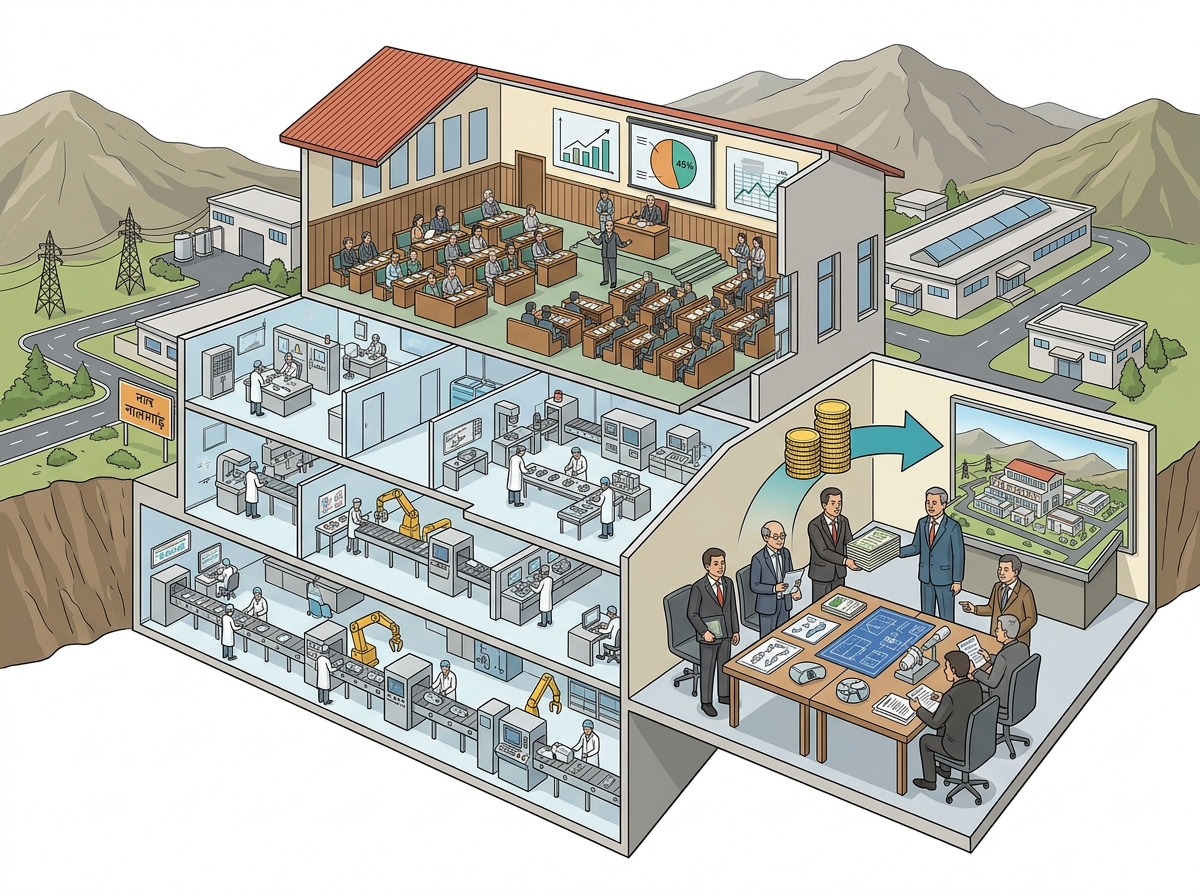
01 Sep Himachal Pradesh to Complete Medical Device Park with 45% Advance from Industrialists
✎ Medical Device Parks are industrial clusters designed to boost domestic manufacturing of medical devices, with fiscal incentives balanced against revenue considerations to ensure sustainable development.
Subject Relevance — Where This Topic Fits
- GS Paper III — Development, Growth and Employment | GS Paper III — Investment Models and Public-Private Partnerships | GS Paper III — Government Budgeting and Fiscal Policy
- Prelims: Medical Device Parks Scheme, Public-Private Partnership (PPP) Models, Fiscal Responsibility and Budget Management (FRBM) Act, Make in India, Pharmaceutical Policy 2020
- Essay: Role of State Governments in Industrial Development and Employment Generation, Balancing Fiscal Prudence with Economic Growth: A Governance Imperative
Quick Revision: Medical Device Parks are industrial clusters designed to boost domestic manufacturing of medical devices, with fiscal incentives balanced against revenue considerations to ensure sustainable development.
Why is this in the news?
The Himachal Pradesh government has announced a revised funding mechanism for the completion of the Medical Device Park in Nalagarh, Solan district, by requiring investors to contribute 45% of the project cost upfront. This decision follows a review of the previous administration’s incentives, which were projected to result in significant revenue losses. The move underscores the state’s emphasis on fiscal sustainability while advancing industrial development and employment generation in the pharmaceutical sector.
Background
- The Medical Device Park in Nalagarh, Solan district, is a flagship industrial project aimed at fostering the medical device manufacturing ecosystem in Himachal Pradesh.
- Previous incentives included nominal land lease rates (₹1 per unit) and subsidized electricity (₹3 per unit), which were intended to attract investors but raised concerns over revenue foregone.
- An estimated financial loss of ₹300–400 crore was projected due to these incentives, prompting a reassessment of the policy framework.
- The state government has also initiated the establishment of a Bulk Drug Park in Una, targeting the start of construction work by March 2027, to further strengthen the pharmaceutical value chain.
- The decision aligns with national initiatives such as the ‘Make in India’ program, which emphasize domestic manufacturing and self-reliance in critical sectors.
- The announcement was made during a discussion in the Himachal Pradesh Legislative Assembly under Rule 130, highlighting the intersection of legislative oversight and executive action in policy implementation.
What is a Medical Device Park and How Does It Function?
- A Medical Device Park is a designated industrial zone established to promote the manufacturing, research, and development of medical devices, including diagnostic equipment, implants, and consumables.
- Such parks are typically developed under the aegis of state governments or central agencies, with support from schemes like the Medical Device Park Scheme under the Department of Pharmaceuticals, Ministry of Chemicals and Fertilizers.
- The primary objectives include reducing import dependence, enhancing domestic production capabilities, and generating employment in the healthcare and allied sectors.
- State governments often provide incentives such as subsidized land, tax exemptions, and infrastructure support to attract investors and anchor industries.
- The parks operate on a cluster-based model, where multiple manufacturers and suppliers co-locate to benefit from shared infrastructure, logistics, and regulatory support.
- The financial sustainability of such parks hinges on a balanced approach between incentives and revenue generation, ensuring long-term viability without imposing undue fiscal burden on the exchequer.
- The Himachal Pradesh Medical Device Park in Nalagarh is projected to create significant employment opportunities, particularly for local youth, in alignment with the state’s youth employment guarantees.
Key Features
| Feature | Significance |
|---|---|
| Public-Private Partnership (PPP) Model Adjustment | The government has revised the PPP model for the Medical Device Park by mandating upfront collection of 45% of the project cost from investors, replacing previous incentives like nominal land lease and subsidised electricity. |
| Financial Viability of State Schemes | The change addresses the estimated ₹300–400 crore financial loss projected under the earlier scheme due to low-cost land leases and electricity tariffs. |
| Employment Generation Mechanism | Completion of the Medical Device Park is expected to create new job opportunities in the pharmaceutical sector, aligning with the state’s youth employment guarantee initiatives. |
| Infrastructure Development in Pharma Sector | The park aims to position Himachal Pradesh as a hub for medical device manufacturing, leveraging existing industrial corridors in Solan district. |
| Resource Optimisation in Education Sector | The rationalisation of 1,526 schools (including 734 with zero enrolment) is intended to reallocate teaching staff and infrastructure to viable institutions. |
Why it Matters
Economic Development
- The Medical Device Park is a strategic intervention to diversify Himachal Pradesh’s industrial base beyond traditional sectors like tourism and horticulture.
- Upfront capital infusion from investors reduces the state’s fiscal burden while accelerating project completion timelines.
- The park aligns with the ‘Make in India’ initiative by promoting indigenous manufacturing of medical devices, reducing import dependence.
- Job creation in the pharmaceutical sector supports the state’s demographic dividend, particularly in Solan’s industrial belt.
Fiscal Governance
- The revised PPP model exemplifies fiscally prudent policy-making by eliminating unsustainable subsidies that distort market mechanisms.
- Revenue loss from earlier incentives (₹200 crore from electricity subsidies and ₹150+ crore from land leases) is mitigated through upfront payments.
- The state’s decision to merge non-viable schools demonstrates commitment to efficient resource allocation in public expenditure.
Industrial Policy
- The Medical Device Park reflects a shift from incentive-driven industrialisation to a cost-sharing model, ensuring long-term sustainability.
- Integration with the proposed Bulk Drug Park in Una creates a vertically integrated pharmaceutical ecosystem in the state.
- The policy change underscores the importance of aligning state incentives with global competitiveness standards.
Employment & Skill Development
- Completion of the park is expected to generate direct and indirect employment, particularly for local youth in technical and managerial roles.
- The state’s school rationalisation policy indirectly supports skill development by reallocating resources to functional educational institutions.
Challenges
1. Investor Reluctance Due to Upfront Payments
- High upfront capital requirements (45% of project cost) may deter small and medium enterprises from participating in the Medical Device Park.
- Competitor states offering more attractive PPP terms could divert potential investors away from Himachal Pradesh.
UPSC Link: GS-III: Industrial Policy & PPP
2. Infrastructure Bottlenecks
- Incomplete infrastructure (e.g., power supply, logistics) in Solan’s industrial zones may delay project timelines despite financial commitments.
- Land acquisition and environmental clearances remain persistent challenges in Himachal Pradesh’s hilly terrain.
UPSC Link: GS-III: Infrastructure Development
3. Policy Continuity Risks
- Frequent changes in industrial policies (e.g., shifting from subsidies to upfront payments) may erode investor confidence in the state’s business environment.
- Lack of long-term vision in sector-specific policies could hinder sustained industrial growth.
UPSC Link: GS-II: Government Policies & Interventions
4. Human Resource Constraints
- The pharmaceutical sector requires a skilled workforce, but Himachal Pradesh faces a shortage of technical and vocational training institutions.
- Brain drain of qualified professionals to other states may limit local talent availability for the park.
UPSC Link: GS-III: Human Resource Development
5. Balancing Fiscal Prudence and Industrial Growth
- While upfront payments improve fiscal health, excessive reliance on private capital may limit the state’s ability to attract large-scale investments.
- Ensuring equitable distribution of benefits across districts (e.g., Una’s Bulk Drug Park vs. Solan’s Medical Device Park) poses governance challenges.
UPSC Link: GS-III: Fiscal Federalism
Challenges — UPSC Perspective
| Issue | Concern |
|---|---|
| High Upfront Capital Requirement | May deter SMEs from participating in the Medical Device Park due to liquidity constraints. |
| Policy Inconsistency | Frequent changes in industrial incentives could undermine investor trust in the state’s business environment. |
| Infrastructure Gaps | Incomplete power, logistics, and land infrastructure in Solan may delay project execution. |
| Skill Shortage | Limited availability of technically trained workforce in Himachal Pradesh could hinder operational efficiency. |
| Fiscal Trade-offs | Balancing upfront payments with long-term industrial growth requires careful policy calibration. |
| Regulatory Delays | Land acquisition and environmental clearances in hilly regions may prolong project timelines. |
Way Forward
- Finalise the revised PPP framework for the Medical Device Park, including transparent bidding processes and clear timelines for upfront payments.
- Accelerate infrastructure development in Solan’s industrial zones, prioritising power supply, road connectivity, and logistics hubs.
- Establish vocational training centres in collaboration with pharmaceutical companies to address skill gaps in the local workforce.
- Conduct a feasibility study to identify and mitigate policy risks, ensuring investor confidence in the state’s industrial ecosystem.
- Develop a phased rollout plan for the Medical Device Park, aligning with the proposed Bulk Drug Park in Una to create a synergistic pharmaceutical cluster.
- Strengthen inter-departmental coordination (e.g., Industries, Power, and Environment) to streamline regulatory approvals and land acquisition.
- Monitor and evaluate the impact of school rationalisation on resource allocation, ensuring no adverse effects on educational equity.
- Promote public-private partnerships for research and development in medical devices, leveraging Himachal Pradesh’s academic institutions.
UPSC Value Addition
Keywords for Mains Answer-Writing
Medical Device Parks Scheme · State Industrial Policy · Public-Private Partnership in Infrastructure · Lease and Utility Pricing Policy · Employment Generation through Industrial Parks · State Legislative Assembly Debates · Public Exchequer and Fiscal Responsibility · Pharmaceutical and Medical Devices Sector · Ease of Doing Business Reforms · Subsidies and Incentives for Industries
Concept Flow
State’s fiscal stress from unsustainable industrial incentives → Policy review to replace subsidies with upfront payments → Revised PPP model for Medical Device Park (45% upfront collection) → Upfront capital requirement deters investors → Potential investor reluctance → Need for infrastructure and skill development to offset deterrents → Completion of Medical Device Park → Job creation in pharmaceutical sector → Alignment with youth employment guarantee schemes → School rationalisation to reallocate resources → Fiscal efficiency in education sector → Indirect support for skill development → Policy continuity risks → Investor confidence erosion → Need for long-term industrial policy vision → Infrastructure bottlenecks in hilly terrain → Regulatory delays → Impact on project timelines → Balancing fiscal prudence and industrial growth → Equitable resource distribution across districts → Governance challenges
Prelims Practice Questions
Q1. Consider the following statements regarding the Medical Device Parks Scheme in India:
1. The scheme aims to reduce the cost of medical devices by providing land at subsidised rates.
2. The Himachal Pradesh government has recently decided to collect 45% of the project cost upfront from investors.
3. The scheme is implemented under the aegis of the Ministry of Health and Family Welfare.
4. The primary objective is to generate employment opportunities in the pharmaceutical sector.
How many of the above statements are correct?
- Only one
- Only two
- Only three
- All four
Answer: Only three — Statements 1 and 4 are correct. Statement 2 is correct as per the news report. Statement 3 is incorrect; the scheme is typically implemented by state governments with support from the Department for Promotion of Industry and Internal Trade (DPIIT).
Q2. Assertion (A): The Himachal Pradesh government has revised its policy for the Medical Device Park to ensure fiscal sustainability.
Reason (R): The previous policy offered land at ₹1 per lease and electricity at ₹3 per unit, which could have resulted in a financial loss of ₹300–400 crore to the state exchequer.
In the context of the above statements, which one of the following is correct?
- Both A and R are true, and R is the correct explanation of A.
- Both A and R are true, but R is not the correct explanation of A.
- A is true, but R is false.
- A is false, but R is true.
Answer: Both A and R are true, and R is the correct explanation of A. — Both the assertion and reason are true, and the reason correctly explains the assertion. The revision of the policy was necessitated by the potential financial loss highlighted in the reason.
Q3. Which of the following is NOT a stated objective of the Medical Device Parks Scheme in India?
A. To reduce the cost of medical devices for domestic consumption.
B. To promote exports of medical devices.
C. To generate employment opportunities in the pharmaceutical sector.
D. To provide land at subsidised rates to investors.
- A
- B
- C
- D
Answer: B — The primary objectives of the Medical Device Parks Scheme include reducing the cost of medical devices, generating employment, and providing subsidised land. Export promotion is not explicitly mentioned as a stated objective.
Mains Practice Question
✍ The Himachal Pradesh government has recently revised its policy for the Medical Device Park in Nalagarh by mandating that investors deposit 45% of the project cost upfront to complete the unfinished work. Critically examine the rationale behind this policy shift and its implications for the state’s industrial development and fiscal health. (15 Marks)
Approach: MODEL-ANSWER SKELETON:
1. **Introduction**: Briefly define the Medical Device Parks Scheme and its objectives (cost reduction, employment generation, and industrial development).
2. **Rationale for Policy Shift**:
– **Fiscal Responsibility**: Explain the potential financial loss of ₹300–400 crore due to the previous policy of ₹1 land lease and ₹3/unit electricity.
– **Sustainability**: Highlight the need to balance industrial incentives with state exchequer sustainability.
– **Ease of Doing Business**: Discuss how upfront deposits align with broader reforms to attract genuine investors and reduce speculative investments.
3. **Implications for Industrial Development**:
– **Investor Confidence**: Analyse how the new policy may enhance investor confidence by ensuring project completion and reducing financial risks.
– **Employment Generation**: Discuss the potential for job creation in the pharmaceutical and medical devices sector.
– **Regional Development**: Examine the impact on local economies in Himachal Pradesh, particularly in Solan district.
4. **Fiscal Health Considerations**:
– **Revenue Neutrality**: Discuss how the policy aims to avoid undue burden on the state exchequer while ensuring project viability.
– **Transparency**: Highlight the role of the policy in ensuring transparency and accountability in public-private partnerships.
5. **Conclusion**: Weigh the trade-offs between attracting investment and ensuring fiscal prudence. Suggest measures to further strengthen the policy, such as performance-linked incentives or phased deposit structures.
Source: amarujala.com
Generated by AanyaAi for educational purpose.
Related guides on our sites
- Current affairs for upsc 2026
- How to prepare for GS paper 1 for UPSC CSE mains exam
- Best UPSC coaching for IFOS exam
- Best mentorship programme for upsc

- AI vs Handwritten Notes: Indian Students’ Learning Preferences Explained - October 21, 2026
- संयुक्त राष्ट्र में भारत ने अपने लोकतंत्र को बदनाम करने के प्रयासों का किया खंडन - October 21, 2026
- Tamil Nadu Guest Lecturers Await ₹5,000 Honorarium Hike in Budget - October 21, 2026

No Comments