


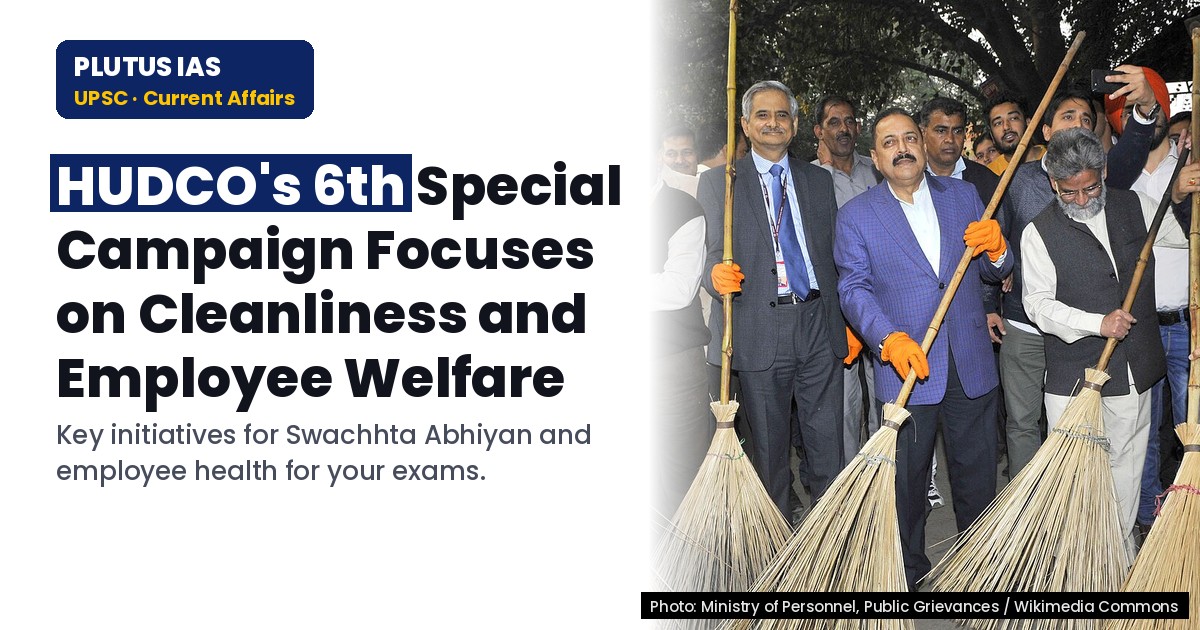
12 Nov HUDCO’s Special Campaign: Swachhta, Waste Management & Employee Welfare
✎ HUDCO's special campaign exemplifies a public sector undertaking's integrated approach to promoting cleanliness, optimising resources, and ensuring employee welfare, aligning with national developmental objectives.
Subject Relevance — Where This Topic Fits
- GS Paper II — Government Policies and Interventions for Development in various sectors and Issues arising out of their Design and Implementation | GS Paper III — Conservation, Environmental Pollution and Degradation, Environmental Impact Assessment
- Prelims: HUDCO, Swachhta Abhiyan, Waste Management, Resource Optimisation, Employee Welfare, Public Sector Undertakings (PSUs), Ministry of Housing and Urban Affairs
- Essay: The role of public sector enterprises in promoting sustainable development and social welfare., Cleanliness and resource management as pillars of good governance and corporate responsibility.
Quick Revision: HUDCO’s special campaign exemplifies a public sector undertaking’s integrated approach to promoting cleanliness, optimising resources, and ensuring employee welfare, aligning with national developmental objectives.
Why is this in the news?
The Housing and Urban Development Corporation Limited (HUDCO), under the Ministry of Housing and Urban Affairs, recently undertook its sixth special campaign, focusing on comprehensive initiatives across its corporate and regional offices. This campaign encompassed promoting cleanliness, implementing effective waste management strategies, and enhancing workplace conditions, alongside a significant emphasis on employee welfare through health-focused interventions.
Background
- HUDCO is a Public Sector Undertaking (PSU) under the administrative control of the Ministry of Housing and Urban Affairs, Government of India.
- It was established in 1970 with the primary objective of providing long-term finance for housing and urban development projects across the country.
- The Swachh Bharat Abhiyan (Cleanliness Campaign) is a nationwide initiative launched by the Government of India to promote cleanliness and hygiene.
- Public sector enterprises are often mandated to undertake corporate social responsibility (CSR) activities and align their operations with national developmental goals.
- Regular special campaigns by government entities aim to reinforce institutional commitment to cleanliness, resource efficiency, and employee well-being.
- Effective waste management and resource optimisation are critical components of sustainable urban development and responsible organisational conduct.
What is the significance of such special campaigns by Public Sector Undertakings?
- These campaigns serve to reinforce the principles of cleanliness and hygiene within government organisations, aligning with broader national initiatives like the Swachh Bharat Abhiyan.
- They promote efficient asset management and optimal utilisation of available space by systematically disposing of old files, unusable documents, and obsolete equipment.
- Such initiatives foster a culture of responsible waste disposal, including the collection of plastic waste and proper management of scrap materials and non-functional IT assets.
- Awareness activities conducted during these campaigns educate employees on sustainable practices and the importance of maintaining a clean and organised work environment.
- Employee welfare initiatives, such as eye examination camps for support staff, underscore the organisation’s commitment to the well-being and dignity of all its personnel.
- These campaigns demonstrate a public sector entity’s commitment to corporate social responsibility (CSR) and its role in contributing to a healthier and more sustainable society.
- They encourage purposeful employee participation, fostering a collective sense of ownership and responsibility towards maintaining a clean, healthy, and sustainable workplace.
- The systematic approach to office upkeep and maintenance ensures a more productive and aesthetically pleasing work environment, enhancing overall operational efficiency.
Key Features
| Feature | Significance |
|---|---|
| Swachhta Abhiyan and Swachhta Shapath | Promotes a culture of cleanliness and instills a sense of responsibility among employees towards maintaining hygienic workspaces. |
| Plastic Waste Collection and Awareness Activities | Addresses environmental concerns by reducing plastic pollution and fostering ecological consciousness within the organisation. |
| Systematic Cleaning and Maintenance of Office Premises | Ensures a clean, organised, and conducive work environment, enhancing productivity and employee well-being. |
| Disposal of Old Files, Unused Papers, Scrap, and IT Equipment | Optimises asset management, improves space utilisation, and streamlines administrative processes by decluttering workspaces. |
| Eye Check-up Camp for Sanitation Workers and Support Staff | Demonstrates a commitment to employee welfare and occupational health, recognising the vital role of support staff in maintaining workplace hygiene. |
Why it Matters
Governance and Public Administration
- Illustrates a public sector undertaking’s (PSU) commitment to good governance principles through efficient resource management and a focus on employee welfare.
- Highlights the importance of internal cleanliness drives and waste management protocols in government and public offices, setting a standard for administrative efficiency and environmental responsibility.
Social Welfare and Inclusivity
- Emphasises the dignity of labour and the welfare of sanitation workers and support staff, aligning with broader governmental objectives of inclusive growth and social justice.
- Promotes a holistic approach to workplace well-being, extending health benefits to all categories of employees, thereby fostering a more equitable work environment.
Environmental Sustainability
- Contributes to sustainable practices by focusing on effective waste management, including plastic waste collection and responsible disposal of e-waste and other materials.
- Reinforces the broader national agenda of ‘Swachh Bharat’ by demonstrating institutional commitment to cleanliness and resource optimisation.
Challenges
1. Sustaining Cleanliness Initiatives
- Ensuring long-term adherence to cleanliness protocols beyond special campaigns requires continuous monitoring and reinforcement.
- Maintaining employee engagement and motivation for sustained participation in waste management and hygiene practices can be challenging.
UPSC Link: Governance: Role of Civil Services
2. Effective Waste Segregation and Disposal
- Implementing robust systems for source segregation of various waste types (e.g., plastic, paper, e-waste) across all offices.
- Ensuring authorised and environmentally sound disposal mechanisms for all collected waste materials, particularly hazardous e-waste.
UPSC Link: Environment: Pollution and Degradation
3. Resource Optimisation and Asset Management
- Developing systematic approaches for identifying and disposing of redundant assets and documents to free up space and improve efficiency.
- Integrating digital solutions for record-keeping to reduce reliance on physical files and minimise paper waste.
UPSC Link: Governance: Transparency & Accountability
4. Holistic Employee Well-being
- Expanding welfare initiatives beyond basic health check-ups to include mental health support and other occupational safety measures.
- Ensuring equitable access to welfare programmes for all staff, including contractual and outsourced personnel.
UPSC Link: Social Justice: Welfare Schemes
Challenges — UPSC Perspective
| Issue | Concern |
|---|---|
| Behavioural Change | Sustaining individual and collective habits of cleanliness and responsible waste disposal beyond campaign periods. |
| Infrastructure for Waste Management | Adequacy of facilities for segregation, collection, and processing of diverse waste streams, especially in regional offices. |
| Technological Upgradation | Adopting modern technologies for efficient waste management, digital record-keeping, and smart office solutions. |
| Funding and Resources | Allocating sufficient budgetary provisions and human resources for ongoing maintenance, welfare activities, and environmental initiatives. |
| Monitoring and Evaluation | Establishing robust mechanisms to track progress, measure impact, and ensure accountability for cleanliness and welfare targets. |
Government Initiatives — Must-Memorise for Prelims
- Swachh Bharat Abhiyan
Way Forward
- Institutionalise regular audits and feedback mechanisms for cleanliness and waste management to ensure continuous improvement.
- Integrate digital platforms for efficient record-keeping and asset management, reducing reliance on physical files and optimising space.
- Expand employee welfare programmes to encompass a broader range of health and safety initiatives, including mental health support.
- Promote a ‘reduce, reuse, recycle’ ethos through awareness campaigns and provision of appropriate infrastructure for waste segregation.
- Develop partnerships with local urban bodies and NGOs for responsible disposal and recycling of various waste materials.
- Incorporate environmental sustainability metrics into performance appraisals for departments and individual employees to foster accountability.
- Conduct regular training sessions for all staff on best practices in office hygiene, waste management, and resource conservation.
UPSC Value Addition
Keywords for Mains Answer-Writing
Swachh Bharat Abhiyan · Waste Management · Resource Utilisation · Employee Welfare · Corporate Social Responsibility · Public Sector Undertakings · Sustainable Workplace · Urban Development · Housing and Urban Development Corporation Limited (HUDCO) · Government Initiatives · Environmental Governance · Occupational Health and Safety
Concept Flow
Special Campaign by HUDCO → Focus on Swachhta, Waste Management, Employee Welfare → Initiatives like Eye Camps, Plastic Collection, Office Decluttering → Improved Workplace Hygiene and Resource Utilisation → Enhanced Employee Well-being and Productivity → Contribution to Swachh Bharat Abhiyan Goals
Prelims Practice Questions
Q1. Consider the following statements regarding the Housing and Urban Development Corporation Limited (HUDCO):
1. HUDCO is a Public Sector Undertaking under the Ministry of Housing and Urban Affairs.
2. Its primary mandate includes financing housing and urban infrastructure projects.
3. HUDCO is responsible for implementing the Swachh Bharat Abhiyan across all urban local bodies.
How many of the above statements are correct?
- Only one
- Only two
- Only three
- None
Answer: Only two — Statement 1 is correct: HUDCO is indeed a PSU under the Ministry of Housing and Urban Affairs. Statement 2 is correct: HUDCO’s core function involves providing financial assistance for housing and urban development projects. Statement 3 is incorrect: While HUDCO may participate in related initiatives, the primary responsibility for implementing Swachh Bharat Abhiyan rests with the Ministry of Housing and Urban Affairs and urban local bodies, not solely with HUDCO.
Q2. Which of the following initiatives is most directly aligned with the ‘Swachhata Abhiyan’ undertaken by organisations like HUDCO?
- Pradhan Mantri Awas Yojana (PMAY)
- Smart Cities Mission
- Jal Jeevan Mission
- Swachh Bharat Mission (Urban)
Answer: Swachh Bharat Mission (Urban) — The ‘Swachhata Abhiyan’ directly relates to cleanliness and waste management, which are core objectives of the Swachh Bharat Mission (Urban). PMAY focuses on housing, Smart Cities Mission on comprehensive urban development, and Jal Jeevan Mission on rural water supply.
Mains Practice Question
✍ Examine the multifaceted role of Public Sector Undertakings (PSUs) in promoting sustainable urban development and employee welfare, with particular reference to initiatives like the ‘Swachhata Abhiyan’. (15 Marks)
Approach: MODEL-ANSWER SKELETON: The answer should begin by defining the role of PSUs in India’s economic and social landscape. It should then elaborate on their contribution to sustainable urban development, citing examples beyond just financial aspects, such as infrastructure development, technological adoption, and environmental stewardship. The discussion should specifically address how initiatives like the ‘Swachhata Abhiyan’ contribute to this, detailing aspects like waste management, resource optimisation, and creating cleaner urban environments. The second part of the answer should focus on employee welfare, explaining how PSUs integrate health, safety, and well-being initiatives for their workforce, including contractual staff, and how this contributes to overall organisational productivity and social responsibility. Concrete examples of welfare measures, such as health camps and safe working conditions, should be provided. Conclude by summarising the dual impact of PSUs on both urban sustainability and human resource development.
Source: PIB (Press Information Bureau)
Generated by AanyaAi for educational purpose.
Related guides on our sites
- Anthropology VS PSIR
- Best PSIR optional coaching
- Best PSIR optional coaching online
- Best PSIR optional teacher

- NAMASTE Scheme: Enhancing Sanitation Workers’ Livelihoods & Safety - November 14, 2026
- एमएसएमई का विशेष अभियान 6.0: स्वच्छता और लंबित मामलों का निपटारा - November 14, 2026
- Sea Vigil-26: Coastal Defence Drills Off Visakhapatnam - November 14, 2026

No Comments