


07 Aug IIITDM Kurnool Tops India’s 5G Use Case Labs Ranking: Key Details for UPSC
5G infrastructureUse Case LabsInterdisciplinary researchAdvanced 5G network✎ IIITDM Kurnool’s top ranking in the DoT’s 5G Use Case Labs underscores the critical role of interdisciplinary research and indigenous innovation in advancing India’s digital infrastructure and technological self-reliance.
Subject Relevance — Where This Topic Fits
- GS Paper III — Science and Technology — Developments and their Applications and Effects in Everyday Life | GS Paper III — Science and Technology — Awareness in the fields of IT, Space, Computers, Robotics, Nano-technology, Bio-technology
- Prelims: 5G technology, 5G Standalone (SA) Base Station, Bharat 6G Alliance (B6GA), Department of Telecommunications (DoT), IIITDM Kurnool, IoT devices, drone technology, smart agriculture, interdisciplinary research
- Essay: Technological self-reliance through indigenous innovation in emerging technologies, The role of educational institutions in shaping India’s digital future
Quick Revision: IIITDM Kurnool’s top ranking in the DoT’s 5G Use Case Labs underscores the critical role of interdisciplinary research and indigenous innovation in advancing India’s digital infrastructure and technological self-reliance.
Why is this in the news?
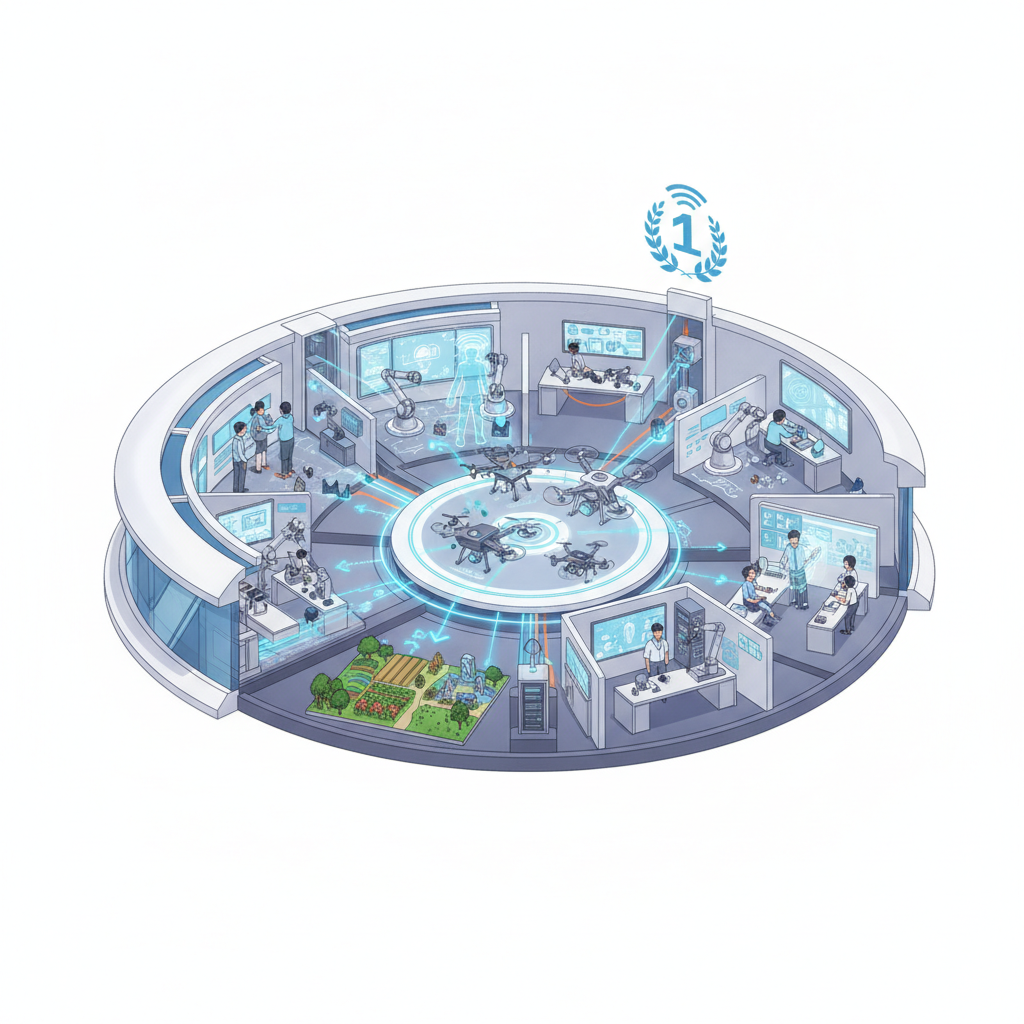
The Indian Institute of Information Technology, Design and Manufacturing (IIITDM) Kurnool has been ranked first in India in the Department of Telecommunications’ (DoT) ‘100 5G Use Case Labs’ ranking for the January–June 2026 assessment period. This recognition underscores the institute’s leadership in developing indigenous 5G use cases across diverse sectors, including communications, drone technology, robotics, optics, smart agriculture, healthcare, education, and skill development. The achievement highlights the efficacy of interdisciplinary research and the strategic deployment of advanced 5G infrastructure in fostering innovation.
Background
- The Department of Telecommunications (DoT), under the Ministry of Communications, launched the ‘100 5G Use Case Labs’ initiative to accelerate the development and deployment of 5G applications across India, aligning with the government’s vision of a ‘Digital India’ and ‘Atmanirbhar Bharat’.
- The initiative aims to create a robust ecosystem for 5G innovation by providing institutions with state-of-the-art infrastructure, including 5G Standalone (SA) Base Stations, IoT devices, and advanced network equipment.
- The ranking framework evaluates institutions based on four major criteria: Overall Excellence, Foundational Excellence, Engagement Excellence, and Innovation Excellence, ensuring a comprehensive assessment of their contributions to 5G technology.
- The Bharat 6G Alliance (B6GA) serves as a collaborative platform for industry, academia, and government to drive research and development in 6G technology, with IIITDM Kurnool’s achievement being a key milestone in India’s 5G/6G journey.
- The 5G Use Case Lab at IIITDM Kurnool was inaugurated in 2023, marking the beginning of a focused effort to integrate 5G technology into practical applications across multiple domains.
- The initiative reflects the broader national push towards indigenous technological self-reliance, reducing dependence on foreign technology in critical sectors such as telecommunications and digital infrastructure.
What are 5G Use Case Labs?
- 5G Use Case Labs are specialized research and development hubs established by the Department of Telecommunications (DoT) to foster the creation of practical applications of 5G technology across diverse sectors such as agriculture, healthcare, education, robotics, and smart cities.
- These labs are equipped with advanced 5G infrastructure, including 5G Standalone (SA) Base Stations, IoT devices, application servers, and other cutting-edge research tools to enable experimentation and innovation.
- The primary objective is to bridge the gap between theoretical research and real-world deployment by developing use cases that demonstrate the transformative potential of 5G technology in enhancing efficiency, connectivity, and service delivery.
- Institutions participating in the initiative are evaluated on parameters such as innovation, scalability, interdisciplinary collaboration, and societal impact, ensuring a holistic assessment of their contributions.
- The labs serve as a platform for collaboration between academia, industry, and government, facilitating knowledge exchange, technology transfer, and the development of commercially viable solutions.
- The initiative aligns with global trends in digital transformation, positioning India as a leader in 5G innovation and preparing the groundwork for the transition to 6G technology.
- The labs also play a crucial role in skill development by providing students and researchers with hands-on experience in emerging technologies, thereby contributing to the nation’s human resource capacity in advanced telecommunications.
Key Features
| Feature | Significance |
|---|---|
| 5G Standalone (SA) Base Station | Enables end-to-end 5G network deployment without reliance on 4G infrastructure, ensuring ultra-low latency and high reliability for mission-critical applications. |
| Interdisciplinary Research Collaboration | Fosters synergy between Electronics & Communication Engineering (ECE), Computer Science (CSE), Mechanical Engineering (ME), and Sciences, enhancing innovation in diverse domains. |
| 18 Innovative Products | Demonstrates tangible outcomes in communication systems, drone technology, robotics, optics, smart agriculture, healthcare, education, and skill development. |
| Gradation Framework Evaluation | Assesses institutions across Overall Excellence, Foundational Excellence, Engagement Excellence, and Innovation Excellence, ensuring a holistic benchmarking system. |
| Bharat 6G Alliance (B6GA) Recognition | Aligns with India’s vision for 6G leadership by validating 5G use-case development, positioning IIITDM Kurnool as a national leader in next-generation telecom research. |
Why it Matters
Technological Leadership
- Establishes IIITDM Kurnool as a premier hub for 5G research and development in India, setting benchmarks for other institutions to emulate.
- Demonstrates India’s indigenous capability in designing and deploying advanced telecom infrastructure, reducing dependence on foreign technology.
- Accelerates the transition from 5G to 6G by fostering early-stage innovation in use cases critical for future networks.
Economic Impact
- Drives job creation in high-tech sectors such as robotics, drones, and smart agriculture, aligning with the ‘Atmanirbhar Bharat’ initiative.
- Enhances India’s competitiveness in the global telecom market by showcasing indigenous 5G solutions with export potential.
- Supports startups and MSMEs in Andhra Pradesh and beyond by providing a testbed for commercializing 5G-enabled products.
Social and Sectoral Benefits
- Improves healthcare delivery through remote diagnostics and telemedicine, particularly in rural and underserved regions.
- Revolutionizes agriculture via precision farming, IoT-enabled soil monitoring, and AI-driven crop management systems.
- Enhances education through immersive learning experiences using AR/VR and real-time collaboration tools over 5G networks.
Strategic Autonomy
- Reduces reliance on foreign telecom equipment by developing indigenous 5G infrastructure and use cases, strengthening national security.
- Supports India’s goal of becoming a global leader in 6G technology by building a robust R&D ecosystem in 5G.
- Facilitates the deployment of smart cities, smart grids, and Industry 4.0 applications, aligning with the Digital India and Smart Cities Mission.
Challenges
1. Infrastructure and Funding Gaps
- Sustaining high-end research infrastructure requires continuous funding and public-private partnerships to avoid obsolescence.
- Limited access to advanced manufacturing facilities for prototyping and scaling 5G-enabled products remains a bottleneck.
- Need for greater collaboration between academia, industry, and government to bridge the ‘valley of death’ in technology translation.
UPSC Link: /mains/paper3/technology
2. Talent Development and Retention
- Shortage of skilled professionals in 5G/6G technologies, particularly in niche areas like network slicing and edge computing.
- Risk of brain drain as top researchers migrate to global tech hubs due to better opportunities and infrastructure.
- Requirement for industry-aligned curriculum updates and hands-on training programs to meet industry demands.
UPSC Link: /mains/paper2/human-resources
3. Regulatory and Spectrum Challenges
- Complexity in spectrum allocation and licensing for 5G trials and deployments, particularly in rural and remote areas.
- Need for a clear policy framework to incentivize R&D in telecom technologies and protect intellectual property rights.
- Ensuring equitable access to 5G services across socio-economic strata to prevent a digital divide.
UPSC Link: /mains/paper3/telecom-policy
4. Interdisciplinary Integration
- Coordinating research across diverse disciplines (ECE, CSE, ME, Sciences) poses logistical and administrative challenges.
- Ensuring seamless collaboration between faculty, students, and industry partners requires robust project management systems.
- Balancing fundamental research with applied outcomes to meet both academic and industry expectations.
UPSC Link: /mains/paper4/science-technology
Challenges — UPSC Perspective
| Issue | Concern |
|---|---|
| Spectrum Allocation | Delays in allocating dedicated spectrum for 5G trials hinder innovation and deployment. |
| Industry-Academia Gap | Limited industry participation in academic research projects reduces real-world applicability of innovations. |
| Rural Connectivity | Ensuring 5G coverage in rural and remote areas remains a challenge due to infrastructure and cost constraints. |
| Data Privacy | Developing 5G use cases raises concerns about data security and privacy in sectors like healthcare and smart agriculture. |
| Standardisation | Lack of uniform standards for 5G use cases complicates interoperability and scalability across regions. |
| E-Waste Management | Rapid obsolescence of 5G equipment necessitates sustainable e-waste disposal mechanisms. |
Way Forward
- Strengthen public-private partnerships to fund and scale 5G/6G research initiatives, ensuring long-term sustainability.
- Expand the 5G Use Case Labs initiative to cover more institutions, particularly in Tier-2 and Tier-3 cities, to democratise innovation.
- Develop industry-aligned curricula and certification programs in 5G/6G technologies to address the talent shortage.
- Establish a national 5G/6G innovation fund to support startups and MSMEs in commercialising indigenous technologies.
- Enhance spectrum policy reforms to simplify licensing for 5G trials and deployments, particularly in rural areas.
- Promote interdisciplinary research clusters to accelerate breakthroughs in sectors like healthcare, agriculture, and smart cities.
- Invest in advanced manufacturing facilities to bridge the gap between prototyping and commercial production.
- Create a national repository of 5G use cases to facilitate knowledge sharing and replication across institutions.
UPSC Value Addition
Keywords for Mains Answer-Writing
5G Use Case Labs Ranking · Department of Telecommunications (DoT) · IIITDM Kurnool · 5G Standalone (SA) Base Station · Interdisciplinary research in technology · Bharat 6G Alliance (B6GA) · 5G applications in agriculture, healthcare, and education · Drone technology and robotics · Union Minister for Communications · State-of-the-art research infrastructure · Innovation Excellence in 5G use cases · 5G ecosystem development in India
Concept Flow
Department of Telecommunications (DoT) launches ‘100 5G Use Case Labs’ initiative to foster indigenous 5G innovation. → IIITDM Kurnool establishes a state-of-the-art 5G Standalone (SA) Base Station and assembles interdisciplinary research teams. → Faculty and students develop 18 innovative 5G-enabled products across sectors like healthcare, agriculture, and robotics. → IIITDM Kurnool’s proposal is ranked first in the DoT’s Gradation Framework evaluation for January–June 2026. → The institute receives national recognition at the Bharat 6G Alliance (B6GA) review meeting, validating its leadership. → Recognition catalyses further investment, collaboration, and scaling of 5G/6G research, contributing to India’s technological sovereignty.
Prelims Practice Questions
Q1. Consider the following statements regarding the 5G Use Case Labs initiative by the Department of Telecommunications (DoT):
1. The DoT ranked IIITDM Kurnool as the top institution in India for the January–June 2026 assessment period.
2. The initiative provided IIITDM Kurnool with a 5G Standalone (SA) Base Station and advanced IoT devices.
3. The ranking was based solely on the number of 5G products developed by the institution.
4. The Bharat 6G Alliance (B6GA) presented the awards during a review meeting in New Delhi.
How many of the above statements are correct?
- Only one
- Only two
- Only three
- All
Answer: Only three — Statements 1, 2, and 4 are correct. Statement 3 is incorrect because the ranking was based on multiple evaluation categories, including Overall Excellence, Foundational Excellence, Engagement Excellence, and Innovation Excellence, not solely on the number of products developed.
Q2. Assertion (A): The 5G Use Case Labs initiative by the DoT aims to foster interdisciplinary research in emerging technologies.
Reason (R): IIITDM Kurnool’s proposal was ranked first due to the involvement of faculty members from the Departments of ECE, CSE, Mechanical Engineering, and Sciences.
Options:
A. Both A and R are true, and R is the correct explanation of A.
B. Both A and R are true, but R is not the correct explanation of A.
C. A is true, but R is false.
D. A is false, but R is true.
Answer: ? — Both Assertion (A) and Reason (R) are true. The initiative explicitly aims to foster interdisciplinary research, and IIITDM Kurnool’s success was attributed to the collaborative efforts of faculty from multiple departments, making R the correct explanation of A.
Q3. Which of the following sectors were explicitly mentioned as beneficiaries of the 5G use cases developed by IIITDM Kurnool?
1. Communication systems
2. Smart agriculture
3. Healthcare
4. Space exploration
5. Education
Select the correct answer using the code below:
- 1, 2, 3, and 5 only
- 1, 2, 3, 4, and 5
- 2, 3, and 4 only
- 1, 3, and 5 only
Answer: 1, 2, 3, and 5 only — The sectors explicitly mentioned as beneficiaries are communication systems, smart agriculture, healthcare, and education. Space exploration was not listed.
Mains Practice Question
✍ The development of 5G technologies in India represents a pivotal shift towards a technologically advanced and digitally inclusive future. In this context, critically examine the role of institutions like IIITDM Kurnool in advancing India’s 5G ecosystem. Also, discuss the significance of such initiatives in achieving the objectives of the Bharat 6G Alliance (B6GA). (15 Marks)
Approach: MODEL-ANSWER SKELETON:
1. **Introduction (2 marks)**
– Define 5G technology and its transformative potential in sectors such as agriculture, healthcare, education, and smart infrastructure.
– Mention the Government of India’s initiatives, including the DoT’s 5G Use Case Labs and the Bharat 6G Alliance (B6GA), to position India as a global leader in 5G/6G technologies.
2. **Role of IIITDM Kurnool (5 marks)**
– Highlight IIITDM Kurnool’s top ranking in the 5G Use Case Labs Gradation Framework for January–June 2026, emphasizing its interdisciplinary research approach.
– Discuss the infrastructure provided under the initiative: 5G Standalone (SA) Base Station, IoT devices, and advanced research equipment.
– Enumerate the 18 innovative products developed, including applications in communication systems, drone technology, robotics, optics, smart agriculture, healthcare, and education.
– Cite the collaborative efforts of faculty from ECE, CSE, Mechanical Engineering, and Sciences, demonstrating the importance of interdisciplinary research in technology development.
3. **Significance for India’s 5G Ecosystem (4 marks)**
– Explain how such initiatives align with India’s vision of digital transformation and the Atmanirbhar Bharat initiative.
– Discuss the role of 5G in enabling smart cities, precision agriculture, telemedicine, and e-governance, thereby promoting inclusive growth.
– Highlight the potential for job creation and skill development in emerging technologies like AI, IoT, and robotics.
4. **Connection to Bharat 6G Alliance (B6GA) (3 marks)**
– Define the Bharat 6G Alliance and its objectives, including fostering global collaboration and indigenous development of 6G technologies.
– Discuss how IIITDM Kurnool’s achievements contribute to B6GA’s goals by demonstrating India’s capability in cutting-edge research and innovation.
– Critically examine the challenges ahead, such as the need for sustained funding, regulatory frameworks, and industry-academia collaboration to maintain momentum.
5. **Conclusion (1 mark)**
– Summarize the importance of institutional initiatives like IIITDM Kurnool’s in positioning India as a leader in 5G/6G technologies.
– Emphasize the need for continued investment in research and development to ensure India’s competitiveness in the global technology landscape.
Source: The Hindu
Generated by AanyaAi for educational purpose.

- KWML’s Feasibility Reports for Water Metro in 18 Cities: UPSC & PCS Insights - October 3, 2026
- ओडिशा में वन्यजीव अनुसंधान अनुदान कार्यक्रम शुरू, सिमिलिपाल में 300 कैमरे और बढ़ेंगे - October 3, 2026
- India Summons Pakistan High Commission Official Over Violation - October 3, 2026

No Comments