


13 Dec India and Pax Silica: Between Strategic Absence and Emerging Aspirations
This article covers “Daily Current Affairs” and From India and Pax Silica: Between Strategic Absence and Emerging Aspirations
SYLLABUS MAPPING
GS – 3 Indian Economy – India and Pax Silica: Between Strategic Absence and Emerging Aspirations
FOR PRELIMS
What is meant by ‘Pax Silica’? Why is it relevant for India?
FOR MAINS
How does India’s dependence on foreign semiconductors affect its national security in the era of Pax Silica?
Why in the News?
The issue of Pax Silica is in the news due to the recent launch of a US-led multilateral initiative and declaration aimed at securing global silicon, semiconductor, AI, and critical technology supply chains amid intensifying US–China technological rivalry. Several key US allies such as Japan, South Korea, and others have joined this framework, highlighting the emergence of a technology-centric global order where control over chips and digital infrastructure defines geopolitical power. India’s absence from the initial grouping has attracted attention, especially given its ambitions in semiconductor manufacturing and strategic partnerships with the US, raising debates about India’s position in the evolving tech-driven world order.
India and Pax Silica: Between Strategic Absence and Emerging Aspirations
In recent geopolitical and technological discourse, the term “Pax Silica” has emerged to describe a new global order shaped by control over silicon-based technologies, especially semiconductors, artificial intelligence, advanced computing, and digital infrastructure. Much like Pax Americana denoted US-led political and military dominance, Pax Silica signifies technological dominance as the foundation of global power. Despite being a major economy and a leading digital market, India is often described as being outside the core of Pax Silica, raising concerns for its strategic and economic future.
What is Pax Silica?
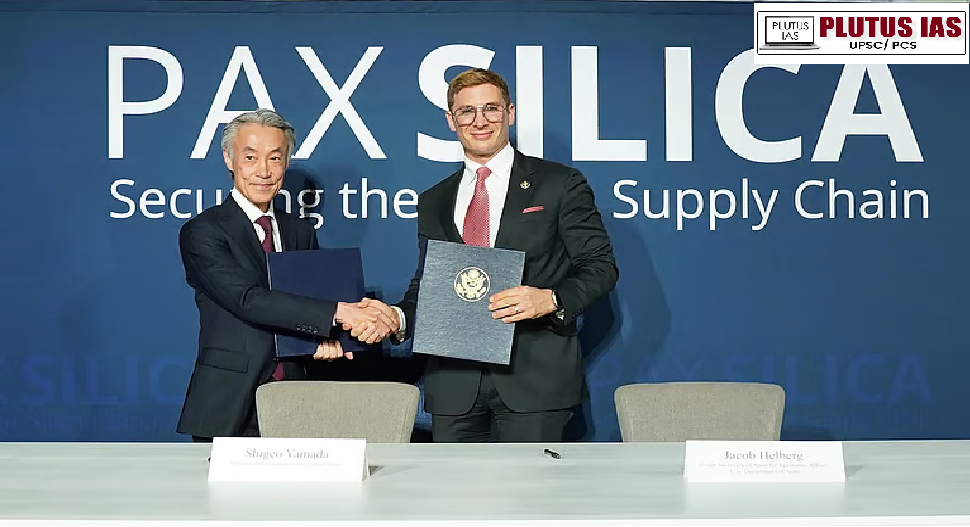
Pax Silica refers to a technology-driven world order where:
- Power flows from control over semiconductors, chip design, fabrication, and supply chains
- Dominance in AI, cloud computing, quantum technologies, and advanced manufacturing shapes geopolitics
- Countries setting tech standards and intellectual property regimes exercise disproportionate global influence
Key Pillars of Pax Silica:
- Semiconductor Manufacturing (fabs)
- Advanced Chip Design & IP
- AI and Data Ecosystems
- Tech Alliances & Supply Chains
- Standard-setting Institutions
Why India Is Not Centrally Placed in Pax Silica
| Factor | Explanation |
|---|---|
| 1. Absence of Advanced Semiconductor Fabrication | India lacks cutting-edge semiconductor fabrication plants (below 10 nm technology). Global chip manufacturing is concentrated in Taiwan, South Korea, and the US. Semiconductor fabrication demands very high capital investment, deeply integrated global supply chains, and decades of industrial learning, which India is still building. |
| 2. Weak Position in Core Chip Design IP | While India is strong in chip verification and back-end design, it lacks ownership of core processor architectures. Indian firms depend on foreign intellectual property such as ARM and x86 ecosystems, resulting in limited value capture despite a large engineering workforce. |
| 3. Limited Role in Global Tech Rule-Making | India often functions as a rule-taker rather than a rule-maker in areas such as semiconductor standards, AI governance frameworks, and digital trade rules. These standards are largely shaped in Western-led institutions and forums. |
| 4. Late Entry into Strategic Tech Industrial Policy | Compared to proactive initiatives like the US CHIPS Act, EU Chips Act, and China’s long-term state-led semiconductor push, India’s focused semiconductor policy has gained momentum only in recent years, placing it at a relative disadvantage. |
| 5. Infrastructure and Ecosystem Constraints | Semiconductor fabs require uninterrupted power supply, ultra-pure water, specialized logistics, and dense supplier ecosystems. Such supporting ecosystems are still under development in India, affecting large-scale and high-end semiconductor manufacturing. |
Strategic Implications for India
Economic Implications:
India’s continued dependence on imported semiconductors limits the development of a robust domestic chip ecosystem and results in a missed opportunity to expand into high-value manufacturing. This reliance also exposes the economy to global supply-chain disruptions, price volatility, and external shocks, which can affect industrial growth and technological competitiveness.
Geopolitical Implications:
In an increasingly technology-driven global order, limited domestic semiconductor capacity reduces India’s leverage in geopolitics. Dependence on strategic alliances for access to critical technologies constrains policy autonomy and raises the risk of exclusion from emerging technology blocs that may shape future standards, trade, and innovation networks.
National Security Concerns:
Semiconductors are foundational to defence systems, space programmes, and cybersecurity infrastructure. Heavy import dependence in such critical sectors creates strategic vulnerabilities, as supply restrictions or disruptions during geopolitical tensions could directly impact national security preparedness and strategic autonomy.
Is India Completely Outside Pax Silica?
No. India is not outside Pax Silica; rather, it occupies a peripheral yet ascending position within the emerging semiconductor-driven global order. While India does not currently dominate advanced chip fabrication, it is steadily strengthening its role across design, policy, and strategic partnerships.
India’s Structural Strengths:
India possesses a large and skilled STEM workforce, making it a global hub for semiconductor design, verification, and embedded systems. Its rapidly expanding digital public infrastructure (DPI) demonstrates strong state capacity in deploying technology at scale. Additionally, India’s strategic partnerships with the United States, Japan, the European Union, and Quad nations enhance access to critical technologies, investment, and supply-chain collaboration.
Policy Push and Recent Initiatives:
The government has launched the India Semiconductor Mission (ISM) to build an end-to-end semiconductor ecosystem, complemented by Production Linked Incentive (PLI) schemes to attract global manufacturers. Planned semiconductor fabrication units in Gujarat and Assam signal intent to enter manufacturing, while focused investment in compound semiconductors, advanced packaging, and chip assembly reflects a pragmatic strategy to integrate into global value chains before moving up the technology ladder.
Overall Assessment:
India’s approach reflects strategic gradualism—leveraging existing strengths in design and partnerships while building manufacturing capacity. This positions India as a rising stakeholder in Pax Silica rather than an outsider, with the potential to gain greater influence as its semiconductor ecosystem matures.
Way Forward for India
1. Focus on Strategic Niches: India should prioritize segments of the semiconductor value chain where entry barriers are relatively lower and market demand is growing. Chip packaging, testing, and assembly (OSAT), along with power electronics and automotive semiconductors, offer viable pathways to build scale, gain manufacturing experience, and integrate into global supply chains without immediately competing in the most advanced fabrication nodes.
2. Strengthen Design-to-Manufacturing Linkages: Moving beyond a services-led model, India must bridge the gap between chip design and fabrication. Encouraging intellectual property (IP) creation and supporting fabless Indian semiconductor firms will help retain value domestically, foster innovation, and gradually transition India from a design services hub to a product- and IP-owning ecosystem.
3. Deepen Global Tech Alliances: Strategic cooperation with key technology leaders such as the United States, Japan, the European Union, and Taiwan is essential for accessing advanced know-how, capital, and equipment. Through friend-shoring arrangements, India can secure resilient supply chains while positioning itself as a trusted partner in the global semiconductor ecosystem.
4. Invest in R&D and Human Capital: Long-term competitiveness requires sustained investment in research and skilled manpower. Establishing semiconductor-focused universities, research labs, and industry-academia partnerships, alongside stable public funding for deep-tech research, will help build indigenous capabilities and reduce technological dependence.
5. Become a Rule-Shaper in Global Governance: India should actively participate in international forums shaping rules for semiconductors, artificial intelligence, and digital technologies. By contributing to standard-setting and governance frameworks, India can protect its strategic interests, influence emerging norms, and enhance its standing as a responsible and proactive technology power.
Conclusion
Pax Silica marks a shift in global power where control over semiconductors and advanced technologies defines economic strength, geopolitical influence, and security. India’s position is currently peripheral due to structural and policy constraints and a late start in high-end manufacturing, rather than a lack of capability. With its strong talent base, growing design ecosystem, and strategic partnerships, India retains significant potential. Sustained investment, coherent industrial policy, and deeper integration into global tech value chains can enable India to gradually move from the margins toward a meaningful role in the emerging silicon-based world order.
Prelims question:
Q Consider the following reasons for India not being centrally placed in Pax Silica:
1. Absence of cutting-edge semiconductor fabrication facilities
2. Dependence on foreign core processor intellectual property
3. Dominance of India in global semiconductor standard-setting bodies
Which of the above are correct?
(a) 1 and 2 only
(b) 2 and 3 only
(c) 1 and 3 only
(d) 1, 2 and 3
Answer: A
Mains Question
Q. Critically examine India’s semiconductor policy in the context of the emerging Pax Silica global order. What gaps remain in achieving technological self-reliance? (250 words)

- PRAGATI: A Decade of Cooperative, Outcome-Driven Governance - January 15, 2026
- Iran’s Large-Scale Protests: Political Stability, Public Dissent and Regional Implications - January 14, 2026
- India–Oman CEPA: A Strategic Trade Pact for Jobs, Exports and Regional Integration - January 10, 2026

No Comments