


27 Sep India at UN: Wars Far Away Impoverishing Distant Nations Globally
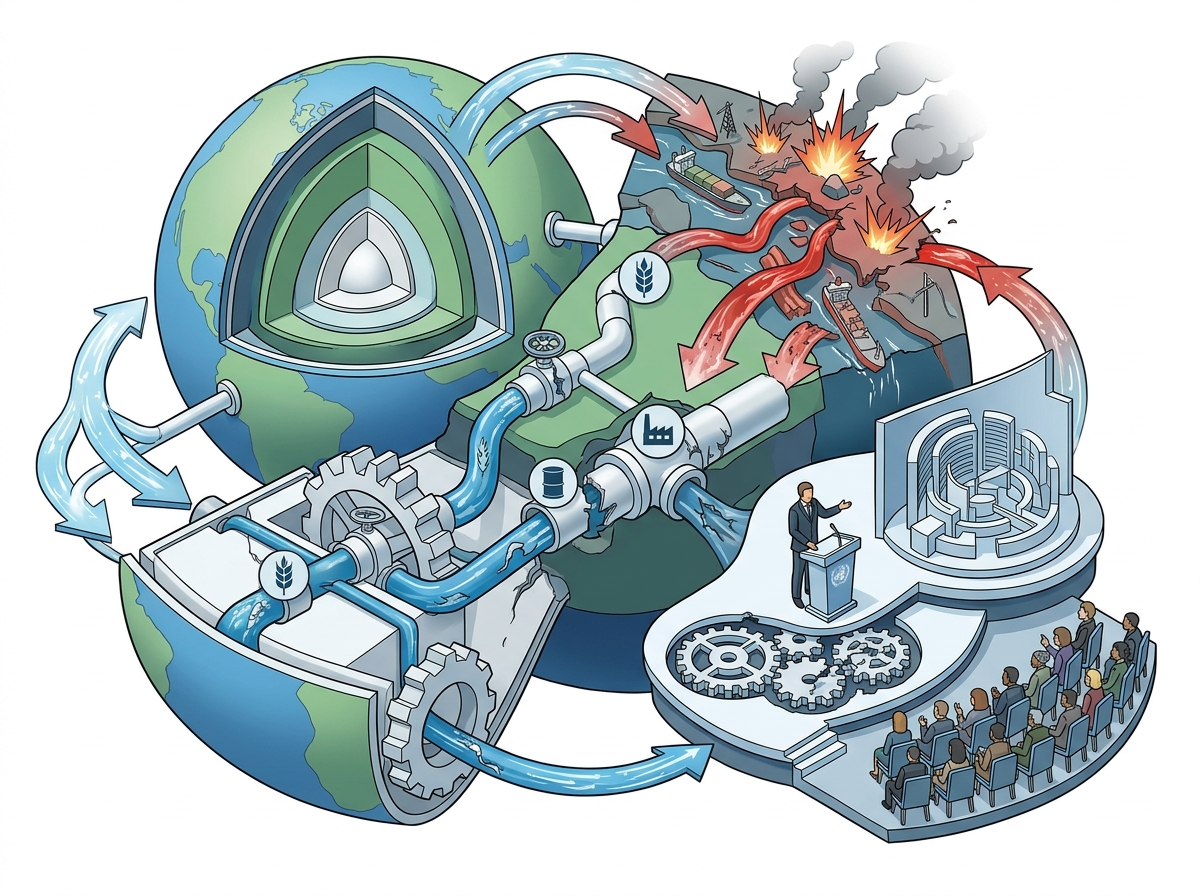
✎ Protracted conflicts generate systemic spillovers—economic, security, and institutional—that disproportionately burden nations distant from the battlefield, necessitating a renewed commitment to multilateralism, de-escalation…
Subject Relevance — Where This Topic Fits
- GS Paper II — International Relations: Global Issues and Challenges | GS Paper II — International Relations: Role of Major Powers and Regional Organisations | GS Paper II — International Relations: Issues Relating to Development and Management of Social Sector/Services relating to Health, Education, Human Resources | GS Paper III — Economy: Effects of Liberalisation on the Economy, Changes in Industrial Policy and their Effects on Industrial Growth | GS Paper III — Economy: Infrastructure: Energy, Ports, Roads, Airports, Railways etc.
- Prelims: Global South, Multipolar world order, Maritime security, Two-State solution, Digital public infrastructure, State-sponsored terrorism, Hyper-competition in global markets, De-risking and diversification
- Essay: Globalisation and its discontents: The paradox of interconnectedness in an era of fragmentation, The erosion of multilateralism: Can the UN remain relevant in a multipolar world?
Quick Revision: Protracted conflicts generate systemic spillovers—economic, security, and institutional—that disproportionately burden nations distant from the battlefield, necessitating a renewed commitment to multilateralism, de-escalation, and the preservation of the rules-based international order.
Why is this in the news?
On 26 September 2026, India’s External Affairs Minister, Subrahmanyam Jaishankar, addressed the 81st session of the United Nations General Assembly, highlighting the disproportionate economic and security burdens borne by nations distant from conflict zones. His remarks underscored the systemic risks posed by protracted conflicts—ranging from disruptions in global supply chains to the weaponisation of trade, finance, and technology—while advocating for a renewed commitment to multilateralism, de-escalation, and the preservation of the rules-based international order.
Background
- The post-Cold War era has witnessed a paradoxical decline in interstate wars but a rise in protracted intrastate and regional conflicts, particularly in West Asia, the Middle East, and Eastern Europe.
- The United Nations, established in 1945 to prevent such conflicts, has seen its efficacy challenged by veto powers in the Security Council, which often paralyse collective action in crises like the war in Ukraine or the Israel-Palestine conflict.
- Globalisation, while fostering economic interdependence, has also created vulnerabilities where localised conflicts can trigger cascading disruptions in global trade, energy markets, and financial systems.
- The concept of the ‘Global South’—encompassing developing nations in Africa, Asia, and Latin America—has gained prominence as these countries bear the brunt of geopolitical spillovers despite contributing minimally to the conflicts themselves.
- India’s stance at the UN reflects its long-standing advocacy for a multipolar world order, where power is distributed among multiple centres rather than concentrated in a few hegemonic states.
- The weaponisation of trade, technology, and finance—evident in sanctions, export controls, and cyber warfare—has eroded the predictability and stability that underpin global economic governance.
Understanding Geopolitical Spillovers and Their Global Impact
- Geopolitical spillovers refer to the unintended consequences of conflicts or tensions in one region that adversely affect nations and systems far removed from the immediate battlefield. These spillovers manifest in economic disruptions (e.g., supply chain breakdowns, inflation), security threats (e.g., maritime piracy, cyberattacks), and institutional strain (e.g., UN deadlock, WTO paralysis).
- The concept of ‘weaponisation’ in international relations describes the deliberate use of economic, technological, or informational tools as instruments of coercion or pressure. Examples include sanctions, export controls, cyber warfare, and the manipulation of global commons (e.g., maritime routes, space assets).
- A multipolar world order is characterised by the diffusion of power among multiple states or blocs, as opposed to a unipolar or bipolar system. This shift is driven by the rise of emerging economies (e.g., India, Brazil, South Africa), regional powers (e.g., Turkey, Iran), and the relative decline of traditional hegemons.
- The ‘Global South’ is a geopolitical and economic grouping of developing nations, primarily in Africa, Asia, and Latin America, that share common challenges such as colonial legacies, underdevelopment, and vulnerability to external shocks. Their collective bargaining power in global institutions remains limited despite their demographic and economic significance.
- Maritime security is a critical dimension of geopolitical spillovers, as 90% of global trade by volume is transported via sea routes. Disruptions in key chokepoints (e.g., Strait of Hormuz, Bab el-Mandeb) can trigger global energy crises, inflation, and food shortages, disproportionately affecting import-dependent nations.
- The ‘two-State solution’ for the Israel-Palestine conflict is a proposed framework for a peaceful resolution, involving the establishment of an independent Palestinian state alongside Israel, based on pre-1967 borders with mutually agreed land swaps. Its viability hinges on sustained international diplomacy and the willingness of both parties to compromise.
- Digital public infrastructure (DPI) refers to the foundational digital systems (e.g., Aadhaar, UPI, e-governance platforms) that enable the delivery of public services, financial inclusion, and socioeconomic development. India’s DPI model is often cited as a case study for scalable governance in the Global South.
- State-sponsored terrorism involves the direct or indirect support of terrorist groups by a state actor, either through funding, training, or providing safe havens. Such actions violate international law and undermine global counter-terrorism efforts, as seen in the UN’s repeated calls for zero tolerance towards terrorism.
Key Features
| Feature | Significance |
|---|---|
| Externalities of distant conflicts | Economic disruptions, supply chain volatility, and inflationary pressures disproportionately affect non-belligerent nations, particularly in the Global South, due to interconnected global systems. |
| Weaponisation of global commons | Escalation of geopolitical tensions transforms traditionally neutral domains—finance, trade, technology, and maritime routes—into instruments of coercion, undermining multilateral stability. |
| State-sponsored terrorism | Cross-border terrorism constitutes a direct violation of international law and sovereignty, eroding trust in global institutions and necessitating robust counter-terrorism frameworks. |
| Multipolarity and institutional adaptation | The post-1945 international order faces structural challenges as rising powers reshape governance norms, requiring inclusive dialogue to prevent fragmentation. |
| Digital public infrastructure (DPI) | India’s DPI model—demonstrated through Aadhaar, UPI, and DigiLocker—enhances governance efficiency and service delivery, offering scalable solutions for developing nations. |
Why it Matters
Economic
- Global supply chains remain vulnerable to disruptions in conflict zones, leading to shortages of critical inputs (e.g., fertilizers, energy) and exacerbating inflation in import-dependent economies.
- Sanctions and secondary restrictions (e.g., on financial transactions, technology transfers) create collateral damage, disproportionately impacting small and medium economies with limited policy space.
- The weaponisation of trade routes (e.g., Red Sea, Strait of Hormuz) raises maritime insurance costs and delays shipments, directly affecting food and fuel security in Africa and South Asia.
Strategic
- Persistent conflicts in West Asia and Eastern Europe challenge the UN’s collective security mandate, testing the efficacy of existing peacekeeping and mediation mechanisms.
- Maritime security threats (e.g., hijackings, blockades) threaten global commons, necessitating renewed emphasis on UNCLOS and regional maritime cooperation frameworks.
- The rise of multipolarity introduces competing normative orders (e.g., BRICS, G20 initiatives), requiring India to balance strategic autonomy with multilateral engagement.
Institutional
- The UN’s credibility is undermined by the inability to resolve prolonged conflicts, prompting calls for structural reforms in the Security Council to reflect contemporary geopolitical realities.
- Weakening of multilateral institutions (e.g., WTO, IMF) due to unilateral actions reduces their capacity to address systemic crises, such as debt distress in vulnerable nations.
- The erosion of consensus on global norms (e.g., non-proliferation, humanitarian law) complicates efforts to frame unified responses to transnational threats.
Developmental
- Global South nations face compounded challenges from food-fuel-finance crises, reversing progress on SDGs and necessitating targeted international support mechanisms.
- India’s development partnerships (e.g., Lines of Credit, capacity-building) offer alternative models for South-South cooperation, particularly in clean energy and digital governance.
- Climate-vulnerable economies bear disproportionate costs from conflicts (e.g., disrupted adaptation finance), highlighting the need for integrated security-development frameworks.
Challenges
1. Collateral Economic Damage from Conflicts
- Non-belligerent nations experience spillover effects via trade, remittances, and investment flows, leading to fiscal strain and policy dilemmas (e.g., import substitution vs. fiscal consolidation).
- Volatility in commodity markets (e.g., oil, wheat) disrupts fiscal planning in import-reliant economies, exacerbating debt burdens and social unrest.
- Disruptions to global value chains (e.g., semiconductors, pharmaceuticals) create bottlenecks, delaying industrial recovery in post-pandemic economies.
UPSC Link: GS III: Indian Economy and issues relating to planning, mobilization of resources
2. Erosion of Multilateral Norms
- Selective enforcement of international law (e.g., sanctions regimes) undermines trust in institutions like the UN and ICJ, fostering a climate of impunity.
- Proliferation of parallel institutions (e.g., AIIB, BRICS New Development Bank) risks fragmenting global governance, complicating consensus-building on critical issues.
- Normalisation of unilateral actions (e.g., economic coercion) weakens the rule-based order, incentivising revisionist behaviour by states.
UPSC Link: GS II: Important International institutions, agencies and fora
3. Transnational Terrorism and Asymmetric Threats
- State-sponsored terrorism challenges the principle of sovereign equality, as non-state actors exploit safe havens to launch cross-border attacks.
- Financing of terrorism via cryptocurrencies and informal networks complicates regulatory oversight, requiring coordinated global action.
- The use of terrorism as a tool of statecraft (e.g., proxy wars) blurs lines between war and peace, complicating counter-terrorism responses.
UPSC Link: GS III: Linkages between development and spread of extremism
4. Maritime Security and Freedom of Navigation
- Targeting of commercial vessels in international waters (e.g., Red Sea, Black Sea) threatens global trade, accounting for ~12% of seaborne oil and ~8% of grain shipments.
- Piracy and armed robbery at sea disrupt supply chains, particularly affecting landlocked and Small Island Developing States (SIDS).
- Climate change exacerbates maritime risks (e.g., melting Arctic routes, extreme weather), necessitating adaptive governance frameworks.
UPSC Link: GS II: Bilateral, regional and global groupings and agreements involving India
5. Balancing Strategic Autonomy and Multilateralism
- India’s role in mediating conflicts (e.g., Ukraine, West Asia) requires navigating divergent interests among major powers to avoid entanglement in proxy dynamics.
- Diversification of partnerships (e.g., with Africa, Latin America) is essential to mitigate over-reliance on traditional allies, but demands sustained diplomatic and resource commitments.
- Domestic imperatives (e.g., energy security, food self-sufficiency) must align with global commitments (e.g., Paris Agreement, SDGs) without compromising strategic flexibility.
UPSC Link: GS II: India and its neighbourhood- relations
Challenges — UPSC Perspective
| Issue | Concern |
|---|---|
| Spillover effects of conflicts | Non-belligerent nations face economic instability due to disrupted trade, remittances, and investment flows. |
| Weaponisation of global systems | Sanctions, trade restrictions, and financial measures are used as instruments of coercion, undermining multilateral stability. |
| Maritime security threats | Attacks on commercial vessels and blockades disrupt global supply chains, particularly for energy and food commodities. |
| Erosion of multilateral norms | Selective enforcement of international law and parallel institutions fragment global governance structures. |
| State-sponsored terrorism | Cross-border terrorism challenges sovereign equality and complicates counter-terrorism frameworks. |
| Climate-security nexus | Conflicts exacerbate climate vulnerabilities (e.g., droughts, floods) in conflict-affected and neighbouring regions. |
Way Forward
- Strengthen UN mechanisms for conflict mediation and peacekeeping, including reforms to the Security Council to reflect contemporary geopolitical realities.
- Promote dialogue on de-escalation in conflict zones (e.g., West Asia, Ukraine) through Track-II diplomacy and confidence-building measures.
- Enhance maritime security cooperation under UNCLOS, including joint patrols and information-sharing to protect global commons.
- Develop multilateral frameworks to address collateral economic damage from conflicts, such as pooled procurement for critical commodities (e.g., fertilizers, energy).
- Invest in digital public infrastructure (DPI) and South-South cooperation to build resilient supply chains and alternative trade routes.
- Establish a global fund for climate-resilient recovery in conflict-affected regions, integrating security and development agendas.
- Adopt a unified stance against state-sponsored terrorism in multilateral forums, including sanctions and diplomatic isolation of perpetrators.
- Encourage the adoption of non-aligned economic policies to mitigate the impact of unilateral sanctions and trade restrictions.
UPSC Value Addition
Keywords for Mains Answer-Writing
United Nations General Assembly · International peace and security · Global South · weaponization of global commons · multipolar world order · State-sponsored terrorism · maritime security · two-State solution for Palestine · India’s foreign policy · zero tolerance for terrorism · global supply chains · digital public infrastructure · India’s development partnerships · UN Charter principles · economic weaponization · energy security · food security · financial stability · de-escalation mechanisms · sustainable development
Concept Flow
Escalation of regional conflicts → Disruption of global supply chains → Spillover effects on non-belligerent economies → Erosion of multilateral norms → Weaponisation of trade, finance, and technology → Increased vulnerability of Global South → Calls for structural reforms in global governance → Emergence of multipolarity and competing normative orders → Need for inclusive dialogue and adaptive frameworks.
Prelims Practice Questions
Q1. Consider the following statements regarding the United Nations General Assembly (UNGA):
1. The UNGA is the main deliberative, policymaking and representative organ of the United Nations.
2. Each member state of the UN has one vote in the UNGA.
3. The UNGA can impose binding sanctions on member states for violations of international peace and security.
How many of the above statements are correct?
- Only one
- Only two
- All three
- None
Answer: Only two — Statement 1 is correct as the UNGA serves as the main deliberative organ. Statement 2 is correct as each member has one vote. Statement 3 is incorrect as the UNGA can only recommend actions; binding decisions are taken by the UN Security Council.
Q2. Assertion (A): India has consistently advocated for a zero-tolerance policy towards State-sponsored terrorism.
Reason (R): India argues that terrorism undermines international peace and security and violates the principles of the UN Charter.
Options:
A. Both A and R are true, and R is the correct explanation of A.
B. Both A and R are true, but R is not the correct explanation of A.
C. A is true, but R is false.
D. A is false, but R is true.
Answer: ? — Assertion (A) is true as India has repeatedly emphasized zero tolerance for State-sponsored terrorism. Reason (R) is also true and correctly explains (A) as terrorism directly contravenes UN Charter principles of peaceful coexistence and collective security.
Q3. Match the following pairs related to maritime security and international law:
Column I (Concept) Column II (Description)
1. Freedom of the High Seas A. Principle that no state may claim sovereignty over any part of the high seas
2. Innocent Passage B. Right of vessels to pass through the territorial sea of another state without entering internal waters
3. Exclusive Economic Zone (EEZ) C. Area beyond territorial waters where a coastal state has sovereign rights over natural resources
4. Territorial Sea D. Belt of coastal waters extending up to 12 nautical miles from the baseline
Options:
1. 1-A, 2-B, 3-C, 4-D
2. 1-B, 2-A, 3-D, 4-C
3. 1-C, 2-D, 3-A, 4-B
4. 1-D, 2-C, 3-B, 4-A
Answer: ? — 1-A: Freedom of the High Seas grants all states the right to use the high seas for peaceful purposes. 2-B: Innocent Passage allows vessels to transit through another state’s territorial sea without stopping. 3-C: EEZ extends up to 200 nautical miles for resource exploitation. 4-D: Territorial Sea extends up to 12 nautical miles from the baseline.
Mains Practice Question
✍ The global order established in 1945 is increasingly being challenged by the weaponization of global commons, which undermines international peace and security. Critically examine the implications of this trend for the Global South, with reference to contemporary conflicts and India’s diplomatic stance. (15 Marks)
Approach: MODEL-ANSWER SKELETON:
1. **Introduction (2 marks)**
– Define ‘weaponization of global commons’ (e.g., finance, supply chains, technology, maritime routes) and its contemporary manifestations (e.g., sanctions, trade wars, cyber-attacks, maritime blockades).
– Highlight India’s articulation at the UNGA 81st session (2026) regarding the impact on distant nations.
2. **Dimensions of Weaponization (4 marks)**
– **Economic**: Use of sanctions, trade restrictions, and financial exclusion (e.g., SWIFT restrictions) as coercive tools.
– **Maritime**: Targeting of commercial vessels in international waters (e.g., Gulf of Aden, Strait of Hormuz) disrupting global trade.
– **Technological**: Restrictions on technology transfers, semiconductor bans, and digital sovereignty debates.
– **Energy and Food**: Weaponization of energy supplies (e.g., oil/gas disruptions) and agricultural exports (e.g., fertilizer/food price volatility).
3. **Impact on the Global South (4 marks)**
– **Economic Vulnerability**: Dependence on global supply chains, energy imports, and export markets makes Global South nations disproportionately affected.
– **Development Setbacks**: Resource diversion to mitigate crises (e.g., food/fuel subsidies) slows progress toward SDGs.
– **Institutional Erosion**: Weakening of multilateral institutions (WTO, UN) reduces avenues for collective problem-solving.
– **Humanitarian Crises**: Prolonged conflicts (e.g., Ukraine, Gaza) exacerbate refugee flows and humanitarian funding gaps.
4. **India’s Diplomatic Stance (3 marks)**
– **Neutrality and Multipolarity**: India’s advocacy for multipolarity and non-alignment in a polarized world.
– **Zero Tolerance for Terrorism**: Emphasis on State-sponsored terrorism as a direct threat to global order.
– **Support for Two-State Solution**: Position on Palestine-Israel conflict as a pathway to regional stability.
– **Development Partnerships**: Highlight India’s role in supporting 600 projects in 78 countries (clean energy, IT, agriculture) as an alternative to weaponized aid.
5. **Way Forward (2 marks)**
– **Strengthening Multilateralism**: Reform of UNSC and WTO to reflect contemporary geopolitical realities.
– **Conflict De-escalation**: Emphasis on dialogue, restraint, and adherence to UN Charter principles.
– **Resilience Building**: Diversification of supply chains, energy transitions, and digital public infrastructure for self-reliance.
**Balanced View**: Acknowledge that weaponization is not solely a Western phenomenon (e.g., use of economic coercion by non-Western states) and that Global South nations must balance sovereignty with pragmatic engagement.
Source: news.un.org
Generated by AanyaAi for educational purpose.
Related guides on our sites
- Best economics services coaching
- Anthropology VS PSIR
- Best PSIR optional coaching
- Best PSIR optional coaching online

- यूक्रेन का रोबोट सेना अभियान: युद्ध में मानव हानि कम करने की रणनीति - September 27, 2026
- Ukraine’s ‘Army of Robots’: A Game-Changer for UPSC Mains 2026 Polity & Governance - September 27, 2026
- रूस ने भारत-ब्राजील को दिया UNSC स्थायी सदस्यता का समर्थन, जर्मनी-जापान विरोध में - September 27, 2026

No Comments