


24 Sep India-EU Energy Cooperation: Key Highlights from Bilateral Meeting on 24 Sept 2026
✎ The India-EU energy dialogue is a strategic platform to align India’s energy transition with the EU’s climate neutrality goals, focusing on decarbonisation, technology transfer, and regulatory cooperation, including the EU’s…
Subject Relevance — Where This Topic Fits
- GS Paper II — International Relations (Bilateral/Multilateral Institutions and Agreements) | GS Paper III — Environment, Climate Change and Energy
- Prelims: Carbon Border Adjustment Mechanism (CBAM), National Determined Contributions (NDC), Green Hydrogen Mission, Small Modular Reactors (SMRs), Smart Grids, Energy Storage Systems, Carbon Markets, Paris Agreement
- Essay: Climate Change and Global Governance: The Role of Multilateral Energy Partnerships, Energy Transition: Balancing Development, Sustainability, and Geopolitical Cooperation
Quick Revision: The India-EU energy dialogue is a strategic platform to align India’s energy transition with the EU’s climate neutrality goals, focusing on decarbonisation, technology transfer, and regulatory cooperation, including the EU’s Carbon Border Adjustment Mechanism (CBAM).
Why is this in the news?
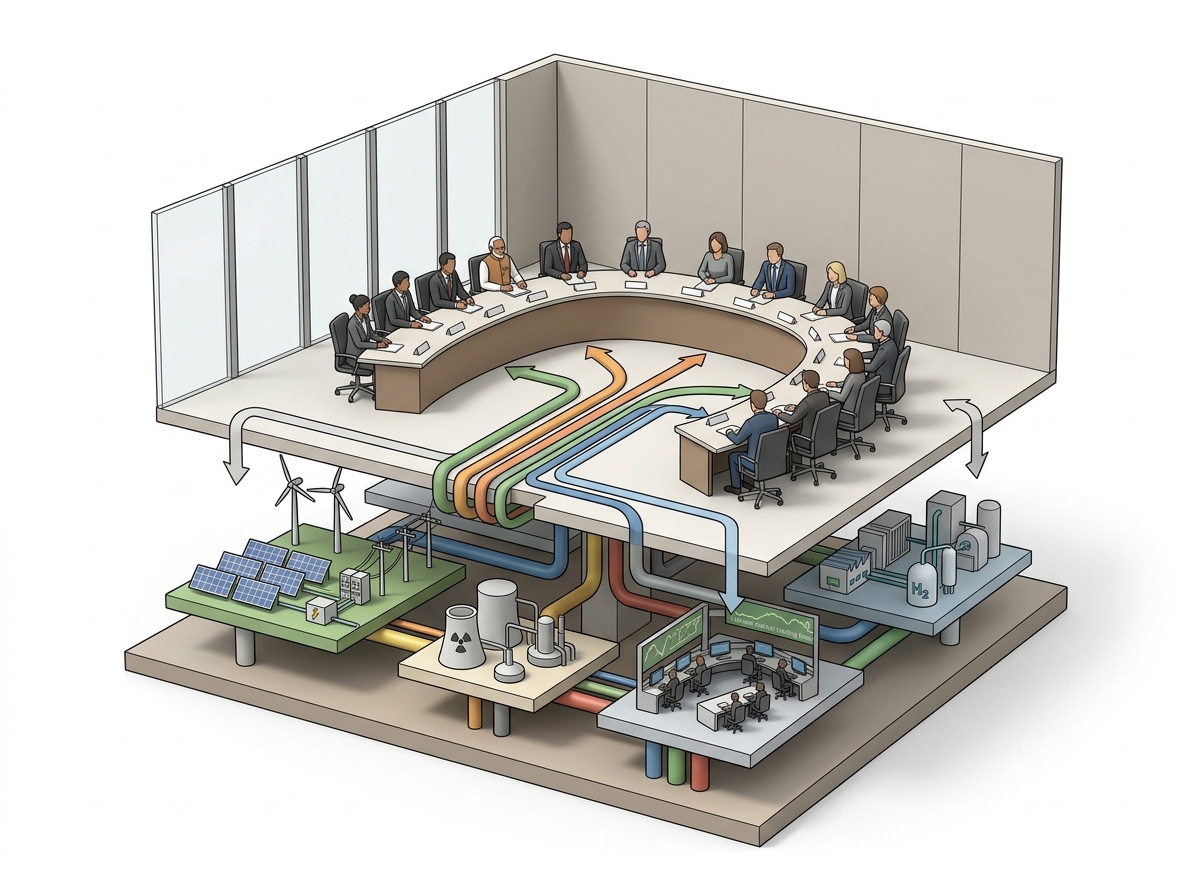
On 24 September 2026, the Minister of State for Power and New & Renewable Energy, Shripad Naik, held a bilateral meeting with a delegation from the European Parliament’s Industry, Research and Energy (ITRE) Committee in New Delhi. The meeting reviewed and explored avenues to strengthen cooperation between India and the European Union (EU) in the power sector, focusing on energy security, decarbonisation, nuclear energy, carbon markets, and emerging technologies. This dialogue is significant as it aligns with India’s accelerated energy transition goals and the EU’s strategic priorities under the European Green Deal, while also addressing trade and regulatory frameworks such as the proposed India-EU Free Trade Agreement (FTA).
Background
- The India-EU strategic partnership, formally established in 2004, includes energy and climate change as key pillars, with regular high-level dialogues since 2005.
- India’s energy transition is driven by its commitment to achieve 50% cumulative electric power installed capacity from non-fossil fuel sources by 2030, as outlined in its Nationally Determined Contributions (NDCs) under the Paris Agreement.
- The EU’s Green Deal, launched in 2019, aims for climate neutrality by 2050, with intermediate targets such as a 55% reduction in greenhouse gas emissions by 2030 (Fit for 55 package).
- The Carbon Border Adjustment Mechanism (CBAM), effective from 2026, is an EU policy to impose carbon costs on imports of carbon-intensive goods, impacting India’s trade with the EU.
- India’s power sector reforms include the Green Hydrogen Mission launched in 2023.
- The India-EU Free Trade Agreement (FTA) negotiations, launched in 2022, aim to enhance trade and investment in goods, services, and technology, including clean energy technologies.
What is the India-EU Bilateral Energy Dialogue?
- The India-EU Bilateral Energy Dialogue is a structured mechanism for high-level engagement between Indian and EU officials to discuss energy policy, technology cooperation, and regulatory frameworks.
- The dialogue covers a wide spectrum of energy-related issues, including energy security, decarbonisation pathways, nuclear energy, carbon markets, and emerging technologies such as green hydrogen, carbon capture utilisation and storage (CCUS), and small modular reactors (SMRs).
- The dialogue aims to align India’s energy transition goals with the EU’s climate neutrality objectives, fostering mutual learning and best practices in policy design, regulatory frameworks, and technological innovation.
- Key areas of collaboration include long-duration energy storage, digitalisation of power systems, smart grids, and energy efficiency measures to enhance grid resilience and reliability.
- The dialogue also addresses trade and regulatory challenges, such as the EU’s Carbon Border Adjustment Mechanism (CBAM), which impacts India’s exports of carbon-intensive goods to the EU.
- The meeting on 24 September 2026 reviewed progress on ongoing initiatives, including India’s achievements in expanding non-fossil fuel-based energy capacity ahead of its NDC targets and strengthening transmission and distribution infrastructure.
- The dialogue serves as a platform for India and the EU to explore joint research, development, and deployment (RD&D) projects in clean energy technologies, leveraging each other’s strengths in innovation and industrial capacity.
- The partnership underscores the importance of multilateral cooperation in addressing global energy challenges, particularly in the context of climate change mitigation and sustainable development.
Key Features
| Feature | Significance |
|---|---|
| Bilateral Meeting (India-EU ITRÉ Committee) | Formal diplomatic engagement to review and strengthen energy cooperation between India and the European Union, focusing on policy alignment and joint initiatives. |
| Energy Transition Discussions | Exchange of perspectives on decarbonization pathways, renewable energy integration, and grid modernization to align with global climate commitments. |
| Carbon Market & CBAM | Exploration of carbon pricing mechanisms, including the EU’s Carbon Border Adjustment Mechanism (CBAM), and their implications for trade and industrial competitiveness. |
| Emerging Technologies Focus | Identification of collaborative opportunities in green hydrogen, long-duration energy storage, digital power systems, and small modular reactors (SMRs). |
| Nuclear Energy Cooperation | Discussion on leveraging nuclear power for baseload energy security, including advanced technologies and regulatory frameworks. |
Why it Matters
Diplomatic & Institutional
- Reinforces the India-EU Strategic Partnership, particularly in energy security and climate action, as outlined in the 2021 EU-India Connectivity Partnership.
- Demonstrates India’s proactive engagement in multilateral energy governance, aligning with the EU’s Green Deal and India’s own energy transition goals.
- Provides a platform for institutional dialogue on regulatory harmonization, technology transfer, and joint research initiatives.
Economic & Trade
- Facilitates discussions on the India-EU Free Trade Agreement (FTA), where energy transition commitments could influence tariff structures and market access.
- Highlights the economic imperative of decarbonization, particularly for energy-intensive industries (e.g., steel, cement) facing carbon border adjustments.
- Opportunities for joint ventures in clean energy technologies, enhancing India’s export potential in green hydrogen and smart grid solutions.
Climate & Sustainability
- Aligns with India’s updated NDCs (2022), which target 50% non-fossil fuel-based electricity capacity by 2030 and net-zero emissions by 2070.
- Explores collaborative frameworks for carbon capture, utilization, and storage (CCUS), critical for hard-to-abate sectors.
- Strengthens India’s role in global climate finance negotiations, particularly under the Paris Agreement’s Article 6 mechanisms.
Technological & Infrastructure
- Accelerates adoption of advanced energy storage systems (e.g., battery swapping, pumped hydro) to address grid intermittency from renewables.
- Promotes digitalization of power systems through smart grid technologies, AI-driven demand forecasting, and blockchain for energy trading.
- Encourages R&D collaborations in small modular reactors (SMRs) to diversify India’s nuclear energy portfolio.
Challenges
1. Regulatory Divergence in Carbon Pricing
- EU’s CBAM may impose carbon costs on Indian exports, creating trade barriers for energy-intensive industries unless aligned with global standards.
- Lack of harmonized carbon accounting frameworks between India and the EU could lead to double taxation or compliance inefficiencies.
UPSC Link: GS III: Environment & Climate Change
2. Technology Transfer & IPR Constraints
- Restrictions on transfer of critical clean energy technologies (e.g., green hydrogen electrolyzers, SMRs) due to intellectual property rights (IPR) regimes.
- Dependence on foreign suppliers for key components (e.g., battery cells, nuclear fuel) poses supply chain vulnerabilities.
UPSC Link: GS III: Science & Technology
3. Grid Stability & Storage Limitations
- High variability in renewable energy generation necessitates large-scale energy storage solutions, which are currently cost-intensive.
- Limited domestic manufacturing capacity for advanced battery storage systems hinders rapid deployment.
UPSC Link: GS III: Infrastructure & Energy
4. Geopolitical & Supply Chain Risks
- Over-reliance on critical minerals (e.g., lithium, cobalt) for clean energy technologies exposes India to price volatility and geopolitical disruptions.
- Sanctions or trade restrictions (e.g., on Russian nuclear fuel or Chinese solar panels) could disrupt energy transition plans.
UPSC Link: GS II: International Relations
5. Financing & Investment Gaps
- High capital costs for green hydrogen projects, SMRs, and grid modernization require blended finance models (public-private partnerships).
- Limited access to concessional climate finance for developing nations may delay large-scale clean energy deployment.
UPSC Link: GS III: Economy & Development
Challenges — UPSC Perspective
| Issue | Concern |
|---|---|
| CBAM Compliance | Potential trade barriers for Indian exporters due to carbon pricing disparities with the EU. |
| Technology Lock-in | Risk of dependence on foreign technologies without domestic R&D and manufacturing capabilities. |
| Storage Infrastructure | Inadequate grid-scale energy storage to support high renewable energy penetration. |
| Critical Minerals Supply | Vulnerability to supply chain disruptions in key minerals for clean energy technologies. |
| Regulatory Fragmentation | Differences in carbon accounting and energy standards between India and the EU. |
Way Forward
- Establish a joint India-EU task force to harmonize carbon pricing frameworks and align CBAM compliance mechanisms.
- Expand bilateral R&D collaborations in green hydrogen, SMRs, and digital power systems through dedicated funding mechanisms (e.g., Horizon Europe).
- Accelerate domestic manufacturing of critical clean energy components (e.g., battery cells, electrolyzers) via Production-Linked Incentive (PLI) schemes.
- Develop a phased roadmap for integrating carbon markets, leveraging Article 6 of the Paris Agreement for cooperative approaches.
- Strengthen grid resilience through investments in pumped hydro storage, battery energy storage systems (BESS), and smart grid technologies.
- Enhance climate finance access for Indian clean energy projects via multilateral development banks (e.g., World Bank, EIB).
- Promote skill development in advanced energy technologies through joint vocational training programs with EU institutions.
UPSC Value Addition
Keywords for Mains Answer-Writing
India-EU Energy Cooperation · Paris Agreement and NDCs · Energy Transition in India · Carbon Border Adjustment Mechanism (CBAM) · Green Hydrogen and Energy Storage · Smart Grid Technologies · Small Modular Reactors (SMRs) · Carbon Capture, Utilisation and Storage (CCUS) · India’s Non-Fossil Fuel Capacity Targets · Digital Power Systems and Grid Modernisation
Concept Flow
India’s updated NDCs (2022) → Commitment to 50% non-fossil fuel capacity by 2030 and net-zero by 2070 → → EU’s Green Deal and CBAM → Imposition of carbon costs on energy-intensive exports → → Bilateral meeting to align policies → Discussions on carbon pricing, green hydrogen, and SMRs → → Opportunities for technology transfer and joint R&D → Enhanced energy security and decarbonization → → Strengthened India-EU strategic partnership in climate action and trade.
Prelims Practice Questions
Q1. Consider the following statements regarding India’s National Determined Contributions (NDCs) under the Paris Agreement:
1. India aims to achieve 40% of its total electricity generation from non-fossil fuel sources by 2030.
2. India has already achieved its NDC targets well ahead of the stipulated timeline.
3. India’s NDCs include a commitment to reduce the emissions intensity of its GDP by 33-35% by 2030 compared to 2005 levels.
How many of the above statements are correct?
- Only one
- Only two
- All three
- None
Answer: All three — Statements 1 and 3 are correct as per India’s NDCs. Statement 2 is incorrect because while India has made significant progress, the NDC targets are yet to be fully achieved in all dimensions.
Q2. Assertion (A): The Carbon Border Adjustment Mechanism (CBAM) is designed to prevent carbon leakage by imposing a carbon price on imports of certain goods.
Reason (R): CBAM aims to ensure that imported goods do not gain an unfair competitive advantage over domestically produced goods due to lower carbon pricing in their country of origin.
Select the correct answer using the code below:
- Both A and R are true, and R is the correct explanation of A.
- Both A and R are true, but R is not the correct explanation of A.
- A is true, but R is false.
- A is false, but R is true.
Answer: Both A and R are true, and R is the correct explanation of A. — Both the Assertion and Reason are correct, and the Reason accurately explains the Assertion. CBAM is a mechanism to address carbon leakage by equalising carbon costs.
Q3. Match the following initiatives with their respective objectives:
Column I (Initiative) | Column II (Objective)
— | —
A. National Smart Grid Mission | 1. Enhance energy storage capacity for renewable integration
B. National Hydrogen Mission | 2. Modernise power transmission and distribution infrastructure
C. National Mission on Transformative Mobility and Battery Storage | 3. Promote hydrogen as a clean energy carrier
D. National Mission for Enhanced Energy Efficiency | 4. Improve energy efficiency across sectors
Select the correct match using the codes below:
- A-2, B-3, C-1, D-4
- A-1, B-2, C-3, D-4
- A-3, B-1, C-2, D-4
- A-4, B-3, C-1, D-2
Answer: A-2, B-3, C-1, D-4 — A (National Smart Grid Mission) aligns with objective 2 (modernise infrastructure). B (National Hydrogen Mission) aligns with 3 (promote hydrogen). C (Transformative Mobility and Battery Storage) aligns with 1 (energy storage). D (Enhanced Energy Efficiency) aligns with 4 (energy efficiency).
Mains Practice Question
✍ ‘Energy cooperation between India and the European Union (EU) is a strategic necessity in the context of global energy transitions and climate commitments.’ Critically examine this statement with reference to recent bilateral engagements, technological collaborations, and policy frameworks. Also, outline the challenges in deepening this partnership. (15 Marks)
Approach: MODEL-ANSWER SKELETON:
1. **Strategic Necessity of India-EU Energy Cooperation** (4 points)
– Shared commitment to the Paris Agreement and SDGs (e.g., SDG 7 on affordable and clean energy).
– India’s NDC targets (40% non-fossil fuel capacity by 2030, 33-35% emissions intensity reduction) and EU’s Green Deal objectives.
– Energy security imperatives: diversification of energy sources, reducing import dependence on fossil fuels.
– Technological complementarities: EU’s expertise in smart grids, hydrogen, and CCUS vs. India’s large-scale renewable deployment.
2. **Recent Bilateral Engagements and Collaborations** (4 points)
– 24 September 2026 bilateral meeting between India’s Minister of State for Power and New & Renewable Energy and the European Parliament’s Industry, Research and Energy (ITRE) Committee.
– Focus areas: energy transition, carbon markets, green hydrogen, long-duration energy storage, small modular reactors (SMRs), and digital power systems.
– Progress in India-EU Free Trade Agreement (FTA) negotiations, including energy-related clauses.
– Institutional mechanisms: Joint Working Groups on Renewable Energy, Energy Efficiency, and Nuclear Energy.
3. **Policy Frameworks Underpinning Cooperation** (4 points)
– India’s National Smart Grid Mission (NSGM) and EU’s Smart Grids Task Force.
– India’s National Hydrogen Mission (2021) and EU’s Hydrogen Strategy for a Climate-Neutral Europe.
– Carbon Border Adjustment Mechanism (CBAM): alignment with India’s carbon pricing discussions and trade implications.
– International Solar Alliance (ISA) and EU’s participation in global renewable energy initiatives.
4. **Challenges in Deepening the Partnership** (3 points)
– **Technological and Financial Gaps**: High capital costs for green hydrogen, CCUS, and SMRs; need for blended finance and risk-sharing mechanisms.
– **Regulatory Divergences**: Differences in standards for carbon markets, grid codes, and energy efficiency labelling.
– **Geopolitical and Trade Frictions**: Impact of CBAM on India’s exports; negotiations on FTA chapters on energy and climate.
– **Institutional Coordination**: Ensuring alignment between central ministries (MNRE, Ministry of Power) and EU counterparts (DG ENER, European Commission).
5. **Conclusion** (1 point)
– While the strategic alignment is evident, overcoming challenges requires sustained dialogue, capacity-building, and innovative financing models to translate commitments into tangible outcomes.
Source: PIB (Press Information Bureau)
Generated by AanyaAi for educational purpose.
Related guides on our sites
- Best PSIR optional coaching for upsc
- Best PSIR optional teacher for upsc
- Best teacher of PSIR optional for upsc
- Best PSIR optional coaching in delhi for UPSC

- भारत-यूरोपीय संघ ऊर्जा सहयोग: 2026 में हुई महत्वपूर्ण द्विपक्षीय बैठक - September 24, 2026
- India-EU Energy Cooperation: Key Highlights from Bilateral Meeting on 24 Sept 2026 - September 24, 2026
- आईआईडब्ल्यूडब्ल्यू 2026: भारत-नीदरलैंड ने जल साझेदारी मजबूत की, कल्पसर परियोजना पर समझौता - September 24, 2026

No Comments