


11 Aug India Leads Global Ship Recycling: Regulatory Reforms & Economic Impact for UPSC
✎ Ship recycling in India is governed by the Recycling of Ships Act, 2019, which aligns with the Hong Kong International Convention, ensuring safe, environmentally sound, and economically viable dismantling of end-of-life vessels…
Subject Relevance — Where This Topic Fits
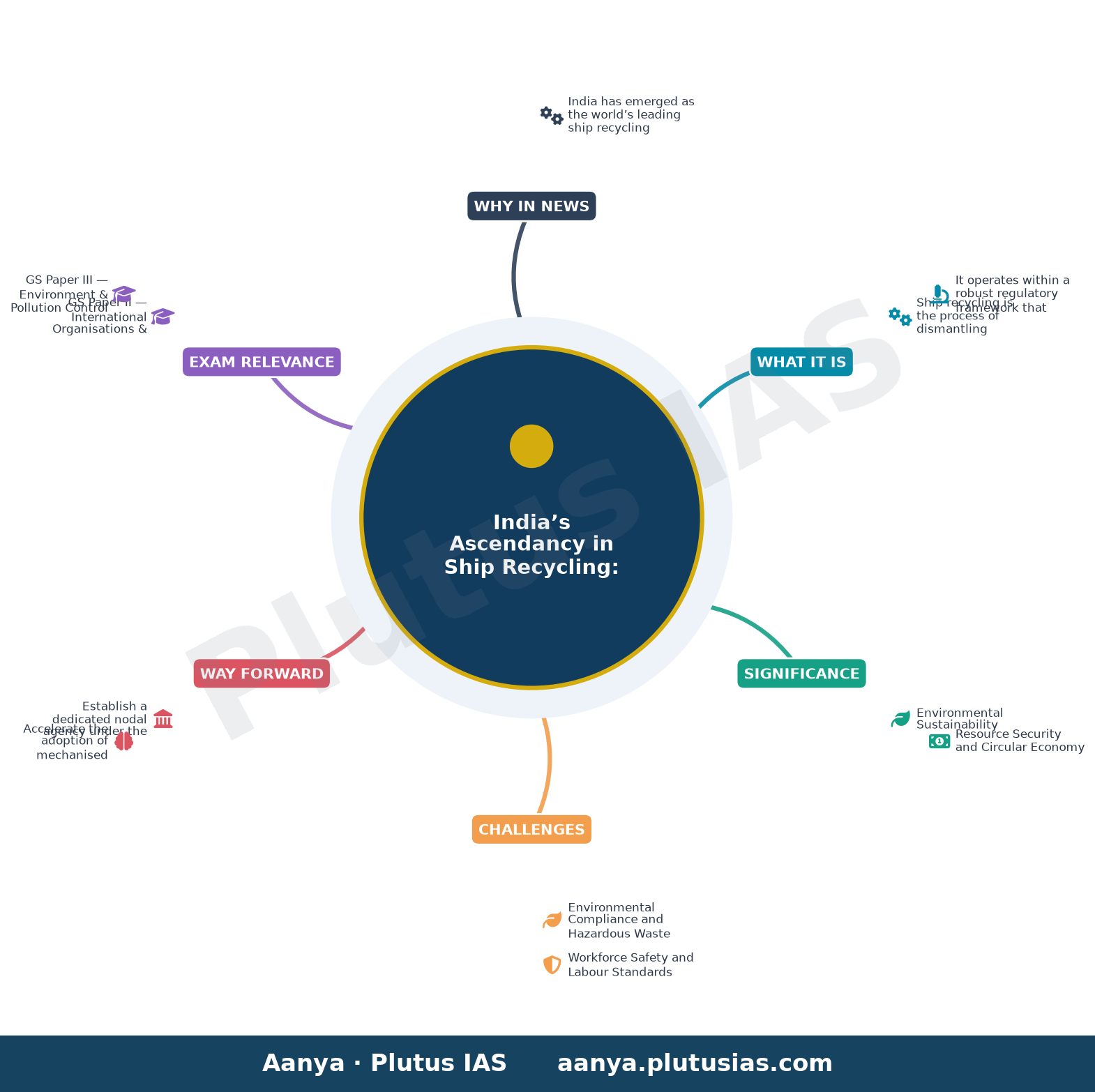
- GS Paper II — International Organisations & Treaties (Hong Kong International Convention) | GS Paper III — Environment & Pollution Control (Circular Economy, Basel Convention) | GS Paper III — Industrial Policy & Promotion (Resource Security, MSMEs) | GS Paper III — Infrastructure (Ports & Shipping)
- Prelims: Ship Recycling Facility (SRF), Hong Kong International Convention (HKC), Basel Convention, Circular Economy Action Plan, Shipbreaking Code of Practice, Ship Recycling Plan (SRP), Green Ship Recycling Yard, ILO Convention 162 (Safety and Health in Shipbreaking)
- Essay: Sustainable Industrialisation: Balancing Economic Growth with Environmental Stewardship, Global Supply Chains and Circular Economy: India’s Strategic Position
Quick Revision: Ship recycling in India is governed by the Recycling of Ships Act, 2019, which aligns with the Hong Kong International Convention, ensuring safe, environmentally sound, and economically viable dismantling of end-of-life vessels while supporting circular economy and resource security objectives.
Why is this in the news?
India has emerged as the world’s leading ship recycling nation in 2025, with its global market share rising from 30.1% in 2024 to 35.4% in 2025, and recycling volume increasing by approximately 60% from 1.86 million gross tonnes to 2.99 million gross tonnes. This transformation is underpinned by regulatory reforms, institutional capacity-building, and integration with international conventions such as the Hong Kong International Convention for the Safe and Environmentally Sound Recycling of Ships (HKC), positioning India as a global hub for environmentally sound and economically viable ship recycling.
Background
- Ship recycling is a critical component of the maritime lifecycle, facilitating the responsible disposal of end-of-life vessels while enabling resource recovery and circular economy objectives.
- India’s ship recycling industry has historically been concentrated in the Alang-Sosiya cluster in Gujarat, which remains the backbone of the country’s recycling capacity.
- The sector has evolved from traditional, labour-intensive practices to a modern, internationally compliant industry through regulatory reforms and technological upgradation.
- India’s ship recycling sector contributes to resource security by supplying scrap steel to domestic industries, reducing dependence on imported raw materials.
What is Ship Recycling? A Governance and Sustainability Perspective
- Ship recycling is the process of dismantling end-of-life vessels to recover reusable materials such as steel, copper, and aluminium, while ensuring the safe disposal of hazardous substances like asbestos, PCBs, and oils.
- It operates within a robust regulatory framework that includes the Hong Kong International Convention (HKC) and India’s domestic legal instruments such as the Recycling of Ships Act, 2019.
- The Hong Kong International Convention sets international benchmarks for the safe and environmentally sound recycling of ships, including requirements for the preparation of a Ship Recycling Plan (SRP), hazardous material inventory, and worker safety protocols.
- India’s ship recycling yards, particularly in the Alang-Sosiya cluster, have undergone significant modernisation, including the adoption of green technologies, mechanised cutting, and improved waste management systems.
- The sector supports circular economy principles by enabling the recovery and reuse of materials, thereby reducing the demand for virgin resources and lowering greenhouse gas emissions associated with primary steel production.
- Environmental safeguards in ship recycling include the containment of hazardous materials, controlled dismantling processes, and the rehabilitation of dismantled shipyards to prevent soil and water contamination.
- Economic benefits include job creation across the recycling value chain, support for allied industries such as steel re-rolling mills and equipment suppliers, and alignment with national initiatives like ‘Make in India’ and ‘Atmanirbhar Bharat’.
Key Features
| Feature | Significance |
|---|---|
| Regulatory Framework | India’s transition from conventional to internationally compliant ship recycling practices, driven by legal reforms and adherence to the Hong Kong International Convention. |
| Alang-Sosiya Cluster | The backbone of India’s ship recycling capacity, with modernised yards ensuring safety, environmental compliance, and operational efficiency. |
| Global Market Share | India’s share in global ship recycling rose from 30.1% (2024) to 35.4% (2025), reflecting enhanced competitiveness and capacity. |
| Volume Growth | Recycling volume increased by ~60% from 1.86 million GT (2024) to 2.99 million GT (2025), indicating scaling industrial capability. |
| Sustainability Integration | Ship recycling now aligns with circular economy principles, reducing GHG emissions and promoting resource efficiency through material recovery. |
Why it Matters
Environmental Sustainability
- Regulated ship recycling prevents hazardous material leakage into marine ecosystems, reducing coastal and oceanic pollution.
- Safe dismantling of end-of-life vessels mitigates risks from asbestos, heavy metals, and oils, protecting biodiversity.
- Contributes to India’s commitments under international conventions like the Hong Kong International Convention and Basel Convention.
Resource Security and Circular Economy
- Provides ~30% of India’s annual steel scrap demand, reducing reliance on imported iron ore and enhancing supply chain resilience.
- Recovered steel requires 70% less energy than primary production, lowering carbon footprint and supporting decarbonisation goals.
- Promotes secondary raw material markets, fostering a closed-loop industrial ecosystem.
Economic and Industrial Development
- Generates direct and indirect employment across dismantling, logistics, and ancillary industries (e.g., re-rolling mills, equipment suppliers).
- Supports ‘Make in India’ and ‘Atmanirbhar Bharat’ through indigenous material recovery and reduced import dependence.
- Strengthens port infrastructure and maritime logistics, creating a multiplier effect on coastal economies.
Strategic Maritime Position
- Leverages India’s geographic advantage as a hub for ship recycling in the Indian Ocean region.
- Enhances India’s role in global maritime governance, aligning with UNCTAD’s sustainable shipping initiatives.
- Reduces geopolitical risks in raw material supply chains for critical industries like construction and automotive.
Challenges
1. Environmental Compliance and Hazardous Waste Management
- Ensuring 100% removal of hazardous materials (e.g., asbestos, PCBs) during dismantling remains technically and logistically challenging.
- Monitoring and enforcement of environmental norms in high-density recycling clusters like Alang-Sosiya require robust institutional capacity.
- Upscaling of waste treatment facilities to handle non-recyclable residues (e.g., insulation, plastics) is critical.
UPSC Link: GS3: Environmental Pollution & Waste Management
2. Workforce Safety and Labour Standards
- High-risk operations (e.g., cutting, handling heavy plates) expose workers to occupational hazards despite regulatory safeguards.
- Need for continuous training, protective gear, and health monitoring to align with ILO standards.
- Informal labour practices in some yards pose challenges to formalising safety protocols.
UPSC Link: GS2: Labour Reforms & ILO Conventions
3. Infrastructure and Technological Upgradation
- Modernisation of ship recycling yards requires significant capital investment for mechanised dismantling and material recovery systems.
- Limited availability of advanced cutting technologies (e.g., plasma, laser) in some facilities hinders efficiency and safety.
- Port infrastructure constraints (e.g., draft limitations, crane capacity) can delay vessel handling.
UPSC Link: GS3: Industrial Infrastructure
4. Global Competitiveness and Market Dynamics
- Fluctuations in global steel prices and shipping demand impact the economic viability of ship recycling operations.
- Competition from emerging hubs (e.g., Bangladesh, Pakistan) necessitates continuous innovation and cost optimisation.
- Stringent international regulations (e.g., EU Ship Recycling Regulation) create compliance burdens for Indian yards.
UPSC Link: GS3: Trade & Industrial Policy
5. Regulatory Harmonisation and Governance
- Ensuring uniformity in enforcement across multiple regulatory bodies (e.g., DG Shipping, MoEFCC, state authorities).
- Streamlining approval processes for ship recycling facilities to reduce bureaucratic delays without compromising safety.
- Strengthening international cooperation for mutual recognition of compliance certificates.
UPSC Link: GS2: Governance & Regulatory Framework
Challenges — UPSC Perspective
| Issue | Concern |
|---|---|
| Hazardous Material Handling | Risk of toxic substance release into marine and coastal environments during dismantling. |
| Worker Safety Protocols | Inadequate adherence to safety standards in high-risk operations leading to accidents and health hazards. |
| Waste Disposal Infrastructure | Limited capacity for processing non-recyclable residues, leading to potential environmental contamination. |
| Technological Lag | Outdated dismantling methods in some yards, affecting efficiency and safety compliance. |
| Port Infrastructure Bottlenecks | Constraints in handling large vessels due to draft limitations or inadequate cranes. |
| Regulatory Fragmentation | Overlapping jurisdictions among central and state agencies, causing delays in compliance verification. |
Way Forward
- Establish a dedicated nodal agency under the Ministry of Ports, Shipping and Waterways to oversee unified implementation of ship recycling norms and monitor progress.
- Accelerate the adoption of mechanised dismantling technologies (e.g., plasma cutting, robotic systems) in Alang-Sosiya and other clusters through PLI schemes or concessional financing.
- Strengthen hazardous waste management infrastructure by setting up regional treatment and disposal facilities near major recycling yards.
- Mandate periodic third-party audits of ship recycling yards to ensure compliance with environmental and safety standards, with penalties for violations.
- Develop a skilled workforce through industry-academia partnerships, focusing on safety protocols, hazardous material handling, and modern dismantling techniques.
- Promote research and innovation in green ship recycling, including pilot projects for zero-waste dismantling and carbon-neutral operations.
- Enhance port infrastructure through targeted investments in draft deepening, crane capacity, and berthing facilities to accommodate larger vessels.
- Foster international collaborations with the IMO, ILO, and UNCTAD to harmonise regulatory frameworks and facilitate technology transfer.
UPSC Value Addition
Keywords for Mains Answer-Writing
Ship Recycling in India · Hazardous and Other Wastes (Management and Transboundary Movement) Rules, 2016 · Hong Kong International Convention for Safe and Environmentally Sound Recycling of Ships, 2009 · Circular Economy · Resource Efficiency · Greenhouse Gas Emissions Reduction · Alang-Sosiya Ship Recycling Yard · UNCTAD Report on Ship Recycling · Make in India · Atmanirbhar Bharat · Steel Scrap Recovery · Maritime Pollution Prevention · Extended Producer Responsibility · Sustainable Development Goals (SDG 12, SDG 14) · Maritime Governance · Industrial Employment Generation
Concept Flow
Global Maritime Trade → End-of-Life Vessels → Regulated Ship Recycling → Resource Recovery & Circular Economy → Reduced Import Dependence & Lower Carbon Footprint → Alignment with Sustainable Development Goals (SDGs) → Enhanced India’s Global Maritime Leadership
Prelims Practice Questions
Q1. Consider the following statements regarding ship recycling in India:
1. India is the world’s leading ship recycling nation as of 2025.
2. The Alang-Sosiya cluster in Gujarat is the backbone of India’s ship recycling capacity.
3. Ship recycling contributes significantly to the domestic steel industry by providing a major source of iron scrap.
4. The Hong Kong International Convention for Safe and Environmentally Sound Recycling of Ships, 2009 has no bearing on India’s ship recycling practices.
How many of the above statements are correct?
- Only one
- Only two
- Only three
- All four
Answer: Only three — Statements 1, 2, and 3 are correct. Statement 4 is incorrect as India has aligned its regulatory framework with the Hong Kong International Convention to enhance safety and environmental standards in ship recycling.
Q2. Assertion (A): Ship recycling in India has contributed to a reduction in greenhouse gas emissions by providing recycled steel for domestic industries.
Reason (R): Recycled steel requires significantly less energy to produce compared to primary steel, thereby lowering carbon emissions.
Options:
A. Both A and R are true, and R is the correct explanation of A.
B. Both A and R are true, but R is not the correct explanation of A.
C. A is true, but R is false.
D. A is false, but R is true.
Answer: ? — Both the Assertion (A) and Reason (R) are true, and the Reason (R) correctly explains the Assertion (A). Recycled steel production is indeed more energy-efficient and emits fewer greenhouse gases than primary steel production.
Q3. Match the following columns related to ship recycling regulations and their significance:
Column I
1. Hazardous and Other Wastes (Management and Transboundary Movement) Rules, 2016
2. Hong Kong International Convention for Safe and Environmentally Sound Recycling of Ships, 2009
3. Extended Producer Responsibility (EPR)
4. Circular Economy
Column II
A. Ensures safe handling and disposal of hazardous materials in ship recycling
B. Promotes the recycling and reuse of materials to minimize waste
C. Provides international standards for environmentally sound ship recycling
D. Encourages manufacturers to take responsibility for the end-of-life management of their products
Options:
1-A, 2-C, 3-D, 4-B
1-B, 2-A, 3-C, 4-D
1-C, 2-D, 3-A, 4-B
1-D, 2-B, 3-A, 4-C
Answer: ? — The correct matches are: 1-A (Hazardous and Other Wastes Rules govern hazardous waste management), 2-C (Hong Kong Convention sets international standards for ship recycling), 3-D (EPR encourages manufacturers to manage end-of-life products), and 4-B (Circular Economy promotes recycling and reuse).
Mains Practice Question
✍ Critically examine the regulatory transformation in India’s ship recycling sector and its implications for environmental sustainability, resource efficiency, and global maritime governance. Substantiate your arguments with reference to India’s alignment with international conventions and the role of the Alang-Sosiya cluster. (15 Marks)
Approach: MODEL-ANSWER SKELETON:
1. **Regulatory Framework and Alignment with International Conventions**
– Discuss the Hazardous and Other Wastes (Management and Transboundary Movement) Rules, 2016, and their role in regulating hazardous waste in ship recycling.
– Explain India’s ratification and alignment with the Hong Kong International Convention for Safe and Environmentally Sound Recycling of Ships, 2009, and its impact on safety and environmental standards.
– Highlight the role of the Directorate General of Shipping (DGS) and other regulatory bodies in enforcing these norms.
2. **Environmental Sustainability in Ship Recycling**
– Examine how modern ship recycling practices mitigate marine pollution and reduce hazardous material leakage into coastal ecosystems.
– Discuss the role of the Alang-Sosiya Ship Recycling Yard in Gujarat as a model for environmentally sound practices, including the use of dry docks, impermeable floors, and waste management systems.
– Assess the contribution of ship recycling to India’s commitments under the Sustainable Development Goals (SDG 12: Responsible Consumption and Production, SDG 14: Life Below Water).
3. **Resource Efficiency and Circular Economy**
– Analyse how ship recycling provides a critical source of iron scrap for India’s steel industry, reducing dependence on imported raw materials and enhancing supply chain resilience.
– Discuss the energy efficiency of recycled steel production compared to primary steel, and its impact on reducing greenhouse gas emissions.
– Explain how ship recycling aligns with the principles of the circular economy, promoting resource recovery and waste minimization.
4. **Global Maritime Governance and India’s Leadership**
– Evaluate India’s emergence as the world’s leading ship recycling nation (35.4% global share in 2025) and its implications for global maritime governance.
– Discuss how India’s regulatory reforms and technological advancements have set benchmarks for other ship-recycling nations.
– Assess the role of international cooperation, including UNCTAD reports and bilateral agreements, in strengthening India’s position in the global ship recycling market.
5. **Challenges and the Way Forward**
– Identify challenges such as ensuring worker safety, addressing informal sector practices, and maintaining compliance with evolving international standards.
– Suggest measures for further improvement, including technological upgradation, capacity building, and strengthening institutional oversight.
**Balanced View:**
– Acknowledge the progress made in regulatory transformation and environmental compliance.
– Highlight the need for continuous monitoring, stakeholder engagement, and adaptive governance to address emerging challenges.
Source: PIB (Press Information Bureau)
Generated by AanyaAi for educational purpose.

- KWML’s Feasibility Reports for Water Metro in 18 Cities: UPSC & PCS Insights - October 3, 2026
- ओडिशा में वन्यजीव अनुसंधान अनुदान कार्यक्रम शुरू, सिमिलिपाल में 300 कैमरे और बढ़ेंगे - October 3, 2026
- India Summons Pakistan High Commission Official Over Violation - October 3, 2026

No Comments