


23 Dec India–New Zealand FTA: Expanding Trade Horizons with Strategic Caution
This article covers “Daily Current Affairs” and From India–New Zealand FTA: Expanding Trade Horizons with Strategic Caution
SYLLABUS MAPPING
GS- 2 – International Relations – India–New Zealand FTA: Expanding Trade Horizons with Strategic Caution
FOR PRELIMS
Discuss the strategic importance of the India–New Zealand FTA in the context of the Indo-Pacific region.
FOR MAINS
Trade agreements are increasingly tools of strategic diplomacy rather than purely economic instruments.
Why in the News?
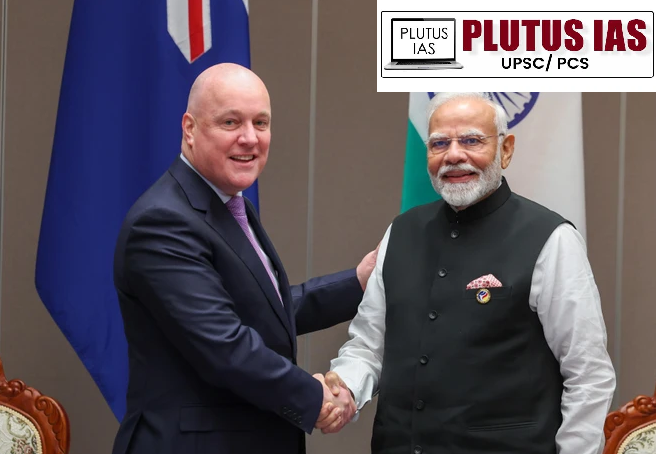
India and New Zealand are in the news after concluding a Free Trade Agreement (FTA) following fast-paced negotiations. The announcement was made at the Prime Ministerial level, signalling strong political backing. The deal is significant as it is one of India’s quickest FTAs with a developed country and forms part of India’s broader strategy of selective, balanced trade agreements after exiting RCEP. The FTA has also attracted attention due to domestic political debate in New Zealand, especially over limited market access for its dairy sector.
Background of India–New Zealand Economic Relations
Complementary Economies: India’s strengths in services, skilled manpower and manufacturing complement New Zealand’s agricultural exports, food processing and natural resource-based sectors.
Limited Trade Volume: Despite long-standing diplomatic ties, bilateral trade has remained relatively low, highlighting under-utilised economic potential.
Earlier Negotiation Attempts: Previous FTA talks stalled mainly due to India’s concerns over dairy imports and farmer livelihoods, which continue to shape negotiations.
Strategic Indo-Pacific Context: Both countries share an interest in a free, open and rules-based Indo-Pacific, making economic cooperation strategically relevant beyond trade.
Diaspora and Education Links: Indian students and professionals form a significant presence in New Zealand, strengthening people-to-people ties and services trade.
Key Features of the India–New Zealand FTA
| Feature | Expanded Explanation (UPSC-Oriented) |
|---|---|
| Tariff Liberalisation | New Zealand has committed to providing zero-duty access to a majority of Indian exports, enhancing India’s competitiveness in the Pacific market. India, in return, has agreed to phased tariff reductions on selected industrial and agricultural products, ensuring a calibrated opening of markets while allowing domestic industries time to adjust. This reflects India’s strategy of asymmetric liberalisation in FTAs. |
| Protection of Sensitive Sectors | India has excluded sensitive sectors, particularly dairy and select agricultural commodities, from tariff concessions. This safeguards the interests of small and marginal farmers, protects rural livelihoods, and prevents market distortions arising from New Zealand’s highly subsidised and efficient dairy sector. The approach aligns with India’s food security and socio-economic priorities. |
| Boost to Labour-Intensive Exports | The FTA is expected to significantly benefit labour-intensive sectors such as textiles, apparel, leather goods, engineering products and marine exports. Improved market access can lead to employment generation, especially for MSMEs, women workers and coastal communities, supporting India’s objectives of inclusive growth and export-led development. |
| Services and Mobility Provisions | Enhanced market access for services, including IT, education, healthcare and professional services, strengthens India’s comparative advantage. Provisions facilitating movement of professionals and skilled workers improve opportunities for Indian talent abroad while deepening people-to-people ties. This complements India’s emphasis on Mode-4 (movement of natural persons) in trade negotiations. |
| Investment Cooperation | The agreement promotes bilateral investment flows, encouraging collaboration in infrastructure, renewable energy, agri-technology and manufacturing. It facilitates technology transfer, skill development and innovation, supporting initiatives like Make in India, Digital India, and supply chain diversification in the Indo-Pacific region. |
Significance for India
Export Diversification: The FTA enables Indian exporters to reduce over-reliance on traditional markets such as the US and EU by accessing New Zealand, a high-income and rules-based economy. According to the Commerce Ministry’s Foreign Trade Policy 2023, diversification into developed markets enhances export resilience against global demand shocks. Sectors like pharmaceuticals, engineering goods and textiles can use New Zealand as a gateway to the wider Pacific region.
Employment Generation: Labour-intensive sectors such as textiles, apparel, leather and marine products are expected to benefit from improved market access. The NITI Aayog and ILO reports on employment highlight that export-oriented growth has a strong employment multiplier in India, especially for semi-skilled workers. Increased exports under the FTA can thus translate into job creation, particularly in MSME-dominated clusters.
Strengthening MSMEs: Simplified tariff schedules, transparent rules of origin and trade facilitation provisions can reduce compliance costs for MSMEs. As noted in the MSME Ministry Annual Report, limited access to foreign markets is a key constraint for small firms. The FTA can help MSMEs integrate into cross-border trade by providing predictable market access and encouraging participation in e-commerce-enabled exports.
Supply Chain Integration: The agreement aligns with India’s strategy to integrate into resilient global value chains, as emphasised in the Economic Survey. New Zealand’s strengths in agri-technology, food processing and logistics can complement India’s manufacturing and services base. Such integration supports India’s “China-plus-one” opportunity by offering trusted supply chain partnerships in the Indo-Pacific.
Strategic Economic Diplomacy: Beyond trade, the FTA enhances India’s image as a predictable and pragmatic economic partner. It complements initiatives like the Indo-Pacific Economic Framework (IPEF) and reinforces India’s Act East and Indo-Pacific strategies. By engaging constructively with a developed economy, India strengthens its negotiating credibility in future FTAs with larger partners such as the EU and UK.
Challenges and Concerns
Agricultural Sensitivities: Agriculture remains a politically sensitive sector in India, as highlighted in the National Commission on Farmers, with fears that import competition could affect small and marginal farmers, food security, and rural livelihoods.
Domestic Political Opposition in New Zealand: In New Zealand, farmer lobbies and domestic political groups have expressed concerns over market access concessions, which could delay ratification or dilute commitments, as seen in past trade negotiations involving agricultural exports.
Asymmetric Gains Debate: Past assessments such as the NITI Aayog review of FTAs indicate that benefits often accrue disproportionately to services and import-intensive sectors, raising concerns that manufacturing and MSMEs may gain unevenly.
Implementation Capacity: The CAG and Economic Survey have noted India’s low FTA utilisation rates, largely due to limited awareness among exporters, complex rules of origin, and inadequate institutional support at the ground level.
Non-Tariff Barriers: Stringent sanitary, phytosanitary and technical standards in developed economies like New Zealand can act as de facto trade barriers, particularly affecting India’s agri-products and MSME exports despite tariff concessions.
Strategic and Geopolitical Implications
| Dimension | Expanded Explanation (One-liners) |
|---|---|
| Indo-Pacific Economic Engagement | The FTA deepens India’s economic footprint in the Indo-Pacific, complementing its Act East Policy and aligning with the region’s emphasis on resilient, rules-based economic order. |
| Alternative to Mega Trade Blocs | By opting for a bilateral FTA instead of joining large blocs like RCEP, India reinforces its strategy of selective integration that safeguards domestic interests while expanding market access. |
| Trust-Based Partnerships | The agreement underscores India’s preference for economically open, politically stable, and like-minded democracies, strengthening long-term strategic trust beyond transactional trade ties. |
| Soft Power Expansion | Improved access in services, education, and professional mobility enhances India’s people-to-people linkages, reinforcing its image as a knowledge-driven and service-oriented economy. |
| Balancing Openness and Protection | The FTA reflects India’s calibrated globalisation model—opening up competitive sectors while protecting sensitive areas like agriculture and dairy to maintain socio-economic stability. |
Conclusion
The India–New Zealand FTA marks a significant step in India’s evolving trade strategy, balancing openness with domestic safeguards. By promoting exports, investment and strategic partnerships while protecting sensitive sectors, the agreement reflects pragmatic economic diplomacy. Its success will ultimately depend on effective implementation, stakeholder awareness and sustained political commitment.
Q. Why has the India–New Zealand Free Trade Agreement gained significance in India’s recent trade diplomacy?

- PRAGATI: A Decade of Cooperative, Outcome-Driven Governance - January 15, 2026
- Iran’s Large-Scale Protests: Political Stability, Public Dissent and Regional Implications - January 14, 2026
- India–Oman CEPA: A Strategic Trade Pact for Jobs, Exports and Regional Integration - January 10, 2026

No Comments