


31 Aug India Rejects Indus Waters Treaty ‘Award’ by Illegally Constituted Court
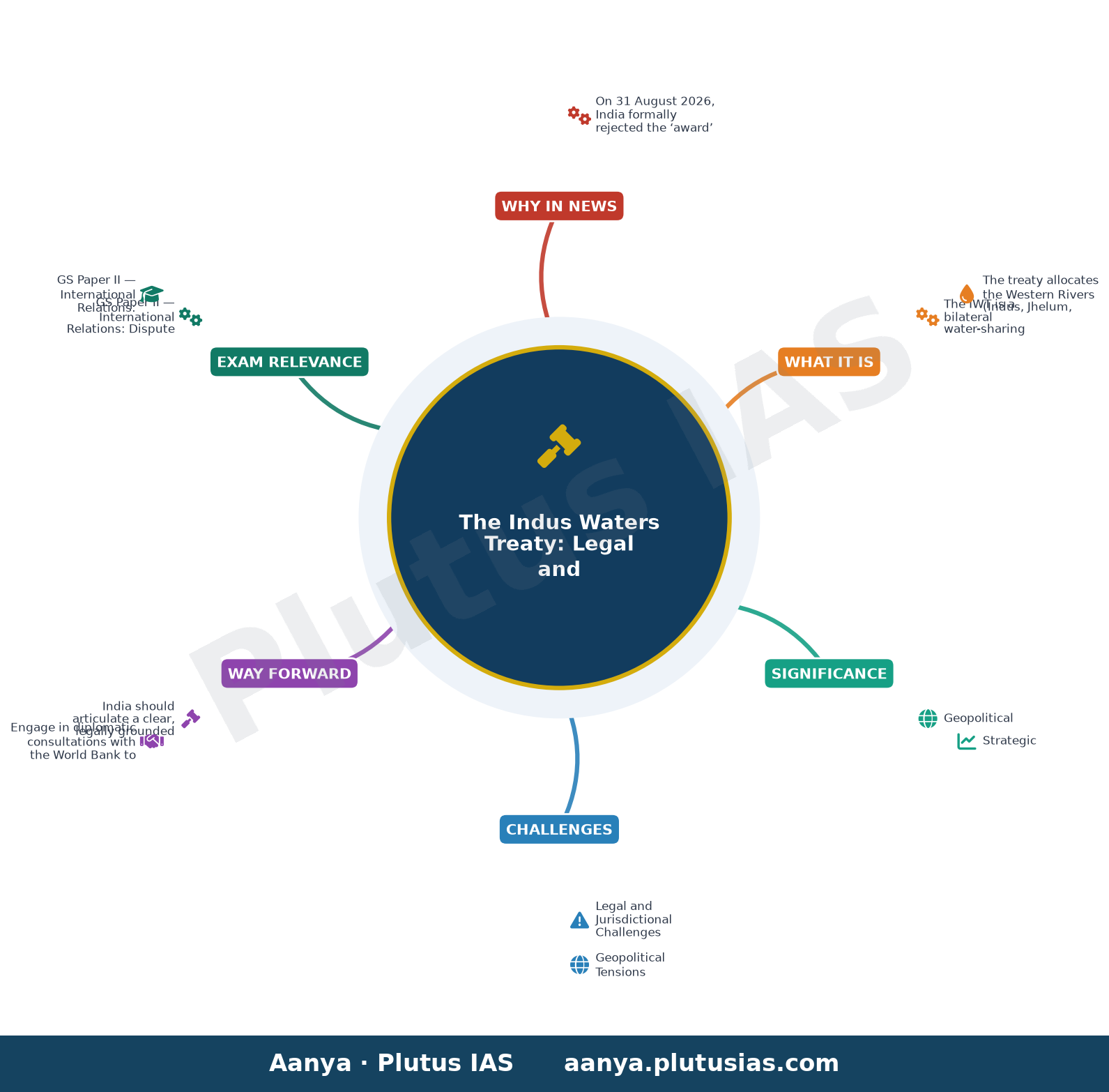
✎ The Indus Waters Treaty (1960) allocates the Western Rivers (Indus, Jhelum, Chenab) to Pakistan and the Eastern Rivers (Ravi, Beas, Sutlej) to India, with dispute resolution mechanisms including Neutral Experts and, if…
Subject Relevance — Where This Topic Fits
- GS Paper II — International Relations: Dispute Resolution Mechanisms and Bilateral Treaties | GS Paper II — International Relations: India-Pakistan Relations
- Prelims: Indus Waters Treaty (IWT), 1960, Permanent Indus Commission, Western Rivers (Indus, Jhelum, Chenab), Eastern Rivers (Ravi, Beas, Sutlej), Court of Arbitration under IWT, Pahalgam terror attack (2025), Suspension of treaty obligations
- Essay: The Role of International Law in Bilateral Dispute Resolution: A Case Study of the Indus Waters Treaty
Quick Revision: The Indus Waters Treaty (1960) allocates the Western Rivers (Indus, Jhelum, Chenab) to Pakistan and the Eastern Rivers (Ravi, Beas, Sutlej) to India, with dispute resolution mechanisms including Neutral Experts and, if unresolved, a Court of Arbitration (CoA) composed of seven members, including appointees by both parties and the World Bank.
Why is this in the news?
On 31 August 2026, India formally rejected the ‘award’ issued by the Court of Arbitration (CoA) concerning interim measures and the ‘status’ of the Indus Waters Treaty (IWT), asserting that the CoA was ‘illegally constituted’ by the World Bank in breach of the treaty’s provisions. The Ministry of External Affairs (MEA) stated that India has never recognised the CoA’s jurisdiction and that its pronouncements hold no legal or operational validity for India’s sovereign decisions regarding hydroelectric projects on the Western Rivers.
Background
- The Indus Waters Treaty (IWT), signed on 19 September 1960 between India and Pakistan, governs the sharing and utilisation of the waters of the Indus River system, including the Western Rivers (Indus, Jhelum, Chenab) and Eastern Rivers (Ravi, Beas, Sutlej).
- The treaty establishes the Permanent Indus Commission (PIC) as a bilateral mechanism for dispute resolution and data exchange, with provisions for neutral expert reviews and, in specific cases, arbitration.
- The treaty allocates exclusive rights to Pakistan over the Western Rivers and to India over the Eastern Rivers, with India permitted limited non-consumptive uses of the Western Rivers for hydroelectric projects under specified design criteria.
- Disputes under the IWT may be referred to a Neutral Expert or, if unresolved, to a Court of Arbitration (CoA) composed of seven members, including one each appointed by India and Pakistan, and five appointed by the World Bank.
- The World Bank’s role in constituting the CoA has been a recurring point of contention, with India arguing that such constitution violates the treaty’s procedural safeguards and Pakistan’s unilateral actions.
What is the Indus Waters Treaty (IWT)?
- The IWT is a bilateral water-sharing agreement between India and Pakistan, mediated by the World Bank, aimed at ensuring equitable utilisation of the Indus River system’s waters.
- The treaty allocates the Western Rivers (Indus, Jhelum, Chenab) to Pakistan and the Eastern Rivers (Ravi, Beas, Sutlej) to India, with India permitted limited non-consumptive uses of the Western Rivers for hydroelectric projects.
- Key provisions include the establishment of the Permanent Indus Commission (PIC) for regular dialogue and data exchange, and dispute resolution mechanisms involving Neutral Experts and, if necessary, a Court of Arbitration (CoA).
- The treaty mandates that hydroelectric projects on the Western Rivers adhere to specific design criteria to minimise impact on downstream flows, with disputes subject to neutral expert reviews or arbitration.
- The IWT is often cited as a successful example of transboundary water cooperation, though its effectiveness has been tested by recurring disputes over project designs and allegations of treaty violations.
- The treaty’s legal framework is rooted in international water law principles, including equitable utilisation, no-harm rule, and the obligation to cooperate in good faith.
Key Features
| Feature | Significance |
|---|---|
| Indus Waters Treaty (IWT) 1960 | A bilateral water-sharing agreement between India and Pakistan, mediated by the World Bank, governing the utilisation of the Indus River system’s waters. |
| Court of Arbitration (CoA) | An arbitral body constituted under the IWT to resolve disputes; India disputes its legality and jurisdiction in this instance. |
| Ratle Hydro-Electric Plant (RHEP) | A hydroelectric project under construction by India on the Chenab River, a Western River under the IWT, central to the dispute. |
| Interim Measures | Temporary directives issued by the CoA regarding the operation and design of hydroelectric projects, pending final resolution. |
| Suspension of IWT | India’s decision to place the treaty in abeyance in response to cross-border terrorism, invoking sovereign rights under international law. |
Why it Matters
Geopolitical
- The dispute underscores the fragility of water-sharing agreements in transboundary river basins, particularly where geopolitical tensions exist.
- The IWT remains a critical instrument of confidence-building between India and Pakistan, despite periodic challenges to its efficacy.
- The case highlights the role of third-party mediation (World Bank) in international water disputes and the limits of its authority when treaty provisions are contested.
Strategic
- Hydroelectric projects on the Indus system are vital for India’s energy security and regional development, particularly in Jammu & Kashmir and Ladakh.
- Control over Western Rivers (Indus, Jhelum, Chenab) is strategically significant for India’s water management and agricultural policies.
- The dispute tests India’s ability to assert sovereign rights while adhering to or contesting international legal frameworks.
Legal
- The dispute raises questions about the jurisdiction and constitutionality of arbitral bodies under bilateral treaties, particularly when one party contests their formation.
- India’s rejection of the CoA’s award invokes principles of sovereign immunity and the supremacy of treaty terms over external arbitration.
- The case may set a precedent for how bilateral water treaties are interpreted and enforced in the context of national security concerns.
Economic
- Hydroelectric projects like RHEP contribute to India’s renewable energy capacity, reducing dependence on fossil fuels and supporting climate goals.
- Disruptions to water-sharing agreements could impact agricultural productivity in riparian states dependent on Indus system waters.
- Legal and diplomatic costs of prolonged disputes may divert resources from developmental priorities.
Challenges
1. Legal and Jurisdictional Challenges
- India’s refusal to recognise the CoA’s jurisdiction challenges the enforceability of international arbitral awards under bilateral treaties.
- The dispute tests the balance between sovereign rights and international legal obligations in water-sharing agreements.
- The World Bank’s role as a mediator is questioned, raising concerns about its impartiality and authority in treaty disputes.
UPSC Link: GS-II: International Relations – Water Disputes
2. Geopolitical Tensions
- The suspension of the IWT in response to cross-border terrorism introduces a new dimension to water diplomacy, complicating bilateral relations.
- The dispute risks undermining decades of confidence-building measures between India and Pakistan.
- Third-party mediation (e.g., by the UN or neutral states) may be required to resolve the impasse, but such interventions are politically sensitive.
UPSC Link: GS-II: International Relations – Bilateral Relations
3. Strategic Water Management
- India’s hydroelectric projects on the Western Rivers must balance developmental needs with treaty obligations, even as the treaty’s status is contested.
- The dispute may delay or alter the design and operation of projects like RHEP, impacting energy security and regional development.
- Climate change-induced water scarcity in the Indus basin exacerbates the need for robust, legally sound water-sharing frameworks.
UPSC Link: GS-III: Environment – Water Resources
4. Diplomatic and Institutional Challenges
- India’s stance risks isolating it diplomatically if perceived as rejecting international legal mechanisms without viable alternatives.
- The World Bank’s credibility as a mediator in water disputes may be undermined, affecting its role in other transboundary river basins.
- The dispute highlights the need for institutional reforms in bilateral water treaties to address evolving security and developmental concerns.
UPSC Link: GS-II: International Organisations – World Bank
5. Domestic Policy and Governance
- The suspension of the IWT requires coordination between central and state governments, particularly in Jammu & Kashmir and Ladakh.
- Legal and policy frameworks governing inter-state water disputes may need alignment with India’s international water diplomacy.
- Public perception and stakeholder engagement in riparian states must be managed to avoid misinformation or political polarisation.
UPSC Link: GS-II: Federalism – Centre-State Relations
Challenges — UPSC Perspective
| Issue | Concern |
|---|---|
| Jurisdiction of CoA | India disputes the legality of the Court of Arbitration, questioning its authority to issue awards under the IWT. |
| Sovereign Rights vs. Treaty Obligations | The dispute tests the balance between India’s sovereign decisions on water projects and its international legal commitments. |
| Cross-Border Terrorism Link | India’s suspension of the IWT in response to terrorism introduces a non-water-related dimension to the dispute. |
| Project Delays (e.g., RHEP) | Legal and diplomatic uncertainties may delay critical hydroelectric projects, impacting energy security. |
| World Bank’s Role | The Bank’s mediation in the dispute raises questions about its impartiality and authority in treaty disputes. |
| Riparian State Coordination | Ensuring alignment between central policies and state-level water management in J&K and Ladakh. |
Way Forward
- India should articulate a clear, legally grounded position on the IWT’s suspension, distinguishing between treaty obligations and national security imperatives.
- Engage in diplomatic consultations with the World Bank to clarify the scope and limits of its role in mediating water disputes under bilateral treaties.
- Accelerate domestic consultations with riparian states (e.g., J&K, Ladakh) to align water management policies with India’s sovereign decisions.
- Explore alternative dispute resolution mechanisms, such as neutral expert reviews or mediation by third-party states, to de-escalate tensions.
- Strengthen institutional capacity for water diplomacy, including legal expertise in international water law and treaty negotiations.
- Monitor and document the environmental and developmental impacts of hydroelectric projects to support India’s position in future negotiations.
- Enhance public awareness campaigns to clarify India’s stance on the IWT, addressing misconceptions and fostering stakeholder support.
- Collaborate with multilateral bodies (e.g., UN Water, World Bank) to advocate for reforms in transboundary water governance frameworks.
UPSC Value Addition
Keywords for Mains Answer-Writing
Indus Waters Treaty (IWT) · Permanent Indus Commission · Court of Arbitration (CoA) · World Bank · Interim measures · Ratle Hydro-Electric Project (RHEP) · Western Rivers · Indus Basin · Permanent Indus Commission · Indus Basin Project · Indus Waters Treaty dispute resolution · International water law · Sovereignty and international obligations · Suspension of treaties · Indus Basin utilisation · Indo-Pakistan water disputes
Constitutional & Policy Linkages
- [‘Article 253 – International Agreements’, ‘Empowers Parliament to make laws for implementing treaties, agreements, or conventions with foreign countries.’]
Concept Flow
Cross-border terrorism → India invokes sovereign rights → Suspension of IWT → World Bank facilitates CoA formation → CoA issues interim measures/awards → India rejects CoA’s jurisdiction → Legal and diplomatic impasse → Need for alternative dispute resolution → Reforms in transboundary water governance.
Prelims Practice Questions
Q1. Consider the following statements regarding the Indus Waters Treaty (IWT) of 1960:
1. The IWT allocates the waters of the Indus River system between India and Pakistan.
2. The Western Rivers (Indus, Jhelum, Chenab) are allocated to Pakistan, while the Eastern Rivers (Ravi, Beas, Sutlej) are allocated to India.
3. The IWT mandates the establishment of a Permanent Indus Commission (PIC) to implement and manage the treaty.
4. The IWT allows India to construct hydroelectric projects on the Western Rivers without any restrictions.
How many of the above statements are correct?
- Only one
- Only two
- Only three
- All four
Answer: Only three — Statements 1, 2, and 3 are correct. Statement 4 is incorrect as the IWT imposes specific design and operational restrictions on hydroelectric projects on the Western Rivers to ensure equitable utilisation.
Q2. Assertion (A): The Court of Arbitration (CoA) constituted under the Indus Waters Treaty (IWT) derives its authority directly from the World Bank.
Reason (R): The IWT empowers the World Bank to appoint arbitrators and constitute a Court of Arbitration in case of disputes between India and Pakistan.
In the context of the above two statements, which one of the following is correct?
- Both A and R are true, and R is the correct explanation of A.
- Both A and R are true, but R is NOT the correct explanation of A.
- A is true, but R is false.
- A is false, but R is true.
Answer: A is false, but R is true. — Assertion (A) is true, but Reason (R) is false. The IWT does not empower the World Bank to appoint arbitrators or constitute a Court of Arbitration; such provisions are governed by the treaty’s dispute resolution mechanism, which does not grant the World Bank unilateral authority.
Mains Practice Question
✍ The recent rejection by India of the ‘award’ issued by the ‘illegally constituted’ Court of Arbitration (CoA) under the Indus Waters Treaty (IWT) raises critical questions about the treaty’s dispute resolution mechanism and India’s sovereign rights. Critically examine the legal and political dimensions of India’s stance on the IWT, with particular reference to the role of the World Bank, the Permanent Indus Commission, and the principles of international water law. Also, analyse the implications of India’s decision to place the IWT in abeyance. (15 Marks)
Approach: MODEL-ANSWER SKELETON:
1. **Introduction (2 marks)**
– Brief background of the IWT (1960), its objectives, and the allocation of rivers (Western Rivers: Indus, Jhelum, Chenab to Pakistan; Eastern Rivers: Ravi, Beas, Sutlej to India).
– Mention the dispute resolution mechanism under the IWT, including the role of the Permanent Indus Commission (PIC) and the provisions for arbitration.
2. **Legal Dimensions (5 marks)**
– **Dispute Resolution Mechanism**: Explain the IWT’s dispute resolution process, including the role of the World Bank (if any) and the conditions under which a Court of Arbitration (CoA) can be constituted.
– **Sovereignty and International Law**: Discuss India’s sovereign rights under international law, including the principle of ‘equitable utilisation’ (Article 5 of the UN Watercourses Convention) and the ‘no-harm’ rule (Article 7).
– **Legitimacy of the CoA**: Analyse India’s argument that the CoA was ‘illegally constituted’—link to treaty provisions, procedural fairness, and the role of the World Bank.
– **Jurisdictional Issues**: Highlight the principle that international tribunals cannot override the sovereign decisions of states unless explicitly authorised by treaty.
3. **Political Dimensions (4 marks)**
– **Geopolitical Context**: Discuss the broader Indo-Pakistan relations and the impact of cross-border terrorism on water diplomacy.
– **Suspension of the IWT**: Explain India’s decision to place the IWT in abeyance, linking it to Pakistan’s alleged support for cross-border terrorism and India’s sovereign right to suspend treaties under international law (Vienna Convention on the Law of Treaties, Article 62).
– **Strategic Implications**: Analyse how this stance may influence future water negotiations and India’s broader foreign policy.
4. **Implications of Placing IWT in Abeyance (4 marks)**
– **Legal Implications**: Discuss the legal status of a suspended treaty—whether it remains in force, the obligations of parties, and the consequences of non-compliance.
– **Practical Implications**: Examine the impact on water-sharing arrangements, hydroelectric projects (e.g., Ratle Hydro-Electric Project), and the functioning of the Permanent Indus Commission.
– **International Precedents**: Cite examples of other countries suspending or renegotiating treaties in response to perceived violations (e.g., China’s suspension of water-sharing agreements with downstream nations).
5. **Conclusion (2 marks)**
– Summarise the key arguments, emphasising the balance between sovereign rights, international obligations, and geopolitical realities.
– Offer a balanced view: While India’s stance is legally defensible, the long-term consequences for water diplomacy and regional stability must be considered.
Source: orissapost.com
Generated by AanyaAi for educational purpose.
Related guides on our sites
- Current affairs for upsc 2026
- Best PSIR optional coaching for upsc
- Best PSIR optional teacher for upsc
- Best teacher of PSIR optional for upsc

- भारत ने बताया UN रिपोर्ट में दाऊद इब्राहिम को ‘भारत-आधारित’ बताना ‘गलत’ - October 22, 2026
- GRAP Stage I activated in Delhi-NCR amid rising AQI: Key actions for aspirants - October 22, 2026
- सीएक्यूएम ने दिल्ली में धूल प्रदूषण नियंत्रण के लिए उठाए कदम, एमसीडी को मिले निर्देश - October 22, 2026

No Comments