


06 Aug India Rejects US Ethanol Import Concessions in Trade Talks: Key Implications for UPSC
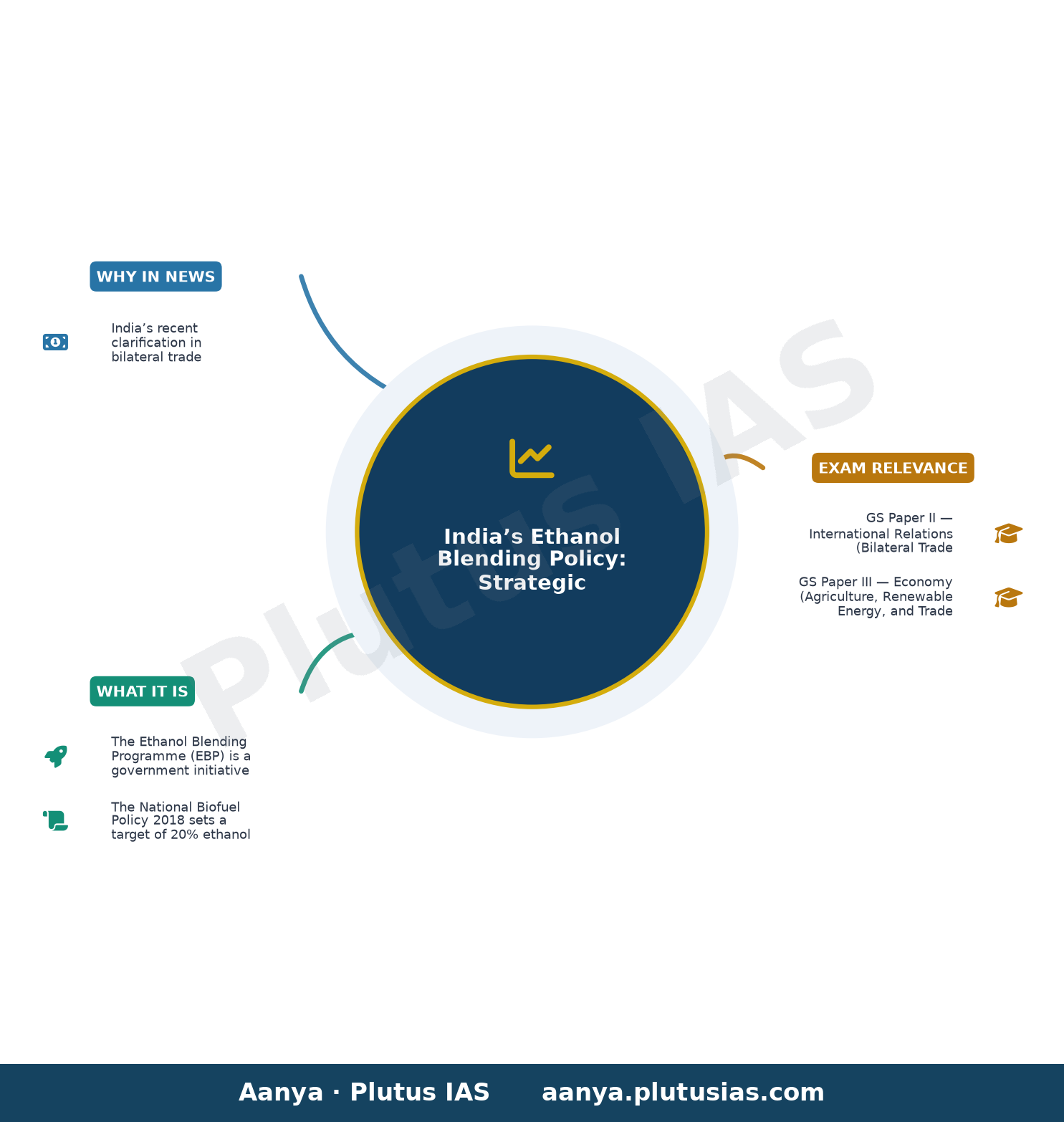
✎ India’s ethanol blending policy prioritises domestic production (E20 mandate by 2025-26) and strategic autonomy, rejecting U.S. import concessions in trade talks to protect local biofuel industries and energy security.
Subject Relevance — Where This Topic Fits
- GS Paper II — International Relations (Bilateral Trade Agreements) | GS Paper III — Economy (Agriculture, Renewable Energy, and Trade Policies)
- Prelims: Ethanol Blending Programme (EBP), National Biofuel Policy 2018, Blending Mandate (20% by 2025-26), U.S.-India Trade Agreement, Non-Tariff Barriers, Ethanol Import Policy
- Essay: India’s Strategic Autonomy in Energy Policy: Balancing Domestic Priorities and Global Trade Commitments, The Role of Renewable Energy in India’s Economic Diplomacy
Quick Revision: India’s ethanol blending policy prioritises domestic production (E20 mandate by 2025-26) and strategic autonomy, rejecting U.S. import concessions in trade talks to protect local biofuel industries and energy security.
Why is this in the news?
India’s recent clarification in bilateral trade negotiations with the United States regarding its ethanol blending policy underscores the country’s commitment to domestic biofuel production and strategic autonomy in energy governance. The statement, issued by the Commerce Ministry on August 6, 2026, explicitly ruled out any concessions for ethanol imports from the U.S., asserting that existing regulations—mandating a 20% ethanol-gasoline blend by 2025-26—prioritise domestically sourced ethanol. This stance is significant as it intersects with ongoing U.S.-India trade talks aimed at deepening economic ties, where ethanol market access has emerged as a contentious issue.
Background
- The Government of India launched the Ethanol Blending Programme (EBP) in 2003 to promote the use of biofuels, reduce import dependence on fossil fuels, and support sugarcane farmers.
- The National Biofuel Policy 2018 categorised biofuels into ‘Basic Biofuels’ (e.g., first-generation ethanol) and ‘Advanced Biofuels’ (e.g., second-generation ethanol from agricultural residues), with a target of 20% ethanol blending in gasoline by 2025-26.
- India’s ethanol production is primarily derived from sugarcane molasses, with maize and other feedstocks gaining traction under the Ethanol Blending Programme to meet the 20% mandate.
- The U.S. is the world’s largest ethanol producer and exporter, with a significant surplus capacity, making ethanol a key export interest in U.S.-India trade negotiations.
- Bilateral trade discussions between India and the U.S. have focused on reducing non-tariff barriers, including import duties and regulatory hurdles, to expand market access for U.S. ethanol.
- India’s refusal to grant concessions on ethanol imports aligns with its broader policy of self-reliance in energy, as articulated in the ‘Atmanirbhar Bharat’ initiative.
What is India’s Ethanol Blending Policy?
- The Ethanol Blending Programme (EBP) is a government initiative mandating the blending of ethanol with gasoline to reduce fossil fuel consumption and carbon emissions.
- The National Biofuel Policy 2018 sets a target of 20% ethanol blending in gasoline (E20) by 2025-26, with an interim target of 10% by 2022 (achieved ahead of schedule).
- Ethanol for blending is primarily sourced from sugarcane molasses, with maize, rice, and agricultural residues emerging as alternative feedstocks to meet the mandate.
- The policy incentivises ethanol production through financial assistance, priority sector lending, and tax exemptions, while regulating imports to protect domestic producers.
- India’s ethanol production capacity has expanded significantly, from 2.7 billion litres in 2014 to over 10 billion litres in 2024, driven by policy support and private investment.
- The blending mandate is complemented by the Ethanol Supply Year (ESY) framework, which aligns ethanol procurement with the sugar crushing season to ensure supply stability.
- The policy also aims to reduce air pollution by lowering vehicular emissions and supporting the agricultural sector through additional income for farmers.
- India’s stance on ethanol imports reflects its broader commitment to energy security and the promotion of indigenous industries under the ‘Make in India’ and ‘Atmanirbhar Bharat’ programmes.
UPSC Value Addition
Keywords for Mains Answer-Writing
Ethanol Blending Programme (EBP) · National Biofuel Policy 2018 · 20% Ethanol Blending Mandate · India-US Trade Agreement Negotiations · Import Policy for Ethanol · Sustainable Alternative Towards Affordable Transportation (SATAT) · Biofuels in India · Trade Barriers and Market Access · Renewable Energy Policy · Bilateral Trade Negotiations · Energy Security in India · WTO and Domestic Regulations
Prelims Practice Questions
Q1. Consider the following statements regarding the Ethanol Blending Programme (EBP) in India:
1. The Government of India mandates a 20% ethanol blending with gasoline.
2. The EBP allows the use of locally produced ethanol only for blending with gasoline.
3. The import of ethanol is permitted under the EBP to meet domestic demand.
How many of the above statements are correct?
- Only one
- Only two
- All
- None
Answer: All — Statements 1 and 2 are correct as the Government mandates 20% ethanol blending and restricts the use to locally produced ethanol. Statement 3 is incorrect as the import of ethanol is not permitted under the EBP.
Q2. Assertion (A): India has ruled out any concessions for ethanol imports from the U.S. in bilateral trade talks.
Reason (R): India mandates the use of locally produced ethanol for blending with gasoline under its biofuel policy.
Choose the correct option:
A. Both A and R are true, and R is the correct explanation of A.
B. Both A and R are true, but R is not the correct explanation of A.
C. A is true, but R is false.
D. A is false, but R is true.
- A
- B
- C
- D
Answer: B — Both the assertion and reason are true. The reason correctly explains the assertion, as India’s policy of mandating locally produced ethanol for blending justifies its refusal to offer import concessions.
Q3. Which of the following is NOT a provision of India’s National Biofuel Policy 2018?
A. Mandating 20% ethanol blending in gasoline by 2025.
B. Allowing the use of imported ethanol for blending.
C. Promoting the use of biofuels to reduce import dependence on fossil fuels.
D. Encouraging the production of second-generation biofuels.
- A
- B
- C
- D
Answer: B — The National Biofuel Policy 2018 mandates 20% ethanol blending by 2030, not 2025. Hence, option A is incorrect.
Mains Practice Question
✍ Critically examine India’s stance on ethanol import concessions in the context of its Ethanol Blending Programme (EBP) and bilateral trade negotiations with the U.S. Also, analyse the implications of this stance for India’s energy security and trade policy. (15 Marks)
Approach: MODEL-ANSWER SKELETON:
1. **Context**: Briefly outline the Ethanol Blending Programme (EBP) and its objectives under the National Biofuel Policy 2018, including the 20% ethanol blending mandate and its timeline.
2. **India’s Stance**: Explain India’s refusal to offer ethanol import concessions to the U.S., citing the government’s statement and the policy of using locally produced ethanol for blending.
3. **Legal and Policy Framework**: Discuss the relevant provisions of the National Biofuel Policy 2018, the SATAT scheme, and any WTO-compliant measures that justify India’s position.
4. **Energy Security**: Analyse how India’s stance aligns with its goal of reducing import dependence on fossil fuels and promoting indigenous biofuel production.
5. **Trade Policy Implications**: Examine the broader implications for India-US trade negotiations, including market access, trade barriers, and the potential impact on other sectors.
6. **Critique and Balance of Views**: Present arguments for and against India’s stance, including perspectives from domestic ethanol producers, environmentalists, and trade negotiators.
7. **Conclusion**: Provide a reasoned conclusion on the efficacy of India’s stance in balancing energy security, trade policy, and environmental goals.
Source: Mint
Generated by AanyaAi for educational purpose.

- गृह मंत्री ने मध्य प्रदेश में गौपालक सम्मेलन का किया उद्घाटन, नए अपराध कानूनों पर प्रदर्शनी का किया शुभारंभ - October 3, 2026
- Jal Arpan: 1850+ Gram Panchayats Join Hands for Rural Water Supply - October 3, 2026
- भारत ने किया 5.56 किमी मुक्त अंतरिक्ष क्वांटम की वितरण लिंक का सफल परीक्षण - October 3, 2026

No Comments