


23 Oct India-Samoa-Naoero Relations: Key Takeaways for UPSC & State PCS
✎ India’s engagement with Pacific Island Countries is anchored in the Forum for India-Pacific Islands Cooperation (FIPIC), the Indo-Pacific Oceans Initiative (IPOI), and development partnerships focused on climate resilience…
Subject Relevance — Where This Topic Fits
- GS Paper II — International Relations — India’s Foreign Policy and Engagement with Pacific Island Countries | GS Paper II — International Relations — Maritime Security and Strategic Partnerships in the Indo-Pacific
- Prelims: Pacific Island Forum (PIF), Blue Economy, Maritime Security, Samoa Agreement, India-Pacific Islands Sustainable Development Conference (IPISDC), Indian Technical and Economic Cooperation (ITEC), Blue Dot Network
- Essay: India’s Role in Strengthening South-South Cooperation in the Indo-Pacific, The Strategic Imperative of Maritime Security and Sustainable Development in the Pacific Islands
Quick Revision: India’s engagement with Pacific Island Countries is anchored in the Forum for India-Pacific Islands Cooperation (FIPIC), the Indo-Pacific Oceans Initiative (IPOI), and development partnerships focused on climate resilience, maritime security, and sustainable economic growth.
Why is this in the news?
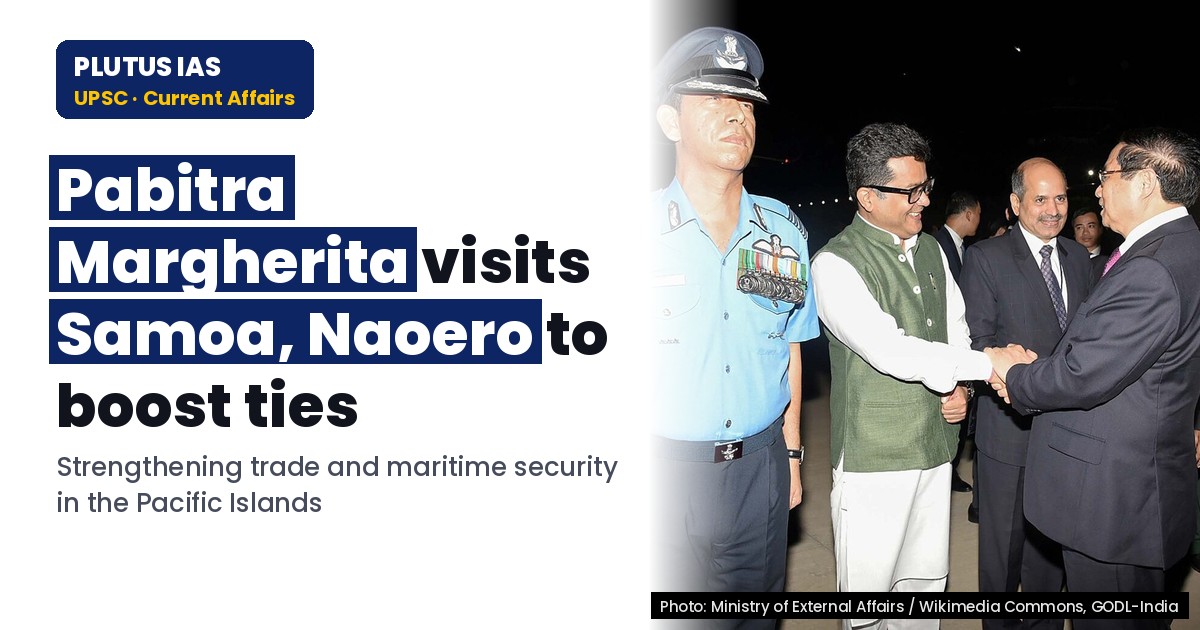
The visit of the Minister of State for External Affairs and Textiles to Samoa and Nauru (16–22 October 2026) underscores India’s sustained diplomatic engagement with Pacific Island Countries (PICs). This visit, aligned with India’s Act East Policy and Indo-Pacific Oceans Initiative (IPOI), aims to deepen bilateral ties, explore economic cooperation, and reinforce India’s commitment to sustainable development and maritime security in the region. The visit is particularly significant in the context of India’s evolving role as a development partner for PICs, amid growing geopolitical interest in the Pacific.
Background
- The Pacific Island Countries (PICs) comprise 14 sovereign nations and several territories, collectively representing a strategic maritime region in the Indo-Pacific.
- India’s engagement with PICs has intensified since the early 2000s, marked by high-level visits, capacity-building initiatives, and development partnerships under frameworks such as the Forum for India-Pacific Islands Cooperation (FIPIC) established in 2014.
- India’s Indo-Pacific Oceans Initiative (IPOI), launched in 2019, prioritizes seven pillars including maritime security, capacity-building, and sustainable development, aligning with the developmental priorities of PICs.
- Climate change and rising sea levels pose existential threats to PICs, necessitating international cooperation for adaptation, mitigation, and resilience-building, areas where India has extended support through grants and technical assistance.
- India’s textile sector, represented by the Minister of State for Textiles, highlights the economic dimension of the visit, with potential collaboration in trade, investment, and capacity-building in the textile industry.
Key Dimensions of India’s Engagement with Pacific Island Countries
- India’s engagement with Pacific Island Countries (PICs) is structured around the Forum for India-Pacific Islands Cooperation (FIPIC), a multilateral platform established in 2014 to foster dialogue and cooperation on developmental, strategic, and environmental issues.
- The Indo-Pacific Oceans Initiative (IPOI), launched by India in 2019, serves as a framework for collaborative action in the region, with pillars such as maritime security, sustainable use of marine resources, and capacity-building for coastal states.
- India’s development partnership with PICs includes grants for climate adaptation projects, scholarships under the Indian Technical and Economic Cooperation (ITEC) program, and support for capacity-building in governance, healthcare, and education.
- Economic cooperation between India and PICs encompasses trade, investment, and technology transfer, with a focus on sectors such as renewable energy, fisheries, and tourism. The visit of the Minister of State for Textiles signals potential collaboration in the textile industry, including skill development and market access.
- Maritime security is a critical area of engagement, with India offering training, equipment, and joint exercises to enhance the capabilities of PICs in maritime domain awareness, search and rescue, and counter-piracy operations.
- Climate change and sustainable development are central to India’s engagement, with initiatives such as the Coalition for Disaster Resilient Infrastructure (CDRI) and the International Solar Alliance (ISA) providing platforms for collaboration with PICs.
- People-to-people ties are strengthened through cultural exchanges, scholarships, and the participation of PICs in India’s global initiatives such as the International Day of Yoga and the celebration of World Heritage Sites.
- India’s engagement with PICs is guided by the principles of mutual respect, sovereignty, and non-interference, ensuring that partnerships are demand-driven and aligned with the developmental priorities of the region.
Key Features
| Feature | Significance |
|---|---|
| Bilateral Engagement with Samoa and Naoero | Demonstrates India’s commitment to strengthening diplomatic and economic ties with Pacific Island nations, enhancing strategic presence in the region. |
| Ministerial-Level Visit | Signals high-level political engagement, facilitating direct dialogue on trade, development cooperation, and regional security concerns. |
| Focus on Textiles Sector | Aligns with India’s ‘Make in India’ and ‘Vocal for Local’ initiatives, exploring export opportunities and textile industry collaboration. |
| Cultural and Developmental Outreach | Reinforces India’s soft power through cultural exchanges, capacity-building programmes, and developmental assistance. |
| Regional Connectivity Initiatives | Explores maritime and air connectivity options to enhance trade and people-to-people ties in the Pacific region. |
Why it Matters
Diplomatic and Strategic
- Reinforces India’s Act East Policy by deepening engagement with Pacific Island nations, countering China’s growing influence in the region.
- Facilitates high-level dialogue on maritime security, climate change, and sustainable development, aligning with India’s Indo-Pacific vision.
- Strengthens India’s role in regional forums such as the Pacific Islands Forum (PIF), where India holds observer status.
Economic
- Explores trade and investment opportunities in textiles, fisheries, and renewable energy sectors, leveraging India’s competitive advantages.
- Promotes India’s textile exports to Pacific Island nations, diversifying trade partners amid global market uncertainties.
- Identifies potential for joint ventures in agro-processing, pharmaceuticals, and digital infrastructure.
Developmental Cooperation
- Highlights India’s commitment to South-South cooperation through grants, lines of credit, and capacity-building programmes.
- Explores collaboration in climate-resilient agriculture, renewable energy, and disaster management, aligning with Pacific Island nations’ priorities.
- Strengthens India’s role as a development partner in the Pacific, complementing existing partnerships with Australia, New Zealand, and Japan.
Soft Power and Cultural Diplomacy
- Showcases India’s cultural heritage through yoga, Ayurveda, and traditional crafts, fostering people-to-people ties.
- Promotes educational exchanges and scholarships for Pacific Island students under the Indian Technical and Economic Cooperation (ITEC) programme.
- Highlights India’s role in preserving maritime heritage and promoting sustainable tourism in the region.
Challenges
1. Geographical Distance and Logistical Constraints
- Limited direct air and maritime connectivity increases travel costs and logistical challenges for trade and diplomatic engagement.
- Dependence on third-country transit hubs (e.g., Australia, New Zealand) for logistics and supply chains.
UPSC Link: Geography of Pacific Islands
2. Climate Change Vulnerabilities
- Pacific Island nations are highly vulnerable to rising sea levels, cyclones, and ocean acidification, requiring climate-resilient development strategies.
- India’s engagement must align with the priorities of these nations, such as accessing climate finance and technology transfer.
UPSC Link: Climate Change and International Relations
3. Competition with Major Powers
- China’s increasing economic and military presence in the Pacific poses a challenge to India’s strategic influence.
- Balancing engagement with traditional partners (Australia, New Zealand) while expanding ties with smaller Pacific Island nations.
UPSC Link: Indo-Pacific Geopolitics
4. Limited Trade and Investment Flows
- Low trade volumes between India and Pacific Island nations due to geographical barriers and lack of awareness about market opportunities.
- Need for targeted trade promotion and investment facilitation to overcome market entry barriers.
UPSC Link: India’s Foreign Trade Policy
5. Institutional and Bureaucratic Hurdles
- Complexity in coordinating multi-stakeholder engagements across ministries, agencies, and international organisations.
- Ensuring timely implementation of developmental projects and follow-up on commitments.
UPSC Link: Public Administration
Challenges — UPSC Perspective
| Issue | Concern |
|---|---|
| Geographical Distance | High transportation costs and logistical inefficiencies limit trade and diplomatic engagement. |
| Climate Vulnerabilities | Pacific Island nations face existential threats from climate change, requiring urgent adaptation and mitigation support. |
| Geopolitical Competition | China’s strategic investments in the Pacific challenge India’s efforts to expand influence in the region. |
| Trade Imbalances | Limited export-import data and lack of trade agreements hinder economic cooperation. |
| Institutional Coordination | Fragmented governance structures across ministries and agencies delay project implementation. |
| Awareness Gaps | Limited knowledge among Indian businesses about market opportunities in Pacific Island nations. |
Way Forward
- Conduct a feasibility study to identify high-potential sectors for trade and investment in Samoa and Naoero, focusing on textiles, fisheries, and renewable energy.
- Explore the establishment of direct air and maritime connectivity routes to reduce logistical costs and enhance trade.
- Strengthen climate resilience programmes by collaborating with Pacific Island nations on adaptation strategies and accessing international climate finance.
- Expand the Indian Technical and Economic Cooperation (ITEC) programme to include more scholarships and training for Pacific Island professionals.
- Develop a dedicated Pacific Islands outreach strategy under the Act East Policy to streamline diplomatic and economic engagement.
- Facilitate business delegations from Pacific Island nations to India to explore joint ventures and investment opportunities.
- Enhance India’s participation in regional forums such as the Pacific Islands Forum (PIF) to amplify its voice on climate change and maritime security.
- Promote cultural diplomacy through exchange programmes in yoga, Ayurveda, and traditional crafts to deepen people-to-people ties.
UPSC Value Addition
Keywords for Mains Answer-Writing
Pacific Islands Forum (PIF) · India-Pacific Islands relations · Blue Economy · Climate Change and Small Island Developing States (SIDS) · Development Partnership Administration (DPA) · Line of Credit (LoC) for Pacific Island nations · India’s Act East Policy · Maritime security cooperation · South-South Cooperation · Samoa and Nauru · Textiles and Apparel Export Promotion Council (TEXPROCIL) · India’s Textiles Mission 2030
Concept Flow
Ministerial visit initiates diplomatic engagement → Bilateral discussions on trade, development, and security → Identification of key sectors for cooperation (textiles, climate resilience) → Exploration of trade and investment opportunities → Addressing logistical and geopolitical challenges → Implementation of developmental projects → Strengthening regional partnerships → Long-term strategic alignment with India’s Indo-Pacific vision
Prelims Practice Questions
Q1. Consider the following statements regarding the Pacific Islands Forum (PIF):
1. The PIF is a regional intergovernmental organization established to enhance cooperation among Pacific Island countries.
2. India is not a member of the PIF but has observer status.
3. The PIF focuses exclusively on economic development and does not address climate change issues.
4. The 2050 Strategy for the Blue Pacific Continent is a key initiative of the PIF.
How many of the above statements are correct?
- Only one
- Only two
- Only three
- All
Answer: Only three — Statements 1 and 4 are correct. The PIF is indeed a regional intergovernmental organization and the 2050 Strategy for the Blue Pacific Continent is a key initiative. Statement 2 is incorrect as India holds observer status in the PIF. Statement 3 is incorrect as the PIF addresses climate change and environmental sustainability alongside economic development.
Q2. Assertion (A): The Act East Policy of India aims to promote economic cooperation and connectivity with the Asia-Pacific region.
Reason (R): The policy includes a focus on maritime security and cultural exchanges as part of its broader strategic framework.
Options:
A. Both A and R are true, and R is the correct explanation of A.
B. Both A and R are true, but R is not the correct explanation of A.
C. A is true, but R is false.
D. A is false, but R is true.
- A
- B
- C
- D
Answer: B — Both the assertion and reason are true. The Act East Policy indeed aims to promote economic cooperation and connectivity with the Asia-Pacific region, and it includes maritime security and cultural exchanges as part of its strategic framework. The reason correctly explains the assertion.
Q3. Match the following Pacific Island nations with their respective geographical locations:
Column I (Nation) | Column II (Location)
— | —
A. Samoa | 1. Melanesia
B. Nauru | 2. Polynesia
C. Fiji | 3. Micronesia
Options:
A. A-2, B-3, C-1
B. A-1, B-2, C-3
C. A-3, B-1, C-2
D. A-2, B-1, C-3
- A
- B
- C
- D
Answer: A — Samoa is located in Polynesia, Nauru in Micronesia, and Fiji in Melanesia. The correct match is A-2, B-3, C-1.
Mains Practice Question
✍ The visit of the Minister of State for External Affairs and Textiles to Samoa and Nauru underscores India’s commitment to strengthening ties with Small Island Developing States (SIDS) in the Pacific. Critically analyse the significance of India’s engagement with SIDS in the context of its Act East Policy and the broader framework of South-South Cooperation. (15 Marks)
Approach: [‘Define Small Island Developing States (SIDS) and their unique vulnerabilities (climate change, economic constraints, geographical isolation).’, “Briefly outline India’s Act East Policy and its objectives, including economic, strategic, and cultural dimensions.”] [{‘dimension’: ‘Strategic Significance of SIDS for India’, ‘content’: [“Geopolitical importance of the Pacific region for India’s maritime security and strategic interests.”, “India’s observer status in the Pacific Islands Forum (PIF) and its role in regional forums.”, “Countering China’s influence in the Pacific through soft power and development partnerships.”]}, {‘dimension’: ‘Economic and Development Cooperation’, ‘content’: [“India’s Line of Credit (LoC) and grant assistance to Pacific Island nations for infrastructure, healthcare, and education.”, ‘Promotion of the Blue Economy and sustainable development in SIDS.’, “Role of the Development Partnership Administration (DPA) in facilitating India’s engagement with SIDS.”]}, {‘dimension’: ‘Cultural and People-to-People Ties’, ‘content’: [‘Historical and cultural linkages between India and Pacific Island nations, including diaspora communities.’, ‘Promotion of yoga, Ayurveda, and traditional knowledge systems as part of cultural diplomacy.’]}, {‘dimension’: ‘Challenges and Critiques’, ‘content’: [‘Limited economic leverage of SIDS in bilateral negotiations with major powers.’, ‘Climate change as a shared vulnerability and the need for collective action.’, ‘Balancing strategic interests with development goals in the Pacific region.’]}] [“Summarize the importance of India’s engagement with SIDS for its global standing and regional influence.”, ‘Emphasize the need for sustained and outcome-oriented partnerships to address the unique challenges faced by SIDS.’]
Source: Ministry of External Affairs
Generated by AanyaAi for educational purpose.
Related guides on our sites
- Current affairs for upsc 2026
- Best PSIR optional coaching for upsc
- Best PSIR optional teacher for upsc
- Best teacher of PSIR optional for upsc

- India-Samoa-Naoero Relations: Key Takeaways for UPSC & State PCS - October 23, 2026
- ग्राम पंचायत ने शुरू किया बाघ-हाथी जैसे वन्य जीवों से फसलों की सुरक्षा का अभियान, जानिए कैसे मिलेगा लाभ - October 23, 2026
- Swachhata Abhiyaan 6.0: ARI’s Waste Management & Sustainable Gardening Model - October 23, 2026

No Comments