


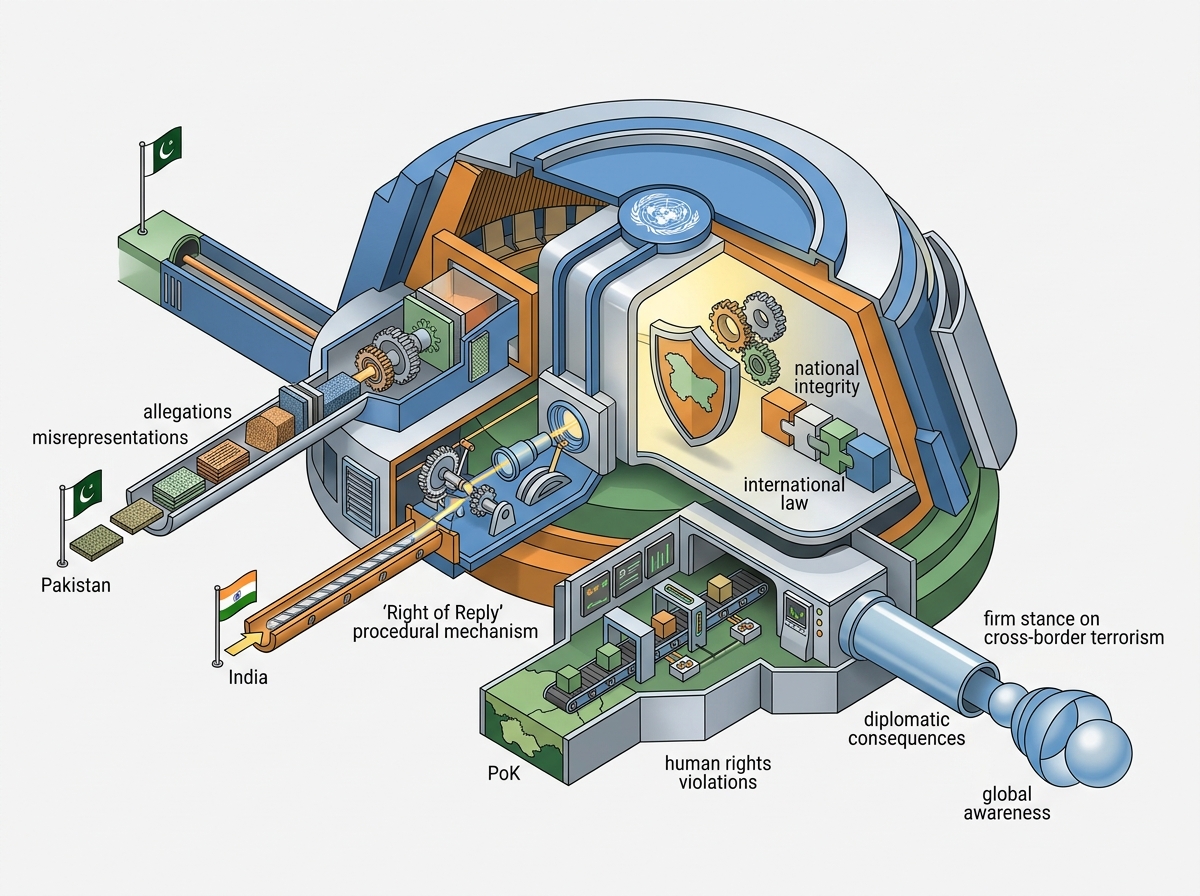
26 Sep India Slams Pakistan at UN: Exposes Terrorism & Hypocrisy in UNGA Speech
✎ The Right of Reply in the UNGA is a procedural mechanism to rebut false or misleading statements made by other states, ensuring diplomatic fairness and transparency in international discourse.
Subject Relevance — Where This Topic Fits
- GS Paper II — International Relations — India’s Foreign Policy, Counter-Terrorism, and UN Diplomacy | GS Paper III — Security — Cross-Border Terrorism, Internal Security, and Constitutional Provisions
- Prelims: Right of Reply (UN), 27th Amendment of Pakistan, Field Marshal immunity, PoK protests, Osama bin Laden’s hideout, UNGA, Counter-Terrorism, Jammu and Kashmir (Union Territory), Pakistan-occupied Kashmir (PoK)
- Essay: The Role of Diplomacy in Countering State-Sponsored Terrorism, Balancing National Security and Human Rights in Conflict Zones
Quick Revision: The Right of Reply in the UNGA is a procedural mechanism to rebut false or misleading statements made by other states, ensuring diplomatic fairness and transparency in international discourse.
Why is this in the news?
India’s exercise of the Right of Reply at the United Nations General Assembly (UNGA) on 26 September 2026, following Pakistan’s Prime Minister’s address, underscores the persistent challenge of cross-border terrorism emanating from Pakistan and the diplomatic recourse available to India under international law. The episode highlights the intersection of constitutional amendments in Pakistan granting military immunity, the historical context of terrorism linked to Pakistan’s territory, and India’s firm stance on the integrity of its Union Territory of Jammu and Kashmir while drawing attention to human rights violations in Pakistan-occupied Kashmir (PoK).
Background
- The Right of Reply is a procedural mechanism in the UNGA allowing member states to respond to allegations or misrepresentations made by other states during debates, ensuring procedural fairness and transparency in international discourse.
- The 27th Amendment to Pakistan’s Constitution, enacted in November 2025, grants lifelong immunity to the Chief of Defence Forces and Chief of Army Staff from legal prosecution, reflecting the military’s dominant role in Pakistan’s political and legal framework.
- The 2025 conflict between India and Pakistan, referenced in Pakistan’s UNGA address, remains a critical point of contention, with both nations attributing escalation to cross-border terrorism and military provocations.
- The 25th anniversary of the 9/11 terrorist attacks (11 September 2001) serves as a poignant backdrop, given the historical links between Osama bin Laden’s hideout in Abbottabad, Pakistan, and the global counter-terrorism discourse.
- India’s consistent position at the UN has been to highlight Pakistan’s role in fostering terrorism, citing evidence such as the 2025 conflict as direct consequences of state-sponsored terrorism.
What is the Right of Reply in the UNGA?
- It is invoked when a state feels its sovereignty, territorial integrity, or national interests have been impugned, allowing for a rebuttal without disrupting the flow of the debate.
- The procedure is non-adversarial and does not involve voting; it is purely a diplomatic tool to correct factual inaccuracies or misleading statements.
- The UNGA Secretariat plays a neutral role in facilitating the Right of Reply, ensuring that responses are delivered in a structured and time-bound manner to maintain decorum.
Key Features
| Feature | Significance |
|---|---|
| Right of Reply at UNGA | A procedural mechanism under UN rules allowing member states to respond to allegations or statements made by other states, ensuring diplomatic parity and preventing misrepresentation. |
| 27th Constitutional Amendment of Pakistan (2025) | Granted lifelong immunity to Pakistan’s Chief of Defence Forces and Chief of the Army Staff, underscoring the military’s institutionalised dominance in governance. |
| Terrorism and State Sponsorship | The systemic use of non-state actors by states to achieve geopolitical objectives, often violating international law and UN Charter principles. |
| Kashmir Issue in International Diplomacy | A long-standing territorial dispute between India and Pakistan, frequently invoked in multilateral forums, with implications for regional stability and bilateral relations. |
| UN General Assembly Platform | A global forum for diplomatic discourse where member states articulate national positions, address grievances, and seek consensus on international issues. |
Why it Matters
Diplomatic and Strategic
- The Right of Reply exercise at the UNGA underscores India’s assertive diplomacy in countering Pakistan’s narrative, particularly on terrorism and Kashmir.
- The exchange highlights the persistent challenge of state-sponsored terrorism and its intersection with Pakistan’s domestic political structures, including military dominance.
- India’s response at the UNGA reinforces its stance on the integral nature of Jammu and Kashmir to its territorial sovereignty, while also drawing attention to human rights violations in PoK.
- The diplomatic spat reflects broader geopolitical tensions in South Asia, where terrorism, regional security, and territorial disputes remain interlinked.
Legal and Constitutional
- The 27th Amendment in Pakistan exemplifies the legal institutionalisation of military authority, raising questions about civilian control and democratic governance in the country.
- The granting of lifelong immunity to the military leadership in Pakistan contravenes principles of accountability and the rule of law, as enshrined in democratic constitutions.
Historical and Geopolitical
- The reference to the 25th anniversary of 9/11 and Osama bin Laden’s presence in Pakistan underscores the historical link between state sponsorship of terrorism and global security threats.
- The 2025 conflict between India and Pakistan, as mentioned in the exchange, reflects the recurring volatility in bilateral relations, driven by cross-border terrorism and territorial disputes.
Challenges
1. State-Sponsored Terrorism
- The persistent use of non-state actors by states to achieve geopolitical objectives violates international law and UN Charter principles.
- State sponsorship of terrorism undermines regional stability, as seen in South Asia, where cross-border attacks have led to escalations and diplomatic crises.
- The challenge lies in holding states accountable for their involvement in terrorism, given the lack of robust enforcement mechanisms under international law.
- The issue is compounded by the lack of consensus among major powers on defining and addressing state sponsorship of terrorism.
UPSC Link: GS II: Security challenges and their management in border areas
2. Military Dominance in Governance
- The institutionalisation of military authority in Pakistan, as evidenced by the 27th Amendment, raises concerns about civilian control and democratic governance.
- The granting of lifelong immunity to military leaders undermines the principles of accountability and the rule of law, eroding public trust in institutions.
- The challenge is to ensure that military institutions operate within constitutional frameworks and respect democratic norms and processes.
UPSC Link: GS II: Structure, organization and functioning of the Executive
3. Territorial Disputes and Regional Stability
- The Kashmir issue remains a flashpoint in India-Pakistan relations, with implications for regional peace and security.
- The persistence of territorial disputes, particularly in PoK, fuels grievances and human rights violations, exacerbating regional instability.
- The challenge is to find a sustainable solution that addresses the aspirations of all stakeholders while upholding territorial integrity and international law.
UPSC Link: GS II: Bilateral, regional and global groupings and agreements involving India
4. Diplomatic Narrative Management
- The exchange at the UNGA highlights the importance of managing diplomatic narratives to counter misinformation and falsehoods propagated by states.
- The challenge lies in ensuring that India’s positions on terrorism and territorial integrity are accurately represented and understood in international forums.
- The use of platforms like the UNGA to counter false narratives requires strategic diplomacy and a deep understanding of international law and norms.
UPSC Link: GS II: Effect of policies and politics of developed and developing countries on India’s interests
5. Human Rights Violations in PoK
- Reports of wanton killings, brutal violence, and denial of basic rights in PoK underscore the humanitarian crisis in the region.
- The challenge is to address these violations while navigating the complexities of territorial disputes and bilateral relations.
- International attention and pressure may be required to ensure accountability and justice for the victims of human rights abuses in PoK.
UPSC Link: GS II: Issues relating to development and management of Social Sector/Services relating to Health, Education, Human Resources
Challenges — UPSC Perspective
| Issue | Concern |
|---|---|
| State Sponsorship of Terrorism | Violation of international law and UN Charter principles, undermining regional stability. |
| Military Dominance in Governance | Institutionalised military authority erodes civilian control and democratic norms. |
| Kashmir Dispute | Persistent territorial dispute fuels regional tensions and human rights violations. |
| Diplomatic Narrative Management | Countering misinformation and false narratives in international forums. |
| Human Rights in PoK | Systemic violations of human rights and denial of basic freedoms. |
| Accountability for State Actions | Lack of robust mechanisms to hold states accountable for terrorism and human rights abuses. |
Way Forward
- Strengthen multilateral frameworks to address state sponsorship of terrorism, including enhanced reporting and enforcement mechanisms under the UN.
- Advocate for the repeal or amendment of laws in Pakistan that grant military leaders lifelong immunity, aligning with principles of accountability and the rule of law.
- Engage in sustained diplomatic efforts at the UNGA and other forums to counter false narratives and misinformation propagated by states.
- Promote dialogue and confidence-building measures between India and Pakistan to address the Kashmir issue, while upholding territorial integrity and international law.
- Enhance international scrutiny and reporting on human rights violations in PoK, leveraging platforms like the UN Human Rights Council.
- Collaborate with like-minded states to develop a unified stance on state-sponsored terrorism and its consequences for global security.
- Invest in strategic communication and public diplomacy to ensure India’s positions on terrorism and territorial integrity are accurately represented internationally.
- Support civil society and human rights organisations working on the ground in PoK to document violations and advocate for justice.
UPSC Value Addition
Keywords for Mains Answer-Writing
India-Pakistan relations · Right of Reply at UN · State-sponsored terrorism · Kashmir issue · UN General Assembly · Constitutional amendments in Pakistan · Army’s role in Pakistan · Immunity to military leadership · Pakistan-occupied Kashmir (PoK) · Counter-terrorism diplomacy · India’s foreign policy stance · UN Charter and terrorism · Human rights violations in PoK · India’s stand on Kashmir · Diplomatic responses to cross-border terrorism
Concept Flow
State sponsorship of terrorism → Violation of UN Charter principles → Diplomatic tensions at UNGA → Right of Reply exercise → Counter-narrative on terrorism and Kashmir → Highlighting military dominance in Pakistan → Emphasis on human rights violations in PoK → Call for accountability and international scrutiny
Prelims Practice Questions
Q1. Consider the following statements about the Right of Reply in the United Nations General Assembly:
1. It is a procedural right granted to member states to respond to allegations made against them during debates.
2. The Right of Reply is explicitly mentioned in Article 99 of the UN Charter.
3. It is typically exercised immediately after the statement that prompted the response.
4. The Right of Reply can be used to introduce new substantive issues into the debate.
How many of the above statements are correct?
- Only one
- Only two
- Only three
- All four
Answer: Only three — Statements 1 and 3 are correct. The Right of Reply is a procedural mechanism to rebut allegations and is exercised immediately after the offending statement. Statements 2 and 4 are incorrect: Article 99 pertains to the Secretary-General’s power to bring matters to the Security Council, and the Right of Reply cannot introduce new substantive issues.
Q2. Assertion (A): The 27th Constitutional Amendment of Pakistan grants lifelong immunity to the Chief of Defence Forces and Chief of the Army Staff from legal prosecution.
Reason (R): This amendment was passed to strengthen civilian control over the military in Pakistan.
- Both A and R are true, and R is the correct explanation of A
- Both A and R are true, but R is not the correct explanation of A
- A is true, but R is false
- A is false, but R is true
Answer: A is true, but R is false — Assertion (A) is true: the 27th Amendment grants lifelong immunity to the military leadership. Reason (R) is false: the amendment was passed to consolidate military influence, not to strengthen civilian control.
Q3. Match the following provisions of the UN Charter with their respective Articles:
Column I (Provision) | Column II (Article)
— | —
A. Maintenance of international peace and security | 1. Article 1(1)
B. Principle of sovereign equality of States | 2. Article 2(1)
C. Right of self-defence | 3. Article 51
D. Settlement of disputes by peaceful means | 4. Article 33
- A-1, B-2, C-3, D-4; A-2, B-1, C-4, D-3; A-1, B-2, C-4, D-3; A-2, B-1, C-3, D-4
- answer_letter_indexed_array_indexed_array_indexed_array_indexed_array_indexed_array_indexed_array_indexed_array_indexed_array_indexed_array_indexed_array_indexed_array_indexed_array_indexed_array_indexed
- explain_letter_indexed_array_indexed_array_indexed_array_indexed_array_indexed_array_indexed_array_indexed_array_indexed_array_indexed_array_indexed_array_indexed_array_indexed
- format
Answer: A-1, B-2, C-3, D-4; A-2, B-1, C-4, D-3; A-1, B-2, C-4, D-3; A-2, B-1, C-3, D-4 —
Source: orissapost.com
Generated by AanyaAi for educational purpose.
Related guides on our sites
- Anthropology VS PSIR
- Best PSIR optional coaching
- Best PSIR optional coaching online
- Best PSIR optional teacher

- Himachal CM Sukhu: All Doctor Vacancies to be Filled by March - September 27, 2026
- कैसे पुलिस की AI तकनीक पहचान कर रही है अस्पष्ट शवों को - September 27, 2026
- Jai Jyoti: 106 km Bisalpur Pipeline to End Jaipur Water Crisis - September 27, 2026

No Comments