


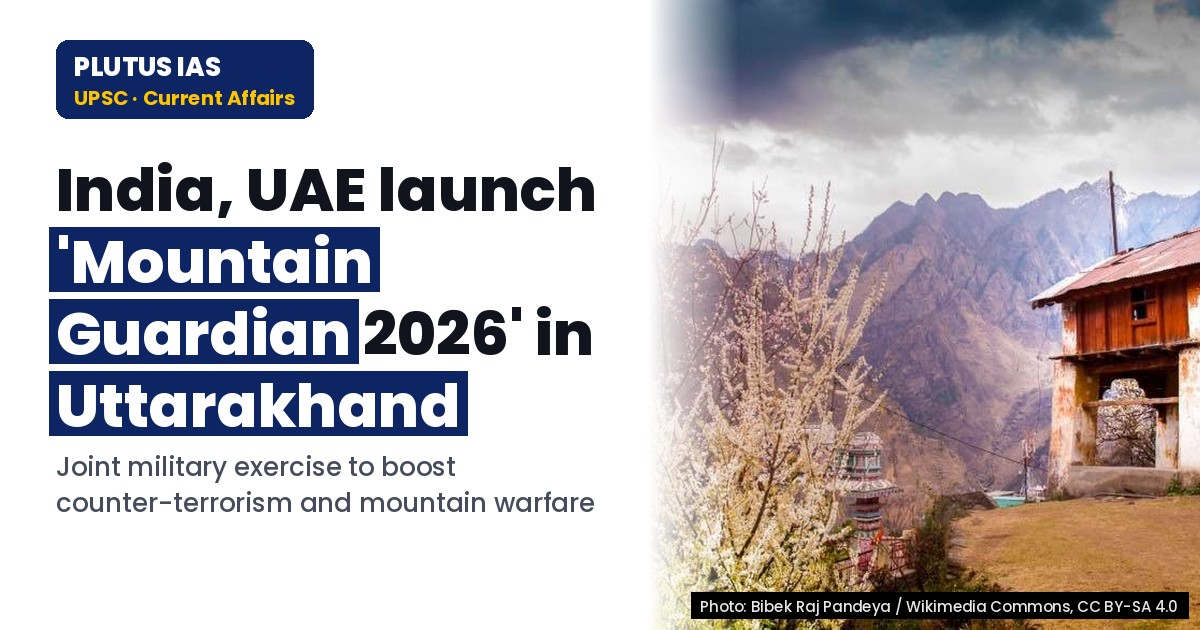
05 Oct India-UAE Mountain Guardian 2026: Key Security Exercise in Uttarakhand
✎ This exercise, involving specialised high-altitude warfare training, underscores the strategic importance of mountain terrain in modern military operations and reflects the growing defence partnership between India and the UAE in…
Subject Relevance — Where This Topic Fits
- GS Paper II — International Relations (Bilateral and Regional Arrangements, Defence Cooperation) | GS Paper III — Security Challenges and their Management (Internal Security, Border Areas)
Why is this in the news?
This exercise, involving specialised high-altitude warfare training, underscores the strategic importance of mountain terrain in modern military operations and reflects the growing defence partnership between India and the UAE in addressing shared security challenges.
Background
- The India-UAE defence cooperation has evolved significantly over the past decade, with joint exercises, training programmes, and defence dialogues becoming a cornerstone of their strategic partnership.
- Uttarakhand, with its diverse and challenging terrain including the Himalayas, serves as an ideal location for conducting high-altitude warfare exercises, which are critical for preparing armed forces for operations in mountainous regions.
- India has been actively engaging in joint military exercises with Gulf Cooperation Council (GCC) countries to enhance interoperability, share best practices, and strengthen regional security frameworks.
- The UAE, as a key partner in West Asia, has been expanding its defence engagements with India, focusing on counter-terrorism, maritime security, and high-altitude operations.
- High-altitude warfare is a specialised domain that requires acclimatisation, logistical planning, and tactical expertise, making exercises like ‘Mountain Guardian’ essential for modernising military capabilities.
- India’s defence diplomacy has increasingly emphasised joint exercises with friendly nations to address emerging security threats and enhance operational readiness.
What is the India-UAE Joint Military Exercise ‘Mountain Guardian 2026’?
- This exercise aligns with India’s broader defence diplomacy, which aims to strengthen partnerships with friendly nations to address shared security challenges and enhance regional stability.
- The participation of the UAE, a key partner in West Asia, highlights the growing strategic convergence between India and Gulf countries in defence and security matters.
- Such exercises also serve as a platform for cultural exchange and mutual learning, fostering long-term defence cooperation between the two nations.
Key Features
| Feature | Significance |
|---|---|
| Bilateral Military Exercise | Demonstrates India-UAE defence cooperation and interoperability in high-altitude mountain warfare. |
| Mountain Terrain Focus | Enhances operational preparedness for both nations in Himalayan and desert mountain environments. |
| Joint Command Structure | Facilitates integrated planning, execution, and post-exercise analysis between participating forces. |
| Logistics and Mobility Enhancement | Tests rapid deployment capabilities, supply chains, and communication networks in rugged terrain. |
| Cultural and Professional Exchange | Strengthens mutual understanding, trust, and institutional linkages between armed forces. |
Why it Matters
Strategic Security
- Reinforces bilateral defence ties in the Indian Ocean Region (IOR) amid evolving geopolitical dynamics.
- Demonstrates India’s commitment to regional security partnerships under the Act East Policy.
- Provides UAE with exposure to high-altitude warfare tactics relevant to its own regional security concerns.
- Complements existing maritime security cooperation in the Arabian Sea and Gulf of Aden.
Operational Preparedness
- Validates joint doctrine for mountain warfare, including acclimatisation, survival, and tactical mobility.
- Tests interoperability between Indian and UAE forces in extreme weather and terrain conditions.
- Enhances real-time intelligence sharing and situational awareness in high-altitude zones.
- Improves coordination for search-and-rescue operations in disaster-prone Himalayan regions.
Defence Diplomacy
- Serves as a confidence-building measure (CBM) to deter regional adversaries and mitigate misperceptions.
- Strengthens defence industrial cooperation, including joint R&D and technology transfer initiatives.
- Positions both nations as reliable security partners in multilateral forums like the Indian Ocean Naval Symposium (IONS).
- Facilitates future joint exercises in cyber, space, and counter-terrorism domains.
Humanitarian Assistance
- Builds capacity for joint disaster response, including avalanche rescue and medical evacuation in remote areas.
- Enhances bilateral cooperation in UN-mandated peacekeeping operations.
- Strengthens civil-military coordination for border-area development and infrastructure resilience.
Challenges
1. High-Altitude Warfare Challenges
- Acclimatisation and altitude sickness affecting operational efficiency.
- Limited infrastructure for rapid deployment and sustainment in mountainous regions.
- Communication blackouts due to terrain and weather disruptions.
- Logistical bottlenecks in transporting heavy equipment and supplies.
UPSC Link: GS III: Security challenges and their management in border areas
2. Bilateral Coordination Gaps
- Differences in military doctrines, training standards, and operational protocols.
- Language and cultural barriers impacting seamless integration.
- Legal and procedural hurdles in joint command structures and decision-making.
- Resource allocation constraints in sustaining long-term defence cooperation.
UPSC Link: GS II: Bilateral, regional and global groupings and agreements
3. Geopolitical Risks
- Potential for misinterpretation by third-party actors in the IOR.
- Impact of regional conflicts on bilateral defence engagement.
- Sanctions or restrictions affecting defence trade and technology transfers.
- Evolving alliances and partnerships altering strategic priorities.
UPSC Link: GS II: Effect of policies and politics of developed and developing countries
4. Climate and Environmental Constraints
- Increased frequency of extreme weather events disrupting exercise schedules.
- Environmental degradation in mountain regions affecting operational sustainability.
- Carbon footprint of military exercises and need for eco-friendly alternatives.
- Impact of climate change on troop mobility and equipment performance.
UPSC Link: GS III: Environmental pollution and degradation
Challenges — UPSC Perspective
| Issue | Concern |
|---|---|
| Altitude Sickness | Reduces combat readiness and increases medical evacuation risks during high-altitude operations. |
| Terrain Complexity | Limits mobility, increases fuel consumption, and complicates logistics planning. |
| Communication Disruptions | Undermines real-time coordination, intelligence sharing, and command-and-control functions. |
| Resource Constraints | Strains budgets, delays procurement, and limits the scope of joint exercises. |
| Legal Ambiguities | Creates delays in joint planning, liability issues, and compliance with international laws. |
| Cultural Differences | Leads to misunderstandings, reduces team cohesion, and impacts operational synergy. |
Way Forward
- Establish a joint working group to institutionalise Mountain Guardian exercises with annual calendars and rotating venues.
- Develop a standardised high-altitude warfare doctrine incorporating lessons from the exercise.
- Enhance infrastructure in border regions, including helipads, roads, and communication towers.
- Promote defence industrial cooperation, including joint R&D in mountain warfare technologies.
- Conduct joint training programmes for military medics on high-altitude medical emergencies.
- Integrate civilian agencies (NDMA, SSB) into future exercises for disaster response planning.
- Expand participation to include other like-minded nations for a multilateral security framework.
- Document and disseminate best practices through defence journals and academic collaborations.
UPSC Value Addition
Keywords for Mains Answer-Writing
Joint Military Exercises · Mountain Guardian 2026 · India-UAE Defence Cooperation · High-Altitude Warfare · Uttarakhand · Strategic Partnerships · Defence Diplomacy · Mountain Warfare Tactics · Regional Security Architecture · Counter-Terrorism Operations · United Arab Emirates · Military Logistics · Indo-Pacific Strategy · UN Peacekeeping Operations
Concept Flow
Geopolitical imperatives in the Indian Ocean Region → India’s Act East Policy and UAE’s regional security concerns → Bilateral defence cooperation → Joint military exercises → Operational interoperability in mountain warfare → Strategic deterrence and regional stability → Enhanced defence diplomacy and humanitarian assistance
Prelims Practice Questions
Q1. Consider the following statements regarding the India-UAE Joint Military Exercise ‘Mountain Guardian 2026’:
1. The exercise is conducted in Uttarakhand, focusing on high-altitude warfare.
2. It is the first-ever joint military exercise between India and the UAE.
3. The exercise includes counter-terrorism operations and mountain warfare tactics.
How many of the above statements are correct?
- Only one
- Only two
- All
- None
Answer: All — Statement 1 and 3 are correct as the exercise is held in Uttarakhand and includes high-altitude warfare and counter-terrorism operations. Statement 2 is incorrect because India and the UAE have conducted joint military exercises before, such as ‘Desert Eagle’ in 2021.
Q2. Assertion (A): Joint military exercises like ‘Mountain Guardian 2026’ enhance interoperability between armed forces of participating nations.
Reason (R): Such exercises are designed to standardise operational procedures and improve logistical coordination.
Options:
A. Both A and R are true, and R is the correct explanation of A.
B. Both A and R are true, but R is not the correct explanation of A.
C. A is true, but R is false.
D. A is false, but R is true.
Answer: ? — Assertion (A) is true as joint military exercises are specifically aimed at enhancing interoperability. Reason (R) is also true and correctly explains why these exercises are conducted, as they focus on standardising procedures and improving coordination.
Q3. Match the following joint military exercises with their respective participating countries:
Column I (Exercise Name)
A. Mountain Guardian 2026
B. Desert Eagle
C. Yudh Abhyas
D. Vajra Prahar
Column II (Countries)
1. India and USA
2. India and UAE
3. India and France
4. India and Russia
Options:
A. A-2, B-4, C-1, D-3
B. A-2, B-3, C-1, D-4
C. A-3, B-2, C-4, D-1
D. A-1, B-2, C-3, D-4
Answer: ? — A. Mountain Guardian 2026 is between India and UAE. B. Desert Eagle is between India and UAE. C. Yudh Abhyas is between India and USA. D. Vajra Prahar is between India and France.
Mains Practice Question
✍ Critically examine the strategic significance of joint military exercises like ‘Mountain Guardian 2026’ in enhancing India’s defence diplomacy and regional security architecture. (15 Marks)
Approach: MODEL-ANSWER SKELETON:
1. **Definition and Purpose**: Define joint military exercises as instruments of defence diplomacy aimed at interoperability, trust-building, and standardisation of operational procedures (cite: MoD press release on ‘Mountain Guardian 2026’).
2. **Strategic Significance for India**:
– **Defence Diplomacy**: Highlight India’s ‘Act East Policy’ and ‘SAGAR Doctrine’ (Security and Growth for All in the Region) as frameworks for engaging with Gulf and Indo-Pacific partners (reference: India-UAE Comprehensive Strategic Partnership, 2017).
– **Regional Security**: Emphasise the role of high-altitude warfare training in Uttarakhand for countering threats in the Himalayan region and supporting UN peacekeeping operations (cite: doctrinal focus on mountain warfare in the Indian Army’s ‘Mountain Strike Corps’).
– **Counter-Terrorism Cooperation**: Discuss the inclusion of counter-terrorism operations in the exercise, aligning with India’s and UAE’s shared concerns over transnational terrorism (reference: India-UAE Joint Statement on Counter-Terrorism, 2022).
3. **Comparison with Other Exercises**:
– Contrast ‘Mountain Guardian 2026’ with India’s other joint exercises (e.g., ‘Yudh Abhyas’ with the USA, ‘Vajra Prahar’ with France) to illustrate thematic specialisation (mountain warfare vs. desert warfare vs. air-land integration).
– Highlight how such exercises diversify India’s defence partnerships beyond traditional allies.
4. **Challenges and Limitations**:
– **Operational Constraints**: Discuss logistical challenges in high-altitude terrains and the need for advanced infrastructure (reference: Uttarakhand’s terrain and climate conditions).
– **Geopolitical Balancing**: Address the delicate balance India must maintain in engaging with multiple regional powers without alienating any (e.g., balancing UAE with Iran or Saudi Arabia).
5. **Conclusion**:
– Summarise that ‘Mountain Guardian 2026’ is a microcosm of India’s evolving defence diplomacy, reinforcing its role as a net security provider in the Indo-Pacific.
– Conclude with a balanced view: while exercises like these enhance capabilities, their long-term impact depends on sustained political will and institutional frameworks.
Source: PIB (Press Information Bureau)
Uttarakhand PCS (UKPSC) — State PCS Practice
Prelims: The ‘Mountain Guardian 2026’ joint military exercise, scheduled to be held in Uttarakhand, involves which two countries?
- India and UAE
- India and USA
- India and France
- India and Japan
Answer: India and UAE — The exercise is a bilateral military drill between India and the United Arab Emirates (UAE), focusing on mountain warfare.
Mains: Discuss the significance of the ‘Mountain Guardian 2026’ joint military exercise for Uttarakhand’s strategic and operational preparedness in high-altitude warfare. Highlight the potential benefits for local defence infrastructure and interoperability with foreign armed forces.
Generated by AanyaAi for educational purpose.
Related guides on our sites
- How to prepare for GS paper 1 for UPSC CSE mains exam
- Best UPSC coaching for IFOS exam
- Best mentorship programme for upsc
- UPSC+BA degree

- India-UAE Mountain Guardian 2026: Key Security Exercise in Uttarakhand - October 5, 2026
- पेंशनरों के जीवन को सरल बनाने हेतु डिजिटल सेवाओं का विस्तार आवश्यक: डॉ. जितेंद्र सिंह - October 5, 2026
- Key Findings of National Household Travel Survey 2025-26 for UPSC - October 5, 2026

No Comments