


08 Aug India-UK Trade Deal: 6 Sectors in Kerala to Benefit from CETA 2026
✎ CETA provides zero-duty access on 99% of India’s exports to the UK, enhancing Kerala’s export competitiveness in fisheries, spices, IT, textiles and handloom, and yoga, wellness, healthcare while facilitating branch campuses of…
Subject Relevance — Where This Topic Fits
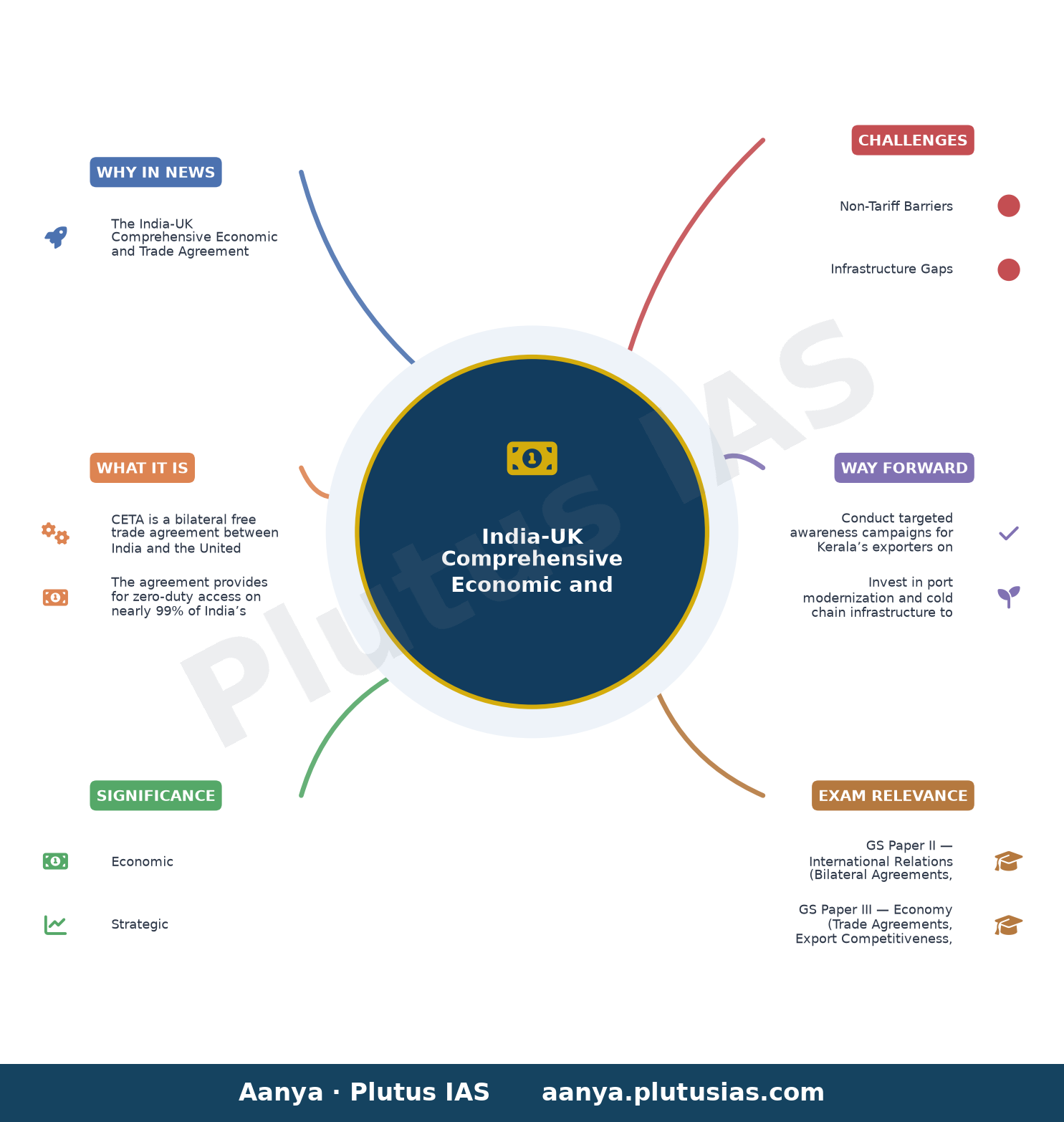
- GS Paper II — International Relations (Bilateral Agreements, UK-India Relations) | GS Paper III — Economy (Trade Agreements, Export Competitiveness, Industrial Sectors)
- Prelims: CETA (Comprehensive Economic and Trade Agreement), Zero-duty market access, Fisheries and marine products, Geographical Indications (GIs), Technopark Thiruvananthapuram, Branch campuses of foreign universities
- Essay: Globalisation and regional economic integration: Balancing sovereignty and cooperation, The role of state governments in India’s foreign trade policy
Quick Revision: CETA provides zero-duty access on 99% of India’s exports to the UK, enhancing Kerala’s export competitiveness in fisheries, spices, IT, textiles and handloom, and yoga, wellness, healthcare while facilitating branch campuses of UK universities.
Why is this in the news?
The India-UK Comprehensive Economic and Trade Agreement (CETA), which entered into force on 15 July 2026, has been highlighted for its potential to enhance Kerala’s export competitiveness in sectors such as fisheries, spices, IT, textiles and handloom, and yoga, wellness, healthcare. The British Deputy High Commissioner’s remarks underscore the strategic opportunities for Kerala under the agreement, particularly in cost reduction and ease of doing business, while also addressing prospects for higher education collaboration through branch campuses of UK universities.
Background
- The India-UK CETA was signed in July 2025 and came into force on 15 July 2026, marking a significant milestone in bilateral economic relations.
- The agreement aims to eliminate tariffs on nearly 99% of India’s exports to the UK, thereby enhancing export competitiveness and attracting investment.
- The Government of India has described CETA as an ‘inclusive and future-oriented agreement,’ emphasising its role in expanding bilateral trade and creating new business opportunities.
- The British Deputy High Commissioner’s visit to Thiruvananthapuram included interactions with the Chief Minister and ministers of Health, Higher Education, and Industries, reflecting the state’s proactive engagement in leveraging the agreement.
What is the India-UK Comprehensive Economic and Trade Agreement (CETA)?
- CETA is a bilateral free trade agreement between India and the United Kingdom, designed to reduce trade barriers and enhance economic cooperation.
- The agreement provides for zero-duty access on nearly 99% of India’s exports to the UK, significantly reducing tariff costs for Indian exporters.
- CETA includes provisions for trade facilitation, customs cooperation, and regulatory alignment, making it ‘cheaper, quicker, and easier’ to conduct business between the two countries.
- The agreement covers a wide range of sectors, including goods, services, investment, intellectual property, and digital trade, with a focus on mutual benefit and sustainable development.
- CETA is expected to strengthen India’s export competitiveness, attract foreign direct investment (FDI), and create new opportunities for businesses in both countries.
- The agreement also includes commitments to labour and environmental standards, aligning with global best practices and ensuring sustainable trade practices.
- The agreement also facilitates collaboration in higher education, with provisions for the establishment of branch campuses of UK universities in India, including potential locations in Kerala.
Key Features
| Feature | Significance |
|---|---|
| Comprehensive Economic and Trade Agreement (CETA) | Facilitates zero-duty access on 99% of India’s exports to the UK, enhancing trade competitiveness and reducing tariff barriers. |
| Cost Advantages for Kerala | Lower tariffs and streamlined customs procedures under CETA reduce operational costs for Kerala’s export-oriented industries. |
| Ease of Doing Business | Simplified regulatory frameworks and reduced bureaucratic hurdles under CETA accelerate trade and investment flows. |
| Branch Campuses of UK Universities | Potential establishment of UK university campuses in Kerala to meet demand for higher education and promote academic collaboration. |
| Focus Sectors for Kerala | Identified sectors—fisheries, spices, IT, textiles, engineering, and wellness—align with Kerala’s existing industrial strengths. |
Why it Matters
Economic
- Enhances Kerala’s export competitiveness by granting preferential market access to the UK, a high-income economy with significant demand for quality goods and services.
- Attracts foreign direct investment (FDI) into Kerala’s priority sectors, particularly IT, marine products, and spices, by reducing investment risks and operational costs.
- Strengthens bilateral trade ties between India and the UK, contributing to India’s goal of diversifying export markets beyond traditional partners.
- Creates employment opportunities in Kerala’s identified sectors, particularly in export-oriented industries and higher education.
Strategic
- Deepens economic integration between India and the UK, reinforcing strategic partnerships amid evolving global trade dynamics.
- Positions Kerala as a key beneficiary of India-UK trade agreements, leveraging its geographic and industrial advantages.
- Facilitates technology transfer and knowledge exchange in sectors like IT and advanced manufacturing, enhancing Kerala’s industrial capabilities.
Sectoral
- Fisheries and Marine Products: UK’s demand for sustainable seafood aligns with Kerala’s established marine industry, offering export growth potential.
- Spices and Food Processing: Reduced tariffs on spices and processed foods can boost Kerala’s traditional strengths in spice exports.
- IT and Digital Services: Streamlined trade in services under CETA can expand Kerala’s IT exports, including software and digital solutions.
- Textiles and Handloom: Enhanced market access for handloom products can revive and modernize Kerala’s textile sector.
- Wellness and Healthcare: Growth in yoga, Ayurveda, and wellness tourism can be accelerated through easier cross-border mobility and service trade.
Challenges
1. Non-Tariff Barriers
- Sanitary and phytosanitary (SPS) measures may still pose challenges for Kerala’s marine and agricultural exports despite tariff reductions.
- Regulatory divergence between India and the UK in sectors like food processing and healthcare could create compliance hurdles.
- Intellectual property rights (IPR) concerns in IT and digital services may require robust legal frameworks to protect Kerala-based firms.
UPSC Link: GS3: Trade Barriers and WTO
2. Infrastructure Gaps
- Inadequate port infrastructure in Kerala may limit the scalability of marine product exports to the UK.
- Logistics bottlenecks in cold chain management for perishable goods like spices and marine products could undermine trade advantages.
- Limited digital infrastructure in rural areas may hinder the growth of IT and digital service exports.
UPSC Link: GS3: Infrastructure and Logistics
3. Skill Mismatch
- Shortage of skilled labor in high-demand sectors like IT, advanced manufacturing, and wellness services may constrain Kerala’s ability to capitalize on CETA.
- Vocational training programs need alignment with UK market requirements to ensure employability and competitiveness.
- Higher education institutions in Kerala must upgrade curricula to meet international standards for potential UK university branch campuses.
UPSC Link: GS2: Education and Skill Development
4. Political and Bureaucratic Hurdles
- Slow implementation of trade facilitation measures at the state level may delay the realization of CETA’s benefits for Kerala.
- Lack of awareness among local businesses about CETA’s provisions and procedures could lead to underutilization of trade opportunities.
- Coordination between central and state governments is essential to align policies with CETA’s objectives.
UPSC Link: GS2: Centre-State Relations
Challenges — UPSC Perspective
| Issue | Concern |
|---|---|
| Sanitary and Phytosanitary (SPS) Measures | May restrict market access for Kerala’s marine and agricultural products despite tariff reductions. |
| Port Infrastructure | Inadequate capacity and efficiency may limit the scalability of exports to the UK. |
| Digital Infrastructure | Gaps in rural connectivity may hinder the growth of IT and digital service exports. |
| Skill Development | Mismatch between industry needs and workforce skills may constrain sectoral growth. |
| Regulatory Compliance | Divergence in standards between India and the UK may create additional compliance costs. |
Way Forward
- Conduct targeted awareness campaigns for Kerala’s exporters on CETA’s provisions, tariff reductions, and compliance requirements.
- Invest in port modernization and cold chain infrastructure to enhance the competitiveness of marine and agricultural exports.
- Strengthen vocational training programs in IT, textiles, and wellness sectors to align with UK market demands.
- Facilitate partnerships between Kerala-based firms and UK enterprises to promote technology transfer and joint ventures.
- Encourage the establishment of UK university branch campuses in Kerala by expediting regulatory approvals and land allocation.
- Develop a state-level export promotion strategy focusing on CETA’s priority sectors to maximize trade benefits.
- Enhance digital infrastructure in rural and semi-urban areas to support the growth of IT and digital service exports.
- Establish a dedicated trade facilitation cell to assist Kerala’s businesses in navigating CETA’s regulatory and procedural frameworks.
UPSC Value Addition
Keywords for Mains Answer-Writing
Comprehensive Economic and Trade Agreement (CETA) · India-UK bilateral trade · Kerala’s export potential · Fisheries and marine products · Spices and food processing · Information Technology (IT) sector · Textiles and handloom industry · Engineering and advanced manufacturing · Yoga and wellness tourism · Zero-duty market access · Trade facilitation measures · Branch campuses of foreign universities · Investment attraction in Kerala · Economic diplomacy · Trade liberalisation
Concept Flow
India-UK CETA signed (July 2025) → Enters into force (July 15, 2026) → Zero-duty access on 99% of Indian exports → Kerala identifies six priority sectors → Cost advantages and ease of doing business improve → Export competitiveness of Kerala’s industries rises → Foreign investment and employment opportunities increase → State infrastructure and skill development gaps emerge as bottlenecks → Targeted policy interventions and infrastructure upgrades required → Sustainable growth in trade and investment achieved.
Prelims Practice Questions
Q1. Consider the following statements regarding the Comprehensive Economic and Trade Agreement (CETA) between India and the United Kingdom:
1. CETA provides zero-duty access on nearly 99% of India’s exports to the UK.
2. The agreement came into force on July 15, 2026.
3. CETA includes provisions for branch campuses of foreign universities in India.
4. The agreement is limited to trade in goods and does not cover services.
How many of the above statements are correct?
- Only one
- Only two
- Only three
- All
Answer: Only three — Statements 1, 2, and 3 are correct. Statement 4 is incorrect as CETA covers both goods and services, including provisions for educational services.
Q2. Assertion (A): The Comprehensive Economic and Trade Agreement (CETA) between India and the UK is designed to make bilateral trade ‘cheaper, quicker, and easier’.
Reason (R): CETA eliminates tariffs on nearly all goods traded between the two countries and simplifies customs procedures.
Options:
A. Both A and R are true, and R is the correct explanation of A.
B. Both A and R are true, but R is not the correct explanation of A.
C. A is true, but R is false.
D. A is false, but R is true.
Answer: ? — Both A and R are true, and R correctly explains A. The reduction of tariffs and simplification of customs procedures under CETA directly contribute to making trade cheaper, quicker, and easier.
Q3. Which of the following sectors in Kerala is NOT explicitly identified by the British Deputy High Commissioner as a potential beneficiary under the India-UK Comprehensive Economic and Trade Agreement (CETA)?
Options:
A. Fisheries and marine products
B. Spices and food processing
C. Automobile manufacturing
D. Yoga, wellness, and healthcare
- A
- B
- C
- D
Answer: C — Automobile manufacturing is not listed among the six sectors identified by the British Deputy High Commissioner as potential beneficiaries under CETA. The sectors listed are fisheries and marine products, spices and food processing, IT and digital, textiles and handloom, engineering and advanced manufacturing, and yoga, wellness, and healthcare.
Mains Practice Question
✍ The Comprehensive Economic and Trade Agreement (CETA) between India and the United Kingdom is poised to significantly enhance bilateral trade and investment flows. Critically analyse the potential benefits and challenges that Kerala may face in leveraging this agreement, with specific reference to its identified strengths. (15 Marks)
Approach: MODEL-ANSWER SKELETON:
1. **Introduction (2 Marks)**: Define CETA and its objectives, highlighting its role as a future-oriented and inclusive agreement. Mention the sectors identified for Kerala’s benefit (fisheries, spices, IT, textiles, engineering, yoga/wellness).
2. **Potential Benefits for Kerala (5 Marks)**:
– **Zero-duty access**: Explain how near-total tariff elimination under CETA enhances export competitiveness for Kerala’s key sectors (e.g., marine products, spices).
– **Trade facilitation**: Discuss reduced non-tariff barriers, simplified customs procedures, and streamlined regulatory frameworks.
– **Investment attraction**: Analyse how CETA’s provisions may attract foreign direct investment (FDI) in Kerala’s identified sectors, including the potential for branch campuses of UK universities.
– **Diversification opportunities**: Highlight new market access for Kerala’s niche products (e.g., handloom textiles, wellness tourism).
– **Institutional support**: Reference the role of institutions like Technopark Thiruvananthapuram in fostering IT growth.
3. **Challenges and Constraints (5 Marks)**:
– **Sectoral limitations**: Discuss challenges in fisheries (sustainability, EU standards), spices (quality certification), and IT (skill gaps, competition).
– **Infrastructure deficits**: Highlight gaps in logistics, port infrastructure, and digital connectivity that may hinder trade expansion.
– **Regulatory hurdles**: Address non-tariff barriers such as sanitary and phytosanitary (SPS) measures, technical barriers to trade (TBT), and intellectual property rights (IPR) concerns.
– **Competition**: Examine the risk of increased competition from UK imports in sectors like textiles and food processing.
– **Implementation gaps**: Discuss the need for state-level policy alignment, skill development, and ease of doing business reforms.
4. **Way Forward (3 Marks)**:
– **Policy interventions**: Recommend measures such as infrastructure upgradation, skill development (e.g., vocational training in fisheries/IT), and strengthening of export promotion agencies.
– **Institutional collaboration**: Suggest partnerships between Kerala’s chambers of commerce, state government, and UK counterparts to address non-tariff barriers.
– **Leveraging education**: Propose targeted efforts to attract UK university branch campuses to Kerala to enhance human capital and research collaboration.
Balance: Ensure a critical analysis by weighing benefits against challenges, supported by concrete examples from Kerala’s economic profile.
Source: The Hindu
Generated by AanyaAi for educational purpose.

- KWML’s Feasibility Reports for Water Metro in 18 Cities: UPSC & PCS Insights - October 3, 2026
- ओडिशा में वन्यजीव अनुसंधान अनुदान कार्यक्रम शुरू, सिमिलिपाल में 300 कैमरे और बढ़ेंगे - October 3, 2026
- India Summons Pakistan High Commission Official Over Violation - October 3, 2026

No Comments