


16 May India Unveils Its First Genome-Edited Rice Varieties: Kamala and Pusa DSR Rice 1
This article covers “Daily Current Affairs” and the Topic India Unveils Its First Genome-Edited Rice Varieties: Kamala and Pusa DSR Rice 1
SYLLABUS MAPPING:
GS-3- Science and technology- India Unveils Its First Genome-Edited Rice Varieties: Kamala and Pusa DSR Rice 1
FOR PRELIMS
What are the key features of the newly developed genome-edited rice varieties in India? How can they help improve agricultural productivity?
FOR MAINS
What is the difference between genome-edited and genetically modified crops?
Why in the News?
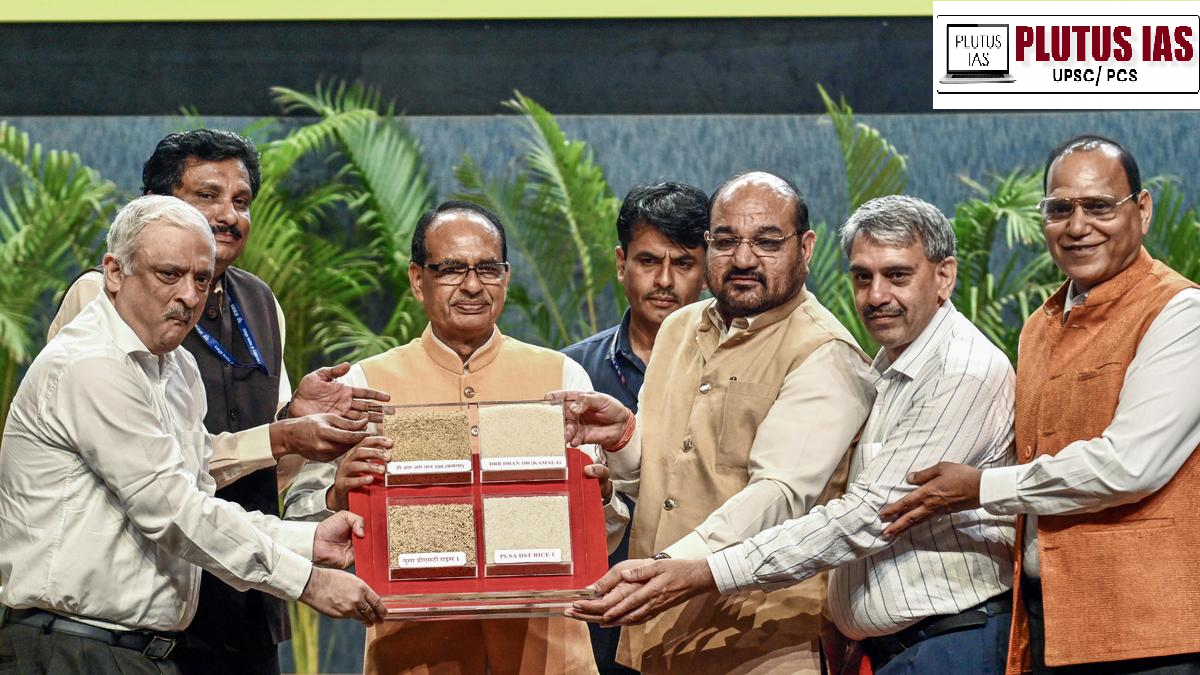
Union Agriculture Minister Shivraj Singh Chouhan recently announced that India has become the first country in the world to develop rice varieties using genome editing technology. The new seeds will be available for farmers after the required clearances within six months and large-scale seed production will probably take place during the next three crop seasons.
What are the new varieties?
A team of researchers from various institutions, guided by the Indian Council of Agricultural Research (ICAR), were behind the development of the two varieties — the DRR Dhan 100, also known as Kamala, which was developed from a popular high-yielding green rice Samba Mashuri, and Pusa DSR Rice 1, which was developed from the Maruteru 1010 (MTU1010) variety.
Benefits of the new rice varieties Kamala and Pusa DST Rice 1
| Feature | Kamala | Pusa DST Rice 1 |
|---|---|---|
| Higher Yield | 5.37 tonnes/ha (vs. 4.5 tonnes/ha in Samba Mahsuri) | 3,508 kg/ha (9.66% more than MTU1010’s 3,199 kg/ha) |
| Drought Tolerance | High drought resilience, performs well with less water | Not specifically designed for drought, but performs well in tough soils |
| Early Maturity | Matures ~20 days earlier than Samba Mahsuri | Not specifically early maturing |
| Salinity & Alkalinity Tolerance | Moderate tolerance | High tolerance — yields 30.4% more under coastal salinity, 14.66% more under alkalinity |
| Environmental Impact | Lower methane emissions due to shorter crop duration | Supports cultivation in marginal lands, improving land-use efficiency |
| Farming Advantage | Enables multiple cropping and input savings (water, fertiliser) | Expands cultivation to degraded or saline soils |
| Parent Variety | Derived from Samba Mahsuri | Derived from MTU1010 |
Salient Features of India’s First Genome-Edited Rice Varieties
1. High Yield Potential
DRR Dhan 100 (Kamala): Average yield 5.37 tonnes/ha (higher than 4.5 tonnes/ha of Samba Mashuri).
Pusa DSR Rice 1: Shows 30.4% yield advantage under coastal saline and water-stressed conditions.
2. Early Maturity: These varieties mature 20 days earlier than their parent varieties. Early maturity helps in crop rotation and reduces the overall water requirement.
3. Climate Resilience: Drought Tolerance: Performs well under limited water availability. Salinity and Alkalinity Tolerance: Pusa DSR Rice 1 performs well under such stress conditions.
4. Nutrient Use Efficiency: High nitrogen-use efficiency, reducing dependency on fertilisers and lowering input costs.
5. Environmental Sustainability: Reduced methane emissions due to shorter crop duration and suitability for DSR. Lower water requirement → water conservation.
6. Non-GMO Status: Developed using genome editing (SDN1 & SDN2) without introducing any foreign genes. Considered non-GMO in regulatory terms, allowing for faster approvals in many countries.
7. Enhanced Agronomic Traits: Better grain quality, pest/disease resistance, and adaptability across multiple agro-climatic zones.
Objections to Genome-Edited Rice Varieties
1. Lack of Transparency: Field trial data was not made public before the announcement. Critics, including ex-ICAR member Venugopal Badaravada, raised concerns about accountability.
2. Regulatory Issues: Exempting SDN-1 and SDN-2 crops from GMO laws is seen as legally questionable. Activist groups argue it bypasses biosafety evaluations.
3. Seed Sovereignty and IPR Concerns: Use of patented gene-editing tools may undermine farmers’ seed rights. Fear of corporate control over seeds.
4. Lack of Peer-Reviewed Evidence: Yield and resilience claims are not yet backed by independent scientific studies.
5. Public Mistrust: Conflicting views between government and civil society have led to confusion and concern.
Way forward
1. Ensure Transparent Evaluation: Conduct multi-location field trials and publish results openly to enhance scientific credibility and public trust.
2. Strengthen Regulatory Oversight: Establish an independent, science-based biosafety authority to evaluate genome-edited crops rigorously.
3. Develop a Clear IPR Policy: Frame policies that balance innovation with protection of farmers’ seed rights and prevent monopolistic control.
4. Engage Stakeholders: Involve farmers, scientists, civil society, and consumer groups in policy decisions to ensure inclusive development.
5. Educate the Public: Launch awareness campaigns to clarify differences between genome editing and traditional GMOs.
6. Promote Indigenous Innovation: Encourage public sector R&D to reduce dependence on patented foreign technologies.
7. Ensure Farmer Access and Benefits: Make improved seeds affordable and accessible, especially to small and marginal farmers.
8. Monitor Long-Term Impact: Set up systems to track environmental, health, and socio-economic impacts post-release.
Conclusion
India’s development of genome-edited rice marks a significant milestone in agricultural innovation, addressing critical challenges like climate change, water scarcity, and food security. The launch of DRR Dhan 100 (Kamala) and Pusa DSR Rice 1 showcases the potential of precision breeding to enhance yield, sustainability, and resilience without introducing foreign genes. However, the controversies surrounding transparency, regulation, and seed sovereignty highlight the need for cautious, inclusive, and science-driven policymaking. By ensuring robust field trials, safeguarding farmer rights, and fostering public trust through education and open data, India can harness the full benefits of genome editing while upholding food sovereignty and environmental safety.
Download Plutus IAS Current Affairs (Eng) 16th May 2025
Prelims Questions
Q. With reference to genome-edited crops in India, consider the following statements:
1. Genome-edited crops developed using SDN-1 and SDN-2 techniques do not introduce foreign genes.
2. The DRR Dhan 100 and Pusa DSR Rice 1 were developed by private seed companies in collaboration with ICAR.
3. Genome-edited crops are currently exempted from India’s GMO regulatory framework.
Which of the statements given above is/are correct?
(a) 1 only
(b) 1 and 3 only
(c) 2 and 3 only
(d) 1, 2 and 3
Answer: A
Mains Questions
Q. Discuss the significance of genome-editing technology in Indian agriculture with reference to the recent development of rice varieties such as DRR Dhan 100 and Pusa DSR Rice 1. What are the concerns raised over such innovations and what should be the way forward?
(250 words, 15 marks)


No Comments