


01 Oct India’s Food Processing Sector: Driving Global Competitiveness and Farm Prosperity
This article covers “Daily Current Affairs” and Topic details “India’s Food Processing Sector: Driving Global Competitiveness and Farm Prosperity”
SYLLABUS MAPPING
GS–3 – Economy & Infrastructure – Food Processing Sector
FOR PRELIMS
What are the major government initiatives, schemes, and production-linked incentive (PLI) programs in India’s food processing sector?
FOR MAINS
Examine the significance of India’s food processing industry in economic growth, employment generation, farmers’ income, export competitiveness, and nutrition security.
Why in the News?
India’s food processing industry has recently gained attention due to its significant growth, global interest, and government initiatives aimed at strengthening agri-food value chains. Over 95,000 participants attended India’s largest food and agriculture convergence, highlighting international collaboration and investment opportunities. The sector has seen rising exports, particularly in processed foods and seafood, supported by policies focusing on quality, safety, and sustainability. Discussions during the event emphasized innovation in nutrition, new-age foods, and sustainable practices, signalling a strategic push for India to emerge as a global food processing hub while boosting farmer incomes and generating employment.
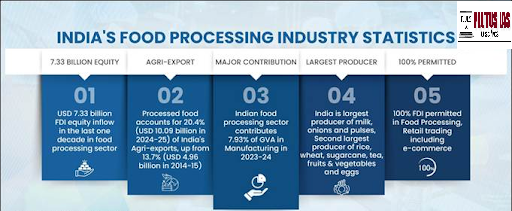
Indian food industry statistics
Food Processing sector significance
| Dimension | Significance | Implementation / Example |
|---|---|---|
| Economic Growth | Contributes ~12% to manufacturing GVA and ~10% of employment | Agricultural & processed food exports touched USD 49.4 billion in 2024–25, up from USD 30.5 bn in 2014–15 |
| Employment Generation | Provides large-scale jobs across rural and urban areas | About 2.23 million workers in registered units & 4.68 million in the unregistered sector |
| Farmers’ Income | Reduces wastage, adds value to crops, and stabilizes farmer earnings | Operation Greens & PM Kisan Sampada Yojana (PMKSY) helped in better price realization |
| Export Competitiveness | Strengthens India’s position in global agri-food chains | Processed food exports accounted for a 20.4% share in 2024–25, up from 13.7% in 2014–15 |
| Infrastructure Development | Creates modern supply chains and reduces post-harvest losses | 24 Mega Food Parks, 289 cold chain projects, and 22 agro-processing clusters established |
| Nutritional & Food Security | Provides diverse, fortified, and longer shelf-life products | Expansion of millet-based products under PLIS-MBP to promote healthy RTE/RTC foods |
| FDI & Private Investment | Attracts global investments and enhances competitiveness | 100% FDI permitted; ₹2,000 crore NABARD fund for credit to Food Parks |
Government Initiatives for Food Industry Development in India
1. Mega Food Parks & Agro-Clusters – 24 Mega Food Parks, 22 Agro-Processing Clusters, 289 cold chain projects, and 305 preservation units completed.
2. Production Linked Incentive Schemes – ₹10,900 crore PLISFPI (2021–27) and PLISMBP for millet-based RTE/RTC products to build global champions.
3. Export Growth – Agri & processed food exports reached USD 49.4 billion (2024–25), processed share rose from 13.7% (2014–15) to 20.4%.
4. Employment Generation – 2.23 million in registered units and 4.68 million in unregistered units.
5. FDI & Investment Support – 100% FDI permitted in food processing; ₹2,000 crore NABARD fund for Food Parks, improving ease of doing business.
6. Formalisation & R&D – Registered food business operators grew from 25 lakh to 64 lakh; 225 R&D projects yielded 20 patents & 52 technologies.
Challenges in the Food Processing Industry
1. Low Processing Levels – Only ~10% of fruits & vegetables processed, vs 40–60% in developed nations.
2. Post-Harvest Losses – Estimated at ₹92,561 crore annually (ICAR, 2023) due to storage & transport gaps.
3. Fragmented Supply Chains – Poor linkages between farmers, processors, and markets lead to inefficiencies.
4. Credit & Investment Gaps – Micro and small units face limited access to affordable finance despite NABARD support.
5. Export Competitiveness – High logistics costs (14% of GDP) make Indian processed foods less competitive globally.
6. Quality & Standards – Compliance with global SPS (Sanitary & Phytosanitary) standards remains a barrier for exports.
Way Forward
| Recommendation | Source / Committee | Example / Context |
|---|---|---|
| Enhance food processing levels to 25% by 2030 | NITI Aayog Vision 2047 | Expand cold chains & Mega Food Parks |
| Strengthen farmer–processor linkages | Dalwai Committee on Doubling Farmers’ Income | Contract farming, FPO-based clusters |
| Promote export competitiveness | Economic Survey 2024 | Rationalize logistics cost, port connectivity |
| Support micro-units with finance & technology | MSME Committee (RBI 2019) | Expand PMFME Scheme |
| Expand millet & nutri-cereal processing | UN Millet Year 2023 & MoFPI roadmap | Global RTE/RTC millet brands |
| Improve quality & certification systems | FAO & APEDA guidelines | GI tags, traceability for global markets |
| Boost innovation & R&D in food tech | ICAR & CSIR panels | Plant-based proteins, bio-fortified foods |
Conclusion
India’s food processing industry stands at a turning point, with strong farm production, rising exports, and robust government support. Yet, challenges of low processing, wastage, and competitiveness must be overcome through better infrastructure, R&D, and farmer linkages. By implementing committee recommendations and scaling up initiatives like PLI, PMKSY, and PMFME, India can transform into a global food processing hub, driving Viksit Bharat 2047 and ensuring food security, employment, and global leadership in agri-food value chains.
Prelims Question
Q. Consider the following statements about the Mega Food Parks Scheme:
1. It is implemented by the Ministry of Food Processing Industries (MoFPI).
2. Each Mega Food Park is based on a “hub and spoke” model with a Central Processing Centre and farm-level Primary Processing Centres.
3. 100% FDI is allowed in Mega Food Parks under the automatic route.
How many of the above statements are correct?
(a) Only one
(b) Only two
(c) All three
(d) None
ANSWER: C
Mains Question
Q. Food processing has been termed as a “sunrise sector” in India. Discuss the role of government initiatives in boosting this industry. What more needs to be done to make India a global food processing hub? (250 words)

- Elderly in India: Population, Challenges, and Government Initiatives - October 29, 2025
- Jal Jeevan Mission (JJM): Ensuring Tap Water to Every Rural Household - October 27, 2025
- National Blockchain Framework: Strengthening Governance through Blockchain Technology - October 25, 2025

No Comments