


11 Aug India’s Ship Recycling Revolution: From Global Leader to Sustainable Future
✎ Ship recycling in India is governed by the Recycling of Ships Act, 2019, aligned with the Hong Kong International Convention, and concentrated in the Alang-Sosiya cluster, contributing to circular economy goals, resource…
Subject Relevance — Where This Topic Fits
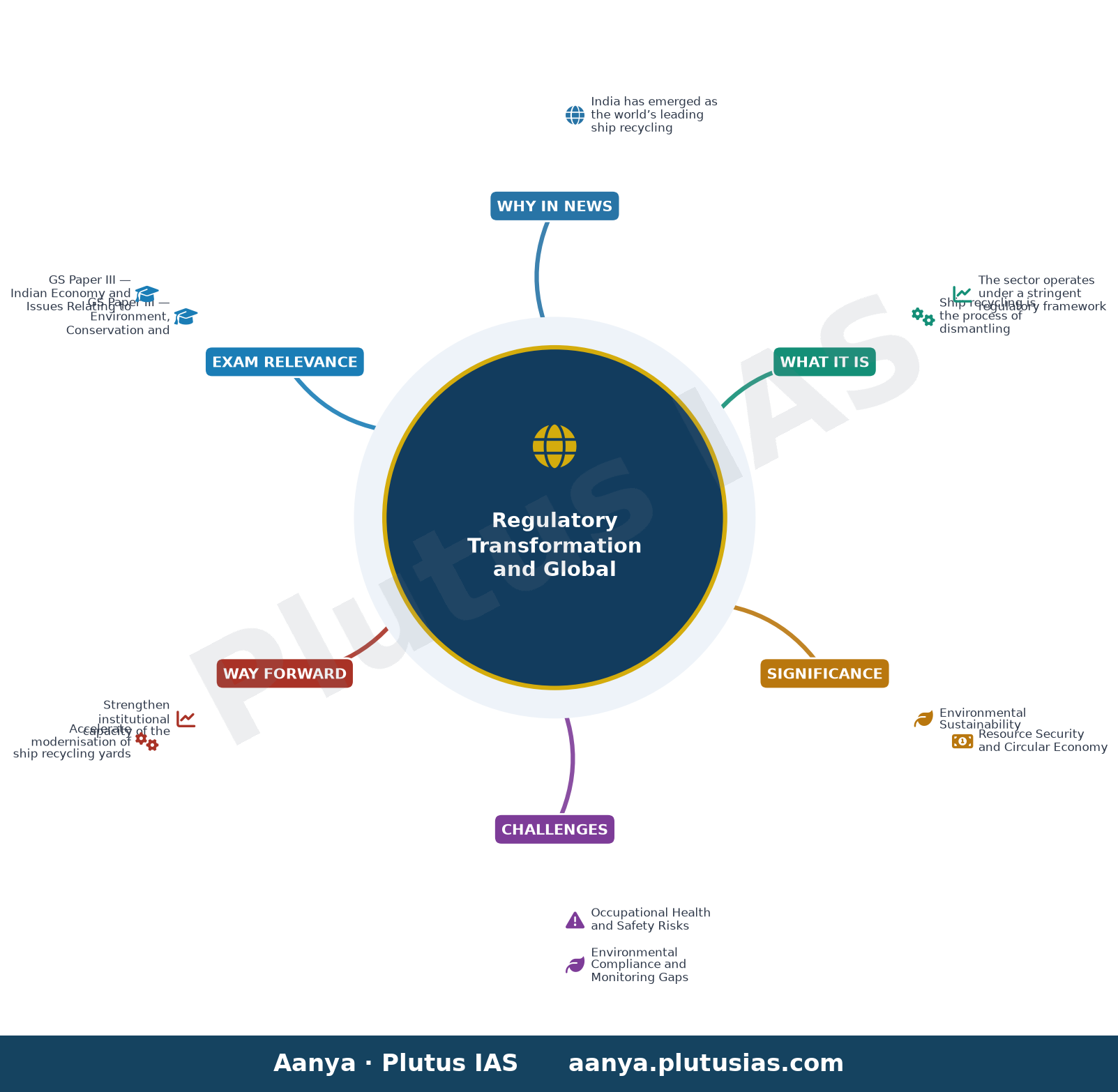
- GS Paper III — Environment, Conservation and Disaster Management | GS Paper III — Indian Economy and Issues Relating to Planning, Mobilisation of Resources | GS Paper III — Effects of Liberalisation on the Economy
- Prelims: Ship Recycling Facility (SRF), Hong Kong International Convention for the Safe and Environmentally Sound Recycling of Ships, 2009, Basel Convention, Extended Producer Responsibility (EPR), Circular Economy, Shipbreaking Yards, Greenhouse Gas Emissions, Iron Scrap
- Essay: The Role of Circular Economy in Sustainable Development, India’s Emergence as a Global Leader in Green Industrial Practices
Quick Revision: Ship recycling in India is governed by the Recycling of Ships Act, 2019, aligned with the Hong Kong International Convention, and concentrated in the Alang-Sosiya cluster, contributing to circular economy goals, resource security, and decarbonisation while ensuring environmental protection and worker safety.
Why is this in the news?
India has emerged as the world’s leading ship recycling nation in 2025, with its share in global recycling volume rising from 30.1% in 2024 to 35.4% in 2025, and recycling tonnage increasing by nearly 60% to 2.99 million gross tonnes. This transformation is attributed to a robust regulatory framework, alignment with the Hong Kong International Convention, and modernisation of ship recycling yards, positioning India as a global leader in environmentally sound and resource-efficient ship recycling.
Background
- Ship recycling is a critical component of the maritime industrial lifecycle, ensuring responsible management of end-of-life vessels through safe, environmentally sound, and resource-efficient dismantling.
- Traditional shipbreaking practices, often associated with hazardous working conditions and environmental degradation, have historically posed significant challenges in India and globally.
- The Hong Kong International Convention for the Safe and Environmentally Sound Recycling of Ships, 2009, provides an international regulatory framework to address these concerns by setting standards for ship recycling facilities, worker safety, and environmental protection.
- India’s ship recycling sector, primarily concentrated in the Alang-Sosiya cluster in Gujarat, has undergone significant regulatory and infrastructural reforms over the past decade.
- The sector’s growth aligns with India’s broader commitments to decarbonisation, circular economy principles, and resource security, as outlined in initiatives such as the National Steel Policy and the Atmanirbhar Bharat Abhiyan.
- Global maritime trade dynamics, including the phasing out of older vessels and the demand for recycled steel, have further catalysed the expansion of India’s ship recycling industry.
What is Ship Recycling and Why is it Significant?
- Ship recycling is the process of dismantling end-of-life vessels to recover reusable materials such as steel, copper, and other metals, while ensuring the safe disposal of hazardous substances like asbestos, oil residues, and polychlorinated biphenyls (PCBs).
- The sector operates under a stringent regulatory framework that mandates compliance with international conventions, national laws, and environmental standards to mitigate pollution and occupational hazards.
- India’s ship recycling industry is governed by the Recycling of Ships Act, 2019, which incorporates provisions of the Hong Kong International Convention and aligns with global best practices for safety, environmental protection, and worker welfare.
- The Alang-Sosiya cluster in Gujarat is the largest ship recycling hub in India, accounting for over 50% of the country’s recycling capacity and adhering to internationally accredited standards.
- Ship recycling contributes to India’s resource security by providing a steady supply of iron scrap for the domestic steel industry, reducing dependence on imported raw materials and supporting the circular economy.
- Environmentally sound ship recycling prevents marine and coastal pollution by ensuring the proper containment and disposal of hazardous materials, thereby protecting marine ecosystems.
- The sector generates substantial employment across dismantling, processing, and material recovery operations, supporting livelihoods in coastal regions and allied industries such as transportation, re-rolling mills, and waste management.
- India’s leadership in ship recycling is reinforced by its adherence to international standards, modernisation of recycling yards, and institutional oversight, which have enhanced its global competitiveness and sustainability credentials.
Key Features
| Feature | Significance |
|---|---|
| Regulatory Framework (Ship Recycling Code, 2023) | Provides a comprehensive legal mandate for safe, environmentally sound and worker-friendly ship recycling operations in India. |
| Hong Kong International Convention for Safe and Environmentally Sound Ship Recycling (HKC) | India’s ratification in 2025 aligns domestic practices with global standards, enhancing international credibility and market access. |
| Modernisation of Shipyards in Alang-Sosiya Cluster | Upgradation of infrastructure, mechanisation and adoption of green technologies improve efficiency, safety and compliance. |
| Institutional Oversight (Directorate General of Shipping, MoPSW) | Strengthens monitoring, enforcement and certification to ensure adherence to international norms and domestic regulations. |
| Circular Economy Integration | Facilitates recovery of ferrous and non-ferrous metals, reducing reliance on virgin raw materials and lowering carbon footprint. |
Why it Matters
Environmental Sustainability
- Prevents uncontrolled beaching of end-of-life vessels, mitigating coastal and marine pollution from hazardous substances such as asbestos, PCBs and heavy metals.
- Ensures controlled dismantling and disposal of toxic materials, aligning with India’s commitments under the Basel Convention and MARPOL Annex I.
- Promotes green ship recycling practices that reduce greenhouse gas emissions compared to primary steel production.
Resource Security and Circular Economy
- Provides ~2.99 million GT of steel scrap annually, reducing import dependency for the domestic steel industry and supporting Make in India initiatives.
- Recovered steel and non-ferrous metals feed into secondary steel production, lowering energy consumption by up to 70% compared to primary steelmaking.
- Contributes to India’s resource efficiency targets under the National Resource Efficiency Policy (NREP) 2022.
Economic and Industrial Impact
- Generates direct and indirect employment across dismantling, processing, logistics and allied sectors, supporting livelihoods in coastal regions.
- Supports ancillary industries including re-rolling mills, equipment suppliers and waste management services, enhancing industrial value chains.
- Enhances export competitiveness of Indian ship recycling yards by meeting international standards and attracting global clients.
Strategic Maritime Advantage
- Positions India as a global leader in ship recycling, complementing its role in international maritime trade and port operations.
- Strengthens India’s maritime diplomacy by demonstrating adherence to international conventions and sustainable practices.
- Supports the vision of a self-reliant maritime ecosystem under the Sagarmala Programme.
Challenges
1. Occupational Health and Safety Risks
- Exposure of workers to hazardous materials such as asbestos, lead and heavy metals during dismantling processes.
- Need for continuous training, protective equipment and medical surveillance to mitigate health risks.
- Linkage: Occupational Safety, Health and Working Conditions Code, 2020
UPSC Link: GS III: Indian Economy & Environment
2. Environmental Compliance and Monitoring Gaps
- Ensuring full compliance with HKC and domestic regulations across all ship recycling yards, particularly in the unorganised sector.
- Monitoring of hazardous waste disposal and effluent treatment to prevent soil and water contamination.
- Linkage: Water (Prevention and Control of Pollution) Act, 1974
UPSC Link: GS III: Environment & Ecology
3. Technological and Infrastructure Constraints
- Limited adoption of advanced dismantling technologies such as dry docks and mechanical cutting in some yards.
- Need for investment in modern cranes, lifting equipment and waste segregation facilities.
- Linkage: National Infrastructure Pipeline (NIP) 2019-2025
UPSC Link: GS III: Infrastructure
4. Global Market Competition and Price Volatility
- Dependence on international steel prices and demand for scrap metal affects revenue stability of ship recycling yards.
- Competition from ship recycling hubs in Bangladesh, Pakistan and Turkey necessitates continuous improvement in efficiency and compliance.
- Linkage: Foreign Trade Policy (FTP) 2023
UPSC Link: GS III: Indian Economy
5. Skill Development and Labour Formalisation
- Need for upskilling workers in hazardous material handling, safety protocols and modern dismantling techniques.
- Formalisation of labour contracts and social security coverage to improve worker welfare and productivity.
- Linkage: Skill India Mission and National Employment Policy
UPSC Link: GS III: Employment & Skill Development
Challenges — UPSC Perspective
| Issue | Concern |
|---|---|
| Hazardous Material Management | Inadequate handling and disposal of asbestos, PCBs and heavy metals leading to occupational and environmental risks. |
| Wastewater and Effluent Treatment | Potential contamination of coastal waters due to untreated effluents from ship recycling activities. |
| Mechanisation and Safety Infrastructure | Limited use of mechanised equipment in some yards increases worker exposure to accidents and toxic substances. |
| Regulatory Enforcement | Inconsistent monitoring and penalties across yards, particularly in the informal sector. |
| Market Price Fluctuations | Volatility in global steel and scrap prices impacting the economic viability of ship recycling operations. |
| Labour Formalisation | Informal employment practices hinder worker rights, social security and skill upgradation. |
Government Initiatives — Must-Memorise for Prelims
- Ship Recycling Code, 2023
- Sagarmala Programme
- Skill India Mission
Way Forward
- Strengthen institutional capacity of the Directorate General of Shipping and state pollution control boards for rigorous monitoring and enforcement of HKC and domestic regulations.
- Accelerate modernisation of ship recycling yards in Alang-Sosiya through public-private partnerships and green financing mechanisms.
- Expand skill development programmes for workers in hazardous material handling, safety protocols and modern dismantling techniques under Skill India Mission.
- Enhance research and development in eco-friendly ship recycling technologies, including dry dock facilities and automated cutting systems.
- Promote circular economy linkages by incentivising the use of recovered steel and non-ferrous metals in domestic manufacturing sectors.
- Strengthen international collaboration through bilateral agreements and participation in global forums to enhance market access and technology transfer.
- Develop a national hazardous waste management framework specific to ship recycling to ensure safe disposal and recycling of toxic materials.
- Establish a dedicated fund for the formalisation of labour contracts and social security coverage for ship recycling workers.
UPSC Value Addition
Keywords for Mains Answer-Writing
Ship recycling · Circular economy · Hazardous waste management · Hong Kong International Convention · Alang-Sosiya Ship Breaking Yard · Resource efficiency · Greenhouse gas mitigation · Maritime pollution control · Steel scrap supply chain · Sustainable industrialisation
Constitutional & Policy Linkages
- Article 21 (Right to Life and Personal Liberty) – Right to a safe and healthy work environment.
- Article 48A (Directive Principles of State Policy) – Protection and improvement of environment and safeguarding of forests and wildlife.
- Article 51A(g) (Fundamental Duties) – Duty to protect and improve the natural environment including forests, lakes, rivers and wildlife.
Concept Flow
Global maritime trade expansion → Increased end-of-life vessels → Demand for responsible disposal → Need for regulated ship recycling → India’s strategic position in global shipping → Growth of ship recycling sector → Regulatory reforms (Ship Recycling Code, HKC ratification) → Modernisation of shipyards → Enhanced compliance and safety → Circular economy integration → Environmental sustainability and resource security → India’s emergence as a global leader in ship recycling
Prelims Practice Questions
Q1. Consider the following statements regarding the Hong Kong International Convention for Ship Recycling (HKC):
1. It aims to ensure that ships, when being recycled, do not pose any unnecessary risks to human health or the environment.
2. The Convention was adopted in 2010 and entered into force in 2025.
3. India has ratified the Convention and aligns its national regulations with its provisions.
4. The Convention mandates that ships must be recycled only in facilities that are pre-approved by the International Maritime Organization (IMO).
How many of the above statements are correct?
- Only one
- Only two
- Only three
- All
Answer: All — Statements 1, 2, and 3 are correct. Statement 4 is incorrect as the Convention does not mandate pre-approval by IMO but encourages flag states to ensure ships are recycled in facilities compliant with HKC standards.
Q2. Assertion (A): Ship recycling in India contributes significantly to the domestic steel industry by providing a substantial source of iron scrap.
Reason (R): The recycling process recovers steel from end-of-life vessels, which is then reused in primary steel production, reducing reliance on imported raw materials.
In the context of the above two statements, which one of the following is correct?
- Both A and R are true, and R is the correct explanation of A
- Both A and R are true, but R is not the correct explanation of A
- A is true, but R is false
- A is false, but R is true
Answer: Both A and R are true, and R is the correct explanation of A — Both the Assertion (A) and Reason (R) are true. The Reason (R) correctly explains the Assertion (A) as ship recycling in India indeed provides iron scrap for the domestic steel industry, reducing import dependence.
Q3. Match the following pairs related to ship recycling regulations in India with their respective descriptions:
Column I
A. Hong Kong International Convention
B. Alang-Sosiya Ship Breaking Yard
C. Ship Recycling Code of India, 2019
D. Directorate General of Shipping (DGS)
Column II
1. Primary regulatory body overseeing ship recycling in India
2. International treaty governing safe and environmentally sound ship recycling
3. Largest ship recycling cluster in India, located in Gujarat
4. National regulatory framework for ship recycling in India
Select the correct match:
- A-2, B-3, C-4, D-1; A-1, B-2, C-3, D-4; A-4, B-1, C-2, D-3; A-3, B-4, C-1, D-2
- answer_string_indexed_answer_array_indexed_answer_array_indexed_answer_array_indexed_answer_array_indexed_answer_array_indexed_answer_array_indexed_answer_array_indexed_answer_array
- answer_string_indexed_answer_array_indexed_answer_array_indexed_answer_array_indexed_answer_array_indexed_answer_array
- answer_string_indexed_answer_array_indexed_answer_array_indexed_answer_array_indexed_answer_array
Answer: A-2, B-3, C-4, D-1; A-1, B-2, C-3, D-4; A-4, B-1, C-2, D-3; A-3, B-4, C-1, D-2 — The correct matches are: A-2 (Hong Kong International Convention is an international treaty), B-3 (Alang-Sosiya is the largest ship recycling cluster), C-4 (Ship Recycling Code of India, 2019 is the national regulatory framework), and D-1 (Directorate General of Shipping is the primary regulatory body).
Mains Practice Question
✍ The transformation of India’s ship recycling sector into a globally competitive and environmentally responsible industry has been driven by robust regulatory reforms and institutional strengthening. Critically examine the role of the Hong Kong International Convention for Ship Recycling (HKC) and India’s domestic legal framework in achieving this transformation. Also, analyse the economic, environmental, and strategic implications of India’s leadership in global ship recycling. (15 Marks)
Approach: MODEL-ANSWER SKELETON:
1. **Introduction (2 Marks)**
– Define ship recycling and its significance in the circular economy.
– State India’s emergence as the global leader in ship recycling (35.4% market share in 2025, 2.99 million GT recycled volume).
2. **Role of the Hong Kong International Convention for Ship Recycling (HKC) (4 Marks)**
– Purpose and key provisions of HKC (safe and environmentally sound recycling, hazardous waste management, worker safety).
– Adoption (2010) and entry into force (2025) — India’s alignment with HKC provisions.
– How HKC has influenced India’s regulatory reforms (e.g., Ship Recycling Code of India, 2019).
3. **India’s Domestic Legal and Institutional Framework (4 Marks)**
– **Ship Recycling Code of India, 2019**: Key provisions (hazardous material management, worker safety, environmental safeguards).
– **Role of Directorate General of Shipping (DGS)**: Regulatory oversight, approval of recycling facilities, and enforcement.
– **Modernisation of Alang-Sosiya Ship Breaking Yard**: Technological upgrades, safety protocols, and environmental compliance.
– Institutional mechanisms: Port State Control, audits, and third-party certification.
4. **Economic Implications (2 Marks)**
– Supply of iron scrap to domestic steel industry (reducing import dependence).
– Employment generation and industrial linkages (transport, re-rolling mills, waste management).
– Contribution to ‘Make in India’ and ‘Atmanirbhar Bharat’ initiatives.
5. **Environmental and Strategic Implications (2 Marks)**
– Reduction in maritime pollution and hazardous waste risks.
– Lower greenhouse gas emissions due to recycled steel (energy efficiency in primary steel production).
– Strategic advantage in global maritime governance and compliance with international standards.
6. **Challenges and Criticisms (1 Mark)**
– Persistent issues: Worker safety, informal labour, and enforcement gaps.
– Balancing economic growth with environmental and social sustainability.
7. **Conclusion (2 Marks)**
– India’s leadership in ship recycling is a model for sustainable industrialisation.
– Future directions: Strengthening institutional capacity, technological innovation, and global partnerships.
Source: PIB (Press Information Bureau)
Generated by AanyaAi for educational purpose.

- KWML’s Feasibility Reports for Water Metro in 18 Cities: UPSC & PCS Insights - October 3, 2026
- ओडिशा में वन्यजीव अनुसंधान अनुदान कार्यक्रम शुरू, सिमिलिपाल में 300 कैमरे और बढ़ेंगे - October 3, 2026
- India Summons Pakistan High Commission Official Over Violation - October 3, 2026

No Comments