


14 Sep INS Mysore Participates in Exercise Samudra Laksamana 2026: Key Takeaways for UPSC
✎ Exercise Samudra Lakshmana is a key bilateral naval exercise between India and Malaysia, designed to enhance maritime interoperability, operational coordination, and strategic trust in the Indo-Pacific region.
Subject Relevance — Where This Topic Fits
- GS Paper II — International Relations: India’s Maritime Diplomacy and Strategic Partnerships in the Indo-Pacific | GS Paper III — Security: Naval Exercises and Maritime Security Cooperation
- Prelims: INS Mysore, Samudra Lakshmana, Royal Malaysian Navy, Indo-Pacific maritime security, bilateral naval exercises, INS Kolkata-class destroyers, maritime domain awareness
- Essay: India’s Role in Enhancing Maritime Security in the Indo-Pacific, The Significance of Naval Diplomacy in India’s Foreign Policy
Quick Revision: Exercise Samudra Lakshmana is a key bilateral naval exercise between India and Malaysia, designed to enhance maritime interoperability, operational coordination, and strategic trust in the Indo-Pacific region.
Why is this in the news?
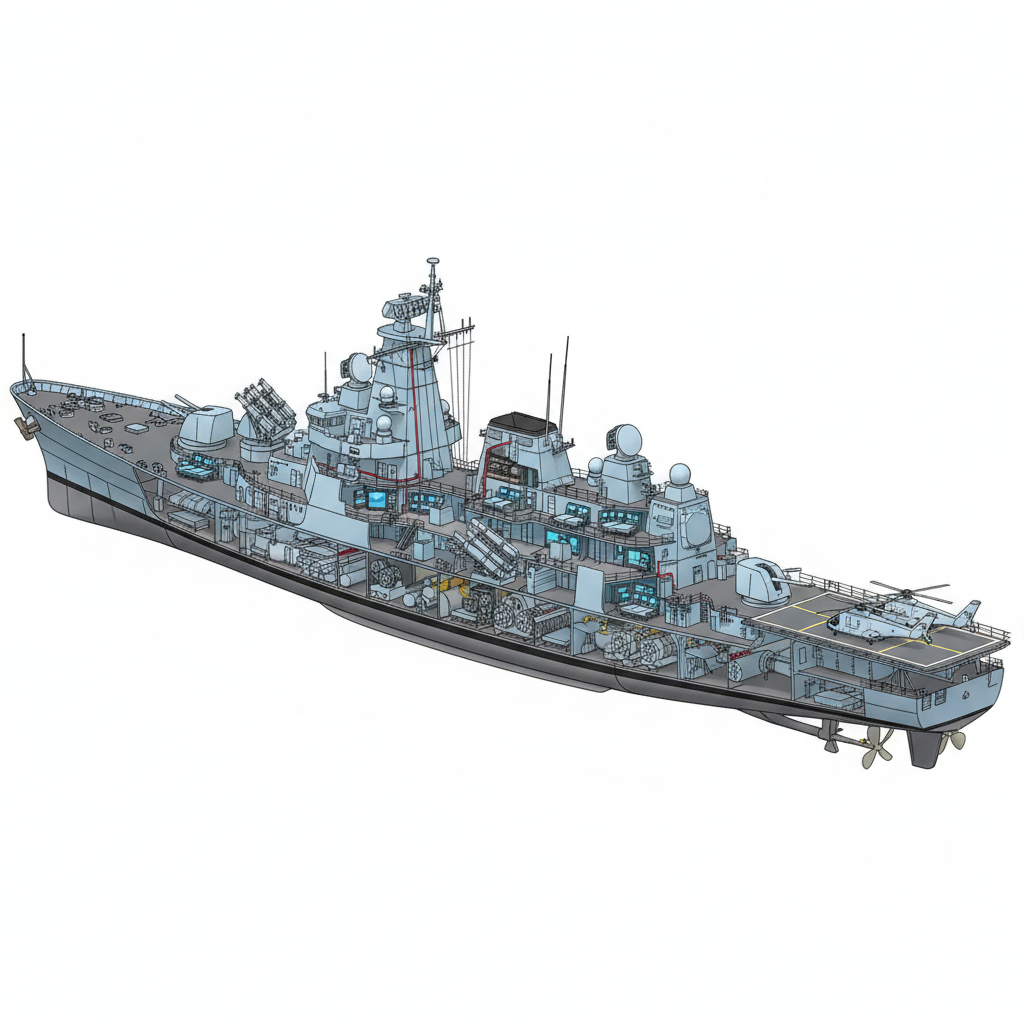
The participation of INS Mysore, a Kolkata-class guided-missile destroyer, in the fourth edition of Exercise Samudra Lakshmana (9–12 September 2026) at Lumut, Malaysia, underscores the growing operational and strategic engagement between the Indian Navy and the Royal Malaysian Navy. This exercise, conducted as part of India’s operational deployment, highlights the strengthening of maritime cooperation, interoperability, and professional exchanges between the two nations, aligning with broader India-Malaysia bilateral initiatives in the maritime domain.
Background
- The India-Malaysia bilateral relationship has historically emphasized maritime security, trade, and cultural ties, rooted in shared historical and geostrategic interests in the Indian Ocean and South China Sea regions.
- Exercise Samudra Lakshmana, initiated in 2018, is a biennial bilateral naval exercise aimed at enhancing mutual understanding, interoperability, and operational coordination between the Indian Navy and the Royal Malaysian Navy.
- The 12th India-Malaysia Sub-Committee Meeting held on 1 July 2026 reaffirmed commitments to deepen maritime security cooperation, including joint exercises, capacity-building, and information-sharing mechanisms.
- India’s ‘Act East Policy’ and ‘Security and Growth for All in the Region (SAGAR)’ initiative prioritize maritime partnerships with Southeast Asian nations, including Malaysia, to ensure a rules-based maritime order.
- The Indian Navy’s operational deployments, such as the deployment of INS Mysore, are part of its broader strategy to project maritime power, conduct joint exercises, and strengthen partnerships across the Indo-Pacific.
What is Exercise Samudra Lakshmana?
- A bilateral naval exercise between the Indian Navy and the Royal Malaysian Navy, conducted biennially since 2018.
- Aims to enhance interoperability, operational coordination, and mutual understanding between the two navies through professional and operational engagements.
- Includes a ‘Harbour Phase’ for port visits, professional exchanges, and joint planning, followed by a ‘Sea Phase’ for coordinated maritime operations.
- Focuses on practical exercises such as anti-submarine warfare, air defense, maritime patrol, and search-and-rescue operations.
- Strengthens maritime domain awareness and builds trust through joint training, thereby contributing to regional maritime security.
- Aligns with India’s broader maritime diplomacy under the ‘Act East Policy’ and ‘SAGAR’ initiative to foster stability and cooperation in the Indo-Pacific.
- The 2026 edition, hosted in Lumut, Malaysia, marks the fourth iteration of the exercise, reflecting the deepening strategic partnership between the two nations.
- Participation of advanced platforms like INS Mysore (a Kolkata-class destroyer) underscores the exercise’s operational significance and technological interoperability.
Key Features
| Feature | Significance |
|---|---|
| Bilateral Naval Exercise ‘Samudra Lakshmana’ | Institutionalises regular maritime cooperation between India and Malaysia, enhancing interoperability and operational coordination. |
| Port Phase (Professional Exchange) | Facilitates mutual learning, experience sharing, and trust-building through structured interactions between naval personnel. |
| Sea Phase (Operational Drills) | Conducts coordinated maritime exercises, including anti-piracy, search-and-rescue, and communication drills, to improve real-time operational synergy. |
| INS Mysore Participation | Demonstrates India’s operational reach and commitment to regional maritime security through active deployment in Southeast Asia. |
| RMN Ships KD Lekir & KD Gagah Samudera | Enhances bilateral naval interoperability by standardising procedures and protocols with partner nations. |
Why it Matters
Strategic Diplomacy
- Strengthens India’s Act East Policy by deepening defence cooperation with ASEAN nations, particularly Malaysia.
- Demonstrates India’s commitment to a rules-based maritime order through joint exercises with partner navies.
- Reinforces regional security architecture by promoting transparency and mutual confidence in the Indian Ocean Region (IOR).
Operational Readiness
- Validates the operational preparedness of the Indian Navy’s frontline warships in multinational maritime environments.
- Provides real-world training for crews in complex scenarios, including anti-submarine warfare and electronic warfare.
- Enhances the Indian Navy’s ability to project power and conduct joint operations with allied forces.
Maritime Security
- Contributes to counter-piracy, counter-terrorism, and maritime domain awareness in the Malacca Strait and adjacent waters.
- Supports the implementation of the Indo-Pacific Oceans Initiative (IPOI) through practical cooperation.
- Aligns with the ASEAN Outlook on the Indo-Pacific (AOIP), fostering shared security priorities.
Institutional Cooperation
- Builds on the India-Malaysia Sub-Committee meeting (July 2026) to institutionalise defence dialogues and joint exercises.
- Promotes standardisation of naval doctrines and communication protocols between the two navies.
- Encourages future engagements under frameworks like the ASEAN Defence Ministers’ Meeting-Plus (ADMM-Plus).
Challenges
1. Ensuring Sustained Operational Engagement
- Balancing the frequency of bilateral exercises with operational commitments of both navies.
- Addressing logistical constraints in deploying frontline warships for extended periods.
- Maintaining continuity in professional exchanges despite personnel rotations.
UPSC Link: GS Paper 2: India and its Neighbourhood
2. Standardising Interoperability Protocols
- Ensuring compatibility in communication systems, weapon platforms, and tactical doctrines.
- Overcoming differences in operational procedures and training standards between navies.
- Investing in joint training programmes to harmonise maritime security practices.
UPSC Link: GS Paper 3: Security Challenges
3. Geopolitical Sensitivity
- Navigating regional power dynamics, including China’s influence in the South China Sea.
- Avoiding perceptions of military alignment that could strain relations with other ASEAN members.
- Ensuring exercises do not inadvertently escalate tensions in disputed maritime zones.
UPSC Link: GS Paper 2: Effect of Policies and Politics of Developed and Developing Countries
Challenges — UPSC Perspective
| Issue | Concern |
|---|---|
| Logistical Constraints | Limited availability of frontline warships for prolonged deployments due to operational commitments. |
| Doctrinal Differences | Variations in naval doctrines and communication protocols hinder seamless interoperability. |
| Geopolitical Balancing | Need to ensure exercises do not exacerbate regional tensions or perceptions of military alignment. |
| Funding and Resources | Allocating sufficient budgetary resources for sustained bilateral naval cooperation. |
| Personnel Rotations | Frequent changes in naval personnel may disrupt continuity in professional exchanges. |
Way Forward
- Institutionalise the ‘Samudra Lakshmana’ exercise as an annual event to ensure regular engagement.
- Expand the scope of exercises to include advanced domains such as cybersecurity and space-based maritime surveillance.
- Develop a joint training curriculum for naval personnel to standardise operational procedures.
- Enhance logistical support through pre-positioned supplies and shared maintenance facilities.
- Strengthen maritime domain awareness by integrating sensor data and intelligence-sharing mechanisms.
- Explore trilateral or multilateral formats (e.g., with Indonesia or Singapore) to amplify regional security cooperation.
- Conduct joint post-exercise debriefs to identify lessons learned and areas for improvement.
UPSC Value Addition
Keywords for Mains Answer-Writing
INS Mysore · Exercise Samudra Lakshmana · bilateral naval exercises · interoperability · operational coordination · India-Malaysia maritime partnership · defence diplomacy · maritime security · Indian Navy · Royal Malaysian Navy · port phase · sea phase · professional exchange · operational deployment · defence cooperation
Concept Flow
India’s Act East Policy → Focus on ASEAN engagement → Bilateral defence cooperation with Malaysia. → Operational deployment of INS Mysore → Participation in ‘Samudra Lakshmana’ exercise. → Port phase (professional exchange) → Sea phase (operational drills) → Enhanced interoperability. → Institutionalisation of exercises → Strengthened maritime security in the Indian Ocean Region. → Alignment with ASEAN Outlook on the Indo-Pacific (AOIP) → Promotion of a rules-based maritime order.
Prelims Practice Questions
Q1. Consider the following statements regarding Exercise Samudra Lakshmana:
1. It is a bilateral naval exercise between India and Malaysia.
2. The exercise includes a port phase and a sea phase.
3. INS Mysore participated in the fourth edition of the exercise held in Lumut, Malaysia.
4. The exercise focuses solely on combat drills and excludes professional exchanges.
How many of the above statements are correct?
- Only one
- Only two
- Only three
- All
Answer: Only three — Statements 1, 2, and 3 are correct. Statement 4 is incorrect as the exercise includes both combat drills and professional exchanges during the port phase.
Q2. Assertion (A): The primary objective of Exercise Samudra Lakshmana is to enhance maritime security in the Indian Ocean Region.
Reason (R): The exercise is conducted annually to strengthen the operational interoperability between the Indian Navy and the Royal Malaysian Navy.
In the context of the above two statements, which one of the following is correct?
- Both A and R are true, and R is the correct explanation of A
- Both A and R are true, but R is not the correct explanation of A
- A is true, but R is false
- A is false, but R is true
Answer: A is true, but R is false — Assertion (A) is true as the exercise aims to enhance maritime security, but Reason (R) is also true and provides a correct explanation of the assertion.
Q3. Match the following naval exercises with their respective partner countries:
Column I (Exercise) | Column II (Partner Country)
——————-|————————
1. Exercise Samudra Lakshmana | A. Singapore
2. Exercise Malabar | B. Malaysia
3. Exercise Varuna | C. France
4. Exercise SIMBEX | D. Indonesia
Select the correct match:
- 1-B, 2-A, 3-C, 4-D; 1-B, 2-C, 3-D, 4-A; 1-A, 2-B, 3-C, 4-D; 1-D, 2-C, 3-B, 4-A
- answer
- explain
- format
- match
Answer: 1-B, 2-A, 3-C, 4-D; 1-B, 2-C, 3-D, 4-A; 1-A, 2-B, 3-C, 4-D; 1-D, 2-C, 3-B, 4-A —
Mains Practice Question
✍ The bilateral naval exercise ‘Samudra Lakshmana’ exemplifies India’s expanding maritime partnerships in the Indo-Pacific region. In this context, critically examine the significance of such exercises for India’s defence diplomacy and maritime security architecture. (15 Marks)
Approach: MODEL-ANSWER SKELETON:
1. **Introduction (2 Marks)**: Define bilateral naval exercises and their role in defence diplomacy. Mention the specific context of Exercise Samudra Lakshmana and its fourth edition.
2. **Significance for Defence Diplomacy (5 Marks)**:
– Strengthening bilateral relations with partner countries (e.g., Malaysia) through institutionalised engagement.
– Building trust and mutual confidence in maritime domains.
– Enhancing interoperability and operational coordination between navies.
– Demonstrating India’s commitment to regional maritime security frameworks (e.g., ASEAN-led initiatives, Indo-Pacific Oceans Initiative).
3. **Contribution to Maritime Security Architecture (5 Marks)**:
– Addressing common maritime challenges (piracy, illegal fishing, smuggling, and terrorism).
– Promoting rules-based order in the Indo-Pacific, aligning with India’s SAGAR doctrine.
– Facilitating information-sharing and joint patrolling mechanisms.
– Enhancing capacity-building and professional exchanges (port phase discussions, training).
4. **Challenges and Limitations (3 Marks)**:
– Resource constraints and operational limitations of participating navies.
– Need for sustained political commitment and institutional frameworks.
– Balancing bilateral engagements with multilateral commitments (e.g., Quad, ASEAN).
5. **Conclusion (2 Marks)**: Summarise the strategic value of such exercises and their role in India’s broader maritime security strategy.
Source: PIB (Press Information Bureau)
Karnataka PCS (KPSC) — State PCS Practice
Prelims: Which Indian Naval Ship (INS) participated in the fourth edition of the ‘Samudra Lakshman’ exercise held in Lumut, Malaysia?
- A. INS Vikramaditya
- B. INS Mysore
- C. INS Chennai
- D. INS Kolkata
Answer: B. INS Mysore — INS Mysore, a guided missile destroyer, represented the Indian Navy in the ‘Samudra Lakshman’ exercise conducted in Malaysia.
Mains: Discuss the strategic significance of the ‘Samudra Lakshman’ exercise for India-Malaysia defense cooperation, with a focus on Karnataka’s role in naval diplomacy and maritime security.
Generated by AanyaAi for educational purpose.
Related guides on our sites
- Current affairs for upsc 2026
- How to prepare for GS paper 1 for UPSC CSE mains exam
- Best UPSC coaching for IFOS exam
- Best mentorship programme for upsc

- INS Mysore Participates in Exercise Samudra Laksamana 2026: Key Takeaways for UPSC - September 14, 2026
- यूपीएससी तैयारी: गुजरात में हुआर संरक्षण के लिए नया एक्शन प्लान, जानिए डिटेल्स - September 14, 2026
- Gujarat Action Plan for Great Indian Bustard Conservation: Key UPSC Focus - September 14, 2026

No Comments