


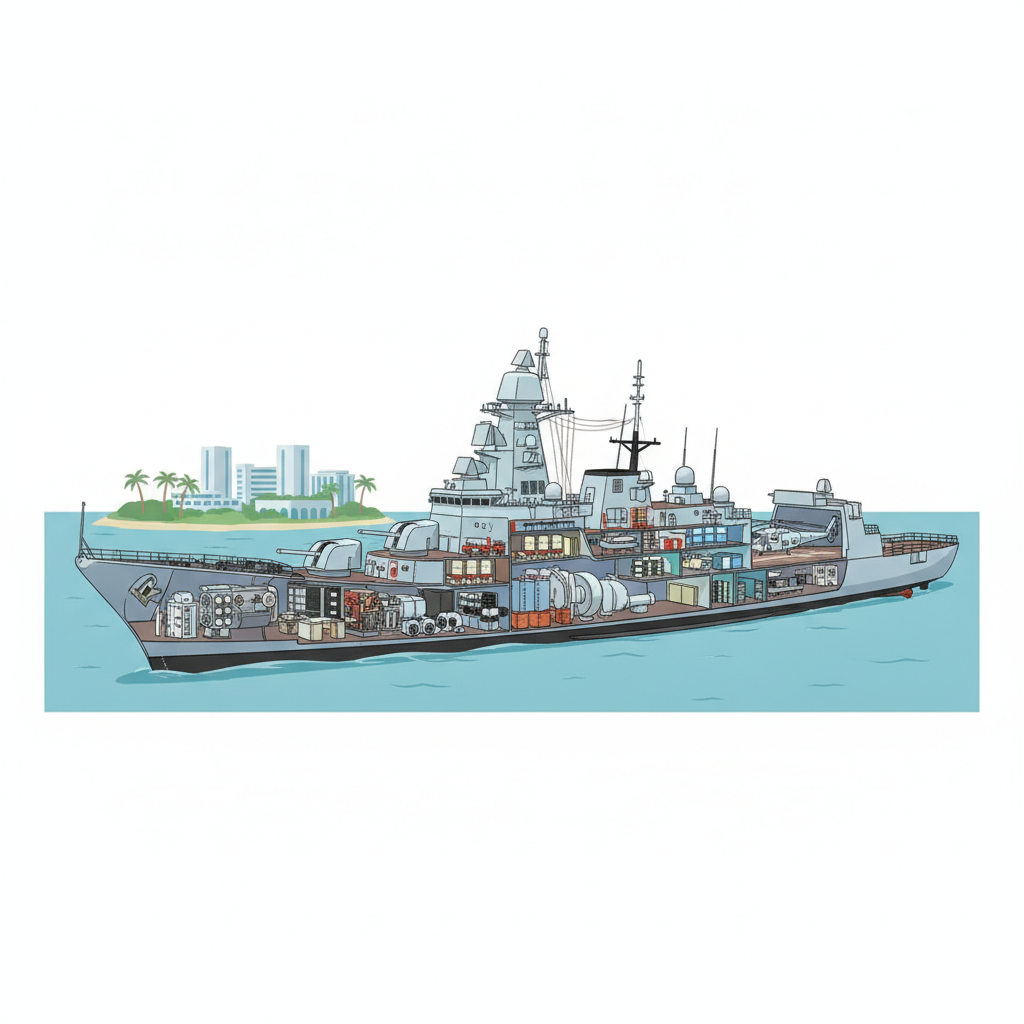
10 Sep INS Mysore reaches Lumut for 4th ‘Samudra Lakshmana’ naval exercise
✎ The 'Samudra Lakshmana' exercise is a bilateral maritime exercise between the Indian Navy and the Royal Malaysian Navy, aimed at enhancing interoperability, professional exchanges, and mutual understanding through harbour and sea…
Subject Relevance — Where This Topic Fits
- GS Paper II — International Relations: Bilateral, Regional and Global Groupings and Agreements involving India and/or affecting India’s interests | GS Paper III — Security: Challenges to Internal Security through External State and Non-State Actors
- Prelims: INS Mysore, Samudra Lakshmana, Royal Malaysian Navy, Lumut Naval Base, ASEAN-India Maritime Cooperation Year 2026, India’s Maritime Doctrine, Cross-deck visits, Maritime Domain Awareness
- Essay: India’s Act East Policy: Strategic Imperatives and Maritime Diplomacy, The Role of Naval Diplomacy in India’s Foreign Policy: Soft Power and Strategic Partnerships
Quick Revision: The ‘Samudra Lakshmana’ exercise is a bilateral maritime exercise between the Indian Navy and the Royal Malaysian Navy, aimed at enhancing interoperability, professional exchanges, and mutual understanding through harbour and sea phases, including cross-deck visits and operational interactions.
Why is this in the news?
The arrival of INS Mysore at the Lumut Naval Base, Malaysia, on 9 September 2026, to participate in the fourth edition of the bilateral maritime exercise ‘Samudra Lakshmana’ underscores the growing operational engagement between the Indian Navy and the Royal Malaysian Navy. This exercise, conducted under India’s operational deployment, serves as a platform for professional exchanges, interoperability enhancement, and mutual understanding, aligning with India’s broader maritime strategy and ASEAN-India maritime cooperation initiatives.
Background
- The 12th India-Malaysia Sub-Committee meeting held on 1 July 2026 provided impetus to bilateral defence engagements, including maritime cooperation.
- The ASEAN-India Maritime Cooperation Year 2026 aims to deepen maritime collaboration between India and ASEAN member states.
What is the ‘Samudra Lakshmana’ Exercise?
- A bilateral maritime exercise between the Indian Navy and the Royal Malaysian Navy, designed to enhance interoperability, professional exchanges, and mutual understanding.
- The exercise includes both harbour and sea phases, with activities such as cross-deck visits, operational interactions, and sports events.
- Cross-deck visits allow naval personnel to observe and learn from each other’s operational procedures, equipment, and training methodologies.
- Operational interactions involve discussions on maritime security challenges, including anti-piracy, search and rescue, and maritime domain awareness.
- Sports events foster camaraderie and team-building among participating naval personnel, reinforcing the human dimension of military cooperation.
- The exercise is conducted under the aegis of India’s operational deployment, signifying its integration into the Indian Navy’s routine maritime engagements.
- The fourth edition of the exercise in 2026 aligns with India’s broader maritime strategy and the ASEAN-India Maritime Cooperation Year 2026.
- The exercise contributes to the operational readiness of both navies, enabling them to respond effectively to maritime security challenges in the Indian Ocean and South China Sea regions.
Key Features
| Feature | Significance |
|---|---|
| Bilateral maritime exercise ‘Samudra Lakshmana’ | Institutionalises interoperability and professional exchange between the Indian Navy and Royal Malaysian Navy through joint drills and cross-deck visits. |
| Port and sea phase activities | Encompasses operational interactions, professional engagements, and sporting events to enhance mutual understanding and operational synergy. |
| Operational deployment of INS Mysore | Demonstrates India’s sustained maritime presence and commitment to regional security architecture in the Indo-Pacific. |
| Cross-deck visits and professional exchanges | Facilitates knowledge sharing on naval tactics, maintenance protocols, and crisis management among personnel. |
| Alignment with ASEAN-India Maritime Cooperation Year 2026 | Reinforces India’s strategic outreach within ASEAN frameworks and promotes collective maritime security initiatives. |
Why it Matters
Strategic Security Cooperation
- Strengthens maritime domain awareness and coordinated responses to non-traditional threats such as piracy, illegal fishing, and smuggling in the Bay of Bengal and Andaman Sea.
- Enhances India’s operational reach in the South China Sea and Malacca Strait, critical chokepoints for global trade and energy flows.
- Demonstrates India’s commitment to a rules-based maritime order and adherence to the United Nations Convention on the Law of the Sea (UNCLOS).
Diplomatic and Geopolitical
- Reinforces India’s Act East Policy by deepening defence engagements with ASEAN member states, particularly Malaysia.
- Contributes to the ASEAN Outlook on the Indo-Pacific (AOIP) by fostering maritime security partnerships.
- Supports India’s vision of SAGAR (Security and Growth for All in the Region) through capacity-building and joint exercises.
Operational and Technological
- Provides real-world operational exposure to Indian naval personnel in diverse maritime environments.
- Facilitates exchange of best practices in naval warfare, logistics, and cyber-domain operations.
- Promotes standardisation of communication protocols and interoperability of naval assets.
Economic and Logistical
- Supports safe and secure sea lanes of communication (SLOCs) essential for trade and energy security.
- Enhances port call logistics, which can reduce turnaround times and improve operational efficiency.
- Encourages mutual logistics support agreements (MLSA) that streamline future joint operations.
Challenges
1. Divergent Naval Modernisation Timelines
- India and Malaysia may operate fleets with varying technological maturity, affecting seamless interoperability.
- Differences in procurement timelines and indigenous defence production capacities can create capability gaps.
UPSC Link: GS III: Defence & Security
2. Regional Maritime Disputes
- Presence of unresolved maritime boundary claims in the South China Sea may influence strategic posturing.
- Need to balance engagement with all claimant states while avoiding entanglement in geopolitical rivalries.
UPSC Link: GS II: International Relations
3. Logistical and Infrastructure Constraints
- Limited port infrastructure in certain ASEAN nations may restrict the scope of large-scale exercises.
- Maintenance of long-range operational deployments requires sustained budgetary and logistical support.
UPSC Link: GS III: Infrastructure
4. Cyber and Information Security Risks
- Increased digital interoperability raises vulnerabilities to cyber threats and electronic warfare.
- Ensuring secure communication channels during joint operations remains a critical challenge.
UPSC Link: GS III: Science & Technology
5. Balancing Bilateral and Multilateral Engagements
- India must harmonise bilateral exercises like Samudra Lakshmana with broader multilateral frameworks such as the ASEAN Defence Ministers’ Meeting (ADMM-Plus).
- Avoiding duplication of efforts while maximising strategic impact requires careful prioritisation.
UPSC Link: GS II: International Organisations
Challenges — UPSC Perspective
| Issue | Concern |
|---|---|
| Asymmetric Threats | Piracy, arms smuggling, and illegal migration in the region require coordinated surveillance and response mechanisms. |
| Climate Change Impact | Rising sea levels and extreme weather events threaten naval infrastructure and operational readiness. |
| Defence Industrial Collaboration | Limited joint R&D and co-production initiatives hinder long-term technological synergy. |
| Maritime Domain Awareness | Inadequate real-time data sharing and sensor networks limit effective monitoring of vast maritime zones. |
| Legal and Jurisdictional Issues | Differences in maritime law enforcement and extradition protocols complicate joint operations. |
Way Forward
- Institutionalise annual or biennial editions of ‘Samudra Lakshmana’ with expanded scope, including submarine and air operations.
- Establish a joint maritime training centre in the Indian Ocean or Southeast Asia to standardise protocols and share best practices.
- Develop a shared maritime domain awareness system utilising satellite and AI-driven analytics for real-time threat detection.
- Enhance logistics support agreements to include fuel, spares, and medical facilities for sustained deployments.
- Promote joint research in maritime technologies such as unmanned systems, AI for threat assessment, and green propulsion.
- Strengthen cybersecurity frameworks to safeguard communication networks during joint exercises and operations.
- Integrate the exercise with other ASEAN-led initiatives like the ASEAN Maritime Forum to foster broader regional cooperation.
UPSC Value Addition
Keywords for Mains Answer-Writing
Indo-Malaysia bilateral maritime cooperation · SIMBEX (Singapore-India Maritime Bilateral Exercise) · ASEAN-India Maritime Cooperation Year 2026 · Indian Navy’s operational deployment · interoperability in naval exercises · maritime security architecture · defence diplomacy · cross-deck visits · professional exchanges in naval operations · maritime domain awareness · India’s Act East Policy · regional maritime cooperation frameworks · naval diplomacy · maritime confidence-building measures
Constitutional & Policy Linkages
- [‘Article 51 (DPSP): Promotion of international peace and security.’, ‘Directly aligns with India’s maritime diplomacy.’]
- [‘Article 73 (Executive Power of Union): Defence cooperation falls under Union’s jurisdiction.’, ‘Ensures legal framework for naval engagements.’]
Concept Flow
India’s Act East Policy → Enhanced defence engagements with ASEAN → Bilateral maritime exercises (Samudra Lakshmana) → Operational deployment of INS Mysore → Joint drills and professional exchanges → Strengthened maritime security cooperation → Alignment with ASEAN-India Maritime Cooperation Year 2026 → Reinforced India’s SAGAR vision.
Prelims Practice Questions
Q1. Consider the following statements regarding the ‘Samudra Lakshmana’ exercise:
1. It is a bilateral maritime exercise between the Indian Navy and the Royal Malaysian Navy.
2. The exercise includes port and sea phases with professional activities such as cross-deck visits and operational interactions.
3. The exercise is conducted under the framework of the ASEAN-India Maritime Cooperation Year 2025.
How many of the above statements are correct?
- Only one
- Only two
- All three
- None
Answer: Only two — Statement 1 and 2 are correct as per the press release. Statement 3 is incorrect because the exercise aligns with the ASEAN-India Maritime Cooperation Year 2026, not 2025.
Q2. Assertion (A): The ‘Samudra Lakshmana’ exercise is designed to enhance interoperability between the Indian Navy and the Royal Malaysian Navy.
Reason (R): The exercise includes professional activities such as cross-deck visits, operational interactions, and sporting events.
In the context of the above two statements, which one of the following is correct?
- Both A and R are true and R is the correct explanation of A.
- Both A and R are true but R is NOT the correct explanation of A.
- A is true but R is false.
- A is false but R is true.
Answer: Both A and R are true and R is the correct explanation of A. — Both A and R are true, and R correctly explains A as the activities mentioned in R are specifically aimed at enhancing interoperability and mutual understanding.
Q3. Which of the following best describes the primary objective of the ‘Samudra Lakshmana’ exercise?
- To conduct joint military operations against piracy in the South China Sea.
- To enhance maritime domain awareness and interoperability between the Indian Navy and the Royal Malaysian Navy.
- To establish a permanent naval base in Malaysia for the Indian Navy.
- To resolve maritime boundary disputes between India and Malaysia.
Answer: To enhance maritime domain awareness and interoperability between the Indian Navy and the Royal Malaysian Navy. — The primary objective of the exercise is to enhance maritime domain awareness, interoperability, and mutual understanding through professional exchanges and joint activities.
Mains Practice Question
✍ The bilateral maritime exercise ‘Samudra Lakshmana’ exemplifies India’s commitment to strengthening maritime cooperation with ASEAN nations. Critically examine the strategic significance of such exercises for India’s maritime security architecture and its foreign policy objectives. Also, discuss how these exercises contribute to India’s Act East Policy. (15 Marks)
Approach: MODEL-ANSWER SKELETON:
1. **Introduction (2 Marks)**
– Define maritime security architecture and its components (e.g., naval diplomacy, joint exercises, maritime domain awareness).
– Briefly introduce the ‘Samudra Lakshmana’ exercise as a case study of India’s bilateral maritime cooperation.
2. **Strategic Significance for Maritime Security (5 Marks)**
– Enhancing interoperability: Cite examples of joint drills, cross-deck visits, and operational interactions.
– Maritime domain awareness: Discuss how such exercises improve surveillance and response capabilities in shared maritime zones.
– Confidence-building measures: Highlight the role of exercises in reducing mistrust and promoting transparency.
– Regional stability: Link to broader frameworks like the ASEAN Regional Forum (ARF) and the Indo-Pacific strategy.
3. **Contribution to India’s Foreign Policy Objectives (4 Marks)**
– Act East Policy: Explain how maritime exercises align with the policy’s goals of deepening economic and security ties with ASEAN.
– Balancing China: Discuss the exercise’s role in countering China’s assertiveness in the Indian Ocean and South China Sea (without naming parties).
– Soft power and diplomacy: Emphasise the role of naval diplomacy in fostering goodwill and strategic partnerships.
4. **Challenges and Limitations (3 Marks)**
– Resource constraints: Limited naval assets and operational deployments.
– Geopolitical complexities: Navigating alliances and rivalries in the region.
– Sustainability: Ensuring long-term commitment to such exercises amid domestic priorities.
5. **Conclusion (1 Mark)**
– Summarise the exercise’s role in India’s maritime security and foreign policy, and its potential for future expansion.
Source: PIB (Press Information Bureau)
Karnataka PCS (KPSC) — State PCS Practice
Prelims: Which of the following statements is correct regarding the ‘Samudra Laksamana’ exercise, in which INS Mysore participated in its fourth edition in 2024?
- A. It is a bilateral naval exercise between India and Malaysia conducted annually.
- B. The exercise is part of the Indian Navy’s outreach to strengthen maritime cooperation in the Indian Ocean Region.
- C. INS Mysore is a guided missile destroyer participating in the exercise for the first time.
- D. The exercise focuses solely on submarine warfare and anti-submarine operations.
Answer: B. The exercise is part of the Indian Navy’s outreach to strengthen maritime cooperation in the Indian Ocean Region. — The ‘Samudra Laksamana’ exercise is a bilateral naval exercise between India and Malaysia aimed at enhancing maritime cooperation, and INS Mysore participated in its fourth edition in 2024.
Mains: Discuss the significance of the ‘Samudra Laksamana’ exercise for Karnataka’s maritime security and its role in strengthening India-Malaysia defense cooperation. (150 words)
Generated by AanyaAi for educational purpose.
Related guides on our sites
- Current affairs for upsc 2026
- How to prepare for GS paper 1 for UPSC CSE mains exam
- Best UPSC coaching for IFOS exam
- Best mentorship programme for upsc

- आईएनएस मैसूर पहुंचा मलेशिया, ‘समुद्र लक्ष्मण’ अभ्यास के चौथे संस्करण में भागीदारी - September 10, 2026
- INS Mysore reaches Lumut for 4th ‘Samudra Lakshmana’ naval exercise - September 10, 2026
- UPSC Civil Services (Main) Examination 2026 — Economics Optional Paper II: Questions with Model Answers | Plutus IAS - September 10, 2026

No Comments