


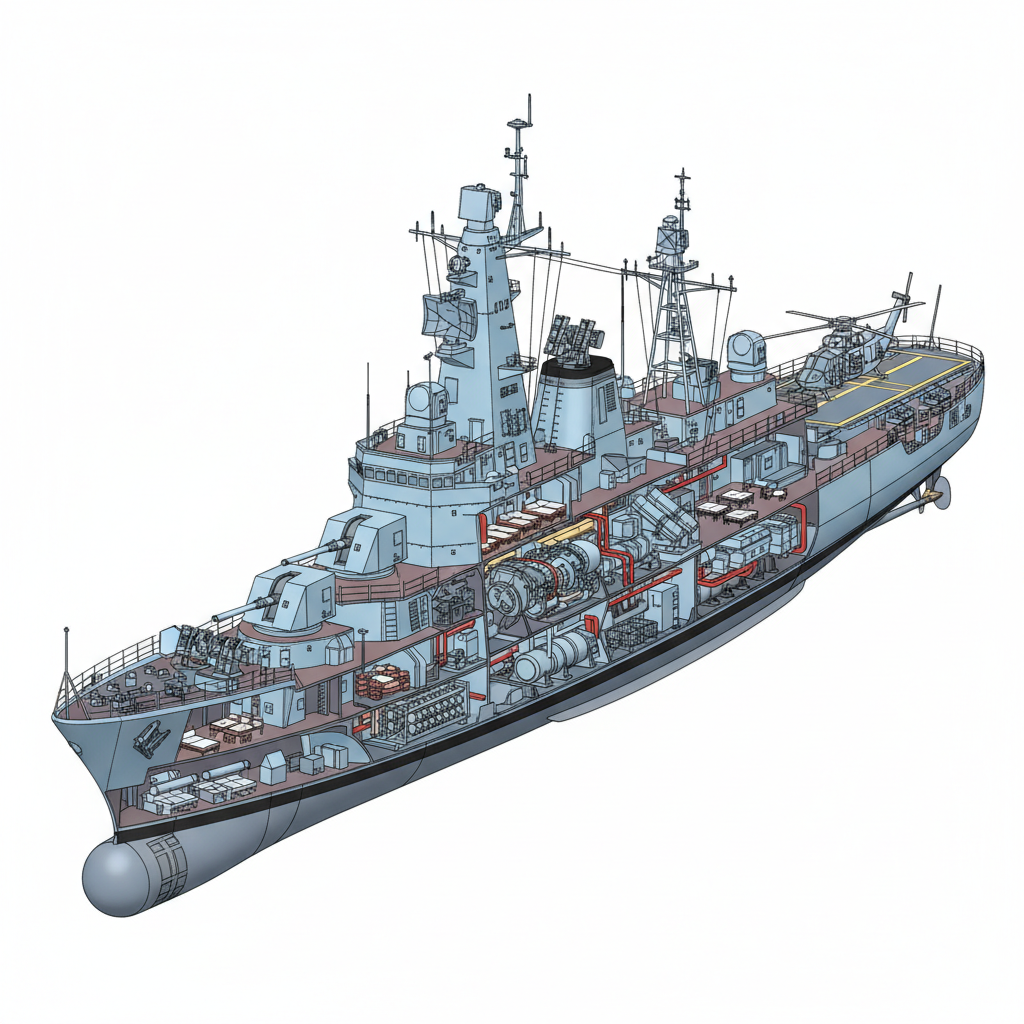
24 Sep INS Trishul reaches Toulon for 24th Varuna Naval Exercise with France
✎ The 'Varuna' exercise is a bilateral maritime exercise between India and France, aimed at enhancing operational interoperability, mutual understanding, and strategic cooperation in the Indo-Pacific region.
Subject Relevance — Where This Topic Fits
- GS Paper II — International Relations: Bilateral and Multilateral Groupings and Agreements involving India and affecting India’s interests | GS Paper III — Security: Challenges to Internal Security through External State and Non-State Actors
- Prelims: INS Trishul, Varuna Exercise, Toulon, Indo-French Strategic Partnership, INS Vikramaditya, Exclusive Economic Zone (EEZ), Blue Economy, Maritime Security, Indo-Pacific Strategy
- Essay: The evolving architecture of India’s maritime diplomacy in the Indo-Pacific, The role of strategic partnerships in ensuring national security
Quick Revision: The ‘Varuna’ exercise is a bilateral maritime exercise between India and France, aimed at enhancing operational interoperability, mutual understanding, and strategic cooperation in the Indo-Pacific region.
Why is this in the news?
On 22 September 2026, the Indian Naval Ship (INS) Trishul arrived at Toulon, France, to participate in the 24th edition of the bilateral maritime exercise ‘Varuna’ with the French Navy. This exercise underscores the deepening maritime cooperation between India and France, reflecting their shared commitment to enhancing interoperability, operational synergy, and mutual understanding in maritime domains. The event is of strategic importance given the evolving geopolitical dynamics in the Indo-Pacific region.
Background
- India and France share a robust maritime relationship, anchored in shared democratic values, historical ties, and convergent strategic interests in the Indo-Pacific region.
- France is a key partner for India in the Indo-Pacific, with both nations advocating for a rules-based order, freedom of navigation, and respect for international law in maritime domains.
- The exercise aligns with India’s broader maritime security strategy, which includes enhancing cooperation with like-minded partners to address emerging challenges such as piracy, terrorism, and climate-induced maritime risks.
- The Indo-Pacific region has emerged as a critical geopolitical theatre, with major powers including India, France, the United States, Japan, and Australia engaging in strategic partnerships to ensure regional stability.
What is the ‘Varuna’ Exercise?
- The ‘Varuna’ exercise is a bilateral maritime exercise between the Indian Navy and the French Navy, designed to enhance operational interoperability and strengthen mutual understanding.
- The exercise includes both harbour and sea phases, featuring professional interactions, cross-deck visits, operational drills, and sports activities to foster camaraderie and teamwork.
- The exercise provides a platform for sharing best practices, technological insights, and operational doctrines, thereby enhancing the combat readiness of both navies.
- It serves as a confidence-building measure, reinforcing the strategic partnership between India and France in the maritime domain.
- Participation in such exercises enhances India’s maritime domain awareness and strengthens its ability to respond to emerging challenges in the Indo-Pacific.
Key Features
| Feature | Significance |
|---|---|
| Port Phase Activities | Facilitates cross-deck visits, operational interactions, and professional exchanges, enabling mutual learning and standardisation of procedures. |
| Sea Phase Exercises | Enhances interoperability through joint drills, tactical manoeuvres, and simulated scenarios, critical for combined maritime operations. |
| Cultural and Sports Activities | Promotes camaraderie and mutual understanding between personnel, fostering long-term professional relationships. |
| Bilateral Maritime Partnership | Reinforces India-France strategic maritime cooperation, aligning with broader Indo-Pacific security frameworks. |
| Platform and Crew Integration | Exposes Indian naval personnel to advanced French naval technologies and operational doctrines, improving combat readiness. |
Why it Matters
Strategic Security
- Strengthens maritime domain awareness in the Indo-Pacific, a critical theatre for global trade and geopolitical stability.
- Demonstrates India’s commitment to maritime security partnerships, complementing its Act East Policy and SAGAR doctrine.
- Enhances operational readiness for combined naval operations, including anti-piracy, search and rescue, and HADR missions.
Defence Diplomacy
- Deepens defence cooperation under the India-France Strategic Partnership, formalised through the 2018 Joint Vision Statement.
- Provides a platform for joint capability development, including technology transfer and co-development of defence equipment.
- Supports India’s objective of reducing dependence on single-source defence imports through diversified partnerships.
Operational Interoperability
- Improves compatibility between Indian and French naval platforms, communications systems, and tactical procedures.
- Facilitates seamless integration in multinational exercises, such as MALABAR, enhancing collective security in the region.
- Enables sharing of best practices in areas like cybersecurity, electronic warfare, and maritime domain awareness.
Economic and Industrial Collaboration
- Promotes defence industrial cooperation, including joint ventures in shipbuilding, aerospace, and defence electronics.
- Encourages technology transfer and skill development, aligning with India’s Atmanirbhar Bharat initiative in defence manufacturing.
- Supports the development of indigenous naval platforms by exposing Indian engineers to cutting-edge foreign technologies.
Maritime Governance and Rules-Based Order
- Reinforces adherence to international maritime laws, including UNCLOS, through joint exercises and operational drills.
- Demonstrates India’s role as a net security provider in the Indian Ocean Region (IOR), ensuring freedom of navigation.
- Contributes to regional stability by deterring non-state threats and enhancing maritime domain awareness.
Challenges
1. Geopolitical Alignments and Neutrality
- Balancing partnerships with multiple naval powers while maintaining strategic autonomy in the Indo-Pacific.
- Avoiding perceptions of alignment with any single bloc, which could complicate India’s foreign policy objectives.
- Ensuring that bilateral exercises do not escalate tensions with other regional stakeholders.
UPSC Link: GS-II: India’s Foreign Policy
2. Operational Readiness and Logistics
- Maintaining high operational readiness of naval platforms for prolonged deployments and joint exercises.
- Ensuring seamless logistics support across distant theatres, including fuel, spares, and maintenance.
- Managing crew fatigue and rotation schedules for sustained participation in international exercises.
UPSC Link: GS-III: Defence Logistics
3. Technology Transfer and Indigenous Development
- Overcoming technology denial regimes and ensuring timely access to advanced naval technologies.
- Accelerating the indigenisation of critical components to reduce reliance on foreign suppliers.
- Balancing the need for technology transfer with national security imperatives.
UPSC Link: GS-III: Defence Manufacturing
4. Maritime Domain Awareness and Surveillance
- Enhancing real-time maritime surveillance capabilities to counter asymmetric threats like piracy and smuggling.
- Integrating AI and data analytics for predictive maritime domain awareness in vast oceanic regions.
- Ensuring interoperability with allied navies for seamless information sharing.
UPSC Link: GS-III: Maritime Security
5. Climate Change and Environmental Sustainability
- Addressing the environmental impact of naval operations, including fuel consumption and waste management.
- Adopting green technologies in naval platforms to align with global climate commitments.
- Ensuring sustainable practices in maritime exercises to minimise ecological footprint.
UPSC Link: GS-III: Environmental Governance
Challenges — UPSC Perspective
| Issue | Concern |
|---|---|
| Technology Denial Regimes | Limits access to advanced naval technologies, impeding indigenous development. |
| Logistics Over Stretch | Prolonged deployments strain maintenance and supply chains, affecting operational readiness. |
| Geopolitical Balancing | Risk of alienating other strategic partners while deepening ties with France. |
| Maritime Surveillance Gaps | Inadequate real-time data integration hampers effective domain awareness. |
| Environmental Compliance | Naval operations contribute to carbon emissions; sustainable alternatives are needed. |
Way Forward
- Strengthen bilateral maritime exercises by increasing frequency and complexity of drills.
- Accelerate technology transfer initiatives under the India-France defence cooperation framework.
- Develop a joint maritime domain awareness system integrating AI and satellite data.
- Enhance indigenous shipbuilding capabilities through technology absorption from French partners.
- Establish a dedicated logistics support framework for sustained naval deployments.
- Promote joint research and development in green naval technologies to reduce environmental impact.
- Expand the scope of exercises to include cybersecurity and electronic warfare domains.
- Formalise a long-term strategic partnership roadmap with clear milestones for defence cooperation.
UPSC Value Addition
Keywords for Mains Answer-Writing
INS Trishul · Varuna bilateral naval exercise · India-France strategic partnership · Maritime interoperability · Defence cooperation · Toulon naval base · Port and sea phase activities · Cross-deck visits · Operational interactions · Maritime security architecture · Indo-Pacific region · Defence diplomacy · Naval exercises and their significance
Concept Flow
Bilateral naval exercises → Strengthened maritime security cooperation → Enhanced interoperability → Interoperability → Seamless combined operations → Improved collective security → Collective security → Deterrence of non-state threats → Stability in the Indo-Pacific → Stability in the Indo-Pacific → Safeguarding global trade routes → Economic prosperity → Economic prosperity → Enhanced national security → Strategic autonomy → Strategic autonomy → Balanced foreign policy → Global leadership
Prelims Practice Questions
Q1. Consider the following statements regarding the Varuna bilateral naval exercise:
1. It is conducted between the Indian Navy and the French Navy.
2. The 24th edition of Varuna is being held in Toulon, France.
3. The exercise includes only port-phase activities and excludes sea-phase activities.
4. The primary objective is to enhance interoperability between the two navies.
How many of the above statements are correct?
- Only one
- Only two
- Only three
- All four
Answer: Only three — Statements 1, 2, and 4 are correct. Statement 3 is incorrect as the exercise includes both port and sea-phase activities.
Q2. Assertion (A): The Varuna naval exercise is a platform for the Indian Navy to demonstrate its operational capabilities to the French Navy.
Reason (R): The exercise includes cross-deck visits, operational interactions, and sports activities aimed at fostering mutual understanding and interoperability.
Codes:
A. Both A and R are true, and R is the correct explanation of A.
B. Both A and R are true, but R is not the correct explanation of A.
C. A is true, but R is false.
D. A is false, but R is true.
- A
- B
- C
- D
Answer: A — Both A and R are true, and R correctly explains A as the activities listed in R are designed to enhance mutual understanding and operational capabilities.
Q3. Which of the following is NOT a component of the Varuna bilateral naval exercise between India and France?
- Cross-deck visits
- Operational interactions
- Sports activities
- Ground-based missile launches
Answer: Ground-based missile launches — Ground-based missile launches are not a component of the Varuna naval exercise, which focuses on maritime interoperability and naval operations.
Mains Practice Question
✍ The Varuna bilateral naval exercise exemplifies the deepening maritime cooperation between India and France. In this context, critically examine the significance of such naval exercises for India’s maritime security architecture and its strategic engagements in the Indo-Pacific region. (15 Marks)
Approach: MODEL-ANSWER SKELETON:
1. Introduction: Define the Varuna exercise and its bilateral nature (1 mark).
2. Strategic significance of naval exercises: Enhancing interoperability, operational experience, and trust-building (3 marks).
3. Maritime security architecture: Role of exercises in addressing non-traditional threats (piracy, terrorism, illegal trafficking) and traditional threats (maritime boundary disputes, power projection) (4 marks).
4. Indo-Pacific engagement: India’s Act East Policy, France’s Indo-Pacific strategy, and the QUAD framework (3 marks).
5. Challenges and limitations: Logistical constraints, cost, and balancing partnerships with other major powers (2 marks).
6. Conclusion: Summarise the importance of such exercises in fostering defence diplomacy and maritime stability (2 marks).
Source: PIB (Press Information Bureau)
Generated by AanyaAi for educational purpose.
Related guides on our sites
- Anthropology VS PSIR
- Best PSIR optional coaching
- Best PSIR optional coaching online
- Best PSIR optional teacher

- आईएनएस त्रिशूल फ्रांस पहुंचा, ‘वरुण 2026’ अभ्यास में भाग लेने के लिए - September 24, 2026
- INS Trishul reaches Toulon for 24th Varuna Naval Exercise with France - September 24, 2026
- तृणमूल कांग्रेस नाम-चिह्न विवाद: सुप्रीम कोर्ट ने चुनाव आयोग से पूछा- अंतिम फैसला कब तक होगा? - September 24, 2026

No Comments