


18 Oct Iran’s 7-Day Strait of Hormuz Proposal: Key Facts for UPSC & PCS
✎ The Strait of Hormuz is a critical maritime chokepoint through which 20% of global oil and LNG trade passes, making it a focal point for geopolitical tensions, particularly between Iran and the United States, with proposals for…
Subject Relevance — Where This Topic Fits
- GS Paper II — International Relations: Bilateral, Regional and Global Groupings and Agreements involving India and/or affecting India’s interests | GS Paper II — India and its Neighbourhood — Relations with West Asia | GS Paper III — Effects of Liberalisation on the Economy, Changes in Industrial Policy and their Effects on Industrial Growth
- Prelims: Strait of Hormuz, Choke point, International Maritime Organisation (IMO), UN Convention on the Law of the Sea (UNCLOS), Economic sanctions, Frozen assets, Maritime security, West Asia geopolitics
- Essay: Energy security and global trade: The Strait of Hormuz as a critical chokepoint, Diplomacy in the face of sanctions: Pathways to de-escalation in West Asia
Quick Revision: The Strait of Hormuz is a critical maritime chokepoint through which 20% of global oil and LNG trade passes, making it a focal point for geopolitical tensions, particularly between Iran and the United States, with proposals for its reopening contingent upon the lifting of sanctions and the cessation of hostilities.
Why is this in the news?
The proposal by Iran to reopen the Strait of Hormuz within seven days, contingent upon the lifting of US sanctions and the cessation of hostilities, has brought renewed attention to the strategic importance of this maritime chokepoint and the broader geopolitical dynamics in West Asia. The proposal, first articulated at the UN General Assembly, reflects ongoing efforts to de-escalate tensions between Iran and the United States, with implications for global oil markets and maritime security.
Background
- The Strait of Hormuz, a narrow waterway between Iran and Oman, is one of the world’s most critical maritime chokepoints, through which approximately 20% of global oil and liquefied natural gas (LNG) trade passes annually.
- Historically, the strait has been a flashpoint for geopolitical tensions, particularly between Iran and the United States, with incidents such as the 2019 tanker seizures and 2021 drone attacks underscoring the volatility of the region.
- The ongoing West Asia conflict, which began in February, has further exacerbated tensions, leading to disruptions in maritime trade and heightened security concerns.
- The United States has imposed extensive economic sanctions on Iran, including restrictions on oil exports, which have significantly impacted Iran’s economy and its ability to engage in international trade.
- A Memorandum of Understanding (MoU) between Iran and the United States in June 2026 granted a 60-day extension to a ceasefire announced in April, with the aim of negotiating a final agreement while gradually restoring pre-war levels of oil shipping through the strait.
- The Strait of Hormuz is governed by the principles of the United Nations Convention on the Law of the Sea (UNCLOS), which delineates the rights and responsibilities of coastal states in maritime zones.
What is the Seven-Day Proposal to Reopen the Strait of Hormuz?
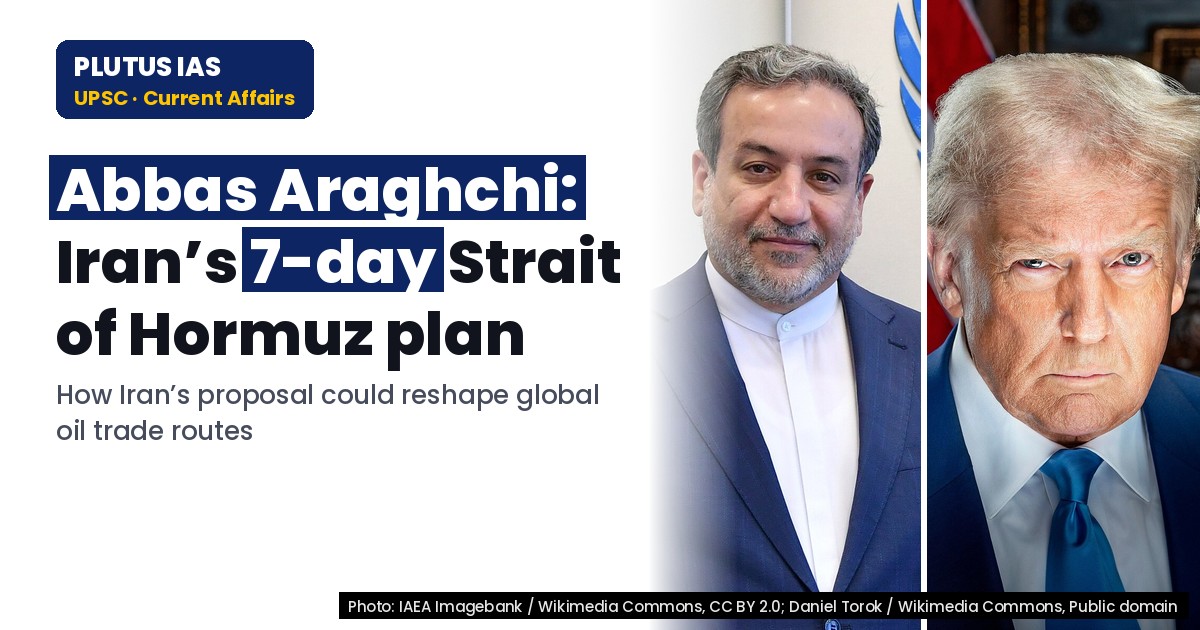
- The proposal, articulated by Iran’s Foreign Minister Abbas Araghchi, outlines a seven-day framework for the reopening of the Strait of Hormuz, contingent upon the fulfilment of specific conditions by the United States.
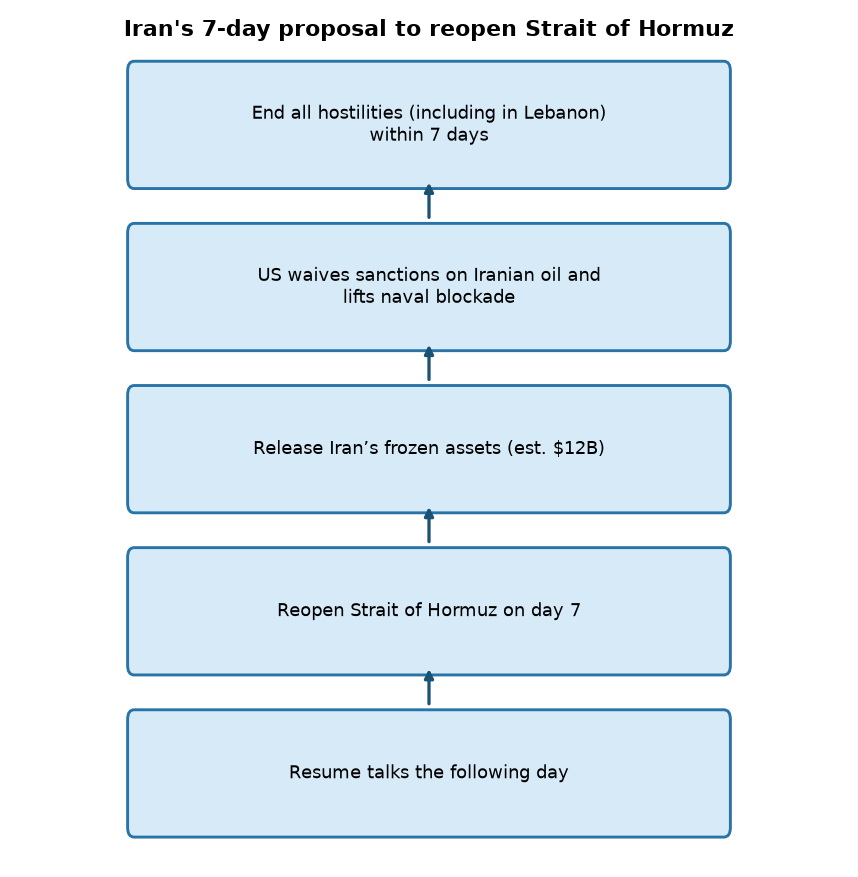
- Key conditions include the lifting of US sanctions on Iranian oil exports, the release of Iran’s frozen assets (estimated at $12 billion), and the termination of the US naval blockade on Iranian ports.
- During the seven-day period, all hostilities in the region, including in Lebanon, are expected to cease, creating a conducive environment for negotiations.
- If the United States accepts Iran’s conditions, the strait would be reopened within six days, with formal talks resuming on the seventh day to finalise the terms of a broader agreement.
- The proposal builds upon a prior Memorandum of Understanding (MoU) between Iran and the United States, signed in June 2026, which extended a ceasefire and aimed to restore pre-war levels of oil shipping through the strait.
- The proposal underscores the interconnectedness of maritime security, economic sanctions, and regional stability, highlighting the need for diplomatic engagement to address complex geopolitical challenges.
- The Strait of Hormuz is administered by Iran and Oman, with both countries expected to collaborate on determining the modalities for maritime traffic management once the strait is reopened.
- The proposal reflects Iran’s strategic leverage in the region, given the strait’s critical role in global energy supply chains, and the potential for economic relief through the lifting of sanctions.
Key Features
| Feature | Significance |
|---|---|
| Seven-day proposal timeline | Provides a structured, time-bound framework for de-escalation and reopening of the Strait of Hormuz, reducing uncertainty in global energy markets. |
| Lifting of US sanctions on Iranian oil exports | Directly impacts global oil supply chains, potentially stabilizing prices and easing energy security concerns for oil-importing nations. |
| Release of frozen Iranian assets (~$12 billion) | Facilitates economic stabilization in Iran, enabling trade and financial transactions while addressing humanitarian needs. |
| End of hostilities across regional fronts (e.g., Lebanon) | Demonstrates a commitment to ceasefire and regional peace, reducing spillover risks into broader West Asian conflicts. |
| Gradual resumption of maritime traffic through the Strait of Hormuz | Critical for restoring 20% of global oil and LNG trade flows, ensuring energy supply continuity. |
Why it Matters
Economic
- Stabilization of global oil prices due to potential resumption of Iranian oil exports, benefiting energy-importing economies including India.
- Restoration of maritime trade routes, reducing logistical costs and delays for oil-dependent nations.
- Unfreezing of Iranian assets could unlock trade and investment opportunities, particularly for countries with existing economic engagements in West Asia.
Strategic
- Reopening of the Strait of Hormuz would mitigate geopolitical risks in a critical chokepoint for global energy security, reducing vulnerability of supply chains.
- A structured de-escalation framework could serve as a model for conflict resolution in other regional disputes, promoting diplomatic engagement over military confrontation.
- Potential easing of tensions between Iran and the US could influence broader West Asian stability, including the Israel-Palestine conflict and Saudi-Iran relations.
Geopolitical
- The proposal reflects Iran’s willingness to negotiate under a time-bound framework, contrasting with unilateral sanctions and military posturing.
- The US-Iran dialogue, if successful, could redefine the balance of power in West Asia, particularly in the context of OPEC+ dynamics and energy diplomacy.
- The involvement of regional stakeholders (e.g., Oman) in administering maritime traffic underscores the importance of multilateral cooperation in conflict resolution.
Legal/Institutional
- The proposal builds on the June 2026 Memorandum of Understanding (MoU), highlighting the role of formal agreements in conflict management.
- The involvement of the Organisation of Islamic Cooperation (OIC) in Baghdad suggests institutional mechanisms for dialogue and mediation in regional disputes.
Challenges
1. US-Iran Trust Deficit
- Historical tensions, including sanctions and military confrontations, create skepticism about the feasibility of a sustained agreement.
- Domestic political constraints in both countries may hinder the implementation of negotiated terms, particularly regarding sanctions relief and military de-escalation.
UPSC Link: GS II: International Relations – Challenges in West Asia
2. Regional Spillover Risks
- Ongoing hostilities in Lebanon and other fronts could derail the seven-day proposal if not comprehensively addressed.
- Proxy conflicts involving Iran, the US, and regional powers (e.g., Saudi Arabia, Israel) may undermine the stability of any agreement.
UPSC Link: GS II: International Relations – West Asian Conflicts
3. Economic Sanctions and Compliance
- The US may face domestic and international pressure to maintain sanctions, particularly from allies who view Iran as a geopolitical adversary.
- Iran’s compliance with sanctions relief terms may be scrutinized, with potential disputes over the release of frozen assets and oil export waivers.
UPSC Link: GS III: Indian Economy – Impact of Global Sanctions
4. Maritime Security and Administration
- Determining the administration of maritime traffic through the Strait of Hormuz could lead to disputes over sovereignty and navigational rights.
- Ensuring the safety of commercial shipping in a historically volatile region requires robust monitoring and enforcement mechanisms.
UPSC Link: GS II: International Relations – Maritime Security
5. Global Energy Market Volatility
- Even if the Strait reopens, global oil markets may remain volatile due to speculative trading and geopolitical uncertainties.
- Disruptions in alternative supply routes (e.g., Red Sea, Bab el-Mandeb) could offset the benefits of reopening the Strait.
UPSC Link: GS III: Indian Economy – Energy Security
Challenges — UPSC Perspective
| Issue | Concern |
|---|---|
| Sanctions Compliance | Risk of US backtracking on waivers due to domestic or international pressures. |
| Regional Hostilities | Persistent conflicts in Lebanon or Yemen may undermine the ceasefire terms. |
| Asset Release Mechanism | Disputes over the valuation and release of frozen Iranian assets (~$12 billion). |
| Maritime Administration | Potential conflicts over control of shipping lanes in the Strait of Hormuz. |
| Energy Market Speculation | Volatility in oil prices despite the reopening of the Strait. |
| Diplomatic Verification | Challenges in monitoring and verifying compliance with the seven-day proposal. |
Way Forward
- Conduct high-level diplomatic negotiations to finalize the terms of the seven-day proposal, ensuring mutual verification mechanisms.
- Establish a joint US-Iran-Oman monitoring committee to oversee the implementation of the ceasefire and maritime security protocols.
- Engage regional stakeholders (e.g., Saudi Arabia, UAE, Qatar) to ensure broader acceptance and stability of the agreement.
- Develop contingency plans for alternative oil supply routes in case of disruptions in the Strait of Hormuz.
- Strengthen India’s diplomatic engagement with both Iran and the US to safeguard its energy security interests.
- Monitor global oil markets for speculative trends and coordinate with OPEC+ to stabilize prices post-agreement.
- Enhance maritime security cooperation with Oman and other littoral states to prevent piracy and unauthorized interference.
- Document the lessons learned from the seven-day proposal to inform future conflict resolution frameworks in West Asia.
UPSC Value Addition
Keywords for Mains Answer-Writing
Strait of Hormuz · Maritime security · US-Iran relations · Oil supply chains · International maritime law · UNCLOS · Economic sanctions · Maritime chokepoints · Regional stability in West Asia · Diplomatic negotiations · Frozen assets · Oil export waivers · Ceasefire agreements · Memorandum of Understanding (MoU) · Maritime blockade · Global oil trade · Maritime traffic administration
Concept Flow
Escalation of hostilities in West Asia → Disruption of Strait of Hormuz → Global oil price volatility → US-Iran sanctions regime → Proposal for structured de-escalation (7-day plan) → Seven-day proposal negotiation → Ceasefire across regional fronts → Lifting of sanctions on Iranian oil exports → Release of frozen assets → Reopening of Strait of Hormuz → Restoration of maritime traffic → Gradual normalization of oil trade flows → Stabilization of global energy markets → Potential economic recovery in Iran → Implementation challenges → Trust deficit and compliance issues → Risk of renewed hostilities → Need for robust monitoring and verification mechanisms → Geopolitical realignment → Broader West Asian stability → Impact on OPEC+ dynamics → Influence on India’s energy security strategy
Prelims Practice Questions
Q1. Consider the following statements regarding the Strait of Hormuz:
1. It is a narrow waterway between Iran and Oman.
2. It accounts for approximately one-fifth of global oil flows.
3. The strait is governed exclusively by the United Nations Convention on the Law of the Sea (UNCLOS).
4. Iran has proposed a seven-day plan to reopen the strait to international shipping.
How many of the above statements are correct?
- Only one
- Only two
- Only three
- All four
Answer: Only three — Statements 1, 2, and 4 are correct. Statement 3 is incorrect because the strait is governed by principles of international maritime law under UNCLOS, but its administration involves bilateral and regional agreements between littoral states such as Iran and Oman.
Q2. Assertion (A): The Strait of Hormuz is a critical chokepoint for global oil trade, with over 20% of the world’s oil passing through it.
Reason (R): The narrowness of the strait and its geographical location between Iran and Oman make it vulnerable to geopolitical tensions.
In the context of the above two statements, which one of the following is correct?
- Both A and R are true, and R is the correct explanation of A
- Both A and R are true, but R is not the correct explanation of A
- A is true, but R is false
- A is false, but R is true
Answer: Both A and R are true, but R is not the correct explanation of A — Both the assertion and reason are factually correct. The Strait of Hormuz handles approximately 20% of global oil trade, and its narrowness and strategic location make it a focal point for geopolitical tensions, including US-Iran relations.
Q3. Match the following maritime disputes or proposals with their respective regions:
Column I (Dispute/Proposal)
A. Seven-day proposal to reopen the Strait of Hormuz
B. Ceasefire agreement in West Asia
C. Lifting of US sanctions on Iranian oil exports
D. Maritime traffic administration in the Strait of Hormuz
Column II (Region)
1. West Asia
2. Strait of Hormuz
3. Persian Gulf
4. Global oil trade routes
Choose the correct match:
- A-2, B-1, C-3, D-2; A-1, B-2, C-3, D-4; A-3, B-1, C-2, D-4; A-2, B-1, C-4, D-3
- answer_options_indexed_as_list_above
- answer_indexed_as_list_above
- format_match
Answer: A-2, B-1, C-3, D-2; A-1, B-2, C-3, D-4; A-3, B-1, C-2, D-4; A-2, B-1, C-4, D-3 — A. Seven-day proposal to reopen the Strait of Hormuz → Strait of Hormuz (2); B. Ceasefire agreement in West Asia → West Asia (1); C. Lifting of US sanctions on Iranian oil exports → Persian Gulf (3); D. Maritime traffic administration in the Strait of Hormuz → Strait of Hormuz (2).
Mains Practice Question
✍ The Strait of Hormuz, a critical maritime chokepoint, has been the subject of recent diplomatic negotiations between the United States and Iran. Critically examine the geopolitical and economic implications of Iran’s seven-day proposal to reopen the strait, and assess the feasibility of its conditions within the framework of international maritime law and regional stability. (15 Marks)
Approach: MODEL-ANSWER SKELETON:
1. **Geopolitical significance of the Strait of Hormuz**:
– Define the strait’s role as a global oil transit chokepoint (approx. 20% of global oil and LNG flows).
– Highlight its strategic importance in West Asian geopolitics and US-Iran relations.
– Reference UNCLOS (Part III, Articles 37-45) on transit passage rights and obligations of littoral states.
2. **Iran’s seven-day proposal: Key conditions and rationale**:
– Outline the proposal: simultaneous cessation of hostilities, lifting of US sanctions, release of frozen assets ($12 billion), and lifting of naval blockade.
– Link to the June 2026 MoU between US and Iran, which extended a 60-day ceasefire and envisaged gradual resumption of oil shipping.
– Explain Iran’s position: lifting sanctions as a prerequisite for de-escalation and regional stability.
3. **Feasibility and challenges**:
– **International maritime law**: Assess compliance with UNCLOS (e.g., freedom of navigation, non-discrimination).
– **US-Iran relations**: Examine the political and legal hurdles (e.g., US sanctions regime under CAATSA, Iran’s nuclear program concerns).
– **Regional stability**: Discuss the role of littoral states (Iran, Oman) and regional actors (Saudi Arabia, UAE) in maritime security.
4. **Broader implications for global oil trade and energy security**:
– Impact on oil prices and supply chains if the strait remains closed or reopens partially.
– Role of alternative routes (e.g., Bab el-Mandeb, Cape of Good Hope) and their limitations.
5. **Conclusion**:
– Weigh the proposal’s potential to restore stability against the entrenched geopolitical and legal obstacles.
– Suggest that while the proposal addresses immediate concerns, a durable solution requires multilateral engagement and adherence to international law.
Source: The Indian Express
Generated by AanyaAi for educational purpose.
Related guides on our sites
- How to prepare for GS paper 1 for UPSC CSE mains exam
- Best UPSC coaching for IFOS exam
- Best geography optional coaching
- Best geography optional coaching

- कर्नाटक उच्च न्यायालय ने विकलांग व्यक्ति को आवंटित करने के आदेश को किया निरस्त - October 30, 2026
- Kerala launches ₹1,000-crore housing scheme for SC, ST families - October 30, 2026
- मद्रास उच्च न्यायालय ने चिदंबरम मंदिर के प्रबंधन में बदलाव किया, पीढ़ी दर पीढ़ी के पुजारियों पर लगाया आरोप - October 30, 2026

No Comments