


29 Jul Is VBSA Bill 2025 Perfect? Key Analysis for UPSC & PCS Aspirants
Subject Relevance — Where This Topic Fits
- GS Paper II — Governance, Administration and Challenges | GS Paper IV — Ethics and Human Interface in Governance
- Prelims: Viksit Bharat Shiksha Adhishthan (VBSA), UGC, AICTE, NCTE merger, National Higher Education Regulatory Authority (NHERA), National Accreditation Council (NAC), National Higher Education Standards Authority (NHESA), Dharmendra Pradhan, Higher Education Commission of India (HECI), NEP 2020 implementation
- Essay: The evolution of higher education governance in India: From fragmentation to consolidation, Regulatory reforms in Indian education: Balancing autonomy and accountability
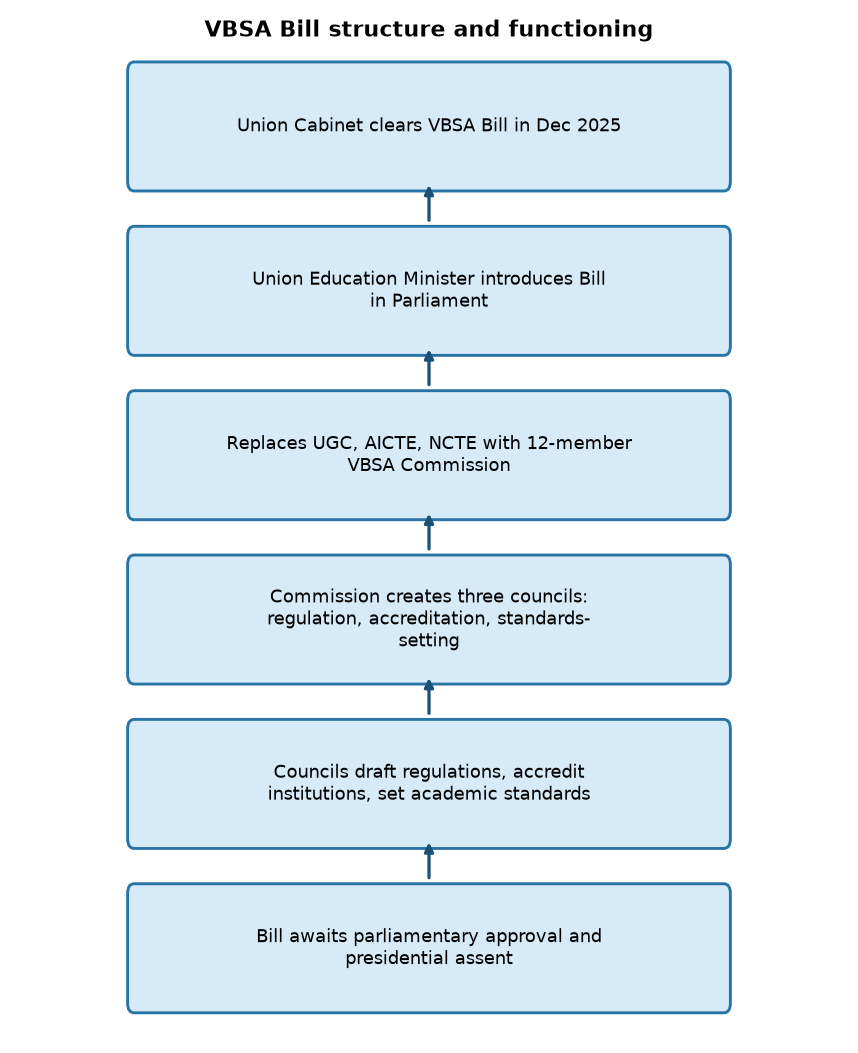
Quick Revision: The VBSA Bill aims to replace the UGC, AICTE, and NCTE with a single regulatory commission (VBSA) comprising three autonomous councils for regulation, accreditation, and standards-setting, aligned with the NEP 2020’s vision of a unified higher education governance framework.
Why is this in the news?
The Viksit Bharat Shiksha Adhishthan (VBSA) Bill, introduced by the Union Education Minister in December 2025, has been the subject of a high-profile webinar titled ‘Is VBSA Bill perfect now?’ hosted by *The Hindu* on July 25, 2026. The discussion critically examines the Bill’s provisions, its alignment with the National Education Policy (NEP) 2020, and its potential to streamline higher education governance by replacing the UGC, AICTE, and NCTE with a unified regulatory framework. The Bill’s structural design, including the creation of three autonomous councils for regulation, accreditation, and standards-setting, has sparked debates on its efficacy in addressing long-standing challenges in India’s higher education system.
Background
- The UGC, AICTE, and NCTE have historically operated as separate regulatory bodies with overlapping jurisdictions, leading to regulatory fragmentation, inefficiencies, and delays in decision-making.
- The National Education Policy (NEP) 2020 recommended the establishment of a single apex regulator, the Higher Education Commission of India (HECI), to replace the UGC and address systemic inefficiencies in higher education governance.
- The VBSA Bill, introduced in December 2025, is a legislative attempt to operationalise the NEP 2020’s vision by consolidating regulatory functions under a single umbrella commission, the Viksit Bharat Shiksha Adhishthan (VBSA), with three autonomous councils.
- The Bill has been introduced against the backdrop of India’s aspiration to achieve a Gross Enrolment Ratio (GER) of 50% by 2035, necessitating a robust and responsive higher education regulatory framework.
- Critics argue that the Bill may centralise power excessively, potentially undermining institutional autonomy and academic freedom, while proponents highlight its potential to reduce bureaucratic delays and improve accountability.
- The webinar hosted by *The Hindu* reflects broader academic and policy discussions on the Bill’s merits, challenges, and implications for India’s higher education landscape.
What is the Viksit Bharat Shiksha Adhishthan (VBSA) Bill?
- The VBSA Bill proposes the establishment of the Viksit Bharat Shiksha Adhishthan (VBSA), a 12-member umbrella commission tasked with overseeing higher education governance in India.
- The VBSA will replace the University Grants Commission (UGC), the All India Council for Technical Education (AICTE), and the National Council for Teacher Education (NCTE), consolidating their functions under a single regulatory authority.
- The Bill envisages three autonomous councils under the VBSA: one for regulation, one for accreditation, and one for standards-setting.
- The VBSA is structured to align with the recommendations of the National Education Policy (NEP) 2020, which advocated for a single apex regulator to streamline higher education governance and reduce regulatory overlap.
- The Bill seeks to enhance the autonomy of higher education institutions by reducing bureaucratic interference while ensuring accountability through a robust regulatory framework.
- The VBSA’s governance structure includes representatives from academia, industry, and government, aiming to balance diverse stakeholder interests in higher education policy formulation.
- The Bill introduces provisions for digital governance, including the use of technology for accreditation, regulatory compliance, and grievance redressal, reflecting a modernised approach to higher education administration.
- The VBSA Bill is part of a broader effort to address systemic challenges in India’s higher education system, including low GER, employability gaps, and the need for global competitiveness.
UPSC Value Addition
Keywords for Mains Answer-Writing
Viksit Bharat Shiksha Adhishthan (VBSA) · Higher Education Commission of India (HECI) · National Education Policy (NEP) 2020 · University Grants Commission (UGC) · All India Council for Technical Education (AICTE) · National Council for Teacher Education (NCTE) · Accreditation Council for Higher Education (ACHE) · Regulatory Council for Higher Education (RCHE) · Standards-Setting Council for Higher Education (SSCHE) · Federalisation of education governance · Autonomy vs accountability in higher education · Constitutional provisions for education (Article 29, 30, 21A)
Prelims Practice Questions
Q1. Consider the following statements regarding the proposed Viksit Bharat Shiksha Adhishthan (VBSA):
1. It seeks to replace the UGC, AICTE, and NCTE with a single umbrella regulatory body.
2. The VBSA will have three separate councils for regulation, accreditation, and standards-setting.
3. The VBSA Bill was introduced by the Union Education Minister in December 2025.
How many of the above statements are correct?
- Only one
- Only two
- All
- None
Answer: All — Statements 1 and 2 correctly describe the structure and intent of the VBSA Bill. Statement 3 is factually accurate as the Bill was introduced in December 2025 by the Union Education Minister.
Q2. Assertion (A): The VBSA Bill aims to centralise the governance of higher education in India.
Reason (R): The Bill proposes to replace multiple regulatory bodies with a single umbrella commission.
- Both A and R are true, and R is the correct explanation of A.
- Both A and R are true, but R is not the correct explanation of A.
- A is true, but R is false.
- A is false, but R is true.
Answer: Both A and R are true, and R is the correct explanation of A. — The VBSA Bill does aim to centralise higher education governance by replacing multiple bodies (UGC, AICTE, NCTE) with a single commission, making R the correct explanation of A.
Q3. Match the following regulatory bodies with their proposed replacements under the VBSA Bill:
Column I (Existing Body) | Column II (Proposed Replacement under VBSA)
1. University Grants Commission (UGC) | A. Standards-Setting Council for Higher Education (SSCHE)
2. All India Council for Technical Education (AICTE) | B. Regulatory Council for Higher Education (RCHE)
3. National Council for Teacher Education (NCTE) | C. Accreditation Council for Higher Education (ACHE)
- 1-B, 2-A, 3-C
- 1-A, 2-B, 3-C
- 1-B, 2-C, 3-A
- 1-C, 2-A, 3-B
Answer: 1-B, 2-A, 3-C — The UGC is proposed to be replaced by the Regulatory Council for Higher Education (RCHE), the AICTE by the Standards-Setting Council for Higher Education (SSCHE), and the NCTE by the Accreditation Council for Higher Education (ACHE).
Mains Practice Question
✍ Critically examine the institutional design of the Viksit Bharat Shiksha Adhishthan (VBSA) as envisaged in the proposed legislation. How does it address the challenges of autonomy, accountability, and federalism in higher education governance? Also, analyse its compatibility with the constitutional framework of education in India. (15 Marks)
Approach: MODEL-ANSWER SKELETON:
1. **Institutional Design of VBSA**:
– Structure: 12-member umbrella commission replacing UGC, AICTE, and NCTE.
– Three councils: Regulatory (RCHE), Accreditation (ACHE), Standards-Setting (SSCHE).
– Powers: Unified regulatory authority, reduced multiplicity of regulators.
2. **Autonomy vs Accountability**:
– **Autonomy**: Concerns over reduced autonomy for universities and institutions due to centralised regulation.
– **Accountability**: Potential for improved accountability through streamlined accreditation and standards-setting.
– **Balance**: Critique whether the design achieves a balance or leans excessively toward centralisation.
3. **Federalism in Education**:
– **Constitutional Provisions**: Education is a concurrent subject (Article 246 read with 7th Schedule).
– **State Role**: Reduction of state-level regulatory bodies may encroach upon federal principles.
– **Centre-State Relations**: Evaluate whether the VBSA Bill respects the federal structure or centralises power.
4. **Constitutional Framework**:
– **Article 29 & 30**: Right to establish and administer educational institutions.
– **Article 21A**: Right to education; implications for regulatory oversight.
– **Judicial Precedents**: Reference to cases like T.M.A. Pai Foundation v. State of Karnataka (2002) on autonomy.
5. **Comparative Perspective**:
– **Global Models**: Contrast with the Higher Education Commission of India (HECI) Bill 2018 or international models like the UK’s Office for Students.
6. **Critique and Way Forward**:
– **Strengths**: Simplification, reduced regulatory overlap, improved standards.
– **Weaknesses**: Over-centralisation, potential erosion of institutional autonomy, federalism concerns.
– **Recommendations**: Suggest measures to address identified gaps (e.g., greater state representation, safeguards for autonomy).
Source: The Hindu
Generated by AanyaAi for educational purpose.

- सुप्रीम कोर्ट ने चुनाव आयोग को दिल्ली में ‘यांत्रिक’ SIR नोटिस पर सावधानियां बरतने को कहा - September 22, 2026
- ‘स्वच्छता ही सेवा-2026’ अभियान: सरकारी विभागों में स्वच्छता क्रांति, जानिए मुख्य बिंदु - September 22, 2026
- DFPD Launches ‘Swachhata Hi Seva-2026’ Campaign for Clean India Mission - September 22, 2026

No Comments