


24 Dec ISRO Breaks Payload Record as LVM3 Launch Signals India’s Heavy-Lift Ambitions
This article covers “Daily Current Affairs” and From ISRO Breaks Payload Record as LVM3 Launch Signals India’s Heavy-Lift Ambitions
SYLLABUS MAPPING
GS- 3 – Science & Technology – ISRO Breaks Payload Record as LVM3 Launch Signals India’s Heavy-Lift Ambitions
FOR PRELIMS
Examine the role of ISRO in strengthening India’s commercial space sector.
FOR MAINS
How do space sector reforms and private sector participation complement ISRO’s long-term vision
Why in the News?
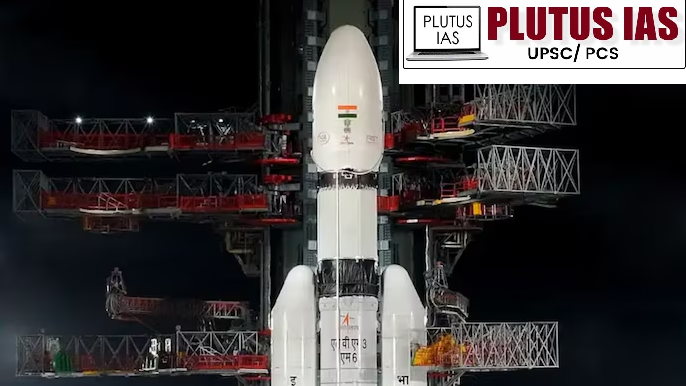
India’s space programme has entered a decisive phase marked by heavy-lift launch capability, commercial expansion, private sector participation, and human spaceflight preparedness. Recent achievements by the Indian Space Research Organisation (ISRO) underscore India’s transition from a developmental space agency to a global space service provider and strategic power.
LVM3-M6 Mission
A Major Technological Milestone for India : Record-Breaking Payload Capability
The LVM3 (formerly Gaganyaan Mark-III) successfully launched a ~6,100 kg communication satellite (BlueBird Block-2) into Low Earth Orbit (LEO), marking the heaviest payload ever carried by an Indian launch vehicle. This achievement represents a significant leap in India’s heavy-lift launch capability.
Why This Achievement Is Significant
1. Entry into the Heavy-Lift Launch Club: With a payload capacity of approximately 8–10 tonnes to LEO, LVM3 places India alongside a select group of space-faring nations possessing reliable heavy-lift launch systems.
2. Validation of Human Spaceflight Readiness: The mission reinforces LVM3’s suitability for crew module launches under the Gaganyaan programme, validating its structural integrity, propulsion systems, and mission reliability.
3. Enabler of Advanced Space Missions: Such payload capability is crucial for launching space station modules, large communication satellites, and deep-space or interplanetary missions, reducing dependence on foreign launch services.
4. Strategic and Commercial Implications: Enhanced lift capacity strengthens India’s position in the global launch market, boosts strategic autonomy, and supports the growth of NewSpace and private satellite operators.
5. Significance for India: The LVM3-M6 mission signifies India’s transition from a cost-effective launch provider to a technologically mature heavy-lift space power, capable of supporting human spaceflight, strategic missions, and next-generation space infrastructure.
Commercial Space Expansion: Economic Data
India’s Space Economy (Current Status)
- Global space economy: ~USD 450 billion
- India’s share: ~2%
- Target by 2030: USD 40–50 billion (~8–10%)
Role of NSIL
- NewSpace India Limited (NSIL) is ISRO’s commercial interface
- Responsible for foreign satellite launches, technology transfer, and revenue generation
Revenue Impact
- Commercial launches generate foreign exchange earnings
- Cost advantage: Indian launches are 30–40% cheaper than many global competitors
Industry Participation and Space Sector Reforms
Key Reform Measures (Post-2020)
- Creation of IN-SPACe as a regulator and facilitator
- Opening launch, satellite, and data services to private firms
- Gradual transfer of PSLV production to industry consortia
Current Plan
- 50% of PSLV manufacturing to be handled by Indian industry
- Firms involved: HAL, L&T, Godrej Aerospace (and others)
Significance
- Moves ISRO from “manufacturer” to technology architect
- Encourages start-ups, MSMEs, and innovation ecosystems
- Aligns with Atmanirbhar Bharat and Make-in-India
Gaganyaan Programme: Human Spaceflight Data
Mission Profile
- Objective: Send 3 Indian astronauts to LEO (~400 km) for ~3 days
- Launch Vehicle: Human-rated LVM3
- Total estimated cost: ₹90,000+ crore (long-term ecosystem)
Progress Achieved
- Successful Crew Escape System tests
- Development of Environmental Control & Life Support Systems (ECLSS)
- Astronaut training underway (India + Russia)
- Planned uncrewed test flights using humanoid robot Vyommitra
Strategic Value
- Makes India the 4th nation with indigenous human spaceflight capability
- High spillover benefits in materials science, medicine, robotics, AI
Strategic and Security Dimensions of ISRO’s Growth
Space as the 4th Dimension of Warfare: Satellites critical for
- Secure communication
- Navigation (NavIC)
- Intelligence, Surveillance & Reconnaissance (ISR)
Dual-Use Technologies
- Launch vehicles & sensors support both civilian and defence needs
- Enhances India’s position in space deterrence and situational awareness
Global Context
- Growing space militarisation (US, China, Russia)
- India’s approach: Defensive, responsible, rule-based use of outer space
Scientific and Developmental Applications of Space Technology
| Domain | Application Area | How Satellites Contribute | Developmental Significance for India |
|---|---|---|---|
| Disaster Management | Cyclones & Floods | Real-time tracking, early warning systems, floodplain mapping | Reduces loss of life and property; supports timely evacuation and relief |
| Forest Fires | Thermal imaging and hotspot detection | Enables rapid response and ecosystem protection | |
| Agriculture & Food Security | Crop Mapping | Remote sensing for crop area estimation and health assessment | Improves yield forecasting and policy planning |
| Drought Assessment | Soil moisture and rainfall anomaly monitoring | Strengthens drought preparedness and farmer support | |
| Urban Planning | Infrastructure Mapping | High-resolution imagery for land-use analysis | Supports smart cities and sustainable urban growth |
| Resource Management | Monitoring water bodies and green cover | Enhances urban resilience | |
| Climate Change Monitoring | Carbon Monitoring | Tracking carbon sinks and emission patterns | Supports India’s climate commitments |
| Glacier Retreat | Observation of Himalayan glaciers and snow cover | Assesses long-term water security risks | |
| Monsoon Prediction | Atmospheric data assimilation | Improves rainfall forecasts and agricultural planning |
Challenges in India’s Expanding Space Programme
Space Debris Management: The rapid increase in satellite launches has intensified the problem of space debris, raising the risk of in-orbit collisions and cascading effects such as the Kessler Syndrome. Limited global enforceability of debris-mitigation norms further complicates tracking, coordination, and accountability.
Long-Term Funding Sustainability: Ambitious missions involving human spaceflight, deep-space exploration, and satellite constellations require predictable and sustained financial commitment. Dependence on annual budgetary allocations can constrain long-term planning and technology development.
Safety and Reliability in Crewed Missions: Human spaceflight demands exceptionally high safety standards, including reliable launch systems, life-support mechanisms, emergency abort protocols, and post-mission recovery infrastructure. Ensuring mission safety remains a complex technological and ethical responsibility.
Absence of a Comprehensive Space Activities Act: The lack of an updated and comprehensive Space Activities Act creates regulatory uncertainty, particularly for private players. Clear legal frameworks are essential for liability, insurance, licensing, and compliance with international space law.
Way Forward for a Sustainable and Secure Space Ecosystem
Strengthening the Space Governance Framework: India should expedite the enactment of a comprehensive space legislation aligned with international treaties while clearly defining the roles of government agencies, private entities, and regulators to ensure transparency and accountability.
Investment in Space Situational Awareness (SSA): Enhancing indigenous capabilities in space surveillance, tracking, and data-sharing will help monitor orbital congestion, predict collision risks, and contribute to global space safety initiatives.
Promoting Public–Private–Academic Collaboration: Deeper collaboration between ISRO, private industry, start-ups, and academic institutions can accelerate innovation, reduce costs, and build a skilled space workforce, supporting long-term mission sustainability.
Focus on Green Propulsion and Debris Mitigation: Adopting environment-friendly propulsion technologies, active debris removal systems, and end-of-life disposal mechanisms will ensure that space exploration remains ecologically responsible and future-ready.
Conclusion
ISRO’s recent developments mark a structural transformation of India’s space programme—from a low-cost launcher to a strategic enabler of national power. Heavy-lift launches, commercial integration, and human spaceflight readiness collectively position India as a credible, responsible, and competitive space power. The challenge ahead lies in converting technological prowess into sustained economic, strategic, and scientific leadership.
Q. ISRO’s recent achievements reflect India’s transition from a developmental space agency to a space power. Critically examine.

- PRAGATI: A Decade of Cooperative, Outcome-Driven Governance - January 15, 2026
- Iran’s Large-Scale Protests: Political Stability, Public Dissent and Regional Implications - January 14, 2026
- India–Oman CEPA: A Strategic Trade Pact for Jobs, Exports and Regional Integration - January 10, 2026

No Comments